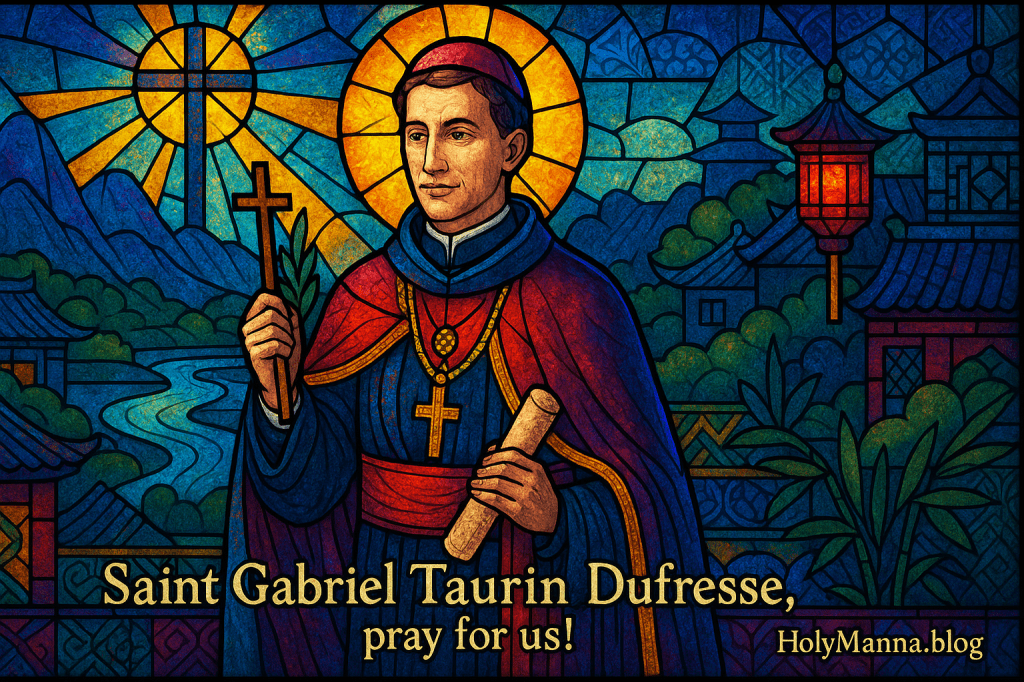
A Shepherd Who Poured Out His Life for China
Bishop Gabriel Taurin Dufresse, priest of the Paris Foreign Missions Society and Vicar Apostolic of Sichuan, stands as a luminous witness to the Gospel in Qing era China. Born in Lezoux, France, on December 8, 1750, he devoted nearly four decades to evangelization, catechesis, and the formation of local clergy. He is remembered for his pastoral wisdom, his fatherly love for Chinese Catholics, and his courageous acceptance of martyrdom by beheading at Chengdu on September 14, 1815. The Church venerates him among the 120 Martyrs of China, canonized in 2000, because his life shows how grace can take root and flourish across cultures. The heart of his legacy is simple and radiant. He was a bishop who led from the front, taught with clarity, and loved his flock to the end.
From Auvergne to Sichuan
Gabriel grew up in the Diocese of Clermont and entered the seminary with a steady disposition and a love for prayer. In 1774 he joined the Paris Foreign Missions and was ordained a priest. He sailed the following year, disembarked at Macau, and undertook the arduous journey to inland Sichuan. He moved quietly through rugged terrain and unfamiliar languages, learning to adapt with humility to local customs that did not conflict with the faith. His early years in China were marked by the patient formation of Christian families, the careful instruction of catechumens, and the cultivation of trustworthy local leaders. He is most widely known for shaping a truly local Church in Sichuan, for fostering Chinese vocations to the priesthood, and for the synodal wisdom he would later set down as a bishop. His witness had a direct evangelical ripple effect. During an early arrest and forced escort, one of the guards who witnessed his patience and serenity later sought baptism and would himself become a priest and martyr, now venerated as Saint Augustine Zhao Rong. Dufresse did not speak often about himself, and few personal sayings survive, yet everything in his choices reveals the inner logic of a man who believed Christ could be encountered in every person he served.
Building Up the Flock
Consecrated a bishop around the turn of the nineteenth century, Dufresse assumed leadership of the Sichuan mission and set out to consolidate pastoral life. In September 1803 he convened the Synod of Sichuan near Chongqing, the first Catholic synod ever held in China. Its decrees were practical and enduring. They clarified sacramental discipline, especially regarding baptism and marriage. They encouraged robust catechesis and confession. They insisted on the careful preparation of catechumens so that the Christian life would take deep root rather than remain a passing enthusiasm. Dufresse worked tirelessly to identify and form Chinese seminarians, to appoint trusted catechists, and to support missionaries with pastoral norms that fit local realities. By God’s grace the Church in Sichuan grew steadily, not only in numbers but also in maturity, with Christian families and small communities learning to pray, to forgive, and to serve. While no spectacular miracle stories are firmly attached to his name during life, the most convincing signs of grace were the fruits themselves. These included conversions, reconciliations, and stable parishes that endured long after his death. The Catechism of the Catholic Church reminds us that “martyrdom is the supreme witness given to the truth of the faith” (CCC 2473). This witness is prepared by a thousand daily acts of fidelity.
Trials by Fire
The Qing edicts against Christianity made Dufresse’s ministry a continual passage through danger. He suffered arrest and interrogation more than once, was marched under guard for long distances, and endured periods of exile before clandestinely returning to his people. Informers were active, and the price placed on missionaries tempted the unscrupulous. In May 1815 he was betrayed, seized, and brought to Chengdu for judgment. There he refused every inducement to renounce the faith or to abandon his flock. He encouraged the faithful to remain steadfast and entrusted the mission to God. Sentenced to death, he was led outside the city walls and beheaded on September 14, the feast now kept as the Exaltation of the Holy Cross. His head was displayed as a warning, yet the faithful drew strength from his peace and from the serenity with which he met the sentence. The Catechism of the Catholic Church teaches that “the martyr bears witness to Christ who died and rose, to whom he is united by charity” and that he accepts death “through an act of fortitude” (CCC 2473). Dufresse’s death was not a protest against his captors, but a proclamation of Christ, a final pastoral act in which the shepherd stood with his sheep until the end.
After the Sword
Christians reverently recovered the bishop’s remains, and devotion to his memory took shape wherever his story was told. His relics were later transferred to the chapel and crypt of the Paris Foreign Missions on Rue du Bac, where pilgrims pray for courage and for the growth of the Church in China. Over the years the faithful have attributed favors and conversions to his intercession. More importantly, his example helped normalize a missionary vision centered on forming local clergy, trusting lay catechists, and discerning pastoral norms that respect the culture while remaining faithful to the Gospel. When the Church raised Gabriel Taurin Dufresse to the altars among the 120 Martyrs of China, it affirmed that the Holy Spirit used his life and death as a seed of unity, charity, and steadfast hope. In the communion of saints, the Church proposes holy men and women as models and intercessors, and our union with them strengthens the whole Church in holiness (CCC 828, CCC 957).
Walking His Road Today
Saint Gabriel’s life offers a roadmap for modern disciples. Begin with fidelity in small things. Pray daily, confess regularly, and frequent the Eucharist. Invest in formation by studying Scripture and the Catechism of the Catholic Church, and invite a friend to join you. Serve your parish by mentoring new Catholics, helping with RCIA or OCIA, or supporting catechists who carry a hidden but decisive responsibility in the Church’s mission. When pressures come, resist fear and resentment. Unite any misunderstanding or opposition you face to the Cross and intercede for those who oppose you. Ask Saint Gabriel to obtain for you a wise and steady heart. The Catechism of the Catholic Church teaches that martyrdom is the supreme witness to the truth of the faith and that the martyr accepts death through an act of fortitude, which conforms us more closely to Christ who loved to the end (CCC 2473, CCC 2474). You may not be asked to shed blood, yet you are asked to love to the end in your family, your work, and your parish.
Engage with Us!
We would love to hear how Saint Gabriel speaks to you. Share your thoughts and reflections in the comments below.
- Where is God inviting you to bear quiet, patient witness rather than seek quick results?
- How could you strengthen catechesis and sacramental life in your parish, family, or small group this month?
- What fears keep you from professing the faith openly, and how does CCC 1816 challenge and encourage you?
- Whom could you mentor or accompany in the faith the way Dufresse formed and trusted local leaders?
Be encouraged to walk in faith, hope, and love. Do everything with the love and mercy Jesus taught us, staying close to the sacraments and the communion of saints.
Saint Gabriel Taurin Dufresse, pray for us!
Follow us on Instagram and Facebook for more insights and reflections on living a faith-filled life.

 Holy Manna!
Leave a comment