A Feast That Proclaims Love Victorious
Every year on September 14, the Church celebrates the victory of divine love revealed in the Cross of Jesus Christ. The feast does not glorify suffering for its own sake. It glorifies the Son of God who freely embraced the Cross to rescue a fallen world and to open the way to everlasting life. The Roman Lectionary places before us Numbers 21:4–9, Philippians 2:6–11, and John 3:13–17 to show the unity of God’s saving plan from promise to fulfillment. Jesus teaches that His Passion is the moment of saving elevation when He says, “As Moses lifted up the serpent in the desert, so must the Son of Man be lifted up, so that everyone who believes in him may have eternal life.” John 3:14–15. The Cross is therefore a sign of judgment upon sin and a sign of hope for sinners. The Apostle puts the same truth with fearless simplicity, “We proclaim Christ crucified, a stumbling block to Jews and foolishness to Gentiles, but to those who are called, the power of God and the wisdom of God.” 1 Corinthians 1:23–24. The Church gives this day to the faithful so that we may look to the Cross and find the measure of God’s mercy and the pattern of our discipleship.
From Jerusalem’s Stones to a World in Awe
The historical roots of this feast reach to fourth century Jerusalem. After the legalization of Christianity, Emperor Constantine ordered basilicas to be built at the very places of the Lord’s Passion and Resurrection. The complex dedicated in 335 included the Martyrium at Golgotha and the Anastasis at the empty tomb. The dedication was celebrated on September 13. The following day the faithful returned to honor the wood of the Cross that had been solemnly displayed for veneration. That commemoration grew into the Exaltation of the Holy Cross observed on September 14. Christian memory also associates the feast with Saint Helena, Constantine’s mother, who journeyed to the Holy Land and, according to ancient tradition, discovered the True Cross along with other Passion relics. The story tells of a miraculous healing that confirmed the identity of the Cross, and of nails that were reverently preserved. In the seventh century the Cross was carried off when the Persians captured Jerusalem. Some years later Emperor Heraclius recovered it and returned it to the Church of the Holy Sepulchre. The return of the Cross was celebrated with extraordinary devotion and further fixed the date and character of the feast. The memory of these events, along with the unbroken practice of venerating the Cross in Jerusalem and throughout the Christian world, explains why the feast is universal. It commemorates sacred places, heroic fidelity, and the enduring conviction that God conquered death through the very wood that once seemed to belong to death.
The Tree of Life and the Triumph of Mercy
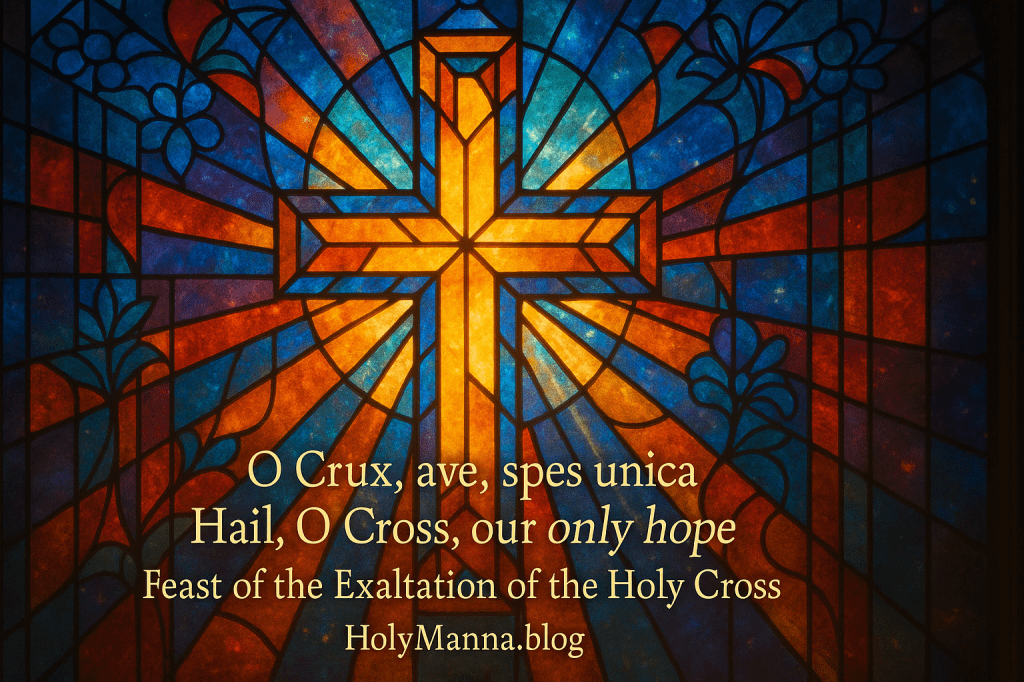
The theology of the feast is written in Scripture and sung by the Church. The Lord Himself unveils the meaning of Calvary when He declares, “And I, when I am lifted up from the earth, will draw all people to myself.” John 12:32. The humiliation of crucifixion becomes the moment of universal attraction. Saint Paul hands on the earliest Christian hymn of the mystery in Philippians 2, where we hear that Christ “emptied himself, taking the form of a slave, coming in human likeness; and found human in appearance, he humbled himself, becoming obedient to death, even death on a cross.” Philippians 2:6–8. Because of this obedience the Father exalts Him and bestows the Name above every name Philippians 2:9–11. The Church contemplates the Cross as the new Tree of Life. Where the first Adam grasped at divinity, the new Adam embraces humility and restores communion. The faithful have always confessed what Paul proclaims elsewhere, “May I never boast except in the cross of our Lord Jesus Christ.” Galatians 6:14. In the language of the liturgy the Church sings, “O Crux, ave, spes unica.” which means “Hail, O Cross, our only hope.” The Catechism of the Catholic Church teaches that Christ’s sacrifice on the Cross is unique and definitive. It is the source of our salvation and it invites us to share in His Paschal Mystery through faith, sacraments, and the patient carrying of our own crosses in union with Him.
Kiss, Venerate, and Walk the Way of the Cross
Devotion to the Holy Cross is as ancient as the Church’s memory. Pilgrims to Jerusalem in the fourth century describe the solemn showing of the relic of the Cross and the reverent kiss offered by the faithful. That same instinct lives every Good Friday when the Cross is unveiled and presented for adoration in the Roman Rite. The Preface of the Holy Cross gives the theology of this act in a single sentence, “You placed the salvation of the human race on the wood of the Cross, so that, where death arose, life might again spring forth, and the evil one who conquered on a tree might likewise on a tree be conquered.” The Basilica of Santa Croce in Gerusalemme in Rome safeguards venerable Passion relics and has long served as a magnet for prayer and penance. The Church encourages the faithful to trace the Sign of the Cross with attentive faith at the beginning and end of the day, before work, before meals, and before any task that requires grace. The tradition is ancient. Tertullian witnesses to this daily practice with unforgettable realism, “At every forward step and movement, at every going in and out, when we put on our clothes and shoes, when we bathe, when we sit at table, in all the ordinary actions of daily life, we trace upon the forehead the sign.” The Stations of the Cross, the Rosary’s Sorrowful Mysteries, and acts of reparation are concrete ways to keep our lives close to the wood that saved us.
How the Church Celebrates Across the Earth
The East and West celebrate this feast with distinct accents that enrich the one faith. In the Byzantine tradition the Cross is decorated with flowers and raised in the midst of the people while the assembly chants the ancient acclamation, “Before Thy Cross we bow down in worship, O Master, and Thy holy Resurrection we glorify.” The elevation is performed toward the four corners of the earth as a sign that the power of Christ’s love reaches every people and place. In the Latin Church the day is marked by festive Masses, processions, and hymns that form the treasury of the Roman patrimony. Venantius Fortunatus composed texts still loved and sung, including lines from Vexilla Regis and Crux fidelis, “Faithful Cross, above all other, one and only noble tree.” Many communities celebrate with public processions of a cross carried through city streets, with relics displayed for veneration, and with the faithful tracing the Sign of the Cross as the clergy bless them. In parts of the Christian world there is also a popular remembrance of the older spring celebration of the Finding of the Cross, which highlights the same mystery of God’s providence in salvation history. Wherever it is kept, the feast draws communities together around the central confession of the Gospel, “God so loved the world that he gave his only Son.” John 3:16.
Taking Up the Cross Today
To exalt the Cross is to exalt the love that refuses to give up on the beloved. The Cross teaches patience in trial, fidelity in temptation, and generosity in service. When we forgive an enemy, when we comfort a sufferer, or when we carry out a hidden duty with cheerfulness, we are living the logic of Calvary. The Cross is not a slogan. It is the place where Jesus hands over His life to the Father for us. If we allow this love to touch our wounds, our wounds can become windows of grace for others. The Lord invites us to turn toward Him with the confidence expressed in the Gospel, “For God did not send his Son into the world to condemn the world, but that the world might be saved through him.” John 3:17. He also promises fruitfulness if we follow Him without reserve, “Whoever wishes to come after me must deny himself, take up his cross, and follow me.” Mark 8:34. The believer who traces the Cross at the doorway of the day learns to live the whole day as an offering. The believer who contemplates Christ lifted up learns to recognize the hidden crosses in family life, in parish service, and in professional work, and to carry them with hope. The Cross is heavy, but it is also holy. It is a school of compassion that forms disciples capable of joy.
Engage with Us!
We’d love to hear from you—share your reflections in the comments below and encourage one another in the journey of holiness.
- What part of today’s feast speaks most to your heart—the history, the liturgy, or the promise that love wins through the Cross?
- Where is Christ inviting you to “lift high the Cross” in your family, parish, or workplace this week?
- How does making the Sign of the Cross change the way you face fear, temptation, or suffering?
Let’s keep growing together. Share your thoughts below, and let’s pray one another closer to the Heart that was pierced for us.
Sacred Heart of Jesus, we trust in You!
Follow us on Instagram and Facebook for more insights and reflections on living a faith-filled life.

 Holy Manna!
Leave a comment