Feast of the Exaltation of the Holy Cross – Lectionary: 638
Exalting the Holy Cross
Today the Church celebrates the Feast of the Exaltation of the Holy Cross, the day we lift high the sign of our salvation and glory in the love that triumphed through suffering. Historically, this feast is tied to the fourth century dedication of the basilicas at Calvary and the Holy Sepulchre in Jerusalem and to the Church’s veneration of the True Cross. Liturgically, the Cross is held before our eyes so that our hearts can learn again to look and live.
Today’s readings trace a single line of salvation through history that culminates in this feast. In Numbers 21:4–9, Israel grows weary and speaks against the Lord, and yet those who look upon the bronze serpent raised on a pole live. In John 3:13–17, Jesus reveals that His own “lifting up” is the true and definitive healing. “Just as Moses lifted up the serpent in the desert, so must the Son of Man be lifted up.” The ancient sign points beyond itself to the Crucified One whose saving love gives eternal life to all who believe. “God so loved the world” is not an abstract slogan. It is the Cross exalted, where love gives Himself to heal what sin has poisoned.
The Church reads this mystery within the rhythm of mercy and remembrance sung in Psalm 78. We forget, we fall, we cry out, and God turns back His anger. “But God being compassionate forgave their sin” becomes the backdrop for the Gospel’s promise. The Cross does not appear as a defeat. It is the place where divine compassion meets human rebellion and transforms it into life. The Roman crucifixion was designed to shame and to crush, yet in the Gospel of John the verb “to lift up” signifies both elevation on the Cross and exaltation to glory. This prepares us to confess with the early Christian hymn in Philippians 2:6–11 that the Son, though in the form of God, humbled Himself in obedient love, even to death on a cross, and was therefore exalted. “Every knee should bend” at the holy Name, because the path of self-emptying love is the path to true glory. Within Catholic tradition, this unity is not accidental. The Catechism teaches that the Word became flesh “so that we might know God’s love” and that our salvation flows from the obedience of the New Adam who offers Himself on the Cross for us (CCC 458; CCC 617–618). It also recognizes the bronze serpent as a preparatory sign that points toward Christ’s saving work, fulfilled when we look with faith upon the One lifted up for our healing (CCC 2130). The central theme for this feast is clear. Look and live. God heals our sin through the lifting up of Jesus Christ, inviting obedient faith that receives mercy and leads to exaltation and eternal life. How might the Lord be inviting you today to fix your gaze on the Crucified and let His mercy make you whole?
First Reading – Numbers 21:4–9
Look and Live
Israel is on the move from Mount Hor, skirting Edomite territory toward the Red Sea. The wilderness is harsh, provisions feel repetitive, and patience collapses into complaint. In the ancient Near East, serpents signified both danger and divine judgment. In this episode God allows “fiery” or seraph serpents to strike. The burning venom becomes a mirror of Israel’s burning words against the Lord. Yet God also provides a startling remedy. Moses must raise a bronze serpent on a pole so that those who look upon it will live. The Church reads this not as magic but as a sacrament of obedience, where healing flows through faith in God’s word rather than the metal image itself. In the fullness of revelation, Jesus unveils the mystery. “Just as Moses lifted up the serpent in the desert, so must the Son of Man be lifted up.” The lifted sign in the desert prepares us to behold the Crucified and receive life. This is the heartbeat of today’s theme. God heals our sin through the lifting up of His Son and He invites us to look with obedient faith.
Numbers 21:4-9
New American Bible (Revised Edition)
The Bronze Serpent. 4 From Mount Hor they set out by way of the Red Sea, to bypass the land of Edom, but the people’s patience was worn out by the journey; 5 so the people complained against God and Moses, “Why have you brought us up from Egypt to die in the wilderness, where there is no food or water? We are disgusted with this wretched food!”
6 So the Lord sent among the people seraph serpents, which bit the people so that many of the Israelites died. 7 Then the people came to Moses and said, “We have sinned in complaining against the Lord and you. Pray to the Lord to take the serpents from us.” So Moses prayed for the people, 8 and the Lord said to Moses: Make a seraph and mount it on a pole, and everyone who has been bitten will look at it and recover. 9 Accordingly Moses made a bronze serpent and mounted it on a pole, and whenever the serpent bit someone, the person looked at the bronze serpent and recovered.
Detailed Exegesis
Verse 4 – “From Mount Hor they set out by way of the Red Sea, to bypass the land of Edom, but the people’s patience was worn out by the journey.”
The detour around Edom intensifies hardship. Israel’s fatigue is not only physical. It is spiritual discouragement that forgets the God who led them out of Egypt. Weariness often precedes grumbling in salvation history. The text teaches vigilance in desolation and perseverance in trust.
Verse 5 – “So the people complained against God and Moses, ‘Why have you brought us up from Egypt to die in the wilderness, where there is no food or water? We are disgusted with this wretched food!’”
Complaint distorts memory. Egypt becomes preferable and God’s manna becomes contemptible. The verse exposes sin as a refusal to receive God’s gifts. It warns us against nostalgia for slavery and the habit of naming grace as burden. The people indict God’s goodness and misread His providence.
Verse 6 – “So the Lord sent among the people seraph serpents, which bit the people so that many of the Israelites died.”
The “fiery” serpents embody both punishment and revelation. They externalize the interior poison of unbelief. Scripture often presents divine chastisement as medicinal, ordered to repentance and life. The severity underscores the seriousness of covenant infidelity.
Verse 7 – “Then the people came to Moses and said, ‘We have sinned in complaining against the Lord and you. Pray to the Lord to take the serpents from us.’ So Moses prayed for the people.”
Confession breaks the spell of pride. Intercession follows contrition. The mediator prays and God listens. The movement is paradigmatic. Sin, repentance, priestly intercession, and divine mercy form the basic rhythm of biblical restoration.
Verse 8 – “And the Lord said to Moses: Make a seraph and mount it on a pole, and everyone who has been bitten will look at it and recover.”
God’s remedy is paradoxical. The very image of the curse becomes the instrument of healing when raised up by divine command. Salvation comes not through human technique but through obedient looking. The act of gazing is faith in motion.
Verse 9 – “Accordingly Moses made a bronze serpent and mounted it on a pole, and whenever the serpent bit someone, the person looked at the bronze serpent and recovered.”
The narrative closes with concrete results. Those who look with trust live. The sign cures, yet only as it directs the heart to the Lord. This anticipates the Gospel, where the lifting up of Christ bestows eternal life on believers in Him.
Teachings
The Church affirms that the bronze serpent is a divinely permitted sign that points to Christ. CCC 2130 teaches, “Nevertheless, already in the Old Testament, God ordained or permitted the making of images that pointed symbolically toward salvation by the incarnate Word: so it was with the bronze serpent, the ark of the covenant, and the cherubim.” The power is not in metal. The power is in God’s promise and in the obedient faith that looks according to His word. The Gospel clarifies the typology. “Just as Moses lifted up the serpent in the desert, so must the Son of Man be lifted up.” The Crucified One is the true remedy for sin. CCC 1846 states, “The Gospel is the revelation in Jesus Christ of God’s mercy to sinners.” Our cooperation is essential. CCC 1847 quotes Saint Augustine and reminds us, “God created us without us: but he did not will to save us without us.” The Cross is utterly unique and all sufficient. CCC 618 declares, “The cross is the unique sacrifice of Christ, the ‘one mediator between God and men’.” Historically, Israel later turned the bronze serpent into an idol and King Hezekiah destroyed it, calling it Nehushtan, a piece of bronze, as recorded in 2 Kings 18:4. This history warns against mistaking the sign for the Savior. The raised serpent was never a rival to the Lord but a pointer to His healing mercy fulfilled in Christ.
Reflection
Look and live is not a slogan. It is a daily path. Fix your gaze on Christ crucified in prayer. Name your complaints before God and then release them. Replace contempt with gratitude by blessing God for small provisions. Practice a simple act of faith throughout the day by slowly praying the holy Name of Jesus. When you feel the bite of impatience or resentment, turn your eyes to the One who was lifted up for you and ask for healing. Where is your gaze drifting to discouragement today, and how will you lift your eyes to the Crucified Lord for mercy and strength? What would it look like for you to obey God’s word today in a concrete act of trust, so that your faith becomes a gaze that heals?
Responsorial Psalm – Psalm 78:1–2, 34–38
Mercy remembers us when we remember God
This psalm, attributed to Asaph and marked as a “maskil”, is a work of instruction that sings Israel’s history so that the community will not forget the God of the covenant. In Israel’s worship, historical psalms like Psalm 78 functioned as catechesis set to prayer. They taught the next generation who God is, how He acts, and how the people must respond. The psalm’s rhythm is sober and hopeful. It recounts human forgetfulness, divine discipline, renewed seeking, and God’s compassionate restraint. That movement fits today’s theme perfectly. In the wilderness narrative of Numbers 21:4–9 the people suffer the bite of serpents and then live by looking up in obedient faith. In the Gospel, Jesus reveals that the true healing comes when the Son of Man is lifted up for our salvation. Psalm 78 gives us the inner soundtrack of that story. We remember, we return, and we discover that God’s mercy is larger than our sin.
Psalm 78:1-2, 34-38
New American Bible (Revised Edition)
A New Beginning in Zion and David
1 A maskil of Asaph.
Attend, my people, to my teaching;
listen to the words of my mouth.
2 I will open my mouth in a parable,
unfold the puzzling events of the past.
34 When he slew them, they began to seek him;
they again looked for God.
35 They remembered that God was their rock,
God Most High, their redeemer.
36 But they deceived him with their mouths,
lied to him with their tongues.
37 Their hearts were not constant toward him;
they were not faithful to his covenant.
38 But God being compassionate forgave their sin;
he did not utterly destroy them.
Time and again he turned back his anger,
unwilling to unleash all his rage.
Detailed Exegesis
Verse 1 – “A maskil of Asaph. Attend, my people, to my teaching; listen to the words of my mouth.”
The psalm opens as catechesis. “Maskil” signals an instructive composition. Israel’s worship is a school where God’s deeds are proclaimed so that faith will be formed. The command to listen places us under the Word. To receive salvation, we first receive teaching.
Verse 2 – “I will open my mouth in a parable, unfold the puzzling events of the past.”
The psalmist frames Israel’s history as a “parable”, a story that unveils deeper meaning. The “puzzling events” include both discipline and deliverance. Interpreting history through God’s covenant is itself an act of faith. The Cross will be the ultimate “parable” that unveils the love at the center of all history.
Verse 34 – “When he slew them, they began to seek him; they again looked for God.”
Divine judgment awakens desire. Suffering becomes medicinal, stirring the heart to seek the Lord. The verb “looked” echoes today’s first reading and anticipates the Gospel’s “lifted up”. When need to look higher meets grace that is given, conversion begins.
Verse 35 – “They remembered that God was their rock, God Most High, their redeemer.”
Memory heals. To remember God as “rock” and “redeemer” restores identity and stability. Israel’s redemption defines who they are. Christian memory centers on the Paschal Mystery, where the Redeemer reveals the Father’s steadfast love.
Verse 36 – “But they deceived him with their mouths, lied to him with their tongues.”
The psalm exposes false repentance. Lips move but hearts remain unchanged. The text warns against pious speech without conversion. Authentic turning to God requires integrity of heart, not mere religious vocabulary.
Verse 37 – “Their hearts were not constant toward him; they were not faithful to his covenant.”
Inconstancy is a covenant wound. Fidelity demands a steady heart. The psalm names the root problem so that grace can address it. Without a transformed heart, the cycle of forgetfulness continues.
Verse 38 – “But God being compassionate forgave their sin; he did not utterly destroy them. Time and again he turned back his anger, unwilling to unleash all his rage.”
The final note is mercy. God’s compassion interrupts the cycle. He forgives and restrains judgment. The verbs “forgave”, “turned back”, and “unwilling” reveal the divine preference for mercy. This prepares us to behold the Crucified and confess that His love is stronger than our sin.
Teachings
The Catechism names the heart of the psalm’s testimony. CCC 1846 teaches, “The Gospel is the revelation in Jesus Christ of God’s mercy to sinners.” Mercy calls for our cooperation. CCC 1847 quotes Saint Augustine: “God created us without us: but he did not will to save us without us.” True conversion is more than words. CCC 1431 explains, “Interior repentance is a radical reorientation of our whole life, a return, a conversion to God with all our heart, an end of sin, a turning away from evil, with repugnance toward the evil actions we have committed.” The Church specifies the first act of the penitent. CCC 1451 states, “Among the penitent’s acts contrition occupies first place. Contrition is ‘sorrow of the soul and detestation for the sin committed, together with the resolution not to sin again.’” These teachings illuminate the psalm’s contrast between deceptive lips and an inconstant heart on the one hand, and God’s patient compassion on the other. The psalm’s narrative is the pedagogy of divine love forming a faithful people through remembrance, repentance, and mercy.
Reflection
Make your prayer today an act of remembering. Speak aloud who God has been for you and what He has done in Christ. Ask for the grace of integrity so that your lips and your heart match. If you notice the bite of impatience or self-deception, pause and turn your gaze to Jesus crucified who is lifted up for your healing. Receive His forgiveness through a sincere act of contrition and prepare for the Sacrament of Reconciliation. Where have your words outpaced your heart, and how is the Lord inviting you to realign them today? What concrete step of remembrance and repentance will you take so that God’s mercy can write a new line in your story?
Second Reading – Philippians 2:6–11
The downward path that lifts the world to life
Composed to a Roman colony steeped in imperial honor and public displays of power, Philippians reaches its blazing center in a hymn many scholars consider an early Christian confession used in worship. Paul places this hymn before the Church in Philippi to form a community whose life reflects the humility of Christ. The hymn traces a twofold movement. The Son descends in self-emptying obedience, then the Father exalts Him and bestows the Name above every name. In the cultural world of Philippi, where citizens bent the knee to Caesar, confessing “Jesus Christ is Lord” was revolutionary. Religiously, the hymn draws on Isaiah 45:23 where every knee bows to the Lord, now applied to Jesus who is lifted up on the Cross. This reading stands at the heart of today’s theme. The One who is in the form of God is lifted up through the Cross, and by that lifting He becomes the healing sign to which all must look and live, just as Israel once looked to the bronze serpent in the wilderness.
Philippians 2:6-11
New American Bible (Revised Edition)
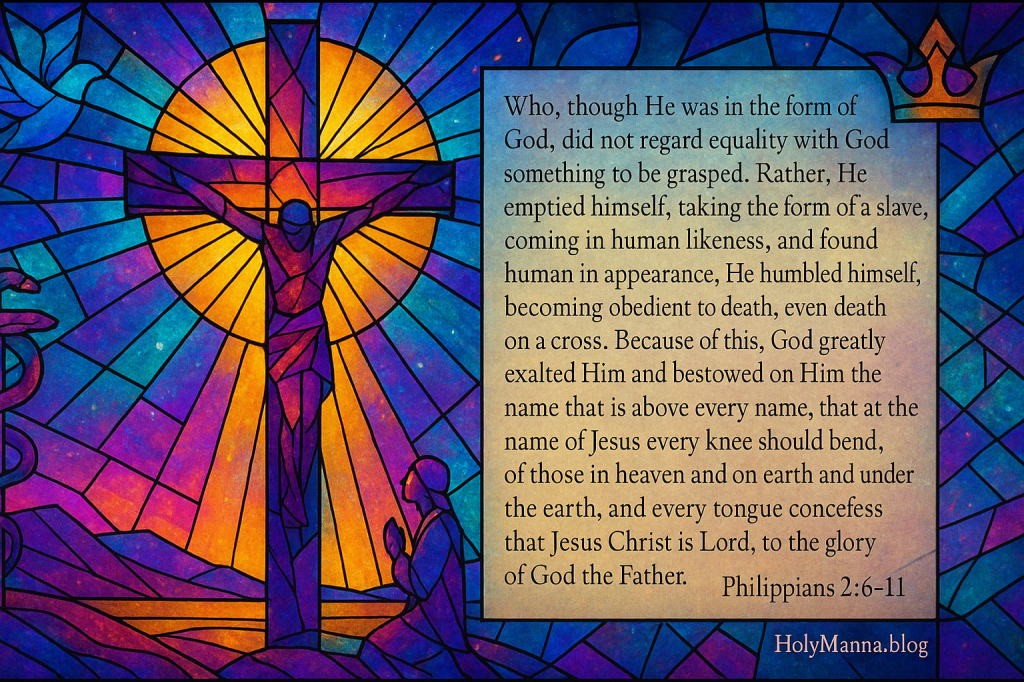
6 Who, though he was in the form of God,
did not regard equality with God something to be grasped.
7 Rather, he emptied himself,
taking the form of a slave,
coming in human likeness;
and found human in appearance,
8 he humbled himself,
becoming obedient to death,
even death on a cross.
9 Because of this, God greatly exalted him
and bestowed on him the name
that is above every name,
10 that at the name of Jesus
every knee should bend,
of those in heaven and on earth and under the earth,
11 and every tongue confess that
Jesus Christ is Lord,
to the glory of God the Father.
Detailed Exegesis
Verse 6 – “Who, though he was in the form of God, did not regard equality with God something to be grasped.”
“Form of God” speaks to the true divinity of the Son. The verb translated “to be grasped” conveys clinging to privilege. Christ does not seize divine status as an advantage for Himself. He reveals that the very nature of God is self-gift. The hymn begins by unveiling the humility that is proper to God.
Verse 7 – “Rather, he emptied himself, taking the form of a slave, coming in human likeness; and found human in appearance.”
“Emptied himself” names the kenosis, not a loss of divinity but the free assumption of our poverty. He truly takes “the form of a slave”, choosing solidarity with the least. The incarnation is God’s descent into our condition, so that our condition might be raised to share His life.
Verse 8 – “He humbled himself, becoming obedient to death, even death on a cross.”
The obedience of the New Adam reverses the disobedience of the first. Crucifixion was the most shameful Roman execution, intended to erase honor. Christ transforms the instrument of shame into the throne of love. Here the “lifting up” of the Son occurs in humiliation that is already the seed of glory.
Verse 9 – “Because of this, God greatly exalted him and bestowed on him the name that is above every name.”
The Father answers the Son’s obedient love with exaltation. The “Name” evokes the divine Name revealed in Scripture. To Jesus, God gives what no creature can bear by nature. The humiliation of the Cross becomes the pathway by which the Son’s Lordship shines forth in the world.
Verse 10 – “That at the name of Jesus every knee should bend, of those in heaven and on earth and under the earth.”
The universal scope mirrors Isaiah 45. All creation acknowledges the Lordship of Jesus. Bending the knee is an act of adoration, not mere respect. The Church bows the body because the heart knows that salvation is found in no other name.
Verse 11 – “And every tongue confess that Jesus Christ is Lord, to the glory of God the Father.”
Confession completes adoration. To say “Jesus Christ is Lord” is to echo the earliest creed and to glorify the Father who sent the Son. The hymn ends where it began. Divine humility is the revelation of divine glory.
Teachings
The mystery of Christ’s descent and exaltation shapes Christian faith and life. CCC 618 teaches, “The cross is the unique sacrifice of Christ, the ‘one mediator between God and men’.” The purpose of the Incarnation is our participation in God’s life. CCC 460 proclaims, “The Word became flesh to make us ‘partakers of the divine nature’.” Saint Athanasius is quoted in the same paragraph: “For the Son of God became man so that we might become God.” The holy Name given in exaltation becomes the Church’s simplest prayer. CCC 2668 states, “The invocation of the holy name of Jesus is the simplest way of praying always.” The Fathers express the healing logic of the kenosis. Saint Gregory of Nazianzus famously says, “For that which He has not assumed He has not healed.” In a city like Philippi, where imperial cults honored Caesar as lord, the confession “Jesus Christ is Lord” marked Christians as a people whose allegiance is to the Crucified and Risen One. The downward path of humility is the very revelation of God’s greatness, and the exaltation of Jesus displays the Father’s answer to obedient love.
Reflection
Let this hymn become your breath prayer today. Quietly adore the Lord by slowly pronouncing His holy Name. Bow your head or bend your knee when you pass a crucifix and let your body teach your heart to worship. Choose a concrete act of humility that serves someone who cannot repay you. Offer your inconveniences in union with Jesus who emptied Himself for you. Where can you freely release a privilege today in order to love as Christ loves? How will you confess with your lips and your life that Jesus Christ is Lord so that the Father is glorified?
Holy Gospel – John 3:13–17
Lifted up in love
This Gospel sits within Jesus’ nighttime dialogue with Nicodemus, a Pharisee and leader of Israel who seeks understanding. In the world of John’s Gospel, crucifixion was a Roman instrument of shame, yet Jesus reframes it with a word that means both elevation on a cross and exaltation in glory. The ancient sign from Numbers 21:4–9, where a bronze serpent was lifted for Israel’s healing, becomes the key for interpreting the Paschal Mystery. Jesus, the Son who has come down from heaven, will be lifted up so that faith may become the gaze that heals and saves. The cultural backdrop of imperial Rome and the religious memory of Israel converge here. The Cross is not divine defeat. It is the revelation of a love that gives, not to condemn, but to save. This passage gathers today’s theme with clarity. Look and live. God heals our sin through the lifting up of His Son, and He invites obedient faith that receives mercy and eternal life.
John 3:13-17
New American Bible (Revised Edition)
13 No one has gone up to heaven except the one who has come down from heaven, the Son of Man. 14 And just as Moses lifted up the serpent in the desert, so must the Son of Man be lifted up, 15 so that everyone who believes in him may have eternal life.”
16 For God so loved the world that he gave his only Son, so that everyone who believes in him might not perish but might have eternal life. 17 For God did not send his Son into the world to condemn the world, but that the world might be saved through him.
Detailed Exegesis
Verse 13 – “No one has gone up to heaven except the one who has come down from heaven, the Son of Man.”
Jesus asserts His unique heavenly origin and authority. The title “Son of Man” evokes Danielic imagery of the figure who receives dominion from God. He alone bridges heaven and earth. Revelation does not rise by human effort. It descends as a gift in the person of the Son.
Verse 14 – “And just as Moses lifted up the serpent in the desert, so must the Son of Man be lifted up,”
The comparison is typological. The bronze serpent prefigures the Cross. The verb “must” signals divine necessity within the Father’s saving plan. The lifting is both physical crucifixion and the beginning of exaltation. What once was a sign of curse becomes the place of cure.
Verse 15 – “So that everyone who believes in him may have eternal life.”
Faith is the act of looking that receives healing. “Eternal life” in John is not only endless duration. It is sharing in God’s own life already now. The fruit of the lifting up is participation in divine communion through believing adherence to the Son.
Verse 16 – “For God so loved the world that he gave his only Son, so that everyone who believes in him might not perish but might have eternal life.”
Here is the motive of salvation. Love gives. The Father’s gift is His only Son. The purpose is rescue from perishing and entrance into life. Judgment is not God’s first word. Love is. The Cross is the grammar of that love.
Verse 17 – “For God did not send his Son into the world to condemn the world, but that the world might be saved through him.”
Mission clarifies meaning. The sending is salvific. Condemnation is not the intent of the Incarnation. Salvation is. Yet salvation calls for a response of faith that welcomes the Son and walks in the light He brings.
Teachings
The Church reads this passage as the radiant center of the Gospel. CCC 458 teaches, “The Word became flesh so that thus we might know God’s love.” The Cross reveals the shape of that love. CCC 616 declares, “It is love ‘to the end’ that confers on Christ’s sacrifice its value as redemption and reparation, as atonement and satisfaction.” Salvation springs from the Father’s initiative. CCC 620 states, “Our salvation comes from the initiative of God’s love for us because ‘he loved us and sent his Son to be the expiation for our sins’.” The Gospel is therefore a summons to mercy. CCC 1846 affirms, “The Gospel is the revelation in Jesus Christ of God’s mercy to sinners.” The life promised by Jesus is truly God’s own life shared with us. CCC 1997 teaches, “Grace is a participation in the life of God.” Finally, the Church summarizes the heart of our proclamation. CCC 571 professes, “The Paschal mystery of Christ’s cross and Resurrection stands at the center of the Good News that the apostles and the Church, following them, are to proclaim to the world.” In light of Numbers 21:4–9, the Church understands that the Son lifted up is the true remedy for the poison of sin. Looking in faith to Jesus crucified and risen is the path to healing and eternal life.
Reflection
Let the Gospel become prayer in you today. Speak the holy Name of Jesus slowly and with faith. Place a crucifix where you can see it and pause to look with love as often as you can. Make a simple act of trust when you feel the sting of discouragement by saying, “Jesus, I trust in You.” Choose reconciliation with someone you have avoided and ask for the grace to forgive. Prepare for the Sacrament of Reconciliation if needed, and receive the mercy the Father delights to give through His Son. Where do you need to lift your eyes to Christ instead of focusing on the serpents of fear or resentment? How will you welcome the saving mission of the Son in a concrete action of faith, hope, and love today?
Look and Live, Fix Your Gaze on the Holy Cross
On this feast the Church invites us to lift high the Cross and to adore the love that saves. In Numbers 21:4–9, the people wounded by serpents live when they look upon the sign God provides. In Psalm 78:1–2, 34–38, the community remembers God’s steadfast compassion and learns that mercy is greater than inconstancy. In Philippians 2:6–11, the Son’s self-emptying love leads to His exaltation so that “every knee should bend” and every tongue confess His holy Name. In John 3:13–17, Jesus reveals the fulfillment of the sign. “Just as Moses lifted up the serpent in the desert”, so the Son of Man will be lifted up for our eternal life, because “God so loved the world” and sent His Son not to condemn but to save. This is the heart of the Good News proclaimed by the Church and taught in The Catechism (CCC 458; CCC 616; CCC 618; CCC 2668). On this Exaltation of the Holy Cross, look and live. Fix your gaze on the Crucified and Risen Lord, and receive the mercy that makes all things new.
Let this feast become life in you today. Choose to look up in faith whenever fear or resentment bites. Speak the holy Name of Jesus with love and bend your knee in adoration, since “Jesus Christ is Lord” to the glory of God the Father. Remember God’s deeds with gratitude, seek reconciliation where there is division, and ask for the grace to obey in small hidden ways. Make room for the Sacrament of Reconciliation and the Eucharist, where Christ’s saving love heals and strengthens your heart. Where is the Lord inviting you to lift your eyes to Him right now? How will you respond to His saving love with a concrete act of faith, hope, and charity today?
Engage with Us!
We would love to hear your reflections in the comments below. Share what moved you and how the Lord is speaking to your heart today.
- Numbers 21:4–9: Where have you been tempted to complain about God’s providence, and how can you choose grateful trust instead? What concrete way will you “look and live” today by fixing your gaze on Christ crucified when spiritual discouragement bites?
- Psalm 78:1–2, 34–38: What act of remembrance can you practice this week to keep God’s mercy before your eyes? Where do your words outpace your heart, and how will you seek integrity through sincere contrition and reconciliation?
- Philippians 2:6–11: What privilege or preference can you freely release today in imitation of Jesus who emptied Himself? How will you honor the holy Name of Jesus in prayer and action so that every part of your life confesses that He is Lord?
- John 3:13–17: Where do you need to welcome the truth that God sent His Son not to condemn you but to save you? What simple act of faith, hope, or love will you take today so that you live more fully in the eternal life Jesus offers?
Go in peace and live a life of faith. Do everything with the love and mercy that Jesus taught us, so that your gaze fixed on Him becomes healing for you and a light for the world.
Sacred Heart of Jesus, we trust in You!
Immaculate Heart of Mary, pray for us!
Saint Michael the Archangel, defend us in battle!
Follow us on Instagram and Facebook for more insights and reflections on living a faith-filled life.

 Holy Manna!
Leave a comment