Memorial of Saint John Chrysostom, Bishop and Doctor of the Church – Lectionary: 442
From Mercy to Bedrock
What if today were the day you let grace rebuild the foundation of your life from the ground up? The readings converge on a single, urgent theme: God’s mercy lifts us from the dust so that our renewed hearts may bear good fruit on the solid rock of Christ. In 1 Timothy 1:15-17, Saint Paul bears witness that “Christ Jesus came into the world to save sinners”, and he calls himself the foremost so that God’s patience would be unmistakable. This personal testimony flows into a doxology that crowns God as “the king of ages”, reminding us that conversion is not self-improvement but worship, a life turned toward the only Lord. Psalm 113:1-7 widens that lens from one sinner to the whole lowly and poor, praising the Lord who “raises the needy from the dust” and who is worthy of blessing from sunrise to sunset. This is the God whose mercy is not sentimental. It is world-shaping and soul-raising. In Luke 6:43-49, Jesus brings mercy to maturity: “A good tree does not bear rotten fruit” and the wise disciple acts on His word, digging deep until the house rests “on rock”. In first-century Palestine, builders who ignored the buried bedrock risked collapse when the flash floods came. Jesus insists that mercy received must become obedience embodied, or else the structure of a life will not withstand the storms. The Church teaches that grace is God’s free and transforming initiative that enables our cooperation, leading to holiness and the fruits of charity (CCC 1996-2000; CCC 1832), and that true worship includes love for the poor whom God exalts (CCC 2443-2449). Are you ready to let the God who lifts the lowly also lay a new foundation beneath your feet so that your words, choices, and relationships reveal the good fruit of a changed heart?
First Reading – 1 Timothy 1:15-17
Mercy That Makes Witnesses
The Pastoral Epistles situate Timothy in the crucible of early Church leadership, likely in Ephesus, where false teaching and fragile communities required both doctrinal clarity and pastoral patience. Within that setting, these verses present the Church’s earliest kerygma in miniature: “Christ Jesus came into the world to save sinners”. Saint Paul does not offer abstract theology. He offers his story as proof that divine mercy is real, effective, and public. The doxology that follows echoes Jewish liturgical praise and places the spotlight where it belongs, on the God who reigns over history and heals the human heart. This reading advances today’s theme by showing how mercy received becomes the foundation for a life that bears good fruit and stands firm on the rock of Christ. It is the hinge between Psalm 113, where God “raises the needy from the dust”, and Luke 6:43-49, where only obedient action on Christ’s word can weather the flood.
1 Timothy 1:15-17
New American Bible (Revised Edition)
15 This saying is trustworthy and deserves full acceptance: Christ Jesus came into the world to save sinners. Of these I am the foremost. 16 But for that reason I was mercifully treated, so that in me, as the foremost, Christ Jesus might display all his patience as an example for those who would come to believe in him for everlasting life. 17 To the king of ages, incorruptible, invisible, the only God, honor and glory forever and ever. Amen.
Detailed Exegesis
Verse 15: “This saying is trustworthy and deserves full acceptance: Christ Jesus came into the world to save sinners. Of these I am the foremost.”
Paul cites a recognized apostolic formula, marking it as authoritative for the whole Church. Salvation is not self-rescue. It is God’s initiative in Christ entering our world to save. By calling himself the foremost of sinners, Paul refuses spiritual posturing. The worse his past, the brighter mercy shines. This confession models evangelical humility and guards the community against despair on one side and pride on the other. It also aligns with the Church’s teaching that sin is real and deadly, yet never the last word because grace precedes, accompanies, and perfects our free response.
Verse 16: “But for that reason I was mercifully treated, so that in me, as the foremost, Christ Jesus might display all his patience as an example for those who would come to believe in him for everlasting life.”
Paul’s conversion is pedagogy. Christ exhibits His perfect patience in Paul, turning a persecutor into an apostle. The purpose is ecclesial and missionary. The Church can point to Paul and say: look at what Christ’s mercy can do. This verse illumines how grace transforms a person into a sign for others. It also hints at perseverance. Divine patience both bears with our slowness and empowers our growth, so that belief flowers into everlasting life. Mercy is not indulgence. It is the power that remakes the heart to trust, to endure, and to witness.
Verse 17: “To the king of ages, incorruptible, invisible, the only God, honor and glory forever and ever. Amen.”
The doxology crowns the confession. Right doctrine ends in right worship. By naming God as eternal, incorruptible, and invisible, Paul distinguishes the Creator from every created rival and reminds the Church that salvation is participation in the life of the one true God. Praise is the fitting response to mercy. Having been lifted “from the dust,” the redeemed do not center themselves, but give “honor and glory” to the only God. This turns mercy into mission, because adoration fuels obedience and strengthens the foundation beneath the house of our lives.
Teachings
The Church understands conversion as the grace-filled turning of the whole person to God, initiated by Christ’s call and realized through our free cooperation. The Catechism teaches: “Jesus calls to conversion. This call is an essential part of the proclamation of the kingdom: ‘The time is fulfilled, and the kingdom of God is at hand; repent, and believe in the gospel.’ In the Church’s preaching this call is addressed first to those who do not yet know Christ and his Gospel. Also, Baptism is the principal place for the first and fundamental conversion.” (CCC 1427). Paul’s testimony in 1 Timothy is a living instance of this call and its fruit.
Regarding the source and power of this transformation, The Catechism states: “Our justification comes from the grace of God. Grace is favor, the free and undeserved help that God gives us to respond to his call to become children of God, adoptive sons, partakers of the divine nature and of eternal life.” (CCC 1996). This is precisely what Paul proclaims when he says he was “mercifully treated.”
The Church further explains the enduring gift at work in the soul: “Sanctifying grace is an habitual gift, a stable and supernatural disposition that perfects the soul itself to enable it to live with God, to act by his love. Habitual grace, the permanent disposition to live and act in keeping with God’s call, is distinguished from actual graces which refer to God’s interventions, whether at the beginning of conversion or in the course of the work of sanctification.” (CCC 2000). Paul’s life displays both the initial intervention on the Damascus road and the abiding habit of grace that made him a tireless apostle.
Finally, the visible outcome of mercy is the fruit of a renewed heart. The Catechism teaches: “The fruits of the Spirit are perfections that the Holy Spirit forms in us as the first fruits of eternal glory: charity, joy, peace, patience, kindness, goodness, generosity, gentleness, faithfulness, modesty, self-control, chastity.” (CCC 1832). This deep harmony with the Spirit corresponds to Jesus’ insistence in Luke 6 that a good tree is known by its good fruit and that a life grounded on His word will stand.
Reflection
God’s mercy does not erase your story. It rewrites the ending and repurposes every page as a witness to His patience. Begin today by confessing with Paul that Christ came to save sinners and include yourself without defensiveness. Receive mercy concretely through an honest examination of conscience and a good confession if it has been a while. Practice daily acts of patience toward others as a participation in Christ’s patience toward you. Let praise become your first language in prayer, because adoration cements the foundation. Then choose one action that bears visible fruit in love for the lowly, since the God who raised you from the dust now sends you to raise others. Where is Christ inviting you to stop performing and start confessing so that His patience can be seen in you? What small act of obedience will reinforce the foundation of your life on His rock today? Which words flowing from your heart will reveal that grace, not pride or fear, is in command?
Responsorial Psalm – Psalm 113:1-7
Praise That Lifts the Lowly
Prayed at Israel’s great feasts as the opening of the Hallel, Psalm 113 summoned priests, Levites, and households to bless the Name from sunrise to sunset. In the liturgy of Israel, praise was public theology. It proclaimed who God is and what God does for the poor and the lowly. This psalm celebrates the Lord who dwells on high yet stoops to raise the needy from the dust. In the Church’s prayer, this text forms disciples whose worship becomes mercy in action. Today’s theme unfolds here with clarity. The God who showed patience to the foremost of sinners in 1 Timothy 1:15-17 is the same Lord who “raises the needy from the dust”. Such praise trains the heart to act on Christ’s word in Luke 6:43-49, so that good fruit grows from a life founded on the rock.
Psalm 113:1-7
New American Bible (Revised Edition)
Praise of God’s Care for the Poor
1 Hallelujah!
Praise, you servants of the Lord,
praise the name of the Lord.
2 Blessed be the name of the Lord
both now and forever.
3 From the rising of the sun to its setting
let the name of the Lord be praised.
4 High above all nations is the Lord;
above the heavens his glory.
5 Who is like the Lord our God,
enthroned on high,
6 looking down on heaven and earth?
7 He raises the needy from the dust,
lifts the poor from the ash heap,
Detailed Exegesis
Verse 1: “Hallelujah! Praise, you servants of the Lord, praise the name of the Lord.”
The psalm begins with the liturgical call “Hallelujah,” literally “Praise Yah.” Addressing the “servants of the Lord” places worship within a covenant identity. To praise the Name is to honor God’s revealed presence and character. Praise is not a mood. It is obedience that acknowledges who God is and reshapes the worshiper for mission.
Verse 2: “Blessed be the name of the Lord both now and forever.”
Time is saturated with blessing. Israel blesses the Lord not only for past rescue but as an unbroken stance of the heart. This trains perseverance. Paul’s doxology in 1 Timothy echoes this posture of forever-praise, anchoring our conversion in worship that does not end.
Verse 3: “From the rising of the sun to its setting let the name of the Lord be praised.”
The whole arc of the day is consecrated to God. Morning to evening becomes an altar. Christian life inherits this rhythm in the Liturgy of the Hours. Praise stretching from dawn to dusk forms a stable foundation, like the house on rock in Luke 6, because it habituates the soul to listen and to act on God’s word.
Verse 4: “High above all nations is the Lord; above the heavens his glory.”
God’s transcendence is confessed without rivalry or pride. He is Lord of history and cosmos. This protects praise from becoming flattery. We do not “use” God. We adore the One whose glory no nation can contain and whose sovereignty relativizes every earthly power.
Verse 5: “Who is like the Lord our God, enthroned on high,”
The rhetorical question is a creed in miniature. There is none like the Lord. Adoration names God’s holiness and otherness. This humility before the Holy One prepares the heart to bear good fruit because it dethrones the ego.
Verse 6: “looking down on heaven and earth?”
The image is not detachment but attentive condescension. The Lord sees. Divine regard means divine involvement. God’s gaze precedes our need, which emboldens the poor to hope and the forgiven to witness, as Paul does.
Verse 7: “He raises the needy from the dust, lifts the poor from the ash heap,”
Here transcendence bends into tenderness. Dust and ash name humiliation and mourning. God’s action is not abstract. He literally lifts. This anticipates Mary’s Magnificat where God “has lifted up the lowly” (Luke 1:52). The Church hears in this verse a charter for mercy. The Lord who raised us from sin sends us to raise the fallen, so that praise becomes concrete love.
Teachings
The Church links praise with adoration and mission. The Catechism teaches: “Praise is the form of prayer which recognizes most immediately that God is God. It lauds God for his own sake, gives him glory, not for what he does, but simply because he is.” (CCC 2639). Such praise, morning to evening, steadies the heart on the rock of God’s unchanging goodness.
Love for the poor is inseparable from true worship. The Catechism states: “God blesses those who come to the aid of the poor and rebukes those who turn away from them: ‘Give to him who begs from you.’ ‘You received without pay, give without pay.’ It is by what they have done for the poor that Jesus Christ will recognize his chosen ones.” (CCC 2443). This is the missionary edge of Psalm 113: praise that becomes generous action.
The same section cites the Fathers to sharpen our conscience. Saint John Chrysostom is quoted in The Catechism: “Not to enable the poor to share in our goods is to steal from them and deprive them of life; the goods we possess are not ours, but theirs.” (CCC 2446). Saint Gregory the Great is also quoted there: “When we attend to the needs of those in want, we give them what is theirs, not ours.” (CCC 2446). In other words, the Lord who lifts the poor claims our hands, our tables, and our schedules as instruments of His mercy.
Finally, Mary’s song confirms the psalm’s promise: “He has cast down the mighty from their thrones, and has lifted up the lowly.” (Luke 1:52). The Church reads Psalm 113 through the Magnificat, seeing in Israel’s praise the blueprint fulfilled in Christ and His Mother.
Reflection
Begin and end your day with deliberate praise, even a single minute that blesses the Name aloud. Let that praise move your feet to someone’s need. Offer a concrete work of mercy this week, such as a visit, a meal, or a bill paid for someone in crisis. Pray the Magnificat after completing the act as a way to return glory to God. Ask the Lord to make your home a place where the lowly are raised. When you bless the Lord at sunrise and sunset, how does your speech during the in-between hours reveal the fruit of a grateful heart? Whom might God be asking you to lift from the dust this week, and what specific action can you take today to begin? How will your worship on Sunday overflow into mercy on Monday so that praise becomes the bedrock of a life built on Christ?
Holy Gospel – Luke 6:43-49
Fruit and Foundations: The Proof of a Transformed Heart
Jesus delivers these words within the Sermon on the Plain in Luke, following blessings and woes that reframe holiness as a beatitude-shaped life. His images are concrete and local. Trees are judged by their fruit, and houses in Palestine survive sudden wadis only when anchored to bedrock. In a world where religious identity could drift toward lip service, Jesus unites interior renewal with exterior obedience. This Gospel completes today’s theme. Mercy raises us from the dust and remakes the heart, but its authenticity is shown when the life bears good fruit and rests on the rock of Christ through deliberate action on His word.
Luke 6:43-49
New American Bible (Revised Edition)
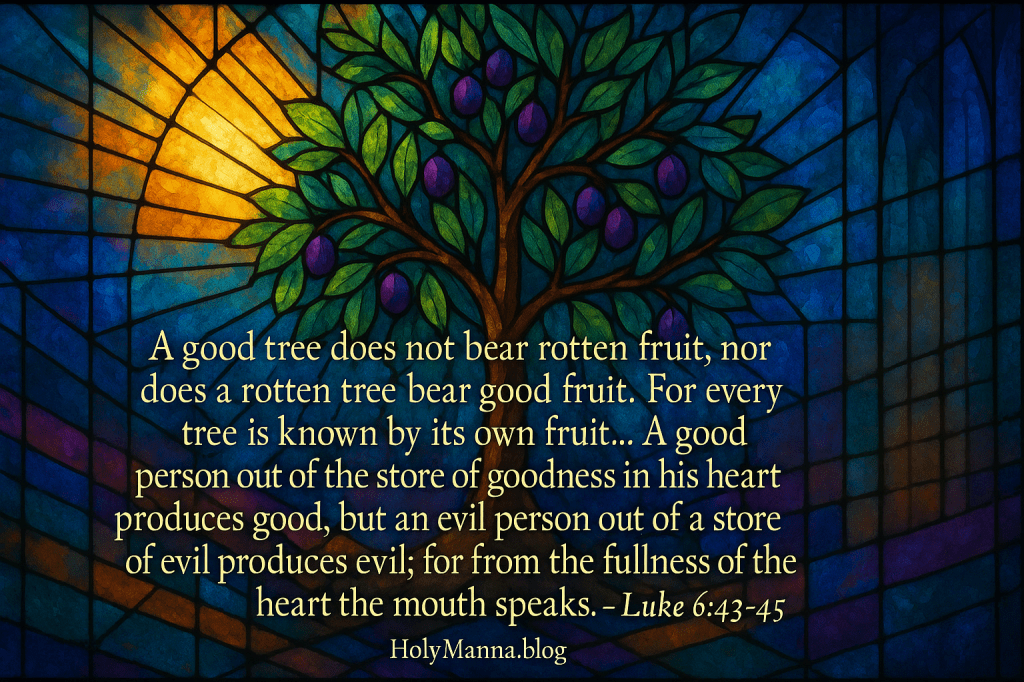
43 “A good tree does not bear rotten fruit, nor does a rotten tree bear good fruit. 44 For every tree is known by its own fruit. For people do not pick figs from thornbushes, nor do they gather grapes from brambles. 45 A good person out of the store of goodness in his heart produces good, but an evil person out of a store of evil produces evil; for from the fullness of the heart the mouth speaks.
The Two Foundations. 46 “Why do you call me, ‘Lord, Lord,’ but not do what I command? 47 I will show you what someone is like who comes to me, listens to my words, and acts on them. 48 That one is like a person building a house, who dug deeply and laid the foundation on rock; when the flood came, the river burst against that house but could not shake it because it had been well built. 49 But the one who listens and does not act is like a person who built a house on the ground without a foundation. When the river burst against it, it collapsed at once and was completely destroyed.”
Detailed Exegesis
Verse 43: “A good tree does not bear rotten fruit, nor does a rotten tree bear good fruit.”
Jesus begins with moral botany. Being and doing are inseparable. Grace transforms the person so that actions become signs of interior renewal. The point is not moralism. It is metaphysics of the heart. What we are becoming in Christ inevitably manifests in what we do.
Verse 44: “For every tree is known by its own fruit. For people do not pick figs from thornbushes, nor do they gather grapes from brambles.”
Discernment is ordinary. Fruit reveals the root. Jesus gives everyday agriculture as a test for discipleship. In the Church, this becomes an examination not of others but of ourselves. Thornbushes can be religiously impressive, but they never yield figs. The Spirit’s presence is recognized by the fruit that fits the tree.
Verse 45: “A good person out of the store of goodness in his heart produces good, but an evil person out of a store of evil produces evil; for from the fullness of the heart the mouth speaks.”
Speech discloses the sanctuary. Words are sacraments of the heart’s abundance. Jesus refuses a split between inner piety and outer behavior. If the mouth poisons, the heart needs healing. If the mouth blesses, the heart is being configured to Christ. Mercy must penetrate the storehouse, not decorate the surface.
Verse 46: “Why do you call me, ‘Lord, Lord,’ but not do what I command?”
Here Jesus exposes the danger of verbal orthodoxy without obedient love. The title “Lord” on our lips demands the deed in our lives. This question is not condemnation. It is invitation. He asks for alignment between confession and conduct.
Verse 47: “I will show you what someone is like who comes to me, listens to my words, and acts on them.”
Discipleship is threefold. We come to Jesus. We listen to Jesus. We act on His words. The order matters. Proximity without obedience builds spiritual complacency. Listening without acting builds delusion. Acting without communion becomes activism. Jesus insists on all three.
Verse 48: “That one is like a person building a house, who dug deeply and laid the foundation on rock; when the flood came, the river burst against that house but could not shake it because it had been well built.”
The wise builder digs. Obedience goes below the surface until it meets the rock who is Christ. Floods are not hypothetical. They will come. Trial reveals foundation. The house stands not because storms are smaller, but because the foundation is sound.
Verse 49: “But the one who listens and does not act is like a person who built a house on the ground without a foundation. When the river burst against it, it collapsed at once and was completely destroyed.”
Hearing without doing is architectural malpractice for the soul. The collapse is immediate when the river strikes because the structure never engaged the rock. Jesus ends with warning to awaken desire, not to produce despair. Today is the day to dig.
Teachings
The Church reads Jesus’ images through the lens of grace and the moral life. The Catechism teaches: “The fruits of the Spirit are perfections that the Holy Spirit forms in us as the first fruits of eternal glory: charity, joy, peace, patience, kindness, goodness, generosity, gentleness, faithfulness, modesty, self-control, chastity.” (CCC 1832). The good fruit Jesus seeks is not self-produced performance. It is the Spirit’s work in a heart yielded to Christ.
On the way Jesus teaches, The Catechism explains: “Jesus’ invitation to enter his kingdom comes in the form of parables, a characteristic feature of his teaching. Through his parables he invites people to the feast of the kingdom, but he also asks for a radical choice: to gain the kingdom, one must give everything. Words are not enough, deeds are required. The parables are like mirrors for man: will he be hard soil or good earth for the word? What use has he made of the talents he has received? Jesus and the presence of the Kingdom in this world are secretly at the heart of the parables. One must enter the kingdom, that is, become a disciple of Christ, in order to ‘know the secrets of the kingdom of heaven.’ For those who stay ‘outside’, everything remains enigmatic.” (CCC 546). Jesus’ twin images of fruit and foundations demand precisely this radical choice.
The early Church framed discipleship with a stark clarity that echoes today’s Gospel. The Didache opens: “There are two ways, one of life and one of death, and there is a great difference between the two ways.” The house on rock is the way of life. The house on sand is the way of death. Saint Augustine captures the heart of Christian morality with luminous brevity: “Love, and do what you will.” When love is real, action aligns. The Rule of Saint Benedict offers the same compass for ordering a life on Christ’s word: “Prefer nothing to the love of Christ.”
Reflection
Begin by inviting the Lord to renovate the storehouse of your heart. Practice a daily examen in the evening that asks where your words revealed trust in Jesus and where they betrayed fear or pride. Choose one command of Christ this week and enact it deliberately. Bless those who insult you. Reconcile with a family member. Give to someone who cannot repay you. Anchor your day in Scripture by praying with this Gospel using lectio divina. Read. Meditate. Pray. Contemplate. Resolve one specific act. Build a rule of life that digs to bedrock. Fix times for prayer, worship, and works of mercy, and hold to them as you would to the foundation of a house. Which of your words this week most clearly revealed what fills your heart, and what does that invite you to confess or to celebrate today? Where is Jesus asking you to act on a command you already know, and what concrete step will you take before the day ends? What practices will help you dig until your life rests on the rock, so that when the floods rise your house will stand?
Lifted from Dust, Built on the Rock
Mercy has a direction. In 1 Timothy 1:15-17, Paul confesses that “Christ Jesus came into the world to save sinners” and lets divine patience turn his story into a sign. In Psalm 113:1-7, the Church learns to bless the Name from sunrise to sunset as we behold the Lord who “raises the needy from the dust”. In Luke 6:43-49, Jesus insists that mercy matures into obedience, so our lives bear good fruit and stand firm because we have “laid the foundation on rock”. Together these readings trace the journey of grace from rescue to praise to practice. They invite us to receive mercy, adore the Giver, and do the word. This is not self-improvement. It is cooperation with grace that justifies and sanctifies as taught in CCC 1996-2000. It is the Spirit forming in us the fruits named in CCC 1832. It is the worship that overflows into love for the poor as urged in CCC 2443-2449.
Here is the call to action. Confess Christ’s mercy over your life today and, if needed, make a plan for a good confession this week. Bless the Lord morning and evening with a simple psalm or the Magnificat. Choose one command of Jesus and do it before the day ends. Reconcile. Bless an enemy. Lift someone from the dust with concrete generosity. Establish a small rule of life that digs to bedrock: fixed moments of Scripture, the Eucharist on Sunday, and one weekly work of mercy. Let your words and deeds reveal what fills your heart until praise becomes the architecture of your life in Christ. Where is the Lord asking you to trust His patience and begin again today? What praise will bookend your day so that your house rests on the rock of His word? Who is the one person you can help God lift from the dust this week?
Engage with Us!
We would love to hear your reflections in the comments below. Share a grace you noticed, a question that challenged you, or a concrete step you plan to take this week.
- First Reading (1 Timothy 1:15-17): How does Paul’s confession “Christ Jesus came into the world to save sinners” reshape the way you see your past and your future with Christ? What act of repentance or thanksgiving will you make in response to God’s patience toward you this week?
- Responsorial Psalm (Psalm 113:1-7): Where do you see the Lord “raising the needy from the dust” around you, and how can you join His work with a specific act of mercy? How will you bless the Name of the Lord from sunrise to sunset tomorrow in a practical way?
- Holy Gospel (Luke 6:43-49): What command of Jesus will you act on today so that your life is truly “laid on rock”? Which words from your mouth this week revealed the fullness of your heart, and what change is the Holy Spirit inviting you to make?
May the Lord strengthen you to live a life of faith, to speak words that give life, and to do everything with the love and mercy that Jesus taught us.
Sacred Heart of Jesus, we trust in You!
Immaculate Heart of Mary, pray for us!
Saint Michael the Archangel, defend us in battle!
Follow us on Instagram and Facebook for more insights and reflections on living a faith-filled life.

 Holy Manna!
Leave a comment