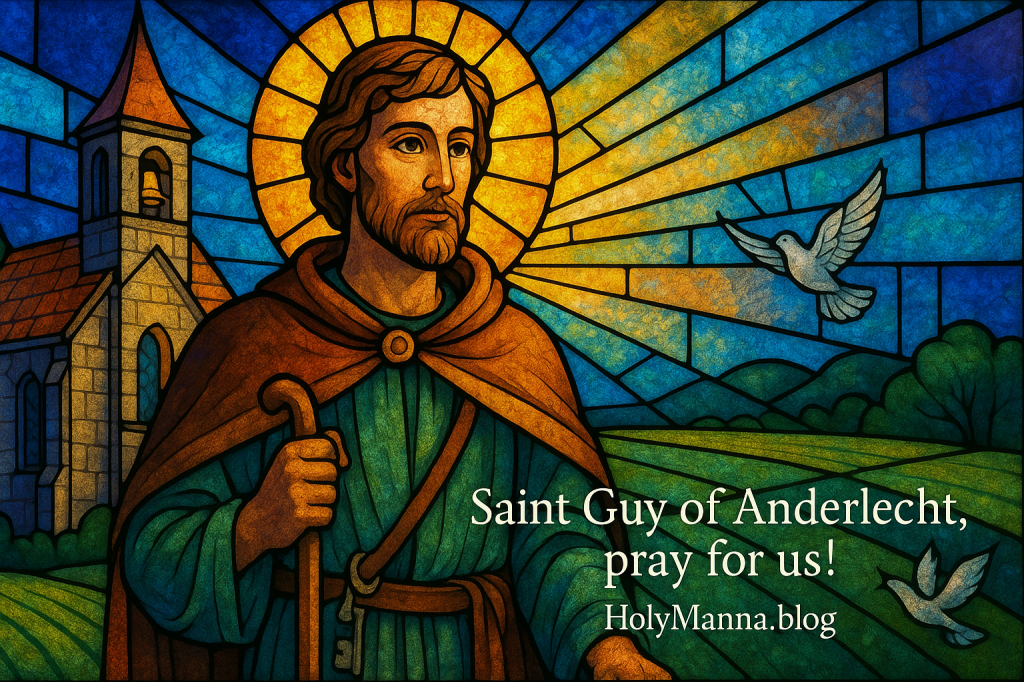
A Heart That Preferred the Tabernacle to Treasure
Saint Guy of Anderlecht stands out in Christian memory as a lay confessor whose holiness was forged in humble service. He lived in the late tenth and early eleventh centuries in the region of present day Brussels. He is honored as the patron of Anderlecht, and he is traditionally invoked by sacristans, laborers, and those who care for draught animals. What makes him revered is not a list of offices or writings but a life of fidelity to prayer, fidelity to the Church, and a pilgrim spirit that chose repentance over riches. His feast is celebrated on September 12. He shows that sanctity is found in ordinary faithfulness near the altar and along the long road of conversion.
Born Lowly, Drawn Higher
Guy was born to poor parents in Brabant and raised near the churches that shaped his devotion. From youth he preferred the House of God to worldly entertainments. He eventually served as a sexton and sacristan at a Marian shrine, most commonly identified as Our Lady of Laeken, where he rang the bells, tended the sanctuary, and safeguarded the sacred vessels. Desiring to give more alms, he allowed himself to be drawn into a trading venture with a merchant who promised great returns. The enterprise failed catastrophically, and a cargo ship was reportedly lost. Guy’s conscience was wounded by the thought that he had trusted gain more than God. In reparation he embraced a life of penance and pilgrimage. He journeyed on foot to Rome and then to the Holy Land, seeking forgiveness and deeper union with Christ. This long season on the road reshaped his heart. He learned to sleep among the poor, to pray at the tombs of the apostles, and to place his life entirely in the hands of Providence. When he finally turned homeward, he carried no treasure but the peace born of repentance.
Work Transfigured by Prayer
The enduring importance of Saint Guy’s life is the witness that hidden service is precious to God. He loved the church where he worked. He kept watch before the tabernacle. He gave away what little he had to those in need. He encouraged others to honor the Mother of God and to reverence the holy things of the altar. Stories from early devotion emphasize that he combined manual labor with mental prayer and that he was quick to mend relationships through humility when he failed. Even during his travels he sought out shrines and offered himself in menial tasks for the sake of pilgrims and the poor. The point of remembering him is not to marvel at spectacular signs but to see that ordinary tasks become luminous when offered to God. As the Lord teaches, “Blessed are the poor in spirit, for theirs is the kingdom of heaven.” Guy’s poverty of spirit became a path of charity and prayer that others wished to imitate.
Hard Roads
Guy is honored as a confessor who endured the ordinary yet real trials of Christian discipleship. He knew poverty. He knew weariness on the road. He bore illness toward the end of his life and the misunderstanding of those who could not grasp why he preferred prayer to profit. After his long pilgrimages, he returned to Anderlecht in fragile health. Tradition tells that as he approached death he fixed his eyes on heaven and awaited the mercy of God with peaceful trust. His example encourages us to accept penance freely when we have strayed, to persevere in prayer when we are tired, and to choose the Lord again and again. The Catechism of the Catholic Church reminds us of the call to conversion and penance throughout life. “Interior repentance is a radical reorientation of our whole life.” Catechism of the Catholic Church (CCC 1431). Guy’s penance was not despair. It was hope expressed in concrete deeds of prayer, almsgiving, and pilgrimage.
When the Pilgrim Rested
Guy is said to have died on September 12, 1012. Soon after his repose, reports of healings multiplied at his tomb in Anderlecht. His relics were enshrined in a crypt that became a place of prayer for the sick and the poor. Pilgrims visited to ask his intercession and to thank God for favors received. Over the centuries, local processions in his honor developed, and animals that served human work were blessed as a sign that labor itself can be sanctified. These practices are expressions of the Church’s communion across time. The Catechism of the Catholic Church teaches, “Being more closely united to Christ, those who dwell in heaven fix the whole Church more firmly in holiness. They do not cease to intercede for us.” Catechism of the Catholic Church (CCC 956). Regarding pilgrimages and sacred places, the Catechism of the Catholic Church notes that they help the faithful search for God and encounter his mercy (CCC 2691). Veneration of relics, when rightly ordered to Christ, belongs to sound Christian piety (CCC 1674 to 1676; CCC 2132). The enduring devotion to Saint Guy’s relics flows from these truths and points beyond the saint to the Lord who works wonders through his friends.
Learning to Prefer Christ
Saint Guy’s story is a simple catechesis lived in real time. He shows that God can take a misstep born of good intentions and draw from it a life of deeper holiness. When plans fall apart, we turn to prayer, make amends through generous love, and begin again. The Catechism of the Catholic Church teaches that detachment from riches frees the heart for God. “All Christ’s faithful are to direct their affections rightly, lest they be hindered in their pursuit of perfect charity by the use of worldly things.” Catechism of the Catholic Church (CCC 2545). Guy embodies this evangelical poverty. Practically, we can imitate him by spending time in quiet before the tabernacle, by giving alms with concrete sacrifice, by choosing a simple act of penance when we have failed, and by making a small pilgrimage to a local shrine for someone who suffers. Above all, we unite our daily work to prayer. We begin the day with the Sign of the Cross. We offer our tasks for someone in need. We ask the Blessed Virgin to teach us humility and perseverance. In this way the Lord transfigures the ordinary and makes it a path to heaven.
Engage with Us!
We would love to hear how Saint Guy’s humble path speaks to you. Share your thoughts and prayers in the comments below.
- Where do you feel God inviting you to simplify your life so you can love more freely?
- What small “pilgrimage” can you make this week to re-center your heart on Christ?
- How might you turn your daily work into prayer for someone who is suffering right now?
- Is there an attachment you need to surrender so that generosity can grow?
- How can you honor the saints in a way that draws you closer to Jesus in the Eucharist?
May Saint Guy of Anderlecht pray for us. Live your days with the love and mercy Jesus taught us, and let every task, great or small, become your offering of praise.
Saint Guy of Anderlecht, pray for us!
Follow us on Instagram and Facebook for more insights and reflections on living a faith-filled life.

 Holy Manna!
Leave a comment