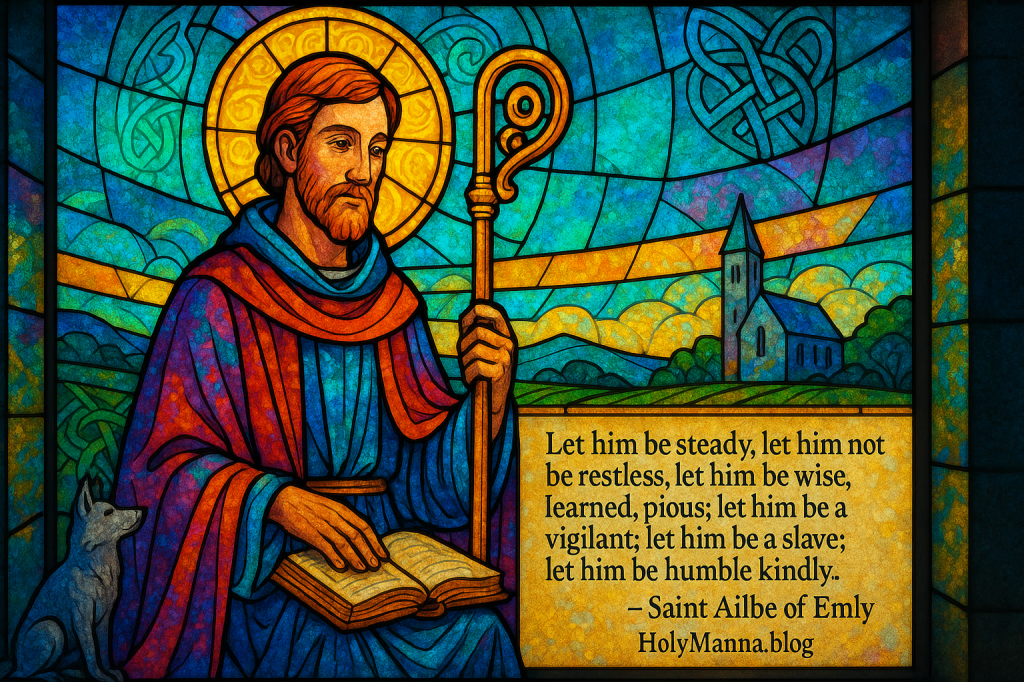
Shepherd of Munster
Saint Ailbe of Emly is revered as a pioneering bishop and evangelizer in early Christian Ireland, remembered especially for establishing the church and monastery at Emly in Munster and for shaping a culture of prayer, learning, and generous hospitality. His feast is kept on September 12, and he’s often referred to as the “Patrick of Munster” in reference to Ireland’s most famous Saint. Later tradition often lists him among the great founders of Irish Christianity in the south, and while the earliest narratives about him include legendary elements, the Church has long honored him as bishop and patron of Emly. He stands out as a pastor whose sanctity was forged in steadfast service rather than in dramatic controversy.
From Fields to Altar
Little can be stated with certainty about Ailbe’s family background or birthplace beyond his enduring link with Emly in present-day County Tipperary. Early Irish sources differ on whether he ministered before or after Saint Patrick, which suggests that memories of Ailbe were already venerable and surrounded by legend. What the tradition emphasizes is his call to shepherd a people. He is consistently remembered as the first bishop of Emly, a founder who organized Christian worship, trained clergy, and guided the growth of a monastic community whose influence spread across Munster. Because nearly all personal details were lost to time, the most reliable portrait of his early life is the one refracted through his later reputation for constancy, prayer, and welcome.
A House of Welcome
Ailbe’s life is best described through the virtues people remembered in him. Ancient praise poems highlight his extraordinary hospitality, his care for the poor, and his readiness to clothe and feed those in need. Stories told about him, while hagiographic, illuminate the living impression he made. One beloved tale says that a she wolf once nursed him as an abandoned infant and that, years later, when the aging wolf sought refuge, Bishop Ailbe protected her from hunters. The account teaches what his contemporaries prized in him, mercy that mirrors the compassion of Christ. The community he founded at Emly became a center of prayer and learning, and Ailbe’s pastoral zeal helped root the Gospel in the daily life of Munster.
Direct, authenticated sayings from Ailbe do not survive. A short monastic verse known as the Rule of St. Ailbe was compiled centuries after his death and is attributed to his spiritual legacy. It sums up the spirit associated with his school by urging steadiness, humility, and vigilance in prayer. One representative line, though not verifiably Ailbe’s personal words, captures the tradition about him: “Let him be steady, let him not be restless.” This is the virtue that defined his leadership and formed his disciples.
Quiet Trials of a Pastor
Ailbe is not commemorated as a martyr. The trials he faced were the ordinary but demanding burdens of a bishop who preached the Gospel, corrected abuses, reconciled enemies, and guarded the unity of the Church. Early Ireland was a world of strong kinship loyalties and shifting alliances, and guiding a Christian flock through those currents required courage and patience. Tradition places his death peacefully in the sixth century. His witness shows that sanctity often matures not in a single dramatic moment but in daily fidelity to prayer, charity, and pastoral care.
The Saint Who Stayed
After his death, Ailbe’s memory drew the faithful to Emly, which remained a prominent ecclesiastical center for many generations. The veneration of his relics and the keeping of his feast fostered confidence in his intercession, and local devotion continued even when church structures changed in later centuries. Emly’s church and the ancient St. Ailbe’s Cross still testify to a living tradition of prayer tied to his name. While specific posthumous miracle records are sparse, the endurance of pilgrimage, the preservation of his feast, and the constant invocation of his patronage are themselves signs of an intercessor who remained close to his people.
Why He Still Matters
The Church proposes the saints as reliable guides. As the Catechism of the Catholic Church teaches, “By canonizing some of the faithful, the Church proposes them to the faithful as models and intercessors.” It also reminds us of the powerful help of the saints in heaven, “They do not cease to intercede with the Father for us.” In Ailbe, we meet a pastor who formed disciples by practicing steady prayer, humble hospitality, and compassionate leadership. His life encourages us to make our homes and parishes places of welcome, to persevere in ordinary duties with extraordinary love, and to trust that faithfulness in little things builds the Kingdom of God. The communion of saints strengthens us in that path and draws us deeper into Christ.
Practicing Ailbe’s Hospitality
Saint Ailbe invites us to sanctify the ordinary by being present to God and neighbor. Make time for prayer that anchors your day. Open your table and your schedule to those the Lord places in your path. Ask for the grace to be steady when you feel restless and to be generous when you feel stretched. Let your home, your parish ministry, and your workplace become fields where Christ’s mercy is planted and tended. As the Catechism of the Catholic Church teaches about the saints’ help in our lives, “Their intercession is their most exalted service to God’s plan.” Ask Saint Ailbe to intercede for you, and then imitate his hospitality with courage.
Engage with Us!
We would love to hear how Saint Ailbe speaks to you. Share your thoughts and prayer intentions in the comments so we can intercede for one another.
- Where might God be asking you to practice Ailbe’s “steadiness” and hospitality this week?
- What concrete act of humble kindness can you offer today in your home, parish, or workplace?
- How does the communion of saints encourage you to persevere in prayer and service when life feels ordinary?
Go forward encouraged. Live your faith with courage and tenderness, and do everything with the love and mercy Jesus taught us.
Saint Ailbe, pray for us!
Follow us on Instagram and Facebook for more insights and reflections on living a faith-filled life.

 Holy Manna!
Leave a comment