Friday of the Twenty-third Week in Ordinary Time – Lectionary: 441
Learning to See with Jesus
Come as you are and let grace steady your steps. In 1 Timothy 1:1-2, 12-14, Paul remembers who he was and Who changed him, confessing “I was once a blasphemer and a persecutor and an arrogant man, but I have been mercifully treated”. That same mercy becomes the lens for the rest of today’s Word. Psalm 16 gives the posture of a converted heart that clings to God as “my allotted portion and my cup” and keeps Him ever before the eyes of the soul. Then Luke 6:39-42 confronts us with the sober logic of discipleship. We cannot guide others if we stumble in the dark. We must first let the Divine Physician remove the beam from our own sight so that we can truly help a brother. In the world of first century Judaism, the image of a teacher and disciple was concrete and communal. Rabbis formed disciples by word and example until the student became “like his teacher.” Jesus applies that familiar model to the inner vision of the heart. He uses vivid Semitic hyperbole about specks and beams to reveal that moral clarity is the fruit of humility, repentance, and ongoing formation. Paul’s pastoral letter to Timothy stands at the dawn of the Church’s mission, where former persecutors become shepherds by grace. The psalm gives the interior soundtrack of that transformation, a steady trust in God’s presence. The Gospel supplies the curriculum of true sight. Together they outline a path the Church safeguards in The Catechism, which teaches that God’s mercy reveals sin and heals it (CCC 1846-1848), that conscience must be formed and judgment enlightened (CCC 1783-1785), and that charity guards us from rash judgment of our neighbor (CCC 2478). The heart that has received mercy, keeps the Lord before its eyes, and submits to the Master’s training gains clear vision for mission. Where is Jesus inviting you today to receive His mercy, to keep Him always before you, and to let Him clarify your sight so that you can love others well?
First Reading – 1 Timothy 1:1-2, 12-14
Mercy That Makes Ministers
Paul’s words to Timothy come from the world of the early Church where apostolic authority, rabbinic style mentorship, and household communities shaped Christian life. Timothy served as Paul’s delegate in Ephesus, a major Greco Roman port city filled with competing philosophies and cults. In this context Paul frames his authority “by command of God” and roots Christian hope in Jesus. He then gives a compact testimony of conversion. He was once a blasphemer and persecutor, yet he was shown mercy and entrusted with ministry. This is not spiritual amnesia. It is the memory of grace that forms the vision of a shepherd. Today’s theme, moving from mercy to clear vision, is evident here. Paul’s past does not paralyze him. It becomes the stage on which grace displays its power. With Psalm 16 as the heart’s posture and the Gospel call to remove the beam from our eyes, Paul shows that the only leader who can guide others is the sinner who lets Christ heal his sight.
1 Timothy 1:1-2, 12-14
New American Bible (Revised Edition)
Greeting. 1 Paul, an apostle of Christ Jesus by command of God our savior and of Christ Jesus our hope, 2 to Timothy, my true child in faith: grace, mercy, and peace from God the Father and Christ Jesus our Lord.
12 I am grateful to him who has strengthened me, Christ Jesus our Lord, because he considered me trustworthy in appointing me to the ministry. 13 I was once a blasphemer and a persecutor and an arrogant man, but I have been mercifully treated because I acted out of ignorance in my unbelief. 14 Indeed, the grace of our Lord has been abundant, along with the faith and love that are in Christ Jesus.
Detailed Exegesis
Verse 1 “Paul, an apostle of Christ Jesus by command of God our savior and of Christ Jesus our hope,”
Paul begins with a solemn claim of divine commissioning. Apostleship is not self appointed. It arises from God’s saving will and is centered on Christ as “our hope.” In a city like Ephesus that prized patronage, Paul names the true Patron who grants life, not favors. The Church reads this as a reminder that vocation is gift and task. Christ Himself is the content and ground of Christian hope, which the Church confesses as the theological virtue given by God and ordering us to eternal life.
Verse 2 “to Timothy, my true child in faith: grace, mercy, and peace from God the Father and Christ Jesus our Lord.”
The familial address situates ministry within spiritual fatherhood. Timothy is a genuine son in the faith, not a mere functionary. The triad “grace, mercy, and peace” declares the Gospel economy. Grace heals and elevates. Mercy removes misery and forgives sin. Peace is the wholeness that flows from reconciliation with God. Paul’s greeting is not formulaic. It is performative blessing that anchors Timothy’s service in the life of the Trinity.
Verse 12 “I am grateful to him who has strengthened me, Christ Jesus our Lord, because he considered me trustworthy in appointing me to the ministry.”
Gratitude is Paul’s keynote. Strength for mission comes from Christ’s ongoing action, not from Paul’s temperament. The phrase “considered me trustworthy” reveals grace that both forgives and entrusts. Ministry is a sharing in Christ’s own service of the Father. The movement from receiving strength to being appointed highlights that divine mercy does not end at pardon. It establishes stewardship.
Verse 13 “I was once a blasphemer and a persecutor and an arrogant man, but I have been mercifully treated because I acted out of ignorance in my unbelief.”
Paul names his past without self defense. Ignorance does not excuse the evil but explains the blindness. Mercy meets ignorance with illumination. This aligns with the Church’s doctrine that grace uncovers sin to heal it. Paul’s candor is the opposite of hypocrisy from Luke 6. He lets the Lord remove the beam first.
Verse 14 “Indeed, the grace of our Lord has been abundant, along with the faith and love that are in Christ Jesus.”
“Abundant” signals superabounding grace. The fruit is “faith and love,” not mere relief from guilt. In Christ, faith becomes vision and love becomes mission. The disciple who abides in Christ receives a new interior sight and a new capacity to love, which is precisely the clarity required to guide others.
Teachings
The Catechism gathers Paul’s witness into a coherent doctrine of mercy and moral vision. It teaches: “The Gospel is the revelation in Jesus Christ of God’s mercy to sinners.” (CCC 1846). It then adds the synergy of grace and freedom with St. Augustine’s line: “God created us without us: but he did not will to save us without us.” (CCC 1847). Regarding the very dynamic Paul describes, the Church confesses: “Where sin increased, grace abounded all the more.” (*CCC 1848; cf. Romans 5:20). Formation for clear judgment is essential to discipleship: “Conscience must be informed and moral judgment enlightened.” (CCC 1783). And when Paul’s mercy becomes our posture toward others, charity governs our interpretation: “To avoid rash judgment, everyone should be careful to interpret insofar as possible his neighbor’s thoughts, words, and deeds in a favorable way.” (CCC 2478). St. Augustine’s own conversion echoes Paul’s logic of humility as the gateway to light: “Do you wish to rise? Begin by descending. You plan a tower that will pierce the clouds? Lay first the foundation of humility.” (Sermon 69). Paul’s testimony also stands in the stream of early Christian history. The persecutor who became apostle models the Church’s earliest experience that the risen Christ turns enemies into evangelists and shapes leaders whose authority is mercy.
Reflection
Paul invites us to remember our story without shame and without denial. Receive mercy concretely in confession. Practice gratitude daily and name how Christ has strengthened you. Keep the Lord always before you by praying with Psalm 16, especially at night when your heart exhorts you. Before you correct anyone, ask Jesus to show you any beam that clouds your sight. Make a simple daily examen. Ask where you resisted grace and where you welcomed it. Choose one person to interpret favorably today and ask Christ to supply faith and love for that encounter. Where is Christ inviting you to let His abundant grace uncover and heal your blind spots? How will you keep Him before your eyes so that gratitude becomes your strength and humility becomes your clarity?
Responsorial Psalm – Psalm 16:1-2, 5, 7-8, 11
The Lord My Portion, My Path, My Peace
Psalm 16 rises from Israel’s worship as a prayer of trust and single hearted devotion. Labeled a “miktam,” likely a liturgical or musical term, it reflects the spirituality of David and the wisdom tradition that prizes God Himself as the believer’s inheritance. In a culture where land, lineage, and ritual portions defined one’s security, the psalmist boldly claims the Lord as his only good and his secure lot. This psalm anchors today’s theme of moving from mercy to clear vision by teaching the posture that sustains a converted life. Having received mercy like Paul in 1 Timothy 1:12-14, the disciple keeps the Lord always before the eyes of the heart. This cultivated focus heals inner blindness so that, as Jesus teaches in the Gospel (Luke 6:39-42), we see clearly enough to guide others. Historically, the early Church also heard Psalm 16 as pointing to the risen Christ, since Peter cites it in Acts 2, reading “the path to life” as fulfilled in the Resurrection and the joy of God’s presence.
Psalm 16:1-2, 5, 7-8, 11
New American Bible (Revised Edition)
God the Supreme Good
1 A miktam of David.
Keep me safe, O God;
in you I take refuge.
2 I say to the Lord,
you are my Lord,
you are my only good.
5 Lord, my allotted portion and my cup,
you have made my destiny secure.
7 I bless the Lord who counsels me;
even at night my heart exhorts me.
8 I keep the Lord always before me;
with him at my right hand, I shall never be shaken.
11 You will show me the path to life,
abounding joy in your presence,
the delights at your right hand forever.
Detailed Exegesis
Verse 1 “Keep me safe, O God; in you I take refuge.”
The prayer begins with a cry for preservation. “Refuge” evokes temple sanctuary and covenant protection. Safety does not come from power or strategy but from entrustment. This line trains our first movement each day toward God, the only reliable shelter for a heart learning to see clearly.
Verse 2 “I say to the Lord, you are my Lord, you are my only good.”
Confession becomes vision. Calling God “my Lord” acknowledges His sovereignty. Declaring Him “my only good” relativizes every created gift. The psalmist renounces idols of control, comfort, and acclaim. Interior freedom grows where God is loved as the Supreme Good, which guards us from judging others as if they were our rivals.
Verse 5 “Lord, my allotted portion and my cup, you have made my destiny secure.”
“Portion and cup” are sacrificial and inheritance images. Israel’s tribes received land, yet the Levites heard that the Lord Himself was their portion. To confess God as portion is to accept one’s lot from His hand and to drink the cup of providence without bitterness. Security flows from belonging, not from outcomes. This stabilizes the soul so it does not grasp at others’ specks while ignoring its own beam.
Verse 7 “I bless the Lord who counsels me; even at night my heart exhorts me.”
God’s counsel forms conscience. Night imagery suggests silent hours when distractions fade and the inner teacher speaks. The heart, schooled by God’s wisdom, becomes a partner in discernment. This verse witnesses to the moral formation the Church calls the illumination of conscience, which leads to right judgment and merciful correction.
Verse 8 “I keep the Lord always before me; with him at my right hand, I shall never be shaken.”
Deliberate recollection is a discipline. To “keep the Lord before me” means to fix the gaze of the mind on God’s presence. “At my right hand” signifies strength and honor. The unshaken life is not storm free but God anchored. Such steadiness gives clarity for leadership and compassion for fraternal correction.
Verse 11 “You will show me the path to life, abounding joy in your presence, the delights at your right hand forever.”
The climax moves from petition to promise. God Himself reveals the way, which culminates not merely in guidance but in joy. The telos of every moral step is communion. The Church reads this line in the light of Christ’s Resurrection and our hope for heaven, where joy is unbounded and delight is unending.
Teachings
The Catechism articulates the worshipful stance of this psalm: “Adoration is the first act of the virtue of religion. To adore God is to acknowledge him as God, as the Creator and Savior, the Lord and Master of everything that exists, as infinite and merciful Love.” (CCC 2096). It describes conscience as God’s interior counsel echoed in the heart: “Deep within his conscience man discovers a law which he has not laid upon himself but which he must obey. Its voice, ever calling him to love and to do what is good and to avoid evil, sounds in his heart at the right moment.” (CCC 1776). It names the virtue needed to walk the path to life: “Prudence is the virtue that disposes practical reason to discern our true good in every circumstance and to choose the right means of achieving it.” (CCC 1806). It grounds our forward looking trust: “Hope is the theological virtue by which we desire the kingdom of heaven and eternal life as our happiness, placing our trust in Christ’s promises and relying not on our own strength, but on the help of the grace of the Holy Spirit.” (CCC 1817). The saints echo the psalmist’s single heart. St. Augustine prays in Confessions: “You have made us for yourself, O Lord, and our heart is restless until it rests in you.” St. Teresa of Avila sings the sufficiency of God as portion: “Let nothing disturb you, let nothing frighten you, all things are passing away; God never changes. Patience obtains all things. Whoever has God lacks nothing; God alone suffices.” Finally, the apostolic preaching reads Psalm 16 through Easter faith. Peter proclaims in Acts 2:25-28: “I saw the Lord ever before me, with him at my right hand I shall not be disturbed. Therefore my heart has been glad and my tongue has exulted; my flesh, too, will dwell in hope, because you will not abandon my soul to the netherworld, nor will you suffer your holy one to see corruption.”
Reflection
The psalm teaches a daily rhythm that turns mercy into vision. Begin and end the day with God as your refuge. Speak aloud verse 2 and renounce rival goods that crowd your heart. Offer your “portion and cup” by receiving today’s providence without resentment. Ask for counsel and make a brief night examen, listening for how the Lord exhorted your heart. Practice recollection during transitions by breathing and repeating verse 8 until your thoughts quiet. Finally, walk toward joy by choosing one concrete act that aligns with the “path to life”, especially interpreting your neighbor favorably before correcting him. Where is God inviting you to make Him your portion in a specific decision today? What practice will help you keep the Lord before your eyes so that you are unshaken and able to love others with clarity and peace?
Holy Gospel – Luke 6:39-42
Clear Eyes, True Discipleship
In Luke 6, within the Sermon on the Plain, Jesus speaks into a first century world where the rabbi disciple relationship shaped moral and spiritual formation. Disciples learned to imitate their teacher until they resembled him in speech and conduct. Jesus takes familiar images and heightens them with striking hyperbole to insist on humility before fraternal correction. Blind guides and eye surgery are not random pictures. They are the Lord’s call to receive mercy that heals our inner vision so that any guidance we offer flows from truth and charity. In light of today’s theme, mercy gives us new sight, Psalm 16 stabilizes the gaze on God, and this Gospel trains us to remove our own beam so that we can help our brother without hypocrisy.
Luke 6:39-42
New American Bible (Revised Edition)
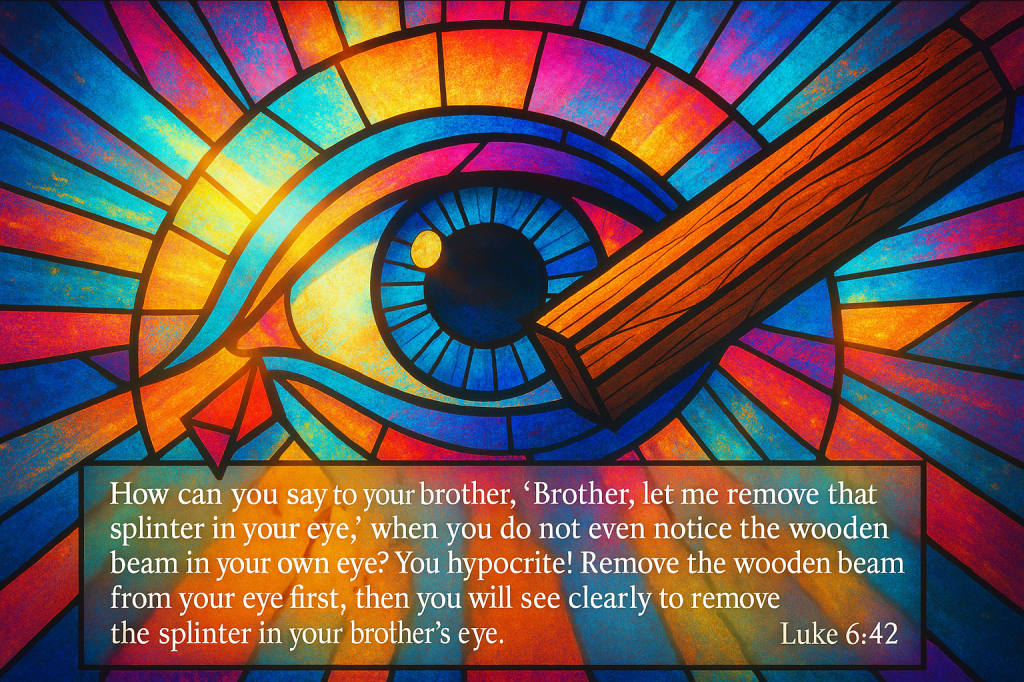
39 And he told them a parable, “Can a blind person guide a blind person? Will not both fall into a pit? 40 No disciple is superior to the teacher; but when fully trained, every disciple will be like his teacher. 41 Why do you notice the splinter in your brother’s eye, but do not perceive the wooden beam in your own? 42 How can you say to your brother, ‘Brother, let me remove that splinter in your eye,’ when you do not even notice the wooden beam in your own eye? You hypocrite! Remove the wooden beam from your eye first; then you will see clearly to remove the splinter in your brother’s eye.
Detailed Exegesis
Verse 39 “Can a blind person guide a blind person? Will not both fall into a pit?”
Jesus begins with a proverb that exposes the danger of moral blindness. Guidance is not a matter of eloquence or status but of sight. The pit signals ruin that follows when leaders lack interior conversion. The Church reads this as a warning that discipleship requires ongoing purification of perception.
Verse 40 “No disciple is superior to the teacher; but when fully trained, every disciple will be like his teacher.”
Formation aims at resemblance. The phrase “fully trained” evokes the long apprenticeship of mind and heart under Christ. The goal is not independence from the Master but likeness to Him. True vision is participation in the Teacher’s wisdom, learned through prayer, obedience, and charity.
Verse 41 “Why do you notice the splinter in your brother’s eye, but do not perceive the wooden beam in your own?”
Jesus unmasks a common human reflex. We magnify minor faults in others and minimize major faults in ourselves. The contrast between splinter and beam reveals the distortion produced by pride. The path forward is not silence about truth but first repentance that restores depth perception.
Verse 42 “How can you say to your brother, ‘Brother, let me remove that splinter in your eye,’ when you do not even notice the wooden beam in your own eye? You hypocrite! Remove the wooden beam from your eye first; then you will see clearly to remove the splinter in your brother’s eye.”
Jesus commands a sequence. First remove your beam, then help your brother. Hypocrisy is not merely inconsistency. It is the pretense of healing others without submitting to healing ourselves. The Lord wants communities where correction is surgical and gentle because it comes from purified hearts.
Teachings
The Catechism describes the necessary interior formation for true sight: “Conscience must be informed and moral judgment enlightened.” (CCC 1783). It situates the entire Gospel in the radiance of divine compassion: “The Gospel is the revelation in Jesus Christ of God’s mercy to sinners.” (CCC 1846). It also witnesses to grace and human cooperation in conversion with St. Augustine’s line: “God created us without us: but he did not will to save us without us.” (CCC 1847). Charity governs how we regard a brother while we address our beam: “To avoid rash judgment, everyone should be careful to interpret insofar as possible his neighbor’s thoughts, words, and deeds in a favorable way.” (CCC 2478). The saints echo this Gospel rhythm. St. Augustine teaches that humility is the doorway to growth in Christ: “Do you wish to rise? Begin by descending. You plan a tower that will pierce the clouds? Lay first the foundation of humility.” (Sermon 69). In the Church’s life, spiritual direction and fraternal correction have always presupposed personal repentance, since only a heart schooled by Mercy can see clearly enough to help another toward the truth in love.
Reflection
Begin with Jesus as your Teacher today. Make a brief morning act of humility and ask Him to reveal any beam that clouds your sight. Before offering advice or correction, pause and pray the words of Psalm 16 until your heart rests in God as your portion. When you must speak, aim for healing not triumph. Choose a concrete act of charity toward the person you are tempted to judge. End the day with a simple examen and thank Jesus for any clarity He gave. Where is the Lord asking you to seek healing first so that your words become medicine for others? How will you train under the Master today so that you begin to see and love as He does?
Eyes Healed, Hearts Steady, Hands Gentle
Today’s Word draws a single arc. In 1 Timothy 1:1-2, 12-14, Paul remembers the mercy that turned a persecutor into a pastor and teaches us that grace not only forgives but entrusts. In Psalm 16, the converted heart learns to live with God as portion and path, keeping the Lord ever before its eyes until joy becomes its compass. In Luke 6:39-42, Jesus completes the lesson by commanding the sequence of love. We must let Him remove our beam so that we see clearly to help a brother. Taken together, the readings form a pattern for discipleship. Receive mercy, remain in trust, and then correct with clarity and charity. Let the Church’s wisdom become your daily rhythm so that you resemble the Master who heals your sight and steadies your steps. Make a concrete response today. Go to confession if it has been a while. Pray with Psalm 16 and repeat “I keep the Lord always before me” until your heart rests in Him. Before you speak a hard truth, ask Jesus to show you your own blind spots and to make your words medicine. Choose one person and interpret their actions favorably, then serve them with quiet love. The Lord will lead you on the “path to life” and teach you to guide others without hypocrisy. How is Jesus inviting you to receive His mercy more deeply, to keep Him before your eyes, and to love your brother or sister with clear vision today?
Engage with Us!
We would love to hear from you in the comments below. Share how today’s readings spoke to your heart and what steps you will take to live them out.
- First Reading (1 Timothy 1:1-2, 12-14): Where do you most need to receive Christ’s mercy today, and how will gratitude become your strength for service this week? What practical step will you take to remember your story honestly and let the Lord turn it into a witness that blesses others?
- Responsorial Psalm (Psalm 16:1-2, 5, 7-8, 11): How will you keep the Lord always before you in your decisions and relationships today? What concrete practice will help you trust God as your portion and your path, especially when you feel shaken?
- Holy Gospel (Luke 6:39-42): Whom are you tempted to correct right now, and what beam might Jesus be inviting you to remove first through prayer and repentance? When you do speak, how will you make sure your words become medicine that heals rather than wounds that divide?
May the Lord deepen your faith, steady your heart, and guide your hands to do everything with the love and mercy that Jesus has taught us.
Sacred Heart of Jesus, we trust in You!
Immaculate Heart of Mary, pray for us!
Saint Michael the Archangel, defend us in battle!
Follow us on Instagram and Facebook for more insights and reflections on living a faith-filled life.

 Holy Manna!
Leave a comment