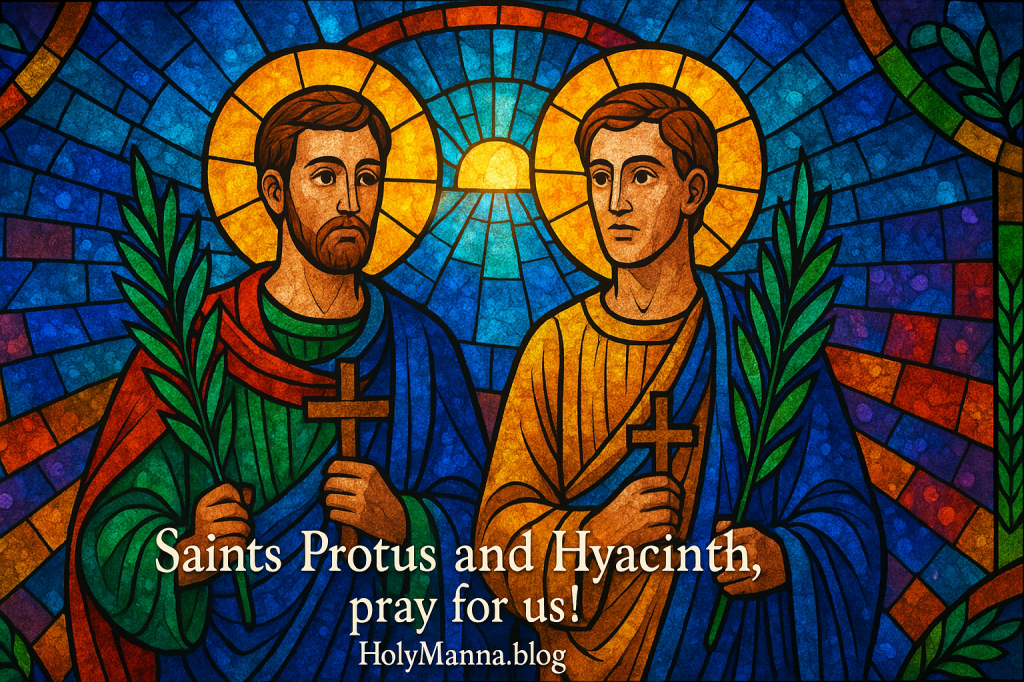
Crowned Together
Protus and Hyacinth are remembered as third century Roman martyrs whose fidelity to Jesus Christ cost them their lives and won them a crown that does not fade. The Church has honored them from very early times, keeping their feast on September 11 and venerating their graves along the Old Salarian Way. Their witness is not a footnote. It is a luminous page in the story of the Gospel’s power to strengthen ordinary disciples for extraordinary courage. They stand as a pair precisely because they suffered together, reminding us that holiness is often cultivated in friendship, shared prayer, and mutual encouragement.
From Service to Sanctity
Very little is known with certainty about the family background of Protus and Hyacinth. Early Christian tradition associates them with the household of Saint Eugenia, describing them as attendants who embraced the faith and lived as dedicated servants of Christ. Whether or not every detail of those narratives is strictly historical, the Church’s memory consistently places them in Rome in the mid third century, already formed by the Scriptures and the life of prayer. What the sources agree on most firmly is also what matters most. They belonged wholly to Jesus, they professed His Name in a hostile culture, and they chose fidelity over safety. If their earliest years are hidden, their identity is not. They are known as brothers in the Lord, united in love for Christ and in the same confession that led them to martyrdom.
Scripture, Service, and Silent Wonders
There are no surviving biographies that give us a step by step account of their daily routines, and there are no writings of Protus or Hyacinth that have come down to us. This silence is instructive. Their greatness is not measured by speeches or books but by a life conformed to the Gospel. They are remembered for prayer, for humble service, and for an unwavering confession of Christ. The Catechism of the Catholic Church teaches with crystalline clarity: “Martyrdom is the supreme witness given to the truth of the faith.” (CCC 2473). Protus and Hyacinth embody that line in full. While there is no reliable record of spectacular public miracles during their lifetime, their most profound sign was the peace and courage with which they bore suffering for Jesus. That serenity under pressure has always been one of the Church’s most persuasive “wonders,” drawing hearts to the Lord more surely than any display of power.
Steel for the Hour
Protus and Hyacinth lived during imperial measures that targeted Christian leaders and laity, pressuring believers to offer sacrifice to the pagan gods as a proof of loyalty to the state. The brothers refused. They were arrested, scourged, and condemned. The tradition gives them a beheading after their confession of faith. They were then laid to rest in a Roman catacomb on the Old Salarian Way, where early pilgrims came to pray. The precise minutes of their last trial are not preserved, but the essential truth is clear and steady. They endured torture without recanting. They preferred faithfulness to life. They died as brothers and entered life together.
Light From the Catacombs
The Church in Rome cherished their tombs from the fourth century onward. Pope Damasus I honored them with a poetic epitaph that calls them brothers and praises their victory in Christ. An English rendering of his verse preserves the heart of his tribute: “The kingdom of heaven holds thee, O Protus, and thither dost thou follow him, O valiant Hyacinth.” In later centuries, their relics continued to be held in honor. Archaeological work in the nineteenth century brought renewed attention to Hyacinth’s burial place, where a marble slab naming him as a martyr was found together with remains that showed signs consistent with the violence of persecution. Over time the veneration of their relics nourished Christian devotion, not as a curiosity, but as a concrete reminder that grace conquers fear and death. Pilgrims have prayed at their resting places for generations, giving thanks for favors received through their intercession and asking for the same courage to confess Christ when it costs.
The Faith We Share
Protus and Hyacinth illuminate what the Church calls the communion of saints. The Catechism of the Catholic Church explains that the Church is a living communion in which the holiness of each member benefits all and that the saints “do not cease to intercede” for us. It also explains that popular expressions of piety, including the veneration of relics and pilgrimages to holy places, belong to the Church’s spiritual heritage when they lead the faithful to Christ. Their shrines, epitaphs, and relics are not ends in themselves. They are signposts pointing to Jesus, the one Lord whom they confessed to the end. Their story also clarifies that Christian courage is not bravado but love. It is charity that stands firm and refuses to betray the Beloved. When we ask Saints Protus and Hyacinth to pray for us, we step into that communion that spans earth and heaven, and we receive strength to be faithful in our own trials.
Walking Their Road
The martyrs’ path is not reserved for a select few. Every baptized person is called to offer his or her life as a living sacrifice to God in the ordinary duties and struggles of each day. Protus and Hyacinth encourage us to confess Christ openly and charitably at home, at work, and online. They nudge us to be steady in prayer, to fast quietly, to forgive real injuries, and to stand with believers who suffer. They remind us that courage grows from the daily disciplines of discipleship, especially the Eucharist and Reconciliation. If you cannot lay down your life in a single moment, you can lay it down a little at a time, choosing truth over comfort, fidelity over convenience, and mercy over resentment. Jesus promised, “Everyone who acknowledges me before others, I will acknowledge before my Father in heaven.” The Gospel of Matthew 10:32. Ask these holy brothers to obtain for you the grace to speak His Name with love and to endure trials with peace.
Engage with Us!
We would love to hear your thoughts and prayers in the comments. How do Protus and Hyacinth speak to your own discipleship today?
- Where is God inviting you to witness to the faith with greater courage this week, and what will that look like in practice?
- How does the Church’s veneration of relics and holy places draw you closer to Christ, rather than distract from Him?
- When you face pressure to compromise, which Scripture verse strengthens you to stand firm, and how can you keep it before your eyes daily?
- What concrete intercession will you ask of Saints Protus and Hyacinth for someone who is suffering for the faith right now?
- How can you build habits that make daily fidelity possible, so that heroic fidelity would be possible if ever required?
Go forth encouraged. Live the Gospel openly, cling to Jesus in every circumstance, and do everything with the love and mercy He taught us.
Saints Protus and Hyacinth, pray for us!
Follow us on Instagram and Facebook for more insights and reflections on living a faith-filled life.

 Holy Manna!
Leave a comment