Thursday of the Twenty-third Week in Ordinary Time – Lectionary: 440
Clothed in Mercy, Singing Praise, Changing Our Measure
Come and let Christ re-clothe your heart in love, so that your steps, your speech, and even your silence become a hymn of mercy. Today’s readings weave a single garment: interior transformation that overflows into generous action and erupts in praise. In Colossians 3:12–17, the Apostle calls a young Christian community to “put on” the virtues of Christ like a new wardrobe, a vivid image in a Greco-Roman world where clothing signified identity and status. He names compassion, humility, gentleness, patience, mutual forbearance, and forgiveness, then crowns them with charity, “And over all these put on love, that is, the bond of perfection”, and urges a life saturated with gratitude, Scripture, and song. Psalm 150, the doxological finale of the Psalter, answers this interior renewal with the full orchestra of worship, inviting horn, harp, strings, pipes, and cymbals to join creation’s breath in a single Alleluia. In Luke 6:27–38, Jesus situates this same love within the real frictions of daily life, where enemies exist, insults sting, and possessions get taken. He commands a higher pattern that transcends the reciprocity code of the ancient world, “love your enemies, do good to those who hate you”, teaching a mercy that imitates the Father and a giving that expects nothing in return. His marketplace image of the “good measure, packed together, shaken down, and overflowing” evokes grain poured into a cloak so generously that it spills over, revealing God’s standard for our relationships. The Church names this theological virtue of charity the form of all the virtues, and unites it with the works of mercy and the praise of God in the life of prayer and worship, see CCC 1822–1827, CCC 2447, and CCC 2637–2639. The central theme is simple and searching: clothed in Christ’s charity, we measure others by mercy, and our lives become thanksgiving from the heart to the heavens. Where is Jesus inviting you to change your measure today, from cautious calculation to overflowing generosity? How might praise and gratitude unlock forgiveness in the concrete stories of your week?
First Reading – Colossians 3:12–17
Dressed for the Kingdom
Paul writes to the Christians in Colossae, a small Phrygian city awash in competing philosophies and religious syncretism, reminding them that baptism has given them a new identity and therefore a new way of life. In the Greco Roman world, clothing signified status and role. Paul seizes that image to say that believers must put on the very virtues of Christ as their daily garment. This language also echoes early Christian baptismal practice, where the newly baptized were clothed in white to signify new creation in Christ. Within the household churches where Scripture was proclaimed and psalms and hymns were sung, this virtue wardrobe would shape a community that bears with one another, forgives as the Lord forgave, and lets the peace of Christ referee their hearts. In this passage, charity crowns every other virtue, gratitude becomes the Christian atmosphere, and every word and deed is done in the name of the Lord Jesus. This fits today’s theme because Colossians sketches the interior clothing of charity that makes possible Jesus’s call to radical mercy and generosity, and it naturally flowers in the doxology of praise that Psalm 150 celebrates.
Colossians 3:12-17
New American Bible (Revised Edition)
12 Put on then, as God’s chosen ones, holy and beloved, heartfelt compassion, kindness, humility, gentleness, and patience, 13 bearing with one another and forgiving one another, if one has a grievance against another; as the Lord has forgiven you, so must you also do. 14 And over all these put on love, that is, the bond of perfection. 15 And let the peace of Christ control your hearts, the peace into which you were also called in one body. And be thankful. 16 Let the word of Christ dwell in you richly, as in all wisdom you teach and admonish one another, singing psalms, hymns, and spiritual songs with gratitude in your hearts to God. 17 And whatever you do, in word or in deed, do everything in the name of the Lord Jesus, giving thanks to God the Father through him.
Detailed Exegesis
Verse 12: “Put on then, as God’s chosen ones, holy and beloved, heartfelt compassion, kindness, humility, gentleness, and patience,”
Paul grounds ethics in identity. The Church is chosen, holy, and beloved because of God’s initiative, not human achievement. The virtues listed mirror Christ’s own Heart and form a countercultural profile that resists pride, harshness, and impatience. The verb “put on” evokes a deliberate, daily choice to live one’s baptismal dignity.
Verse 13: “bearing with one another and forgiving one another, if one has a grievance against another; as the Lord has forgiven you, so must you also do.”
Forbearance and forgiveness are the non negotiables of communion. The measure for our mercy is the Lord’s prior mercy. The logic is Eucharistic and covenantal. We do not forgive because others deserve it but because we have been forgiven by Christ, who is the head of the one Body.
Verse 14: “And over all these put on love, that is, the bond of perfection.”
Charity is the form that binds all other virtues together. It is not one virtue among many. It is the life of God poured into our hearts that perfects and integrates compassion, humility, and patience into a harmonious whole.
Verse 15: “And let the peace of Christ control your hearts, the peace into which you were also called in one body. And be thankful.”
The peace of Christ functions like an arbiter, deciding which impulses rule the heart and the community. This peace is not mere quiet but the shalom of right relationship with God and neighbor. Gratitude becomes the response of hearts reconciled in one body.
Verse 16: “Let the word of Christ dwell in you richly, as in all wisdom you teach and admonish one another, singing psalms, hymns, and spiritual songs with gratitude in your hearts to God.”
The Word does not visit. It dwells richly. A Church saturated in Scripture becomes a school of mutual teaching and gentle correction, and a choir where worship trains the heart. The triad of psalms, hymns, and spiritual songs signals a culture where doctrine and doxology kiss.
Verse 17: “And whatever you do, in word or in deed, do everything in the name of the Lord Jesus, giving thanks to God the Father through him.”
There is no secular corner in the Christian life. Speech and action become sacrificial offerings when done in Jesus’s name. The signature of the Christian is thanksgiving. Gratitude gathers the day’s smallest deeds into worship.
Teachings
Colossians presents charity as the principle that unifies and animates every virtue. The Catechism of the Catholic Church teaches: “Charity is the theological virtue by which we love God above all things for his own sake, and our neighbor as ourselves for the love of God.” CCC 1822. Saint Thomas Aquinas expresses the same truth succinctly: “Charity is the form of the virtues.” Summa Theologiae, II–II, q. 23, a. 8. In this light, Paul’s command to “put on love” is not sentiment but participation in the very life of God poured into our hearts. The Church’s tradition also links gratitude and praise to this life of charity. When the Word dwells richly and the peace of Christ rules, the community naturally becomes Eucharistic, that is, a people of thanksgiving in whom teaching, admonition, and song are ordered to the glory of God and the upbuilding of the Body. Colossians thus offers a baptismal spirituality: identity in Christ, interior habits that mirror his Heart, and a comprehensive consecration of words and deeds to the Father through the Son.
Reflection
The Holy Spirit invites us to dress for the Kingdom each morning. Begin your day by consciously putting on compassion, kindness, humility, gentleness, and patience, and then crown them with love. Let gratitude become your atmosphere by naming three gifts before you speak a single complaint. Allow the peace of Christ to referee your reactions, especially when you feel slighted or impatient. Let the Word dwell richly by placing a short passage of Scripture where you can pray it at midday, and let a simple hymn become your evening prayer. Do everything in Jesus’s name, from sending emails to washing dishes, and offer it as a quiet doxology to the Father. Where is the Lord asking you to forgive as you have been forgiven today? Which virtue do you most need to put on before you walk into your next conversation? How can you let gratitude and praise reshape your tone so that your words build up the Body rather than tear it down?
Responsorial Psalm – Psalm 150
When a Eucharistic Heart Becomes a Symphony
At the summit of the Psalter, Psalm 150 erupts in unfiltered doxology. In Israel’s worship, psalms were not private musings but the beating heart of Temple prayer, sung with instruments and dance in festal assembly. This final psalm gathers the whole story of God’s people into a single Alleluia and points beyond Israel to the praise of all creation. The catalog of instruments reflects the breadth of ancient worship, from horn and harp to cymbals that shook the courts of the Temple. Today it crowns our theme by showing what happens when the Church lives the virtues of Colossians 3:12–17 and the mercy of Luke 6:27–38. A heart clothed in Christ and measured by mercy becomes a life of thanksgiving, where every breath joins the cosmic chorus that praises the Father through the Son in the Spirit.
Psalm 150
New American Bible (Revised Edition)
Final Doxology
1 Hallelujah!
Praise God in his holy sanctuary;
give praise in the mighty dome of heaven.
2 Give praise for his mighty deeds,
praise him for his great majesty.
3 Give praise with blasts upon the horn,
praise him with harp and lyre.
4 Give praise with tambourines and dance,
praise him with strings and pipes.
5 Give praise with crashing cymbals,
praise him with sounding cymbals.
6 Let everything that has breath
give praise to the Lord!
Hallelujah!
Detailed Exegesis
Verse 1: “Hallelujah! Praise God in his holy sanctuary; give praise in the mighty dome of heaven.”
The psalm opens with a summons that spans heaven and earth. The sanctuary evokes the Temple, the locus of God’s presence among his people. The mighty dome of heaven widens the frame to the whole cosmos. Praise is not confined to a building. It is the vocation of creation itself.
Verse 2: “Give praise for his mighty deeds, praise him for his great majesty.”
Praise names both God’s works and God’s being. We praise him for what he has done and for who he is. This twofold movement mirrors Christian worship where thanksgiving and adoration meet. We remember his saving deeds and we honor his glory that surpasses them.
Verse 3: “Give praise with blasts upon the horn, praise him with harp and lyre.”
The horn signaled royal presence and victory. The harp and lyre marked festal joy and contemplation. Worship engages the full range of human expression. It is triumphant and tender, public and personal.
Verse 4: “Give praise with tambourines and dance, praise him with strings and pipes.”
Tambourine and dance recall Miriam and Israel celebrating deliverance at the sea. Strings and pipes add texture and breadth. The psalm envisions a people whose bodies, histories, and cultures are drawn into prayer. Holiness does not mute joy. It purifies it.
Verse 5: “Give praise with crashing cymbals, praise him with sounding cymbals.”
The repetition intensifies. The Temple resounds. When God’s people remember his mercy, their worship cannot stay quiet. Sound becomes sign. Volume is not vanity when it is offered to the One who is worthy.
Verse 6: “Let everything that has breath give praise to the Lord! Hallelujah!”
Breath is the universal instrument. The final call includes every living thing. In Christian light, the Spirit who gives breath also gives the cry Abba in our hearts. The psalm’s last word is God’s first gift, life itself, returned in praise.
Teachings
The Catechism of the Catholic Church describes praise with clarity: “Praise is the form of prayer which recognizes most immediately that God is God. It lauds God for his own sake and gives him glory, quite beyond what he does, but simply because HE IS.” CCC 2639. The Catechism also highlights the Church’s song as a gift of highest value: “The musical tradition of the universal Church is a treasure of inestimable value, greater even than that of any other art. The main reason for this pre-eminence is that, as sacred song united to words, it forms a necessary or integral part of the solemn liturgy.” CCC 1156. The Psalter holds pride of place in this tradition: “The Psalms constitute the masterwork of prayer in the Old Testament.” CCC 2585. Finally, the Eucharistic character of Christian praise is essential: “Thanksgiving characterizes the prayer of the Church which, in celebrating the Eucharist, reveals and becomes more fully what she is.” CCC 2637. Read through this lens, Psalm 150 is not a musical appendix but the blueprint for a life in which charity overflows into worship. The instruments image the Church’s many members, each distinct yet harmonious in one Body, where mercy learned in daily life becomes the loudest Alleluia.
Reflection
Let your breath become prayer today. Begin your morning by naming God’s greatness before you name your needs. Offer your work, your commute, and your conversations as instruments tuned to gratitude. Choose one simple act of mercy and perform it as a quiet song to God. If you carry resentment, sing a psalm out loud and ask the Lord to transform your measure from judgment to generosity. In the evening, thank God specifically for three mighty deeds you witnessed in your day and for his majesty that does not depend on your mood. What would change if you treated every breath as an invitation to praise? Where can your next act of mercy become your loudest Alleluia? How might singing a short psalm each day train your heart to live all of life in the name of Jesus?
Holy Gospel – Luke 6:27–38
Radical Mercy in a Measured World
Jesus speaks these words within what is often called the Sermon on the Plain, a teaching given to disciples and a large crowd in Luke that echoes but is distinct from Matthew’s Sermon on the Mount. His commands confront a first century honor and shame culture that expected reciprocity and justified retaliation. References to the cheek, cloak, and tunic evoke real legal and social practices where an insult demanded response and a cloak could be taken as pledge. The image of a good measure poured into one’s lap draws on marketplace grain sales, where a fair dealer filled the fold of a buyer’s garment with grain, pressed down and overflowing. Into this world Jesus inserts the Father’s own pattern of love. He calls disciples to imitate divine generosity that precedes merit and refuses strict bookkeeping. This fits today’s theme because the charity we put on in Colossians 3:12–17 becomes concrete in merciful actions that surpass the ordinary measure and culminate in a life of praise like Psalm 150.
Luke 6:27-38
New American Bible (Revised Edition)
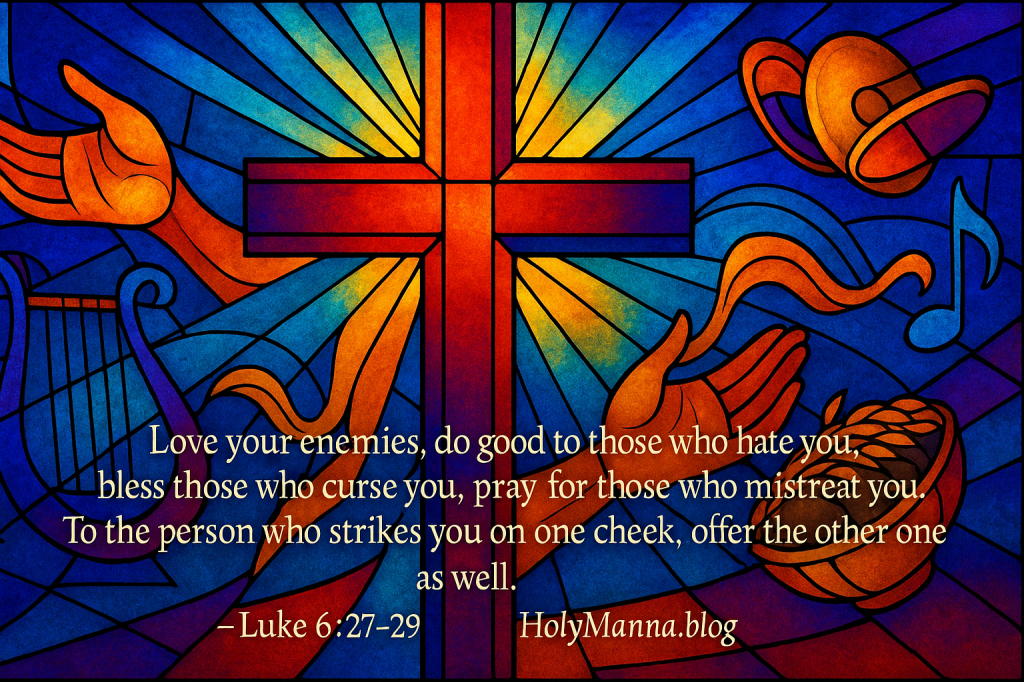
27 “But to you who hear I say, love your enemies, do good to those who hate you, 28 bless those who curse you, pray for those who mistreat you. 29 To the person who strikes you on one cheek, offer the other one as well, and from the person who takes your cloak, do not withhold even your tunic. 30 Give to everyone who asks of you, and from the one who takes what is yours do not demand it back. 31 Do to others as you would have them do to you. 32 For if you love those who love you, what credit is that to you? Even sinners love those who love them. 33 And if you do good to those who do good to you, what credit is that to you? Even sinners do the same. 34 If you lend money to those from whom you expect repayment, what credit [is] that to you? Even sinners lend to sinners, and get back the same amount. 35 But rather, love your enemies and do good to them, and lend expecting nothing back; then your reward will be great and you will be children of the Most High, for he himself is kind to the ungrateful and the wicked. 36 Be merciful, just as [also] your Father is merciful.
Judging Others. 37 “Stop judging and you will not be judged. Stop condemning and you will not be condemned. Forgive and you will be forgiven. 38 Give and gifts will be given to you; a good measure, packed together, shaken down, and overflowing, will be poured into your lap. For the measure with which you measure will in return be measured out to you.”
Detailed Exegesis
Verse 27: “But to you who hear I say, love your enemies, do good to those who hate you,”
Jesus assumes a listening heart and issues the central command. Love is not sentiment but active benevolence. Enemies are the true test of charity because they cannot repay us. This redefines neighbor and reveals the likeness to the Father that grace creates.
Verse 28: “bless those who curse you, pray for those who mistreat you.”
Blessing and prayer are the speech of mercy. Instead of mirroring harm, disciples intercede. Prayer interrupts cycles of vengeance by placing the offender before God. It also converts the one who prays.
Verse 29: “To the person who strikes you on one cheek, offer the other one as well, and from the person who takes your cloak, do not withhold even your tunic.”
The cheek references a public insult that invites retaliation. Jesus calls for a creative, nonviolent witness that refuses to escalate. The cloak and tunic were an outer and undergarment. The point is not indecency but prodigality. The disciple’s security rests in the Father, not possessions.
Verse 30: “Give to everyone who asks of you, and from the one who takes what is yours do not demand it back.”
The teaching widens to generosity that anticipates no return. It is the opposite of transactional life. Mercy risks loss in order to reveal the Father’s heart.
Verse 31: “Do to others as you would have them do to you.”
The Golden Rule summarizes practical charity. It asks the imagination to stand in the other’s place and to act accordingly. It becomes a daily examen for speech, lending, correction, and service.
Verse 32: “For if you love those who love you, what credit is that to you? Even sinners love those who love them.”
Jesus contrasts natural affection with supernatural charity. Loving the lovable accrues no kingdom “credit.” The distinctive mark is love that crosses hostility.
Verse 33: “And if you do good to those who do good to you, what credit is that to you? Even sinners do the same.”
Reciprocity remains the same ledger. Disciples are called to break the accounting cycle with gratuitous goodness.
Verse 34: “If you lend money to those from whom you expect repayment, what credit [is] that to you? Even sinners lend to sinners, and get back the same amount.”
In a world of patronage and interest, lending was leverage. Jesus names the expectation of repayment as the heart of the old measure. Kingdom lending imitates divine largesse.
Verse 35: “But rather, love your enemies and do good to them, and lend expecting nothing back; then your reward will be great and you will be children of the Most High, for he himself is kind to the ungrateful and the wicked.”
Here is the motive and the promise. The Father’s kindness to the ungrateful and wicked grounds our behavior and guarantees our identity as his children. Reward here is not mere payback but communion with the Father’s own life.
Verse 36: “Be merciful, just as [also] your Father is merciful.”
This is the program in one line. The standard is divine likeness. Mercy is not optional. It is the family resemblance of God’s children.
Verse 37: “Stop judging and you will not be judged. Stop condemning and you will not be condemned. Forgive and you will be forgiven.”
Jesus applies mercy to interior posture and community life. Judging here is not discernment of good and evil, which is necessary, but the usurping of God’s tribunal and the habit of condemnation. Forgiveness is the gate through which forgiven sinners must walk.
Verse 38: “Give and gifts will be given to you; a good measure, packed together, shaken down, and overflowing, will be poured into your lap. For the measure with which you measure will in return be measured out to you.”
The marketplace image crowns the teaching. God gives with pressed down abundance. Disciples who adopt his measure discover that generosity begets generosity. The lap filled with grain becomes a sacrament of grace in daily exchanges.
Teachings
This passage reveals the supernatural character of Christian charity and mercy. The Catechism of the Catholic Church teaches that charity is the form of all the virtues and reaches even to enemies, see CCC 1822–1827. The Golden Rule is placed at the heart of moral discernment, see CCC 1789. Works of mercy, which include forgiving offenses and bearing wrongs patiently, are commanded of every Christian, see CCC 2447. The forgiveness we extend is inseparable from the forgiveness we receive in prayer, see CCC 2838–2845, where the Catechism explains that the Father’s mercy cannot penetrate a heart closed to mercy for others. In light of Colossians 3, this Gospel shows how the virtues we put on become a lived liturgy. The peace of Christ ruling the heart issues in non retaliation, generous giving, and a refusal to measure relationships by repayment. In the Church’s history, the saints have embodied this logic. The martyrs refused revenge and prayed for their persecutors. Communities founded hospitals, shelters, and schools that lent expecting nothing in return. All of this is the Father’s generosity taking flesh among his children.
Reflection
Pray today for one person who has wronged you by name. Ask the Father to bless them, and ask for the grace to desire their good. Examine where you keep a ledger in relationships. Cancel one small debt of expectation, whether an apology you think you are owed or a favor you want returned. Practice the Golden Rule concretely by doing for someone what you wish someone would do for you. Choose one act of mercy that costs you and make it your hidden offering to God. When you are tempted to judge, pause and pray the Our Father slowly, lingering over “forgive us our trespasses, as we forgive those who trespass against us.” Where is the Lord inviting you to change your measure from calculation to kindness? Whom is the Spirit asking you to bless out loud today? What would it look like for your giving to become pressed down, shaken together, and overflowing in your home and workplace?
Measure by Mercy, Live as Praise
Today’s Word invites a whole life makeover in Christ. In Colossians 3:12–17 we are told to “put on…compassion, kindness, humility, gentleness, and patience” and to crown all with “love, that is, the bond of perfection.” In Luke 6:27–38 Jesus gives love its hardest edge and its brightest shine, calling us to “love your enemies… be merciful… forgive” and promising the Father’s abundance with “a good measure, packed together, shaken down, and overflowing.” And Psalm 150 shows where such a life leads, as every breath becomes worship, “Let everything that has breath give praise to the Lord!” The thread is clear. Clothed in Christ’s charity, we measure others by mercy, and our days become thanksgiving from heart to heavens. The Church teaches that charity is the form of all the virtues and the soul of holiness, see CCC 1822–1827. Praise is the summit of prayer that celebrates God for who he is, see CCC 2639. Mercy is the family resemblance of God’s children and includes forgiving offenses and bearing wrongs patiently, see CCC 2447.
Here is the call to action. Begin tomorrow by asking Jesus to dress your heart in his virtues and to seal them with love. Let your conversations be ruled by his peace and seasoned with gratitude. Choose one concrete act of mercy for a person who cannot repay you, and offer it quietly in the name of Jesus. End the day by naming three reasons for praise and praying a short psalm aloud. In this simple rhythm the Word will dwell richly, your measure will shift from calculation to kindness, and your life will become a living Alleluia. Where is the Holy Spirit inviting you to change your measure today? Whom will you bless, forgive, and serve so that your breath becomes praise and your heart bears the likeness of the Father?
Engage with Us!
We would love to hear from you in the comments below. Share how the Lord is speaking to you through today’s readings and how you plan to live this Word in the week ahead.
- Colossians 3:12–17: Which virtue do you most need to put on this week, and why? How will you let the peace of Christ control your heart in one difficult relationship today?
- Psalm 150: What would it look like to let every breath become praise in your ordinary routines? Which simple practice will help you cultivate daily gratitude and joyful worship?
- Luke 6:27–38: Whom is Jesus inviting you to bless, forgive, or serve without expecting anything in return? Where can you change your measure from calculation to mercy in a concrete situation this week?
Go forward in faith. Do everything in the name of Jesus, and let love and mercy shape every thought, word, and deed.
Sacred Heart of Jesus, we trust in You!
Immaculate Heart of Mary, pray for us!
Saint Michael the Archangel, defend us in battle!
Follow us on Instagram and Facebook for more insights and reflections on living a faith-filled life.

 Holy Manna!
Leave a comment