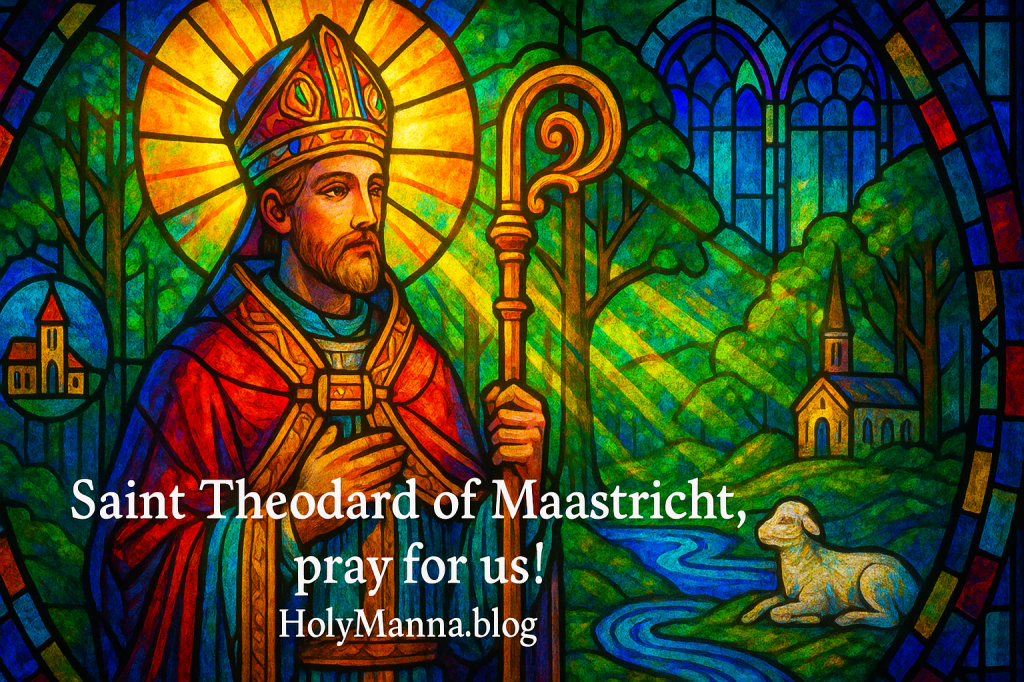
Torchbearer of Justice and Pastoral Courage
Saint Theodard of Maastricht, a seventh century bishop and martyr, shines in Christian memory as a shepherd who defended the rights of the Church and the dignity of the poor. He is revered not because he sought conflict, but because he placed fidelity to Christ and love for the vulnerable above his own safety. The Catechism of the Catholic Church teaches, “Martyrdom is the supreme witness given to the truth of the faith: it means bearing witness even unto death.” (CCC 2473). That is the key to understanding Theodard’s legacy. He embodied a bishop’s heart that guarded the faith, corrected injustice, and strengthened monastic and parish life across his territory. No reliably attested sayings of Saint Theodard have survived, so we honor his voice through the testimony of his life and the early chronicles that remember him.
From the Rhine Valleys to the Meuse
Theodard likely came from the broad Rhine region in today’s southwestern Germany, a frontier where Roman memory, Frankish custom, and Christian mission were still shaping one another. Drawn to a life of prayer and discipline, he entered the orbit of the holy abbot Remaclus, whose double monastery at Stavelot and Malmedy formed many future pastors. This monastic formation marked Theodard with a zeal for contemplation that expressed itself in concrete service. When Remaclus was called to episcopal work in Tongeren Maastricht, Theodard proved a trusted lieutenant. He eventually succeeded Remaclus as abbot, and around the year 663 he himself became bishop of Maastricht. Theodard guided a local Church that straddled ancient Roman towns and emerging Frankish settlements. He is remembered for mentoring his young kinsman, the future Saint Lambert, who would later inherit his pastoral staff. Theodard’s early years therefore read like an apprenticeship in evangelical leadership, combining prayer, fraternal correction, and a careful stewardship of Church goods for the sake of the poor.
Shepherd of a Restless Kingdom
As bishop, Theodard lived at a time when royal courts and aristocratic clans often treated Church lands as negotiable favors. Theodard responded by strengthening the spiritual backbone of his people. He promoted the building and restoration of churches so that the Eucharist would remain the heart of community life. He bolstered monastic witness, knowing that from the cloister flowed a river of prayer, learning, hospitality, and missionary energy. He encouraged clergy to live with integrity and instructed laypeople to practice works of mercy and to keep Sunday as the Lord’s Day. Reports from early ecclesiastical histories praise his tireless visitation of parishes and his readiness to defend the weak against exploitation. Specific miracle stories from his lifetime do not survive in reliable form, and that silence is itself eloquent. Theodard’s holiness appears in the public record of his courageous service. He taught by governing well, he evangelized by guarding the sacred, and he worked wonders by converting hearts to justice and charity.
Ambushed for the Cause of Justice
The most dramatic chapter of Theodard’s ministry came when powerful men in Austrasia began to seize Church property and burden tenants who depended on ecclesial estates for their livelihood. Theodard resolved to appeal directly to the young king, Childeric II, to seek redress and protection for the Church and her poor. On that journey, somewhere in the Bienwald forest south of Speyer near Rülzheim, Theodard was ambushed and killed around 669 or 670. Whether his attackers were common bandits or partisans of the very abuses he opposed, the Christian people recognized in his death the line between coercive power and holy witness. The Catechism of the Catholic Church offers the moral compass that guided saints like Theodard: “The citizen is obliged in conscience not to follow the directives of civil authorities when they are contrary to the demands of the moral order.” (CCC 2242). Theodard died not as a political agitator but as a pastor who bore the cost of defending the Church’s mission and the liberty of the Gospel.
The Silent Sermons of a Martyr’s Tomb
After his death, devotion to Theodard spread along the routes he had traveled in life. His body, first interred near the site of the attack, was later translated with honor to the church of his people by his successor and spiritual son, Saint Lambert. The translation fostered a living memory of the martyr bishop in the regions of Maastricht and Liège, where his relics became a point of prayer. Medieval Christians testified that God granted favors to those who asked Theodard’s intercession, above all in matters of protection, just judgment, and the relief of burdens. The place of his martyrdom itself became a local shrine that drew pilgrims seeking to meditate on the cost of pastoral courage. Even if the precise details of individual cures are lost to time, the enduring veneration of Theodard’s relics and the continuity of prayer at his memory sites are part of the Church’s long history of recognizing God’s grace at the tombs of His friends. Theodard’s legacy also lived on in the holiness of his successors, especially Saint Lambert and Saint Hubert, whose leadership helped the faith take deeper root in the Meuse valley.
Courage and Mercy for Today
What does Saint Theodard’s life ask of us now? First, to love the Church with a shepherd’s heart, even if we are laypeople or students or workers far from a cathedral. Love the sacraments, support your parish, and pray for your priests and bishops to govern with wisdom and courage. Second, to defend the vulnerable without bitterness. The Catechism reminds us of the heart of Christian action: “The works of mercy are charitable actions by which we come to the aid of our neighbor in his spiritual and bodily necessities.” (CCC 2447). Choose one work of mercy and practice it this week with intention. Third, to form our conscience so that we can recognize when cultural pressures or institutional habits drift from the moral order. Theodard teaches us to speak the truth in love, to accept misunderstanding if necessary, and to leave vindication to God. Martyrs like Theodard do not glamorize suffering. They glorify Christ by placing fidelity above fear, justice above convenience, and the common good above private gain. If you feel small before complicated injustices, remember that holiness often looks like quiet, steady faithfulness sustained by Scripture, the Eucharist, and daily prayer.
Engage with Us!
I would love to hear your thoughts in the comments. How does Saint Theodard’s witness challenge and encourage you today?
- Where do you see injustice around you, and how might God be inviting you to respond with courageous charity like Saint Theodard?
- What concrete work of mercy can you practice this week for someone who is vulnerable or burdened?
- How can you support your parish or diocese so that the Church’s mission of evangelization and service flourishes in your community?
- When has speaking the truth in love felt costly for you, and how did God meet you there?
- What aspect of martyrdom as “supreme witness” from the Catechism most resonates with your journey of faith right now?
May we live our faith with courage, mercy, and love in Jesus Christ, trusting that fidelity to the Gospel is always worth the cost.
Saint Theodard of Maastricht, pray for us!
Follow us on Instagram and Facebook for more insights and reflections on living a faith-filled life.

 Holy Manna!
Leave a comment