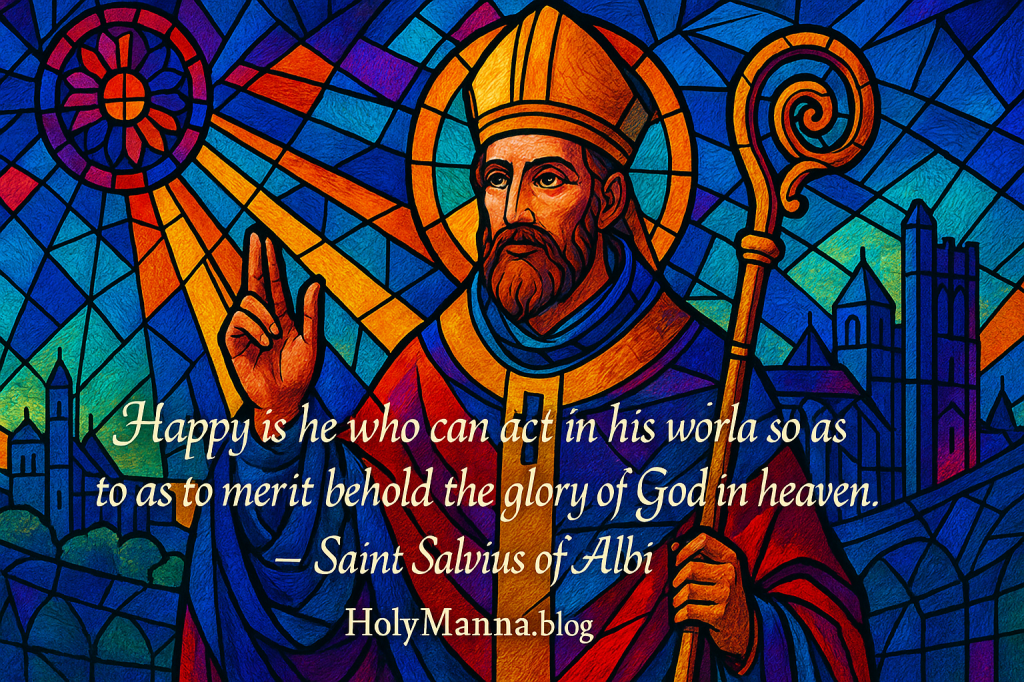
A Shepherd Sent Back From Heaven
Saint Salvius of Albi, a sixth century bishop of southern Gaul, is remembered as a man of intense prayer, fearless charity, and singular grace. He is best known for a striking heavenly vision during a near death experience that redirected the entire course of his life. After years of hidden asceticism he was chosen as bishop and became a steadfast shepherd during plague, famine, and social turmoil. His life beautifully unites the three great movements of Catholic holiness: conversion from worldly prestige, contemplation in the hidden life, and sacrificial charity in pastoral service. The Church proposes saints as models and intercessors, and Salvius stands out as a pastor who let God interrupt his plans for the sake of the flock. The Catechism teaches that the saints manifest the holiness of the Church and encourage us to imitate their charity and perseverance (CCC 828, 956, 2447).
From the Court to the Cell
Salvius was born at Albi in what is now southern France. He first pursued a public career as an advocate and judge, a respected man in “secular garb,” trained to weigh evidence and render verdicts. Over time grace unsettled him. Desiring a life wholly given to God, he left the courtroom and entered the monastery, where he embraced poverty, obedience, and the daily rhythm of prayer and work. He later accepted leadership as abbot, then withdrew even more radically as a recluse, enclosed in a small cell for deeper penance and intercession. From his enclosure he counseled those who sought him, prayed fervently for them, and blessed simple bread that many received as a sign of God’s mercy and healing. This earliest period already shows the contours of his sanctity. He let the Lord re order his ambitions and use his gifts for the salvation of souls. After his later return from the brink of death, he summed up his hope with the exhortation: “Happy is he who can live in the world so as to deserve to see the glory of God in heaven.”
The Vision and the Vocation
While still living as a recluse, Salvius was struck by a violent fever. His attendants prepared his body as if for burial. At dawn he stirred on the bier and, after three days without food, recounted what he had seen. Angels had borne him to a luminous city whose ground shone like gold and silver. There he heard a voice that judged his work not yet complete and sent him back with a mission for the Church. “Let him return to the world since he is necessary to our churches.” This word from heaven did not become a private consolation. It became his marching order.
Soon after, the people and clergy chose him bishop of Albi. He resisted out of humility, then accepted out of obedience. As bishop he continued to live simply and gave the treasures of the Church not to ornament but to ransom captives. When the patrician Mummolus had taken hostages, Salvius liquidated precious vessels to redeem the prisoners and restore them to their families. He preached conversion with fatherly warmth, organized vigils and fasts, and encouraged almsgiving and reconciliation. The same healing grace that touched the sick through his blessed bread as a recluse continued in his episcopate. The afflicted sought his blessing and intercession, and many recovered health of body and soul. In all things he taught his people to love Christ in the poor, to forgive enemies, and to prefer mercy to vengeance. The Catechism calls the works of mercy “charitable actions by which we come to the aid of our neighbor in his spiritual and bodily necessities,” a description that his life embodies (CCC 2447).
Trials, Pestilence, and a Holy Death
The pastoral years of Salvius unfolded during a time of political tension, scarcity, and disease. In roughly the tenth year of his episcopate a devastating plague struck Albi. Many abandoned the city, yet Salvius remained at his post. He consoled the grieving, buried the dead, and urged the living to persevere in prayer, fasting, and almsgiving. He asked his people to hold to Christ together, to make peace while there was time, and to ready their hearts for the Lord. Knowing that his own end was approaching, he prepared his tomb with serenity, cleansed and vested himself as if for liturgy, commended his soul to God, and surrendered his spirit. Salvius was not a martyr in the strict sense of execution for the faith. He died the death of a confessor bishop, a shepherd who refused to flee when suffering intensified. His trials were not wasted. They bore fruit in a purified love that confirmed his people in hope.
Memory That Heals
After his repose the faithful kept vigil at his tomb and invoked his intercession. Over the centuries the Church in Albi honored his memory with public cult. His relics were carefully preserved and, according to local tradition, translated to a church that took his name, where a crypt beneath the altar recalled his resting place. Pilgrims prayed for healing of body and soul, for reconciliation in families, and for protection from calamity. While specific healings were handed down chiefly through local memory rather than formal canonization records that came later in Church history, his intercession continued to be sought in seasons of sickness and civic distress. The quiet stream of favors associated with his name is precisely the sort of hidden mercy by which God confirms the holiness of shepherds who spend themselves for the flock. The communion of saints assures us that those who die in Christ do not cease to intercede for the Church on earth (CCC 956).
Becoming People of Heaven on Earth
Saint Salvius teaches a distinctly Catholic rhythm of discipleship. First, let grace interrupt you. He allowed God to lead him away from ambition to a life of prayer. Second, let contemplation become charity. His hidden years flowered into ransom for captives, healing for the sick, and courage for the fearful. Third, let trials purify love. He did not abandon his city when plague darkened its streets. He stood with them until the end. Ask Saint Salvius to help you hear and obey the Lord’s voice in your duties today. Choose one corporal or spiritual work of mercy and offer it for your parish and for those who suffer alone. Entrust your fears about death and disease to the Savior who conquered the grave. Remember that the holiness of the Church is not a theory. It is a life poured out in love, as Salvius poured out his life for Albi. The communion of saints is not a distant doctrine. It is family, and in that family Saint Salvius continues to pray for you.
Engage with Us!
We would love to hear your thoughts and prayer reflections in the comments.
- Where is God inviting you to move from comfort into deeper conversion, as Salvius moved from the courtroom to the cloister?
- What “enclosure” or hidden discipline could help you grow in charity for others this week?
- How can you imitate Salvius’ courage by staying with someone who is suffering rather than fleeing discomfort?
- Which corporal or spiritual work of mercy will you practice today, and for whom will you offer it?
- How does his vision of heaven re order your priorities on earth?
May Saint Salvius pray that we live our faith with purity, courage, and joy, and that we do everything with the love and mercy Jesus taught us.
Saint Salvius, pray for us!
Follow us on Instagram and Facebook for more insights and reflections on living a faith-filled life.

 Holy Manna!
Leave a comment