Wednesday of the Twenty-third Week in Ordinary Time – Lectionary: 439
Hidden with Christ, Hungry for His Kingdom
Take a deep breath and lift your eyes. Today’s readings invite us to relocate our desires into the space where Christ reigns, to live as people already raised with Him while still walking the dusty roads of this world. In Colossians 3:1–11, Paul speaks in baptismal language, evoking the early Church’s practice of laying aside an old garment and putting on a new one after emerging from the waters. The community at Colossae, surrounded by competing philosophies and social divisions, is told that in Christ there is “not Greek and Jew”, because the new humanity is being renewed “in the image of its creator.” This is not moral window dressing. It is a real participation in Christ’s Paschal Mystery, the death of the old self and the rising of a new one, which The Catechism describes as “new creation” and “partaker of the divine nature” (CCC 1265–1266). The royal hymn of Psalm 145 reorients our horizon with praise, declaring “Your reign is a reign for all ages.” Praise is not an escape from reality. It is the posture of citizens of the Kingdom who make known God’s mighty deeds in every generation. Then the Gospel sets the Kingdom’s surprising economics before our eyes. In Luke 6:20–26, within a first century world marked by honor and status, Jesus blesses those the world pities, and warns those the world envies. He calls the poor, the hungry, the grieving, and the persecuted “blessed”, promising satisfaction, laughter, and a great reward in heaven, while sounding sober “woes” for the self satisfied and celebrated. The Beatitudes are not soft ideals. They are the concrete contours of the “new self” that Colossians commands us to “put on”, and they are the charter of Christian happiness that The Catechism names the “heart of Jesus’ preaching” (CCC 1716–1719). To seek what is above is to embrace the Gospel’s great reversal here below, to let go of greed, anger, and lies, and to let Christ be “all and in all.” “Seek what is above.” “Blessed are you who are poor.” “Your reign is a reign for all ages.” These lines braid into one call. Adore the true King, receive His values, and live a hidden life in Him that will one day appear in glory. Where is Jesus inviting you today to put to death the old self, to praise His Kingship with your lips and your life, and to hunger for the Kingdom that alone can satisfy?
First Reading – Colossians 3:1-11
Putting On the New Self in a World of Old Habits
Written to a small Christian community in Colossae in the Lycus Valley of Asia Minor, Colossians addresses pressures from syncretistic teachings and cultural status markers that threatened to dilute the primacy of Christ. The letter situates believers within the Paschal Mystery. Those baptized into Christ have died and risen with Him, which means a new allegiance and a new way of life. This passage functions like a baptismal homily for the whole Church. If we have been raised with Christ, then our minds, desires, and behaviors must be reoriented to His heavenly reign. In light of today’s theme, the call to “seek what is above” shapes a people who praise God’s eternal Kingship, as in Psalm 145, and who embody the Beatitudes’ great reversal from Luke 6. The “new self” is not a private makeover. It is the visible fruit of belonging to Christ, who is “all and in all”, forming a community where divisions collapse and holiness becomes credible.
Colossians 3:1-11
New American Bible (Revised Edition)
Mystical Death and Resurrection. 1 If then you were raised with Christ, seek what is above, where Christ is seated at the right hand of God. 2 Think of what is above, not of what is on earth. 3 For you have died, and your life is hidden with Christ in God. 4 When Christ your life appears, then you too will appear with him in glory.
Renunciation of Vice. 5 Put to death, then, the parts of you that are earthly: immorality, impurity, passion, evil desire, and the greed that is idolatry. 6 Because of these the wrath of God is coming [upon the disobedient]. 7 By these you too once conducted yourselves, when you lived in that way. 8 But now you must put them all away: anger, fury, malice, slander, and obscene language out of your mouths. 9 Stop lying to one another, since you have taken off the old self with its practices 10 and have put on the new self, which is being renewed, for knowledge, in the image of its creator. 11 Here there is not Greek and Jew, circumcision and uncircumcision, barbarian, Scythian, slave, free; but Christ is all and in all.
Detailed Exegesis
Verse 1 – “If then you were raised with Christ, seek what is above, where Christ is seated at the right hand of God.”
Paul grounds ethics in identity. Baptism unites us to Christ’s Resurrection, so Christian morality is not mere self-improvement. It is participation in the enthroned Christ. Seeking “what is above” means orienting desires toward the Lord’s presence and authority.
Verse 2 – “Think of what is above, not of what is on earth.”
This is a sustained mindset, not a momentary inspiration. “Above” does not reject creation. It orders our thoughts to God’s will. The intellect, renewed by grace, becomes the pilot of our choices.
Verse 3 – “For you have died, and your life is hidden with Christ in God.”
Baptismal death severs sin’s dominion. “Hidden” suggests both security and secrecy. The world may not recognize the Christian’s true life now, but it is safely kept in God.
Verse 4 – “When Christ your life appears, then you too will appear with him in glory.”
Eschatology breaks into ethics. Future glory is the unveiling of what baptism has already begun. Hope strengthens perseverance in conversion.
Verse 5 – “Put to death, then, the parts of you that are earthly: immorality, impurity, passion, evil desire, and the greed that is idolatry.”
The language is surgical. Sin is not managed. It is mortified. Greed is exposed as idolatry because it enthrones created goods as ultimate. This aligns with the Gospel’s blessing of holy poverty of spirit.
Verse 6 – “Because of these the wrath of God is coming [upon the disobedient].”
Divine “wrath” is God’s holy opposition to sin, not volatile anger. It warns that sin carries real consequences, personally and communally.
Verse 7 – “By these you too once conducted yourselves, when you lived in that way.”
Paul evokes memory to stir humility. Christians remember their rescue, which fuels compassion toward others still ensnared.
Verse 8 – “But now you must put them all away: anger, fury, malice, slander, and obscene language out of your mouths.”
Conversion reaches the tongue. Speech reveals the heart. Kingdom people bless rather than tear down, echoing the praise of Psalm 145.
Verse 9 – “Stop lying to one another, since you have taken off the old self with its practices”
Truth builds the Body. Falsehood resurrects the “old self”. The image is baptismal clothing. The old garment is stripped away.
Verse 10 – “and have put on the new self, which is being renewed, for knowledge, in the image of its creator.”
Renewal is continuous. The “image” recalls Genesis. Grace restores what sin disfigured. Knowledge here is relational and transformative, not merely informational.
Verse 11 – “Here there is not Greek and Jew, circumcision and uncircumcision, barbarian, Scythian, slave, free; but Christ is all and in all.”
The new humanity is a reconciled communion. Ethnic, cultural, and class barriers lose their power to divide. Christ’s presence fills and unites His people, offering a living sign to the world.
Teachings
The Catechism describes what Colossians proclaims. “Baptism not only purifies from all sins, but also makes the neophyte ‘a new creature,’ an adopted son of God, who has become a ‘partaker of the divine nature,’ member of Christ and co-heir with him, and a temple of the Holy Spirit.” (CCC 1265). It continues, “The Most Holy Trinity gives the baptized sanctifying grace, the grace of justification: enabling them to believe in God, to hope in him, and to love him through the theological virtues; giving them the power to live and act under the prompting of the Holy Spirit through the gifts of the Holy Spirit; allowing them to grow in goodness through the moral virtues.” (CCC 1266). The moral consequence flows from our dignity. “Christian, recognize your dignity and, now that you share in God’s own nature, do not return to your former base condition by sinning.” (CCC 1691, citing St. Leo the Great). These teachings illuminate Paul’s commands to “put to death” vice and “put on” the new self. Baptism inaugurates a real transformation, sustained by grace, that reorders desire, purifies speech, and builds a reconciled community where Christ is everything.
Reflection
The Holy Spirit invites us to practice a daily exchange of garments. Lay aside the old. Put on the new. Begin each morning with an act of praise, naming God’s goodness as in Psalm 145. Examine your desires and ask where greed, impurity, or resentment still claim space. Choose one concrete mortification this week. Fast from a comfort that fuels distraction, or limit screen time to make room for prayer and works of mercy. Guard your speech. Replace complaint with blessing, sarcasm with encouragement, and rumor with silence. Seek reconciliation across divisions by initiating one conversation that heals. Approach Reconciliation regularly, where the old self is stripped and grace clothes you anew. Where is the Lord asking you today to “seek what is above” in your thoughts and choices? Which vice will you “put to death” with the help of grace this week, and what virtue will you put on in its place? How can your words today witness that Christ is “all and in all” in your home, parish, and workplace?
Responsorial Psalm – Psalm 145:2-3, 10-13
Singing the King’s Reign into Our Every Day
Psalm 145 is a royal hymn of praise, traditionally attributed to David. In Israel’s worship this psalm crowned daily prayer with a sweeping confession that God alone is King, whose dominion extends to every generation. Ancient Jewish practice later prayed this psalm daily within the prayer known as Ashrei, which underlines its role as a rhythm of life rather than a rare eruption of emotion. Today it stands between Colossians 3 and Luke 6 as the Church’s training ground for citizens of the Kingdom. As Paul commands us to “seek what is above” and Jesus blesses the poor, the hungry, and the persecuted, Psalm 145 supplies the soundtrack. It teaches us to narrate reality from the vantage of God’s eternal reign so that our minds, desires, and speech are conformed to Christ who is “all and in all.”
Psalm 145:2-3, 10-13
New American Bible (Revised Edition)
2 Every day I will bless you;
I will praise your name forever and ever.
3 Great is the Lord and worthy of much praise,
whose grandeur is beyond understanding.
10 All your works give you thanks, Lord
and your faithful bless you.
11 They speak of the glory of your reign
and tell of your mighty works,
12 Making known to the sons of men your mighty acts,
the majestic glory of your rule.
13 Your reign is a reign for all ages,
your dominion for all generations.
The Lord is trustworthy in all his words,
and loving in all his works.
Detailed Exegesis
Verse 2 – “Every day I will bless you; I will praise your name forever and ever.”
Praise is not occasional. It is a daily vow that stretches into eternity. The psalmist models perseverance in adoration, which aligns with the baptismal identity described in Colossians 3. A people “raised with Christ” learn to bless God morning and evening until time itself becomes praise.
Verse 3 – “Great is the Lord and worthy of much praise, whose grandeur is beyond understanding.”
The measure of our praise is God’s immeasurable greatness. Confessing that His grandeur exceeds our grasp purifies worship from manipulation. We do not use God. We adore Him for who He is.
Verse 10 – “All your works give you thanks, Lord and your faithful bless you.”
Creation itself is a choir. The faithful join that chorus consciously, giving voice to the gratitude written into the world. This verse also bridges to community life. In a Church where Christ is “all and in all,” the redeemed become a visible thanksgiving.
Verse 11 – “They speak of the glory of your reign and tell of your mighty works,”
Praise becomes proclamation. The language of the Kingdom is testimony about God’s deeds. This anticipates Christian mission. Our lips recount how the King has acted in Christ, especially His death and Resurrection.
Verse 12 – “Making known to the sons of men your mighty acts, the majestic glory of your rule.”
Public witness is essential. God’s rule is not a private comfort. It is a majestic reality to be “made known.” In the light of the Beatitudes, this witness often comes through poverty of spirit, hunger for righteousness, tears of compassion, and endurance under insult.
Verse 13 – “Your reign is a reign for all ages, your dominion for all generations. The Lord is trustworthy in all his words, and loving in all his works.”
God’s Kingship is universal in time and reliable in character. He rules forever, speaks truthfully, and acts lovingly. This verse secures our hope when obedience is costly. The One we praise is faithful.
Teachings
Praise is the Church’s native breath. The Catechism explains this with clarity: “Praise is the form of prayer which recognizes most immediately that God is God. It lauds God for his own sake, gives him glory for his own sake, simply because he is.” (CCC 2639). Adoration orders our whole life to the true King: “Adoration is the first act of the virtue of religion. To adore God is to acknowledge him as God, as the Creator and Savior, the Lord and Master of everything that exists, as infinite and merciful Love.” (CCC 2096). The habit of prayer that fuels praise is beautifully defined by St. John Damascene and cited by The Catechism: “Prayer is the raising of one’s mind and heart to God or the requesting of good things from God.” (CCC 2559). St. Augustine opens Confessions by highlighting why praise becomes delight, not duty: “You stir man to take pleasure in praising you, because you have made us for yourself, and our heart is restless until it rests in you.” In the liturgy, the Church joins heaven’s worship, learning to proclaim the Lord’s mighty works so that, in every generation, His reign is “made known.”
Reflection
Let this psalm set the cadence of your day. Begin and end with a simple doxology, telling God that He is great and that His reign is forever. Name three concrete ways you have seen His faithful love at work and give thanks aloud. Make praise missionary. Share one testimony this week of how God has acted in your life, and let it be humble and specific. When heaviness settles or when you face insult for the name of Jesus, return to this refrain and speak it until your heart rests: “The Lord is trustworthy in all his words, and loving in all his works.” How will you bless the Lord every day this week so that your habits match your hope? What mighty act of God will you “make known” to someone who needs courage? Where do you need to entrust your hunger, tears, or rejection to the King whose dominion endures through every generation?
Holy Gospel – Luke 6:20-26
The Great Reversal: Blessings, Woes, and the True Wealth of the Kingdom
Set on a level place in Luke, this teaching is often called the Sermon on the Plain. First century listeners lived in an honor and shame culture where wealth signaled divine favor and public approval conferred status. Jesus turns this world upside down. Addressing His disciples in the hearing of the crowds, He names as “blessed” those who lack what the world prizes and issues sober “woes” to those who appear secure. In the light of today’s theme, this Gospel shows what it means to “seek what is above” from Colossians 3. The Beatitudes sketch the contours of the “new self”, while the “woes” warn against the old self’s illusions. The hymn of Psalm 145 gives the soundtrack of praise to the King whose reign overturns false measures of success.
Luke 6:20-26
New American Bible (Revised Edition)
20 And raising his eyes toward his disciples he said:
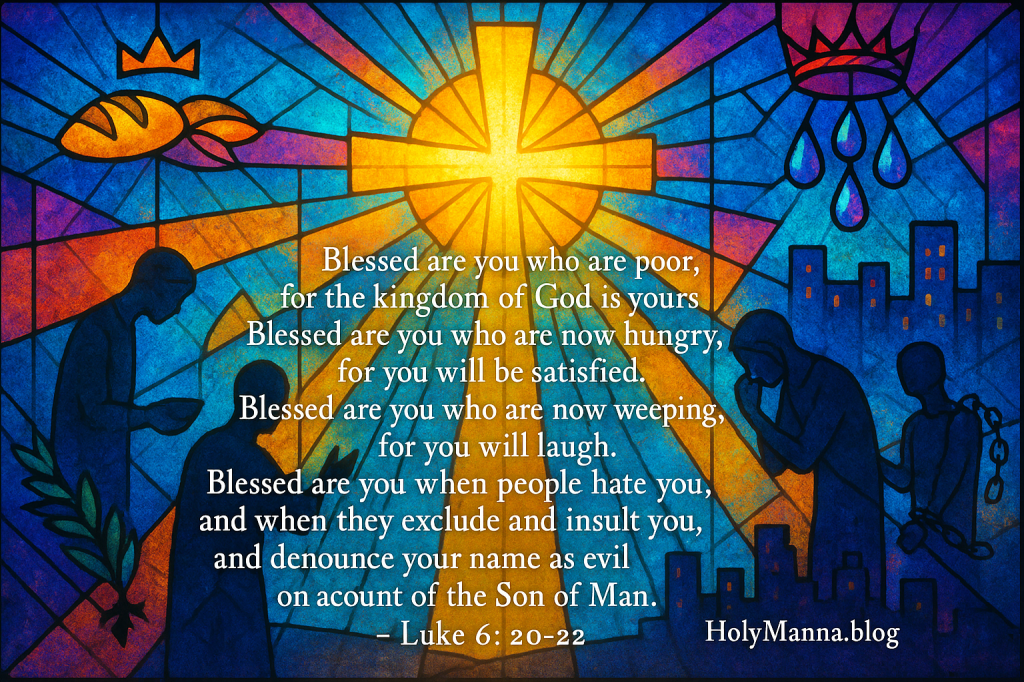
“Blessed are you who are poor,
for the kingdom of God is yours.
21 Blessed are you who are now hungry,
for you will be satisfied.
Blessed are you who are now weeping,
for you will laugh.
22 Blessed are you when people hate you,
and when they exclude and insult you,
and denounce your name as evil
on account of the Son of Man.
23 Rejoice and leap for joy on that day! Behold, your reward will be great in heaven. For their ancestors treated the prophets in the same way.
24 But woe to you who are rich,
for you have received your consolation.
25 But woe to you who are filled now,
for you will be hungry.
Woe to you who laugh now,
for you will grieve and weep.
26 Woe to you when all speak well of you,
for their ancestors treated the false prophets in this way.
Detailed Exegesis
Verse 20 – “And raising his eyes toward his disciples he said: Blessed are you who are poor, for the kingdom of God is yours.”
Jesus looks at His disciples with personal attention and proclaims the paradox of grace. In Luke, poverty is concrete. Those who depend on God rather than wealth already belong to His Kingdom. This answers the greed that Colossians 3 calls idolatry.
Verse 21 – “Blessed are you who are now hungry, for you will be satisfied. Blessed are you who are now weeping, for you will laugh.”
Physical hunger and present sorrow are not ignored. They are met by a future guaranteed by God. Satisfaction and laughter are promised gifts, not self-made achievements. Christian hope reinterprets present lack without denying its pain.
Verse 22 – “Blessed are you when people hate you, and when they exclude and insult you, and denounce your name as evil on account of the Son of Man.”
Discipleship attracts rejection. The blessing rests “on account of the Son of Man”, which purifies motives. It is not suffering for its own sake but participation in Christ. The new self learns to endure dishonor with love.
Verse 23 – “Rejoice and leap for joy on that day! Behold, your reward will be great in heaven. For their ancestors treated the prophets in the same way.”
Joy is not postponed until heaven. It erupts even “on that day” of persecution because heaven’s reward is certain and the disciple stands in the prophetic line. Suffering for Christ links us to Israel’s faithful witnesses.
Verse 24 – “But woe to you who are rich, for you have received your consolation.”
The warning is not a condemnation of every rich person but a judgment against self-sufficiency. If wealth is the only comfort one seeks, then it is all one will have. The old self clings to consolation now and forfeits the Kingdom’s treasure.
Verse 25 – “But woe to you who are filled now, for you will be hungry. Woe to you who laugh now, for you will grieve and weep.”
Self-satisfied fullness and superficial laughter mask spiritual emptiness. The reversal exposes the fragility of worldly joy. Without conversion, present ease becomes future hunger.
Verse 26 – “Woe to you when all speak well of you, for their ancestors treated the false prophets in this way.”
Universal applause can signal compromise. The Church must beware celebrity and flattery. When truth is traded for approval, one joins the false prophets. Fidelity to Christ often includes misunderstanding.
Teachings
The Catechism situates this Gospel at the very center of Christian life: “The Beatitudes are at the heart of Jesus’ preaching. They take up the promises made to the chosen people since Abraham. The Beatitudes fulfill the promises by ordering them no longer merely to the possession of a territory, but to the Kingdom of heaven.” (CCC 1716). It further explains their transformative power: “The Beatitudes depict the countenance of Jesus Christ and portray his charity. They express the vocation of the faithful associated with the glory of his Passion and Resurrection. They shed light on the actions and attitudes characteristic of the Christian life. They are the paradoxical promises that sustain hope in the midst of tribulations. They proclaim the blessings and rewards already secured, however dimly, for Christ’s disciples. They have begun in the lives of the Virgin Mary and all the saints.” (CCC 1717). In the moral life, the Gospel’s “blessed” and “woe” unveil true happiness and unmask counterfeit joy. The “new self” of Colossians 3 is nourished by this charter of the Kingdom. The Church reads the Beatitudes as both portrait and promise. They show us Jesus and assure us that grace will conform us to Him.
Reflection
The Lord invites you to practice the Beatitudes in concrete ways today. Embrace spiritual poverty by beginning with a simple prayer of surrender and by sharing something tangible with someone in need. Welcome holy hunger by setting aside time to fast from a comfort and to feed on Scripture, especially Luke 6. Offer your tears for the suffering of others by a deliberate act of mercy. When insult or exclusion arises for Jesus’ sake, choose rejoicing and pray for your detractors by name. Guard your heart against the lure of approval by speaking the truth with charity even when it costs. Where is Jesus asking you to exchange self-sufficiency for dependence on the Father so that you may truly be “blessed”? What small act today will train your desires to “seek what is above” and resist the counterfeit consolations that draw you from Christ? How will you praise the King when trials come, trusting His promise of a “great reward in heaven”?
Hidden With Christ, Singing His Reign, Living the Beatitudes
Today’s Word forms one seamless invitation. Colossians 3:1-11 calls us to a baptismal way of life in which we “seek what is above”, put to death the old self, and put on the new. Psalm 145:2-3, 10-13 trains our lips and hearts to praise the true King whose “reign is a reign for all ages” and whose works are faithful and loving. Luke 6:20-26 then gives this new life its concrete shape through the Beatitudes, blessing those who trust God in poverty, hunger, tears, and rejection, while warning against the false securities of wealth, self-satisfaction, shallow laughter, and universal applause. Together, these readings teach us that holiness is not an idea. It is a daily surrender that becomes praise in the mouth and mercy in the body.
Here is the path before us. Fix your mind on Christ seated at the right hand of the Father. Praise Him every day until praise becomes the rhythm of your life. Choose one Beatitude to practice in a tangible way this week by sharing, fasting, consoling, or enduring insult for His name with joy. Draw near to the sacraments, especially Reconciliation and the Eucharist, where the old self is stripped away and Christ clothes you with His life. Let your speech bless, your hands serve, and your heart hope. “Blessed are you who are poor.” “Seek what is above.” “Your reign is a reign for all ages.” These are not slogans. They are a promise and a program. Will you let Jesus reorder your desires, your words, and your witness so that Christ may be “all and in all” in you today?
Engage with Us!
Share your reflections in the comments below. Your insights help our community grow in faith and charity together.
- Colossians 3:1-11: What desire or habit is the Holy Spirit asking you to put to death so that your life remains hidden with Christ in God? What concrete practice this week will help you set your mind on the things above and put on the new self?
- Psalm 145:2-3, 10-13: How will you bless the Lord every day this week and make known His mighty acts to someone who needs hope? Where have you recently seen the Lord’s faithful love, and how can you give Him public praise for it?
- Luke 6:20-26: Which Beatitude most speaks to your current season, and what step can you take today to live it with trust? Where is Jesus inviting you to trade human approval for fidelity to Him, rejoicing because your reward is in heaven?
Go forth with courage. Live a life of faith that praises God daily, serves your neighbor generously, and does everything with the love and mercy Jesus taught us.
Sacred Heart of Jesus, we trust in You!
Immaculate Heart of Mary, pray for us!
Saint Michael the Archangel, defend us in battle!
Follow us on Instagram and Facebook for more insights and reflections on living a faith-filled life.

 Holy Manna!
Leave a comment