A Lamp at Ireland’s Heart: Introduction
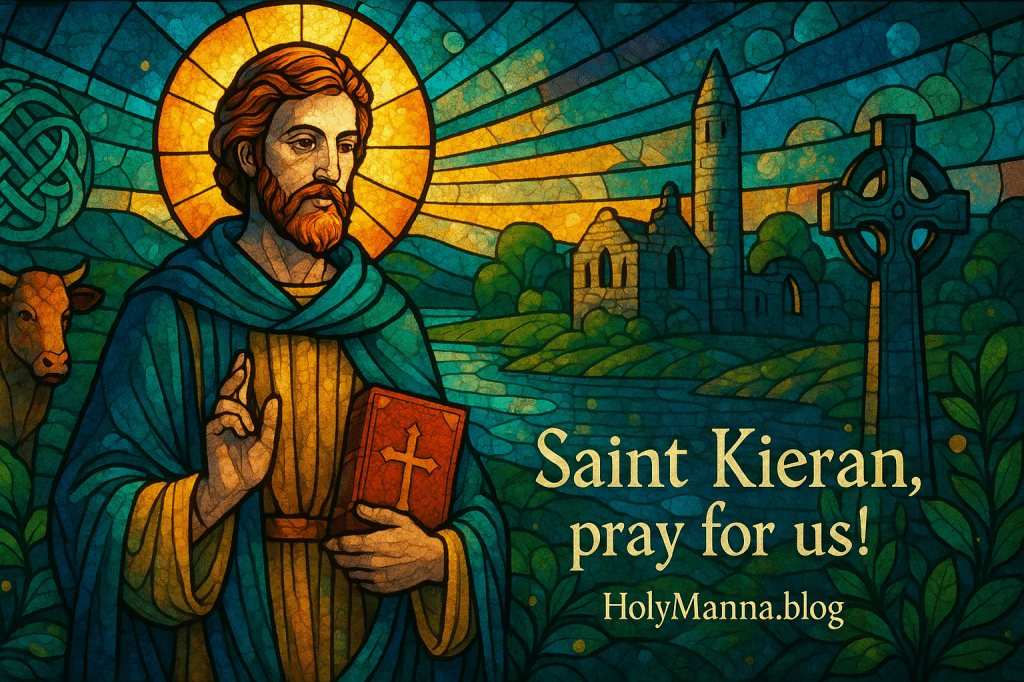
Saint Kieran, known in Irish as Ciarán the Younger and often called “mac an tSaeir,” son of the carpenter, founded the monastery of Clonmacnoise on the River Shannon and helped shape the Christian imagination of Ireland for centuries. Counted among the Twelve Apostles of Ireland, he is remembered for his youthful holiness, his love for the Gospels, his gift for friendship with other saints, and his vision to plant a community at the very center of the island so the light of Christ could reach every corner. His feast is kept on September 9. Clonmacnoise grew into a spiritual city of prayer, study, craftsmanship, and mission, forming generations of monks, scholars, artisans, and kings. Kieran’s sanctity is striking for its simplicity. He prayed, he studied, he served, and he built a home for the Lord that outlived him by a thousand years.
Carpenter’s Son, Scholar of the Gospel
Kieran was born around the early sixth century in the province of Connacht, likely in what is now County Roscommon. His byname tells a lot about him and about God’s choices. He was not noble by birth but was rich in faith. Drawn to Christ at a young age, he sought formation at the celebrated monastery school of Clonard under Saint Finnian, where he studied alongside future giants of Irish Christianity such as Columba, Brendan, and Canice. From there he deepened his ascetical life under Saint Enda on the Aran Islands. In that place of wind and stone he learned the rhythm that would mark his life. Scripture, manual work, and charity moved as one. A cherished tradition says that Enda interpreted a shared vision of a great fruiting tree at the island’s center as a prophecy of Kieran’s mission. The tree would shelter and nourish the whole land. Kieran obeyed the grace, and after a time of prayerful searching he chose the banks of the Shannon. With the goodwill of Diarmait mac Cerbaill, later High King of Ireland, he planted Clonmacnoise in a meadow that would become holy ground for a nation.
Half of Ireland Through Holiness
Stories from Kieran’s early years reveal a kindness and humility that made room for God to act. During his studies at Clonard, a fellow student once borrowed Kieran’s copy of The Gospel of Matthew. When the class was tested, Kieran could only recite the first half of the Gospel, since he had lent his copy, and he was teased as “Ciarán half-Matthew.” Saint Finnian answered with a prophecy that captured Kieran’s vocation: “Not Ciarán half-Matthew, but Ciarán half-Ireland.” The point was not academic prowess but spiritual fruitfulness. By fidelity to the Word, Kieran would feed multitudes.
The traditions that surround him mingle the ordinary with the wondrous in a way characteristic of early Irish monasticism. They speak of a family cow that accompanied him so his brothers in religion would have milk, of a gentle stag that steadied his books while he worked, and of angelic help given to him as he labored. These accounts underline how Kieran’s holiness reconciled creation around him and how his study, prayer, and service bore quiet miracles of provision. Yet his greatest work was Clonmacnoise itself, founded in the mid 500s and destined to become a crossroads of evangelization, learning, manuscript illumination, metalwork, and sculpture. Students came from across Ireland and beyond. The community prayed the Psalms, copied and studied Scripture, taught the poor, and sent forth preachers who kindled faith across the island.
Holy Perseverance
Kieran’s sanctity did not end in bloody martyrdom. Ireland’s saints often spoke of three kinds of martyrdom. Red is for bloodshed, green for penance, and white for the daily dying to self out of love for Christ. Kieran’s was the white path. It meant founding a monastery with few resources, shepherding a fledgling community, and surrendering any desire for acclaim. Not long after the foundation, a severe sickness struck him, and he died very young, likely in his early thirties. He left Clonmacnoise in the hands of his brothers, entrusting the seed to God. The brevity of his life is its own homily. Holiness is measured not by years lived but by love given. Kieran had planted his tree at the island’s center. The Lord promised the fruit.
The City of Saint Kieran Endures
After Kieran’s death, Clonmacnoise blossomed into one of the most important monastic cities in Ireland. Kings from Connacht and other realms sought burial there. Pilgrims prayed among churches, round towers, and high crosses, including the magnificent Cross of the Scriptures, a catechesis in stone for a people that learned by praying with their eyes. A small oratory, Temple Ciarán, rose over the place long associated with the saint’s grave. For centuries the faithful took handfuls of its soil as a sacramental sign seeking protection and healing, a practice so enduring that the little building is said to have sunk noticeably. While medieval tales often adorn the memory of saints with embroidered details, the constancy of such devotion reveals how near Kieran remained to his people as an intercessor.
Clonmacnoise also safeguarded treasures of learning. The twelfth century manuscript known as Lebor na hUidre or The Book of the Dun Cow bears a name that remembers the tradition of Kieran’s faithful cow. Whatever the exact link, the title is a cultural witness to the monastery’s memory and to the way Kieran’s story had become part of Ireland’s Christian identity. Even through waves of Viking raids and later devastations, the pattern of pilgrimage endured. The feast and Pattern Day of Saint Kieran on September 9 continues to draw hearts back to the Shannon, where prayer still rises from stones that remember.
Walking the Kieran Way
Saint Kieran teaches that God loves to begin great works in hidden places. He shows us that study of the Gospels, manual labor done with love, and faithful friendship in Christ can transform a culture. The Church invites us to see the saints as more than distant heroes. As The Catechism teaches, “By canonizing some of the faithful… the Church… proposes the saints to the faithful as models and intercessors.” (CCC 828) It also teaches that “Their intercession is their most exalted service to God’s plan.” (CCC 956) Popular devotions, when they lead us to Christ, are honored by the Church, which urges that they be rooted in the liturgy and sound doctrine (CCC 1674–1676). Kieran’s life is a simple path you can follow. Pray with the Gospels each day. Offer your work, whether study, parenting, or a trade, in union with Jesus. Build community by small, steady acts of welcome, especially to those who are hungry for belonging. When you are tempted to seek results quickly, remember that a monastery raised from meadow grass once evangelized a nation. Let grace teach you to plant, water, and trust the Lord with the harvest.
Engage with Us!
Share your thoughts, prayers, and favorite takeaways about Saint Kieran in the comments below.
- Where do you feel called to “plant” the Gospel in the ordinary soil of your life this week?
- Which practice from Kieran’s life most challenges you to grow: Scripture, community, simplicity, or perseverance?
- How might your home or parish become a place of learning, prayer, and hospitality for others?
May Saint Kieran help us live a life of faith, doing everything with the love and mercy Jesus taught us.
Saint Kieran, pray for us!
Follow us on Instagram and Facebook for more insights and reflections on living a faith-filled life.

 Holy Manna!
Leave a comment