The Bishop Who Saddled a Bear With the Gospel
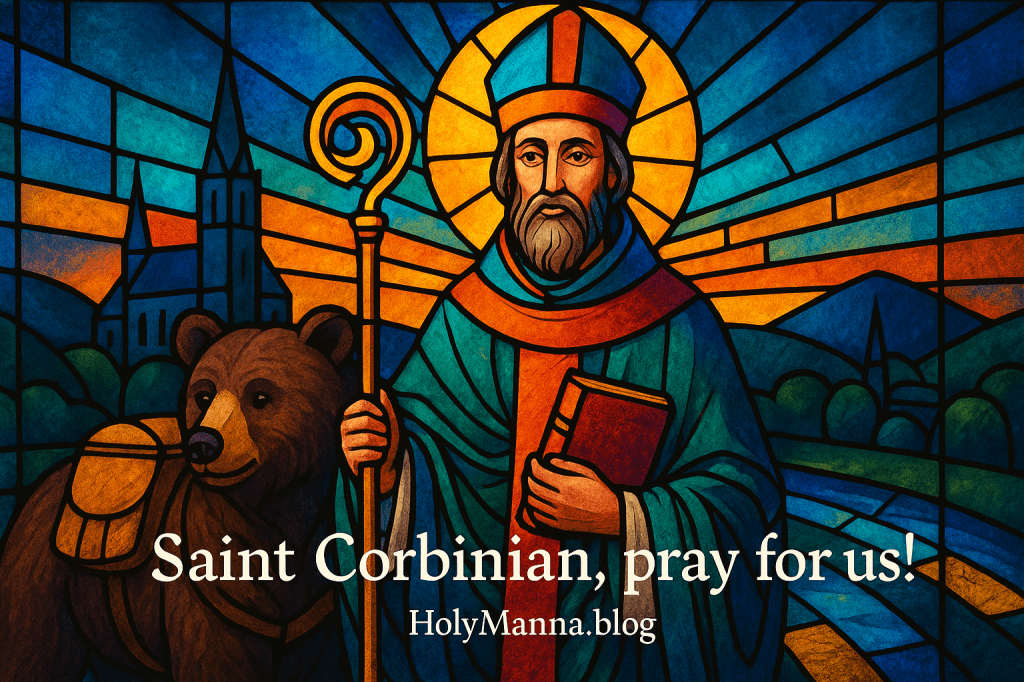
Saint Corbinian, revered as the spiritual father of Freising, stands among the great missionary bishops who helped shape the Church in early medieval Bavaria. Born around 670 and dying about 730, he is remembered for unwavering pastoral courage, clear teaching on Christian marriage, and a missionary heart that built lasting institutions of prayer, learning, and charity. His emblem is a bear that, according to tradition, he compelled to carry his baggage after it killed his packhorse on the road to Rome. That unforgettable sign captures his life in miniature. Grace tamed what was untamed, and the burdens of apostolic ministry became a witness to Christ. His feast is kept on September 8, and his memory remains inseparable from the Cathedral of Freising and the evangelization of southern Germany.
From Hermit to Herald of the Apostolic See
Corbinian was born near Châtres in Neustria, in present day France. Little is known about his family beyond the likelihood that he came from a respected household, but we know he chose the narrow path early. As a young man he sought solitude near a church dedicated to Saint Germain, embracing the demanding rhythm of prayer, fasting, and manual labor. People began to seek his counsel, and he formed companions in the monastic life, among them his brother Erembert who would later succeed him as bishop.
His desire for deeper obedience drew him to Rome. There, Pope Gregory II recognized both his holiness and his gifts and entrusted him with missionary work in Bavaria. Corbinian obeyed, though he never ceased to think of himself as a monk at heart. He brought the discipline and tenderness of the cloister into the pulpit, the chancery, and the marketplace. Around 724 he journeyed east and settled on the hill at Freising, where he raised up a church and community devoted to the Mother of God. From that center he preached, taught the faith, trained clergy, and worked to set the young Church in good order with sacraments, catechesis, and stable structures of pastoral care.
Signs on the Road and a Shepherd’s Voice
Corbinian’s importance rests first in his fidelity to the missionary mandate. He saw himself as a servant of the Word and a father to a people coming to maturity in Christ. He traveled through the valleys and towns of Bavaria and Tyrol, preaching conversion and consoling the poor. He organized parishes and monasteries, called people to confession and penance, encouraged Christian marriage and family life, and insisted on the celebration of the sacraments with reverence and regularity. He was revered as a peacemaker and a protector of the oppressed, interceding for those in danger.
The most vivid miracle of his lifetime is the story of the bear. When a bear killed his pack animal on the Alpine road to Rome, Corbinian rebuked the creature and yoked it to his load. The beast submitted and carried his baggage all the way to the threshold of the Apostles. The tale was treasured not as spectacle, but as parable. When a shepherd walks in the authority of Christ, creation itself is reordered to serve the pilgrimage of the Gospel. Corbinian is also remembered for rescuing a condemned man named Adalbert and for a gift of counsel that often brought reconciliation where violence seemed certain.
His teaching on marriage was especially clear. When he learned that Duke Grimoald had taken his brother’s widow Biltrudis as his wife, Corbinian confronted the scandal with careful pastoral reasoning and firm charity. He appealed to the moral law and to the good of the faithful whose consciences were being misled. He loved the duke enough to speak truth to him and loved the people enough to shield them from confusion.
Exile, Return, and the Cost of Apostleship
Corbinian did not die a martyr, yet he shared in the sufferings of the apostles. His correction of the ducal household provoked fury and plots against his life. Choosing prudence over provocation, he withdrew for a time to Obermais near Meran. Even there he lived as a bishop who would not abandon his flock. He preached, reconciled, and offered Mass, keeping vigil for the day he might return to Freising. After Grimoald’s death and the shifting of political winds, Corbinian was called back to resume his mission. He returned not as a defeated exile but as a father who had kept faith with his children. He carried out his work with renewed patience, formed clergy with a steady hand, and continued to build up the local Church. He died on September 8, likely at Obermais, commending his soul to God with the quiet confidence of a shepherd who had spent himself for the sheep.
He Walks With Us Still
Corbinian asked to be buried near Meran, and so his first tomb became a place of prayer for travelers and villagers who sought protection, healing, and good weather for their fields. Not long after, Bishop Arbeo translated the saint’s relics to Freising, where they were enshrined with solemnity. From that shrine sprang a living devotion that braided together pastors, pilgrims, and the land itself. Stories of help received through his intercession multiplied. Sailors and carters invoked him when their loads were heavy and roads were dangerous. Families prayed to him for reconciliation and courage in trials. The city and the diocese embraced his bear as a sign that Christ can subdue what is fierce and make it serve the Gospel. To visit the cathedral at Freising is to feel his presence in stone, glass, and song. His memory is renewed annually in local pilgrimages and youth gatherings that celebrate not nostalgia but the missionary identity of the Church. The saint who tamed a bear continues to tame fears and strengthen hearts.
Lessons for Today From a Founder and Father
Saint Corbinian’s life offers a pattern for us. He joined monastic humility to apostolic courage. He held together pastoral tenderness and doctrinal clarity. He insisted that the beauty of marriage and the unity of the Church are not negotiable, and he showed that correction offered in love protects both sinners and the scandalized. His bear still speaks. Burdens can be borne with grace. Wild impulses can be harnessed to holy purposes. The ordinary road can become a pilgrimage when we walk under obedience to Christ.
If you lead in the Church, pray for the heart of a father who both nourishes and corrects. If you feel the tug of solitude, remember that God often sends contemplatives into the world as lights for others. If you are wrestling with heavy duties, ask Saint Corbinian to help you shoulder them with patience.
The communion of saints is not an abstract idea. It is a living network of love. Scripture calls us to bear one another’s burdens, and so fulfill the law of Christ. “Bear one another’s burdens, and so fulfill the law of Christ.” (Galatians 6:2) The Catechism of the Catholic Church reminds us that bishops are heralds of faith and authentic teachers of doctrine, and that all the baptized share in the mission to evangelize. Let us receive that call with the joy and steadiness of Saint Corbinian.
Engage with Us!
We’d love to hear your thoughts—share a grace, a challenge, or a prayer request inspired by Saint Corbinian in the comments below.
- Where do you sense God inviting you to carry a “bear’s burden” with patience and faith this week?
- How can you speak the truth in love, as Corbinian did, within your own relationships?
- What concrete step could you take to support your parish’s evangelization—prayer, hospitality, study, or service?
- Which teaching of the Church on marriage or family do you feel called to learn more about and live more fully?
May the witness of Saint Corbinian strengthen your courage. Let us live a bold and joyful faith, doing everything with the love and mercy Jesus taught us.
Saint Corbinian, pray for us!
Follow us on Instagram and Facebook for more insights and reflections on living a faith-filled life.

 Holy Manna!
Leave a comment