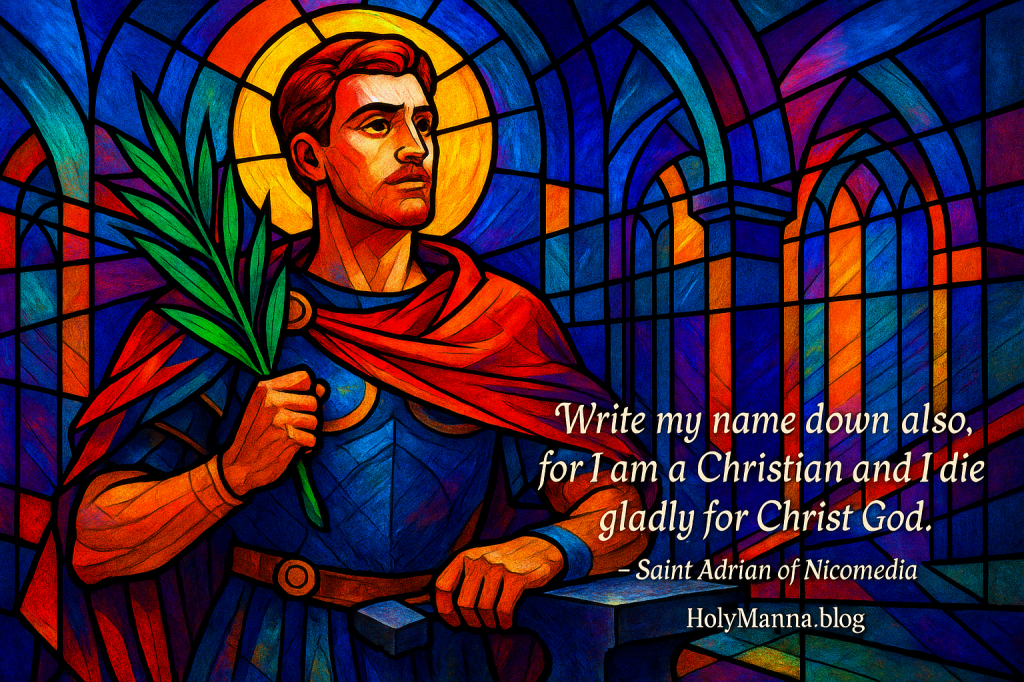
A Defender of the Faith
Saint Adrian, also known as Hadrian of Nicomedia, stands among the most beloved soldier martyrs of the early Church. A senior officer in the imperial service during the Great Persecution, he became a Christian after witnessing the serenity and hope of tortured believers. Together with his wife, Saint Natalia, he shows the beauty of sanctity within marriage, the dignity of courageous witness, and the triumph of grace over fear. He died a martyr in 306, is honored in the Roman Martyrology on September 8, and is often depicted with an anvil, a symbol of the agony he endured for Christ. The Church holds up the martyrs as the most luminous proof of the Gospel, since “martyrdom is the supreme witness given to the truth of the faith.” CCC 2473.
A Soldier Conquered by Christ
Little is known of Adrian’s childhood, which is not uncommon for early martyrs. What tradition preserves with confidence is his role as a high ranking officer in Nicomedia during the persecution ordered by Diocletian and enforced by Galerius. When a group of Christians was arrested and put to brutal tortures, Adrian was struck by their peace and their refusal to betray Christ. He asked what they hoped to receive from God for such steadfastness, and the reply echoed the apostolic promise, “Eye has not seen, nor ear heard, nor has it entered the heart of man, what God has prepared for those who love him.” 1 Corinthians 2:9. Moved by the grace of that moment, he declared himself a Christian and was immediately imprisoned. His wife, Natalia, already a disciple of Jesus in secret, came to the prison to strengthen him in faith, to encourage him to persevere, and to entrust their marriage to the mercy of the Lord. Adrian’s conversion illustrates the mystery that God can claim a heart in an instant, and that heroic charity can become the seed of new believers. The Church teaches that those who die for Christ before receiving the sacrament are united to him by a unique grace, for “those who suffer death for the sake of the faith without having received Baptism are baptized by their death for and with Christ.” CCC 1258.
An Anvil of Courage
Imprisoned with other confessors of the faith, Adrian spent his final days confessing Christ with clarity, consoling the fearful, and preparing his companions for the crown of witness. His life before conversion had been disciplined, but grace refined that discipline into charity and fortitude. He is remembered not for spectacular wonders worked in the streets, but for the greater miracle of a heart transformed so completely that he preferred the Kingdom to a soldier’s honors and the acclaim of Rome. The Church reminds every baptized person that discipleship cannot remain private. “The disciple of Christ must not only keep the faith and live on it, but also profess it, confidently bear witness to it, and spread it.” CCC 1816. Adrian’s quiet ministry in chains shows how ordinary time, even in a dark cell, becomes a liturgy of love when offered to God.
Faith Tested Like Iron
Adrian was brought before the tribunal and ordered to sacrifice to the pagan gods. He refused without hesitation. He was beaten, racked, and finally subjected to the torture that made his emblem famous. His limbs were shattered upon an anvil, and he surrendered his life to Christ on March 4, 306. The number of companions is given in the sources as twenty three, and Natalia’s steadfast presence is remembered with tender reverence. She visited her husband in prison, encouraged him to stand firm, and cared for his remains with devotion. Some accounts preserve a striking detail, that when Adrian reached to aid a fellow sufferer, an executioner severed his hand, which Natalia later secured as a relic. Whether in this particular or in the more general memory of his breaking upon the anvil, the Church sees in Adrian a living homily on perseverance. He teaches that Christian strength is not cruelty, but the patient endurance that refuses to call evil good.
Storm over the Pyre
After Adrian’s death, persecutors attempted to burn the bodies of the martyrs. Tradition relates that a sudden storm extinguished the flames and allowed the faithful to recover the remains. Natalia safeguarded the relics with profound reverence and, according to ancient accounts, later journeyed to the suburb of Argyropolis near Byzantium, where a church in honor of Adrian would become a place of prayer. Veneration spread across East and West. In Rome, the former Senate house in the Forum was consecrated as the church of Sant’Adriano al Foro in the seventh century, a sign that the Gospel refashions even the heart of worldly power. Pilgrims throughout the Middle Ages carried badges that depicted the saint with hammer and anvil, a small catechesis in metal that proclaimed his courage. The communion of saints assures us that such friends of God do not stop loving the Church after death. “Being more closely united to Christ, those who dwell in heaven do not cease to intercede with the Father for us.” CCC 956. Popular devotion to relics and shrines is rightly ordered when it leads us to Christ, as the Church counsels in her teaching on sacred images and pious practices in CCC 1674 to 1675.
Why the Church Remembers
Saint Adrian is a school of decisive grace. He heard the call, and he responded at once. He did not negotiate terms with the Gospel. He entrusted his career, his marriage, and his future to Christ, and he allowed suffering to become a witness that nourished the faith of others. The saints are not remote heroes but living companions who show what God desires to do in every era. “By canonizing some of the faithful, the Church recognizes the power of the Spirit of holiness within her and sustains the hope of believers by proposing the saints to them as models and intercessors.” CCC 828. If you seek a concrete path forward, let Adrian and Natalia mentor your love. Pray for the courage to profess Christ openly. Keep holy friendships that strengthen virtue. Sanctify your daily duty with fidelity. Revere the saints not as ends in themselves, but as signposts that lead to Jesus in the sacraments, especially Confession and the Holy Eucharist. In this way the legacy of a fourth century soldier becomes the marching song of today’s disciples.
Engage with Us!
We’d love to hear how Saint Adrian’s courage touches your life—share your thoughts and prayer intentions in the comments below.
- Where is Christ inviting you to a decisive, public “yes” this week, and what would it cost?
- Who is a “Natalia” in your life—someone who strengthens your faith—and how can you thank or imitate them today?
- What concrete step can you take to honor the saints rightly (venerating, not adoring), allowing their intercession to deepen your love for Jesus in the sacraments?
- If you carry authority (at work, at home, in ministry), how can Saint Adrian teach you to wield it with humility and mercy?
Go in peace, and live your faith boldly—doing everything with the love and mercy Jesus taught us.
Saint Adrian, pray for us!
Follow us on Instagram and Facebook for more insights and reflections on living a faith-filled life.

 Holy Manna!
Leave a comment