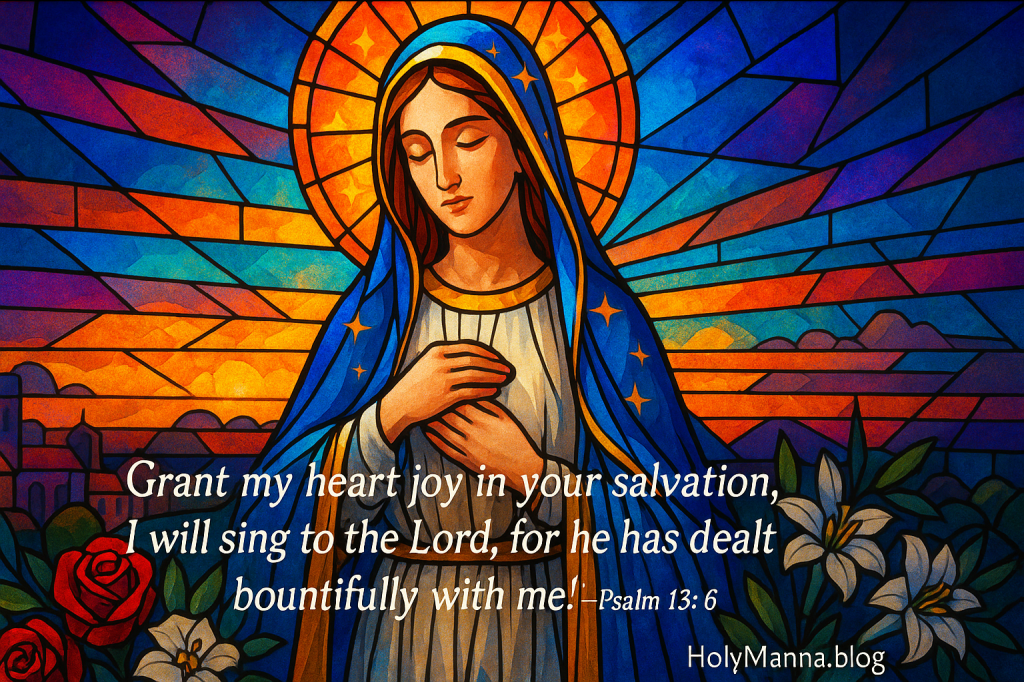
Feast of the Nativity of the Blessed Virgin Mary – Lectionary: 636
The Mother’s Birth and the King’s Coming
Today we step into joy at the threshold of salvation, celebrating the Nativity of the Blessed Virgin Mary, the first light before the rising Sun of Justice. From the smallest of places and the littlest of lives, God brings forth the long-awaited Shepherd-King. Micah 5:1-4 points to Bethlehem, “least among the clans,” and to “she who is to give birth”, through whom the ruler whose “greatness shall reach to the ends of the earth” will come. Matthew 1:18-23 unveils how this plan unfolds in time. Mary conceives by the Holy Spirit, Joseph receives the child’s name, and the promise is revealed as “Emmanuel”, which means “God is with us.” Between promise and fulfillment, Psalm 13:6 gives the Church her song today. “I trust in your mercy. I will sing to the Lord, for he has dealt bountifully with me.”
The Church keeps Mary’s birth on September 8, nine months after the Solemnity of the Immaculate Conception on December 8, because her beginning is entirely ordered to Christ’s coming for us. As The Catechism teaches, God prepared a mother for his Son in a unique and wholly singular way, preserving her from sin and filling her with grace (CCC 488, 491-493). The virginal conception manifests that Jesus’ Father is God and that he is truly the Son who saves his people from their sins (CCC 496-497). The entire sweep of Israel’s hope, from ancient oracles to humble households, converges here. The Church sees in Mary the dawn that precedes the day, since “the coming of God’s Son into the world is an event so great that God willed to prepare for it over centuries.” (CCC 522). Historically, this feast blossomed in the East with devotion at the site venerated as Saint Anne’s home, and it spread throughout the Church as a celebration of the beginning of our redemption, a birthday that announces the Birth.
The central theme is simple and radiant. God chooses littleness to reveal his limitless love. Mary’s birth prepares the way for the Prince of Peace, the true Shepherd who gathers the scattered and makes us dwell secure. Our response is trustful joy. “God is with us.” How will you welcome Emmanuel more fully into your life today?
First Reading – Micah 5:1-4
Small Beginnings, Boundless Promise
Micah prophesies in a turbulent eighth century before Christ, amid the Assyrian threat that loomed over Judah’s kings and people. Into this climate of fear, the prophet directs our gaze to Bethlehem-Ephrathah, the little town of David, where God will surprise Israel with a ruler whose roots stretch into eternity and whose reign will bring true security and peace. This reading fits our feast with striking clarity. The Nativity of the Blessed Virgin Mary signals the dawn of this promise. The one whom Micah enigmatically names as “she who is to give birth” finds her historical and theological fulfillment in Mary. Her birth prepares the way for the Shepherd-King whose “greatness shall reach to the ends of the earth” and who “shall be peace.” In a world that prizes size and power, God chooses littleness and faith, so that salvation appears in history through a humble mother and a hidden town.
Micah 5:1-4
New American Bible (Revised Edition)
1 But you, Bethlehem-Ephrathah
least among the clans of Judah,
From you shall come forth for me
one who is to be ruler in Israel;
Whose origin is from of old,
from ancient times.
2 Therefore the Lord will give them up, until the time
when she who is to give birth has borne,
Then the rest of his kindred shall return
to the children of Israel.
3 He shall take his place as shepherd
by the strength of the Lord,
by the majestic name of the Lord, his God;
And they shall dwell securely, for now his greatness
shall reach to the ends of the earth:
4 he shall be peace.
If Assyria invades our country
and treads upon our land,
We shall raise against it seven shepherds,
eight of royal standing;
Detailed Exegesis
Verse 1 – “But you, Bethlehem-Ephrathah least among the clans of Judah, From you shall come forth for me one who is to be ruler in Israel; Whose origin is from of old, from ancient times.”
Bethlehem-Ephrathah identifies David’s ancestral village and the ancient clan territory, evoking God’s covenant with David and the promise of a lasting dynasty. Calling Bethlehem “least” highlights God’s pattern of choosing the small to manifest his strength. The ruler’s “origin” being “from of old” signals more than a mere dynastic continuity. It hints at a messianic figure whose mission is grounded in God’s eternal plan. Read in light of Christ, the Church recognizes here the Messiah, the Son of David and Son of God, whose coming is prepared across centuries and fulfilled in Jesus.
Verse 2 – “Therefore the Lord will give them up, until the time when she who is to give birth has borne, Then the rest of his kindred shall return to the children of Israel.”
There is a divinely permitted period of trial before the moment of birth. History does not escape suffering, yet it is held within God’s providence. The mysterious reference to “she who is to give birth” reaches its fullness in Mary, whose motherhood becomes the hinge of salvation history. With the Messiah’s arrival, the scattered are gathered. The returning “kindred” evokes both Israel’s restoration and, in Christ, the ingrafting of the nations, uniting Jew and Gentile in the one family of God.
Verse 3 – “He shall take his place as shepherd by the strength of the Lord, by the majestic name of the Lord, his God; And they shall dwell securely, for now his greatness shall reach to the ends of the earth:”
The Messiah’s kingship is pastoral and protective. He shepherds not by coercion but “by the strength of the Lord,” manifesting God’s own care. Security flows from communion with God’s name, that is, from covenant life under his authority. The scope is universal. The Shepherd-King’s “greatness” extends “to the ends of the earth,” anticipating the Gospel’s mission to all peoples and the Church’s catholicity.
Verse 4 – “he shall be peace. If Assyria invades our country and treads upon our land, We shall raise against it seven shepherds, eight of royal standing;”
Peace here is not only the absence of war. The ruler himself “shall be peace.” In Christ, peace is personal and incarnate. The idiom of “seven” and “eight” expresses completeness and superabundance. God supplies more than enough leadership and protection for his people. Historically, Assyria threatens Judah’s borders, yet the prophetic horizon stretches further. In the Messiah, God supplies every grace for his Church to withstand all assaults, interior and exterior, and to lead souls into secure pasture.
Teachings
The Church reads Micah through the light of Christ and the mystery of Mary. The Catechism summarizes the long preparation for the Messiah in a single luminous sentence: “The coming of God’s Son into the world is an event of such immensity that God willed to prepare for it over centuries.” (CCC 522). Mary’s role in this plan is singular. The Catechism professes the enduring holiness of the Mother of God with clarity: “By the grace of God Mary remained free of every personal sin her whole life long.” (CCC 493). In her birth we celebrate the beginning of that unique vocation by which the promised Shepherd would enter our world through a mother prepared by grace.
The Fathers saw Mary as the new Eve whose faith unties humanity’s ancient knot. Saint Irenaeus writes: “The knot of Eve’s disobedience was untied by the obedience of Mary; what the virgin Eve bound by her unbelief, the Virgin Mary loosened by her faith.” (Against Heresies, 3.22.4). Micah’s language of humble origins and a birth that ushers in universal blessing harmonizes with this patristic insight. Through Mary’s fiat the eternal Word takes flesh in David’s line, and the Shepherd-King gathers the dispersed into one, fulfilling Israel’s hope and extending salvation to the nations.
Historically, Micah spoke during the Assyrian crisis, when Judah’s rulers faltered and cities feared invasion. By naming Bethlehem, the prophet anchors hope not in imperial strength but in God’s fidelity to the Davidic promise. Liturgically, the Church places this prophecy on the Feast of Mary’s Nativity to proclaim that God’s quiet beginnings are the sure path to the world’s true peace, which is Christ himself.
Reflection
God loves to begin great things in small places. He chose a little town and a newborn girl to prepare a home for the King who is our peace. In Mary’s birth we learn to trust God’s timing and his ways. Welcome littleness. Cultivate fidelity in hidden tasks. Pray daily for the humility to receive Christ as Mary did. Entrust your anxieties to the Shepherd who rules with strength and tenderness. Where is God inviting you to embrace small beginnings today? How can you let Christ shepherd your fears into secure trust this week? In what concrete way will you honor Mary’s birth by imitating her faith and saying yes to God’s will today?
Responsorial Psalm – Psalm 13:6
Trust That Sings Before the Dawn
Composed within Israel’s ancient worship, Psalm 13 moves from lament to praise, teaching the faithful how to wait on God with honest hearts and steadfast hope. This single verse appointed today becomes the Church’s voice on the Nativity of the Blessed Virgin Mary. Mary’s birth is the first glimmer of the day when Emmanuel comes to dwell with us, and this psalm gives us the fitting response: confidence in God’s mercy, joy in his saving work, and a song that rises from remembered graces. In the rhythm of Israel’s prayer and the Church’s liturgy, this psalm tunes our hearts to the small beginnings that God uses to accomplish boundless mercy.
Psalm 13:6
New American Bible (Revised Edition)
6 But I trust in your mercy.
Grant my heart joy in your salvation,
I will sing to the Lord,
for he has dealt bountifully with me!
Detailed Exegesis
Verse 6 — “But I trust in your mercy. Grant my heart joy in your salvation, I will sing to the Lord, for he has dealt bountifully with me!”
The confession “I trust in your mercy” names God’s covenant love. Biblical “mercy” points to steadfast, faithful love that does not fail. The plea “Grant my heart joy in your salvation” recognizes that joy is God’s gift, not self-produced optimism. The vow “I will sing to the Lord” shifts the psalm from petition to praise, which is the proper end of prayer. Finally, “for he has dealt bountifully with me” remembers concrete graces. Israel prays by recalling God’s deeds, and the Church does the same, especially in the Eucharist. On Mary’s birthday, this verse becomes Marian in tone. God’s mercy prepares Mary, fills her with joy, and through her brings us Jesus, the salvation whose coming turns lament into song.
Teachings
The Catechism describes what this psalm enacts in our mouths. “Thanksgiving characterizes the prayer of the Church which, in celebrating the Eucharist, reveals and becomes more fully what she is.” The same teaching explains the nature of praise: “Praise is the form of prayer which recognizes most immediately that God is God. It lauds God for his own sake and gives him glory, quite beyond what he does, but simply because HE IS.”
Because this verse blossoms into song, the Church links it to the Eucharist, whose very name means thanksgiving. “The Eucharist is a sacrifice of thanksgiving to the Father, a blessing by which the Church expresses her gratitude to God for all his benefits.” In a beautiful Marian key, Saint John Paul II writes: “The Eucharist, like the Canticle of Mary, is first and foremost praise and thanksgiving.” In Mary’s Nativity we see the first dawn of that praise, since her life and Magnificat model the Church’s posture of trusting gratitude before the God who saves.
Reflection
Let this verse become your breath prayer today. Begin every morning by telling God, “I trust in your mercy.” End every day by recalling at least three ways he has “dealt bountifully” with you. Choose one concrete act of praise, such as singing a psalm, praying the Magnificat, or lingering in thanksgiving after Mass. Remember that joy is a grace, so ask for it, and then cooperate with it by praising God aloud. Where is the Lord inviting you to trust his mercy right now? What memory of God’s goodness can you bring to mind and thank him for today? How will you let your prayer move from petition to song, so that your life becomes a living Magnificat?
Holy Gospel – Matthew 1:18-23
Emmanuel in the House of David
The opening of The Gospel of Matthew situates Jesus within Israel’s royal line and within the concrete customs of first century Jewish life. Betrothal was a binding legal covenant that preceded living together. A breach required a formal divorce. Into this sacred and delicate space God reveals his plan. Mary conceives by the Holy Spirit, and Joseph, a just son of David, must discern how to receive this mystery. The angel’s message discloses that the child’s name and mission come from God. He is Jesus, which means salvation, and Emmanuel, which proclaims God’s presence. On the Feast of the Nativity of the Blessed Virgin Mary, this Gospel shows how her hidden beginning unfolds into the fulfillment of ancient promises. Through Mary’s virginal maternity and Joseph’s obedient faith, the Shepherd-King promised in Micah 5 steps into our history as “God is with us.”
Matthew 1:18-23
New American Bible (Revised Edition)
18 Now this is how the birth of Jesus Christ came about. When his mother Mary was betrothed to Joseph, but before they lived together, she was found with child through the holy Spirit. 19 Joseph her husband, since he was a righteous man, yet unwilling to expose her to shame, decided to divorce her quietly. 20 Such was his intention when, behold, the angel of the Lord appeared to him in a dream and said, “Joseph, son of David, do not be afraid to take Mary your wife into your home. For it is through the holy Spirit that this child has been conceived in her. 21 She will bear a son and you are to name him Jesus, because he will save his people from their sins.” 22 All this took place to fulfill what the Lord had said through the prophet:
23 “Behold, the virgin shall be with child and bear a son,
and they shall name him Emmanuel,”
which means “God is with us.”
Detailed Exegesis
Verse 18 — “Now this is how the birth of Jesus Christ came about. When his mother Mary was betrothed to Joseph, but before they lived together, she was found with child through the holy Spirit.”
Matthew begins with the manner of Christ’s coming. The emphasis on betrothal underscores covenant fidelity and the legal gravity of the situation. The passive construction, “was found,” highlights divine initiative. The conception is not humanly engineered. It is the work of the Holy Spirit. In the light of the feast, Mary’s birth was the dawn. Here the day has broken. God acts in the hiddenness of a home to bring forth the Savior.
Verse 19 — “Joseph her husband, since he was a righteous man, yet unwilling to expose her to shame, decided to divorce her quietly.”
Joseph’s righteousness is both fidelity to the Law and mercy toward Mary. He refuses public accusation, which would invite disgrace or worse. Tradition venerates Joseph’s justice as attuned to God’s compassion. He discerns in silence, ready to relinquish his place rather than impede God’s work. The infancy of Mary’s mission is protected by Joseph’s meek strength.
Verse 20 — “Such was his intention when, behold, the angel of the Lord appeared to him in a dream and said, ‘Joseph, son of David, do not be afraid to take Mary your wife into your home. For it is through the holy Spirit that this child has been conceived in her.’”
Heaven interrupts human prudence. The angel addresses Joseph by his royal lineage, “son of David,” anchoring the child’s legal messianic identity. The command, “do not be afraid,” is not mere comfort. It is a summons to participate in the mystery. The virginal conception is affirmed. Joseph’s role is to receive Mary and to guard the child as father in David’s line.
Verse 21 — “‘She will bear a son and you are to name him Jesus, because he will save his people from their sins.’”
Naming is paternal authority in Israel. God entrusts Joseph to confer the name that reveals mission. “Jesus” signifies salvation. The purpose is explicit. He will save his people from their sins. The feast of Mary’s birth points to this end. Her life is perfectly ordered to the Redeemer’s saving work.
Verse 22 — “All this took place to fulfill what the Lord had said through the prophet:”
Matthew’s fulfillment formula interprets events within God’s sovereign plan. History and prophecy converge. The smallness of Nazareth and Bethlehem becomes the stage for the vast fidelity of God.
Verse 23 — “‘Behold, the virgin shall be with child and bear a son, and they shall name him Emmanuel,’ which means ‘God is with us.’”
Isaiah’s oracle is received as present reality. The virgin conceives. The son is Emmanuel. The Church proclaims in Mary’s Nativity that God’s presence has drawn near in a human family. Emmanuel is not an idea. He is a person. He abides with us.
Teachings
The Catechism clarifies Mary’s mystery always in relation to Christ. “What the Catholic faith believes about Mary is based on what it believes about Christ, and what it teaches about Mary illumines in turn its faith in Christ.” (CCC 487). The Gospel reveals the child’s name and mission. “Jesus means in Hebrew: ‘God saves.’ At the Annunciation the angel Gabriel gave him the name Jesus as his proper name, which expresses both his identity and his mission.” (CCC 430). The saving initiative begins when God enters time through Mary’s yes. “The Annunciation to Mary inaugurates the ‘fullness of time,’ the time of the fulfillment of God’s promises and preparations.” (CCC 484).
In confessing who Mary’s Son is, the Church confesses who Mary is. “Called in the Gospels ‘the mother of Jesus,’ Mary is acclaimed by Elizabeth, at the prompting of the Spirit and even before the birth of her son, as ‘the mother of my Lord.’ In fact, the One whom she conceived as man by the Holy Spirit, who truly became her Son according to the flesh, was none other than the Father’s eternal Son, the second person of the Holy Trinity. Hence the Church confesses that Mary is truly ‘Mother of God’ (Theotokos).” (CCC 495). Her virginal maternity is a sign of faith and total gift. “Mary is a virgin because her virginity is the sign of her faith ‘unadulterated by any doubt’ and of her undivided gift of herself to God’s will.” (CCC 506, citing Saint Augustine).
The Fathers perceive in Mary the reversal of the Fall. Saint Irenaeus writes, “The knot of Eve’s disobedience was untied by the obedience of Mary; what the virgin Eve bound by her unbelief, the Virgin Mary loosened by her faith.” (Against Heresies, 3.22.4). Joseph’s role is likewise essential. By taking Mary into his home and naming the child, he gives Jesus Davidic sonship in law, protecting the mystery so that Emmanuel may dwell among us within a true family.
Reflection
Receive Emmanuel as Joseph did. Make room for God’s surprising work in the ordinary places of your life. Practice obedience that listens before it speaks. Honor Mary’s Nativity by imitating her readiness to say yes. Unite your family prayer to the Holy Name of Jesus. Call on his name when you face temptation or fear. Ask Saint Joseph to teach you silent strength and courageous fidelity. Where is God asking you to act in faith rather than fear today? How can you reverence the presence of Emmanuel in your home, workplace, and parish this week? What step can you take to let Jesus save you from a concrete sin by invoking his holy name and obeying his word?
Welcoming Emmanuel with Mary
Today’s readings trace a single line of grace from promise to presence. In Micah 5:1-4 we behold the smallness of Bethlehem and the prophecy of “she who is to give birth”, a sign that God chooses humble places to unveil his Shepherd-King who “shall be peace.” In Psalm 13:6 we learn our proper response to this plan. We trust, we rejoice in salvation, and we sing because God has dealt bountifully with us. In The Gospel of Matthew 1:18-23 the promise becomes a person as Joseph receives Mary and names the child Jesus, the One announced by the prophet as “Emmanuel”, which means “God is with us.” The Nativity of the Blessed Virgin Mary is the dawn that assures the day. Her birth announces that the eternal plan has stepped into time and that the peace promised to Israel now reaches every heart that welcomes her Son.
Let this feast lead you to small and faithful beginnings. Choose one hidden act of love, one quiet yes, and one song of thanksgiving. Honor Mary by imitating her readiness to receive God and by making room for Jesus in your routines, your family, and your decisions. Turn trust into prayer at the start and end of each day, and let your gratitude rise at the Eucharist where salvation is given to you. Where is God inviting you to start small and trust him today? How will you welcome “God is with us” in a concrete way this week? What step will you take to let Christ be your peace and your song?
Engage with Us!
We would love to hear from you in the comments below. Share how today’s feast and readings are speaking to your heart.
- First Reading — Micah 5:1-4: Where is God inviting you to embrace small beginnings with trust? How does Mary’s birth help you believe that God’s plan can unfold in hidden places of your life? What would it look like for Christ the Shepherd to lead your fears into secure peace today?
- Responsorial Psalm — Psalm 13:6: What is one concrete way you can move from petition to praise before the day ends? Which specific graces can you name in gratitude when you pray tonight? How will you let your prayer become a song that remembers how God has “dealt bountifully” with you?
- Holy Gospel — Matthew 1:18-23: Where is God calling you to act in faith rather than fear as Saint Joseph did? How will you welcome “God is with us” in your home, your work, and your parish this week? What step will you take to let Jesus save you from a concrete sin by calling on his holy name and obeying his word?
May the Lord strengthen you to live a vibrant life of faith, and may every thought, word, and action be done with the love and mercy that Jesus taught us.
Sacred Heart of Jesus, we trust in You!
Immaculate Heart of Mary, pray for us!
Saint Michael the Archangel, defend us in battle!
Follow us on Instagram and Facebook for more insights and reflections on living a faith-filled life.

 Holy Manna!
Leave a comment