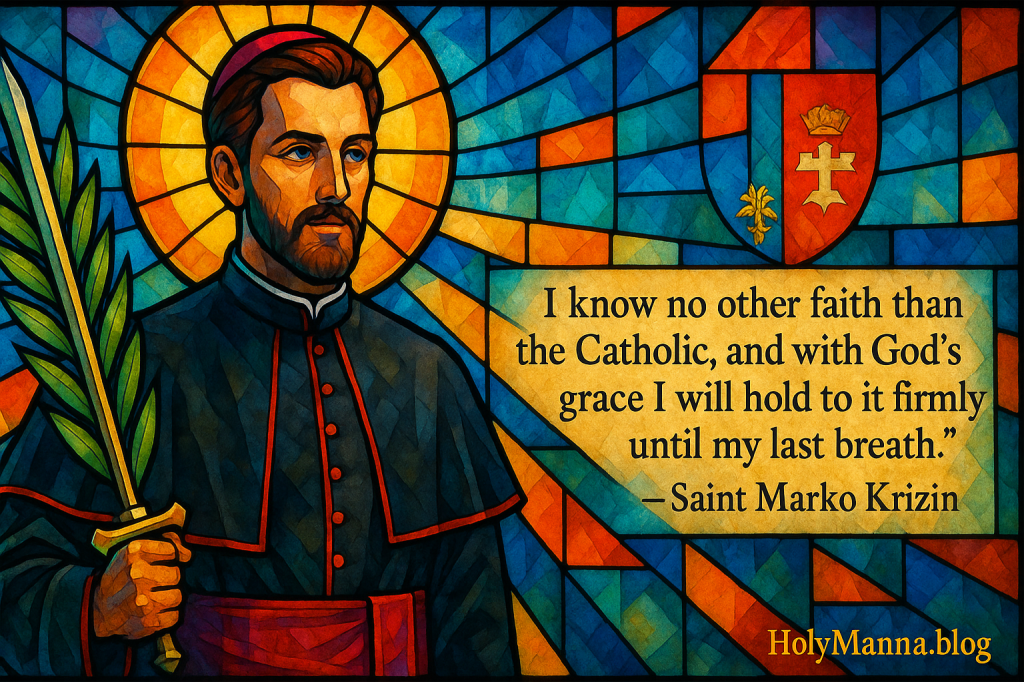
A Shepherd in the Storm
Saint Marko Krizin, a diocesan priest from Croatia and canon of Esztergom, stands alongside the Jesuits Stephen Pongrácz and Melchior Grodziecki as one of the Three Martyrs of Košice. He is venerated for steadfast fidelity to the Catholic Church during a violent chapter of Central European history at the dawn of the seventeenth century. His reputation for integrity, pastoral zeal, and quiet courage made him a trusted collaborator in priestly formation and in the service of Catholic communities that were small, pressured, and often isolated. He was beatified in 1905 and canonized in 1995, and his witness continues to inspire Catholics who face misunderstanding or coercion because of their adherence to the fullness of the faith. His life proclaims the evangelical logic of love that refuses to sever communion with Christ and His Church even when threatened with death, echoing the teaching of The Catechism that “Martyrdom is the supreme witness given to the truth of the faith.” (CCC 2473).
From Križevci to the Altar
Marko Stjepan Krizin was born in the town of Križevci in present day Croatia around 1588 to a family that valued education and the faith. Gifted with a strong intellect and a balanced spirit, he pursued philosophy at Graz and then advanced theological studies in Rome at the Collegium Germanicum et Hungaricum and the Pontifical Gregorian University. These years shaped his priestly identity with a distinctly missionary and pastoral character that he would carry back to his homeland and to the broader Hungarian lands. After ordination he served in the Diocese of Zagreb with humility and competence. His ability to teach, organize, and encourage others soon drew the attention of Church leaders working to renew Catholic life in territories strained by political and confessional conflict. At the invitation of Péter Pázmány, the future cardinal and architect of Catholic reform in the region, Marko accepted roles that joined scholarship with shepherding. He served as head of a seminary at Trnava and as a canon of Esztergom, forming future clergy and strengthening parish life. He is best known for his unwavering fidelity to Catholic doctrine, his practical charity for the poor, and his decision to stand with a vulnerable Catholic community at Košice when doing so entailed grave personal risk.
Love That Does Not Flinch
Marko’s daily life looked simple on the surface, yet it was inwardly heroic. He taught seminarians to pray, to preach with clarity, and to live in personal holiness. He strengthened parishes by encouraging frequent confession, reverent celebration of the Eucharist, and catechesis grounded in Scripture and The Catechism. He also assisted the Jesuits by helping administer temporal goods and by supporting their mission in Košice. While there are no authenticated thaumaturgic miracles attributed to him during his lifetime, the Church recognizes that holiness often shines through unglamorous fidelity and pastoral charity. This kind of faithfulness conforms to the pattern described in The Catechism, which praises those who bear witness to Christ by persevering in truth, purity of heart, and charity. Marko’s life therefore presents a living catechesis on priestly service: prayer first, then preaching, then patient accompaniment of souls. In an anxious age that often confuses strength with harshness, he models the courage to be gentle, the clarity to be truthful, and the humility to be small. His mission was to make Christ known and loved, and he did so by guarding communion with the Church, by honoring the sacraments, and by staying close to the people entrusted to him.
Who Shall Separate Us
The year 1619 placed Marko directly in the path of the storm. The Transylvanian prince Gabriel Bethlen launched military campaigns into Upper Hungary, and Košice fell under the control of forces hostile to Catholic clergy. Marko was arrested together with the Jesuits Stephen Pongrácz and Melchior Grodziecki. They were imprisoned, interrogated, and tortured. They were offered safety and honors if they would abandon communion with the Pope and embrace a different confession. They refused with calm resolve. The cruelty inflicted on them was meant to break their bodies and shatter their spiritual identity. Instead, it revealed the hidden strength formed by years of prayer and sacramental life. Marko was executed by beheading on September 7, 1619, while his companions were killed the same day and the next after prolonged abuse. In the face of threats and pain they held fast to the truth that had seized their hearts. The promise of Scripture became their lived reality as they answered the question of Romans 8:35 with their own blood. “Who shall separate us from the love of Christ?” Their martyrdom mattered not only for their own salvation but also for the Church in the region, since their fidelity strengthened Catholics who felt abandoned, and it planted seeds that would bear fruit in later renewal.
The Light After the Sword
Veneration of the martyrs began quickly after their deaths. Faithful Catholics, moved by their courage, preserved the memory of their passion and sought the reverent burial of their remains. Over time their relics were honored in churches associated with their ministry, particularly in Košice and in centers of Catholic life such as Trnava and Esztergom. Pilgrims came to pray for courage, unity in the Church, and perseverance in trials. Reported favors through their intercession spread devotion across Slovakia, Hungary, and Croatia. The Church formally examined their cause and declared their heroic witness through beatification in 1905. In accordance with the norms of canonization, the Church recognized a miracle attributed to their intercession after beatification, and Pope John Paul II inscribed them in the Catalogue of the Saints in 1995 during celebrations that highlighted their significance for a Europe seeking reconciliation rooted in truth. Their cult remains especially strong in Košice, where the memory of their imprisonment and death continues to draw prayerful crowds, and in places connected to priestly formation and evangelization, where their steadfastness is held up as a model for clergy and laity alike.
Why Saint Marko Matters
Saint Marko invites us to practice a courage that is neither loud nor bitter. He teaches us to stay close to Christ in the sacraments, to seek unity with Peter and the universal Church, and to love those who disagree with us without surrendering the truth that sets us free. When you feel social pressure to dilute your faith, remember the quiet strength of this diocesan priest who would not cut himself off from the vine that is Christ. Ask for his intercession when you need fortitude at work, integrity in public witness, or perseverance in prayer. Make time for confession and the Eucharist, commit to daily Scripture reading, and shape your conscience with The Catechism. Let the words of 2 Timothy 1:8 be your prayer in moments of fear: “Do not be ashamed of testifying to our Lord.” Holiness in our age will usually look like fidelity in small things. That is the path Marko walked, and it is open to us today.
Engage with Us!
We’d love to hear your thoughts and prayers in the comments—your testimony strengthens the Body of Christ.
- Where are you being invited to witness to Christ with greater courage this week?
- How can you hold charity and truth together when conversations about faith become tense?
- What concrete practice—daily Mass, Confession, spiritual reading—will you adopt to deepen fidelity like Saint Marko’s?
Go in peace, and let every word and work be done with the love and mercy Jesus taught us.
Saint Marko Krizin, pray for us!
Follow us on Instagram and Facebook for more insights and reflections on living a faith-filled life.

 Holy Manna!
Leave a comment