A Crown at His Feet
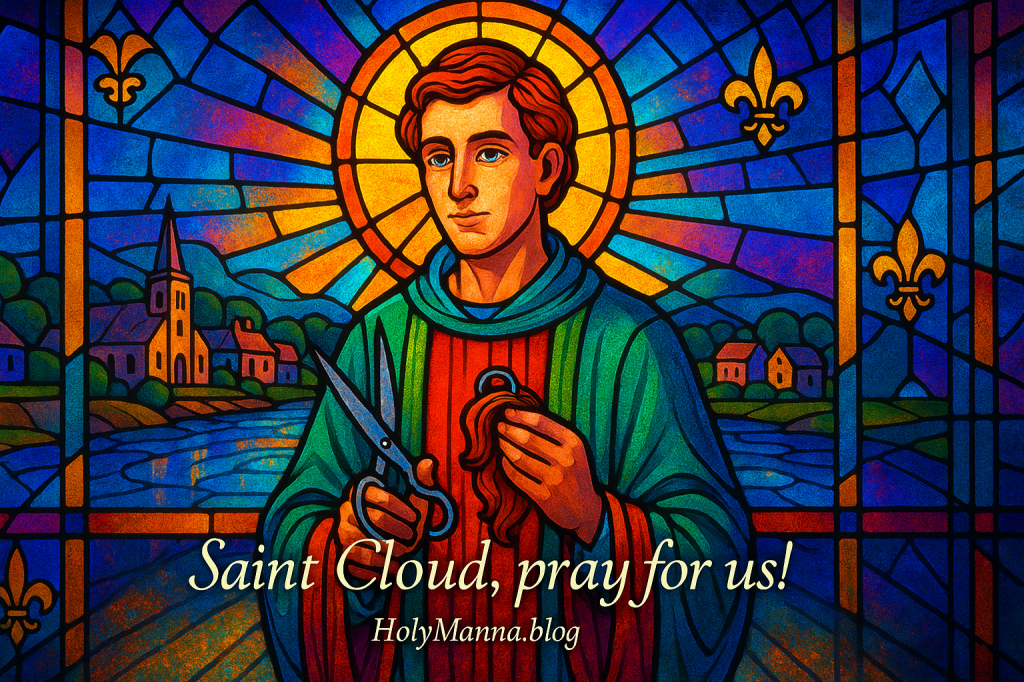
Saint Cloud, known in his own time as Clodoald, stepped away from a royal destiny to follow Jesus with an undivided heart. A grandson of King Clovis I and Saint Clotilde, he possessed every privilege of the Merovingian court. Yet he freely chose the humility of the Gospel, embracing the life of a monk and then a priest who gave himself to prayer, preaching, reconciliation, and works of mercy. His name now marks the town of Saint Cloud on the Seine near Paris, a place that grew around the church and community he founded. Artists often depict him with scissors or a cut lock of hair, a reference to the public renunciation of his royal claims. His feast is celebrated on September 7, inviting us to remember that true greatness is measured not by power but by love. The graced logic of his life echoes the words of the Lord, “For what will it profit a man if he gains the whole world and forfeits his life” in Matthew 16:26. Saint Cloud’s holiness is a luminous instance of the universal call to holiness taught in The Catechism of the Catholic Church (CCC 2013), a call addressed to every baptized person in every state of life.
From Palace to Hermitage
Clodoald was born around 522 to King Chlodomer of Orléans, the son of Saint Clotilde. The world into which he was born was complex and often violent. After his father’s death in battle, court intrigue swirled around the royal children. His two brothers were killed in a ruthless bid for power, while Clodoald’s life was spared through a providential escape. He was raised under the watchful faith of his grandmother Saint Clotilde, who formed him in Christian prayer and piety. The Merovingian symbol of royal authority was long, uncut hair. In time Clodoald faced a decisive question. Would he lay hold of a contested crown, or would he lay that crown at the feet of Christ
He chose the latter. Seeking wisdom rather than domination, he withdrew for a period to live under the guidance of holy men, learning the rhythms of prayer, manual work, and Scriptural meditation. He returned to Paris in ceremonial dress only to set aside those garments and have his royal hair cut in public, a sign that he would seek no throne but that of Christ in his heart. The act foreshadowed the priestly tonsure he would later receive. What could have been a life of conquest and rivalry became a life of service and reconciliation.
A Quiet Life That Moved a Nation
After his renunciation, Cloud settled at Novigentum along the Seine, where fishermen, craftsmen, and farmers labored. He built a simple cell and oratory that grew into a church dedicated to Saint Martin of Tours and then into a small community of prayer and teaching. Cloud was ordained a priest and poured himself into the daily tasks of a pastor who knew his people by name. He preached Christ simply and clearly, taught the Creed and the Lord’s Prayer, reconciled enemies, and urged the wealthy to use their goods for the poor. The Catechism of the Catholic Church describes the heart of such charity with crystalline clarity. “The works of mercy are charitable actions by which we come to the aid of our neighbor in his spiritual and bodily necessities.” (CCC 2447). Tradition remembers that many who sought his counsel experienced deep interior healing and that the sick who came to him frequently recovered health after his prayer. Parents brought children with fevers, sailors asked for blessings before crossings of the river, and laborers entrusted their injuries to his intercession. Whether the grace came as a striking cure or as the quiet restoration of hope, Cloud’s ministry was marked by a fatherly tenderness that made the compassion of Christ visible. His life gave flesh to the words in James 1:27, “Religion that is pure and undefiled before God and Father is this: to visit orphans and widows in their affliction.”
The White Martyrdom of Renunciation
Saint Cloud did not die by the sword. His martyrdom was the daily offering of a will surrendered to God. He endured the memory of family violence, the pressure of political factions who hoped to exploit his lineage, and the misunderstanding that often meets those who choose simplicity over status. Cloud persevered through prayer, fasting, and consistent service. The Catechism of the Catholic Church teaches that discipleship involves detachment from riches and privilege for the sake of Christ. “[He] bids them renounce all that they have for his sake and that of the Gospel.” (CCC 2544). Cloud’s obedience to this teaching was not a single gesture but a pattern that shaped every decision. He remained poor so that others might be enriched in faith, and he guided his community with the authority of a shepherd who first learned to be a servant. These hidden sacrifices cultivate the virtue of hope described in The Catechism of the Catholic Church. “Hope is the theological virtue by which we desire the kingdom of heaven and eternal life.” (CCC 1817). Cloud’s hardships remind us that holiness often advances through small, faithful acts that no one sees but God.
A Light After Death
Saint Cloud fell asleep in the Lord around the year 560 and was buried in the church he had built. Almost immediately, the faithful testified to graces received at his tomb. Accounts speak of cures from illness, restoration of mobility, and answered prayers that drew pilgrims from the surrounding countryside and beyond. The village that grew around his resting place became known as Saint Cloud, a name that remains a living memorial of his holiness. Through centuries of upheaval, the veneration of his relics endured, and his church continued as a house of prayer and a beacon of mercy. Devotion to him crossed borders and oceans as churches and towns in new lands adopted his name, honoring a prince who chose the Gospel. The enduring pilgrimages and the continued invocation of his intercession reflect what the Church has always known. The saints, united to Christ, continue to care for the Church on earth with love that does not end at death.
Walking the Same Road
Saint Cloud teaches that renunciation can be fruitful, joyful, and liberating because it makes space for God to act. Begin where he began with prayer that is simple and faithful. The Catechism of the Catholic Church calls prayer a gift of grace and a covenant relationship that springs from humility. “Prayer is the raising of one’s mind and heart to God.” (CCC 2559). Set aside a daily time for silent conversation with Jesus, even ten minutes to start. Next, let detachment become concrete. Practice almsgiving that actually costs something, forgive an old offense, or fast from a comfort that distracts your heart. The Catechism of the Catholic Church names conversion as a daily task that takes shape in ordinary choices, from works of charity to moments of penance and reconciliation (CCC 1435). Offer your talents in service to the people around you as Cloud did, and allow the Holy Spirit to widen your heart. Finally, foster hope. “Hope is the theological virtue by which we desire the kingdom of heaven and eternal life.” (CCC 1817). Hope does not look away from suffering. It looks through suffering to Christ who is risen. If a prince could become a servant and find joy, then we can entrust our own plans to the Father who knows what will truly make us free.
Engage with Us!
We’d love to hear your thoughts and prayers in the comments—how does Saint Cloud’s witness speak into your story today?
- Where might Christ be inviting you to lay a “crown” at His feet, whether status, comfort, or control, for a freer love?
- How can you practice real detachment this week in light of CCC 2544, through fasting, almsgiving, or a hidden act of service?
- Who is one person you can accompany with prayerful counsel, as Saint Cloud accompanied those who came to him?
- What would it look like for you to build a small “Novigentum” in your life, a place of prayer and welcome for others?
Take to heart: “The precept of detachment from riches is obligatory for entrance into the Kingdom of heaven.” (CCC 2544). Let’s live our faith with Cloud’s humility and Christ’s own mercy, doing everything for love of Jesus, and trusting that the Father will make our hidden offerings shine.
Saint Cloud, pray for us!
Follow us on Instagram and Facebook for more insights and reflections on living a faith-filled life.

 Holy Manna!
Leave a comment