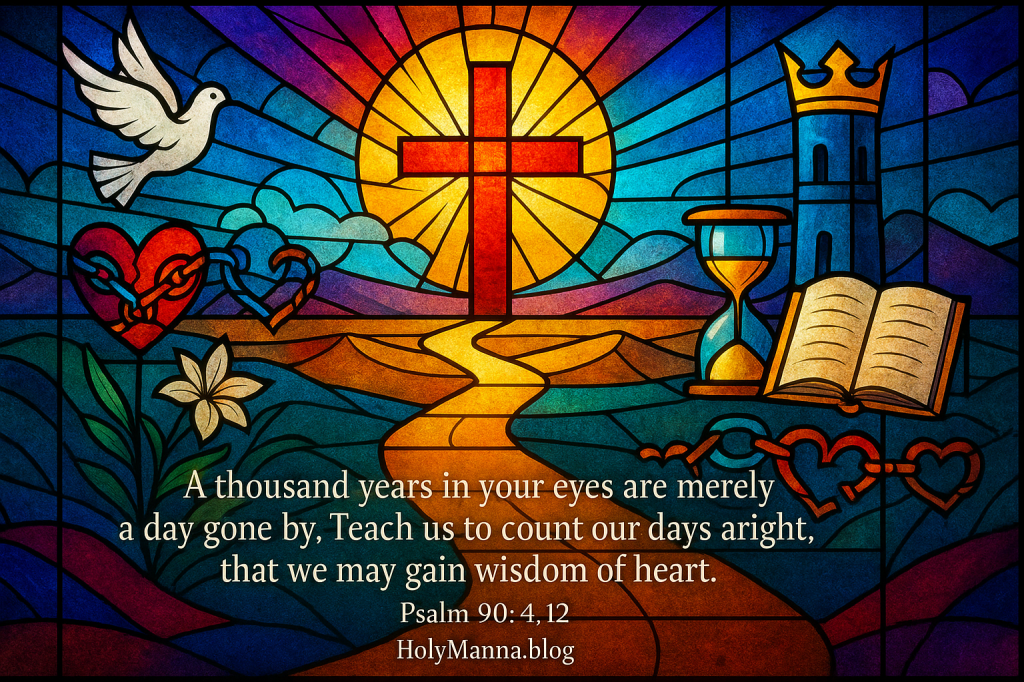
Twenty-third Sunday in Ordinary Time – Lectionary: 129
Counting the Cost with Wisdom
What would change if you asked God today for the wisdom to love Him first, and to order every other love in its proper place? The readings invite us to receive heavenly wisdom that makes our limited plans clear, our fleeting days meaningful, our relationships transformed, and our discipleship honest. Wisdom 9:13-18 confesses our limits before God and pleads for the gift only He can give: “Who can know your counsel, unless you give Wisdom and send your holy spirit from on high?” That plea becomes a prayer of time and trust in Psalm 90, where we learn to measure life not by anxiety but by grace: “Teach us to count our days aright, that we may gain wisdom of heart.” In Philemon 9-17, the same wisdom reorders social bonds in Christ. Paul asks that Onesimus be received “no longer as a slave but… a brother”, and he insists that love be voluntary, not coerced, which anticipates the Church’s constant teaching on the dignity of the human person and the freedom of charity in The Catechism (CCC 1730, CCC 1827, CCC 1935). Finally, Jesus in Luke 14:25-33 brings wisdom to its decisive test. True discipleship requires sobriety, a clear account of the cost, and a heart set on Him above every possession and even every natural tie: “Whoever does not carry his own cross and come after me cannot be my disciple.” In the first century, such language drew on Semitic idiom that contrasts loves in order to exalt God’s primacy, while the parables of the tower and the king echo ancient Near Eastern wisdom about prudent planning. In the Roman world where slavery existed and kinship defined identity, the Gospel created a new family in Christ and a new freedom of heart, which The Catechism names as the gift of wisdom and the poverty of spirit that detaches us for love (CCC 1831, CCC 2544-2547, CCC 2232-2233). This is the thread that binds today’s texts: God grants wisdom through His Spirit so that we can number our days, welcome one another as true brothers and sisters, and choose the cross with eyes open and hearts free. Where is the Holy Spirit inviting you to ask for wisdom, to reorder your loves, and to count the cost with courage today?
First Reading – Wisdom 9:13-18
Heavenly Wisdom that Makes Our Steps Straight
Composed in Greek and likely addressed to Jews living in Hellenistic Alexandria in the late first century before Christ, The Book of Wisdom speaks into a world dazzled by philosophy and civic achievement yet haunted by uncertainty about life’s ultimate meaning. Today’s passage is a humble prayer that acknowledges the limits of human judgment and asks God for the gift that only He can bestow: Wisdom from on high. This plea dovetails with today’s theme of counting the cost of discipleship with clear eyes and free hearts. We are reminded that without divine Wisdom our plans are timid and our days feel scattered, but with His Spirit our paths are made straight, our relationships are reordered in charity, and our choices align with the cross-bearing prudence Jesus demands. How is God inviting you to receive His Wisdom so that your daily decisions become a response of love rather than a reaction to fear?
Wisdom 9:13-18
New American Bible (Revised Edition)
13 For who knows God’s counsel,
or who can conceive what the Lord intends?
14 For the deliberations of mortals are timid,
and uncertain our plans.
15 For the corruptible body burdens the soul
and the earthly tent weighs down the mind with its many concerns.
16 Scarcely can we guess the things on earth,
and only with difficulty grasp what is at hand;
but things in heaven, who can search them out?
17 Or who can know your counsel, unless you give Wisdom
and send your holy spirit from on high?
18 Thus were the paths of those on earth made straight,
and people learned what pleases you,
and were saved by Wisdom.
Detailed Exegesis
Verse 13 – “For who knows God’s counsel, or who can conceive what the Lord intends?”
The verse opens with a confession of creaturely limitation. God’s counsel is not discovered by speculation alone. It is revealed. The Church teaches that we depend upon God’s self-communication for saving truth through Scripture, Tradition, and the guidance of the Holy Spirit in the Church. This humble starting point guards us from pride and prepares us to receive Wisdom as gift rather than as a human achievement.
Verse 14 – “For the deliberations of mortals are timid, and uncertain our plans.”
Human reasoning, while real and valuable, is fragile and fearful when isolated from grace. The moral life requires more than cleverness. It needs prudence perfected by grace so that our choices move from anxiety to trust. Detachment from self-reliance becomes the doorway to courageous discernment.
Verse 15 – “For the corruptible body burdens the soul and the earthly tent weighs down the mind with its many concerns.”
This language reflects the experience of weakness and distraction in a fallen world. It does not deny the goodness of the body, which the Church affirms, but names the heaviness that accompanies our condition after the Fall. The “earthly tent” evokes our pilgrim status and signals our need for the Spirit, who lifts the mind to God amid daily cares.
Verse 16 – “Scarcely can we guess the things on earth, and only with difficulty grasp what is at hand; but things in heaven, who can search them out?”
If even earthly affairs confound us, how much more divine mysteries. This verse reinforces the path of humility: we seek light from above to interpret both the near and the ultimate. Christian discernment therefore begins in prayer and is sustained by the gifts of the Spirit.
Verse 17 – “Or who can know your counsel, unless you give Wisdom and send your holy spirit from on high?”
Here the petition reaches its heart. True understanding is God’s gift. The text links Wisdom and the Holy Spirit, anticipating the New Testament revelation of the Spirit who instructs the Church and guides believers into all truth. The disciple asks and receives.
Verse 18 – “Thus were the paths of those on earth made straight, and people learned what pleases you, and were saved by Wisdom.”
The fruit of Wisdom is a straightened path, a life that actually pleases God, and salvation. Wisdom is not abstract. It is practical and saving. It orders our days, purifies our loves, and equips us to choose the cross freely and joyfully.
Teachings
The Catechism identifies Wisdom as a gift of the Holy Spirit that perfects our moral life and our judgment according to God. CCC 1831 teaches: “The seven gifts of the Holy Spirit are wisdom, understanding, counsel, fortitude, knowledge, piety, and fear of the Lord.” These gifts dispose us to receive and obey divine inspirations so that our choices align with God’s will. Prudence, elevated by grace, is essential for this alignment. CCC 1806 defines prudence with clarity: “Prudence is the virtue that disposes practical reason to discern our true good in every circumstance and to choose the right means of achieving it.” When Wisdom prays for the Spirit from on high, it is asking for precisely this docility and right judgment that make discipleship concrete.
Sacred Scripture echoes the same promise. James 1:5 assures us: “If any of you lacks wisdom, let him ask God, who gives to all generously and ungrudgingly, and it will be given him.” The saints witness to the interior rest that divine Wisdom grants. Saint Augustine famously confesses in Confessions I, 1: “You have made us for yourself, O Lord, and our heart is restless until it rests in you.” Restless plans become straight paths when the heart returns to God. In the Hellenistic context of Wisdom, where Greek philosophy prized the contemplative life yet often lacked covenantal revelation, Israel proclaims that Wisdom is not an impersonal ideal but God’s gracious gift that saves and teaches “what pleases” Him. This prepares us to hear Christ’s call to count the cost, since only hearts taught by Wisdom can renounce lesser goods for the supreme Good.
Reflection
Ask for Wisdom today. Pray with confidence and simplicity, and then act with prudence formed by grace. Begin your decisions in prayer, seek counsel from Scripture and the Church, and examine how attachments or fears may be weighing down your mind like an “earthly tent.” Choose one concrete area where your plans feel timid and surrender it to the Holy Spirit. Make a small act of detachment that frees you to do what pleases God, whether that means reconciling with a brother, simplifying your schedule, or embracing a hidden sacrifice with love. Where do you need the Spirit to straighten your path right now? What plan in your life needs to move from restless self-reliance to peaceful obedience? How will you ask, receive, and respond to the gift of Wisdom today?
Responsorial Psalm – Psalm 90:3-6, 12-14, 17
Learning to Number Our Days with a Wise Heart
Psalm 90 is traditionally attributed to Moses, “the man of God,” and it reads like a desert prayer for pilgrims who have learned the brevity of life in the wilderness and the eternity of the Lord who shepherds them. In a culture that measured greatness by monuments and long dynasties, Israel prays for something far deeper than longevity. Israel asks for “wisdom of heart” to live each short day in covenant fidelity. This psalm perfectly complements today’s theme. Wisdom 9 admits our plans are timid without the Spirit’s gift, and Luke 14 calls us to count the cost of discipleship with clarity. Here the Church sings the posture that makes such clarity possible. We remember that we are dust, we ask for mercy at daybreak, and we beg the Lord to prosper the work of our hands so that our labor becomes love. Where is God teaching you to measure your days by grace rather than by anxiety, and to receive each morning as a fresh outpouring of His mercy?
Psalm 90:3-6, 12-14, 17
New American Bible (Revised Edition)
3 You turn humanity back into dust,
saying, “Return, you children of Adam!”
4 A thousand years in your eyes
are merely a day gone by,
Before a watch passes in the night,
5 you wash them away;
They sleep,
and in the morning they sprout again like an herb.
6 In the morning it blooms only to pass away;
in the evening it is wilted and withered.
12 Teach us to count our days aright,
that we may gain wisdom of heart.
13 Relent, O Lord! How long?
Have pity on your servants!
14 Fill us at daybreak with your mercy,
that all our days we may sing for joy.
17 May the favor of the Lord our God be ours.
Prosper the work of our hands!
Prosper the work of our hands!
Detailed Exegesis
Verse 3 – “You turn humanity back into dust, saying, ‘Return, you children of Adam!’”
The psalmist echoes Genesis 3:19 and sets discipleship within the truth of mortality. We are not masters of time. We are creatures who return to dust. The Church teaches that death unveils the enigma of human existence, yet within faith it becomes a passage to God. Recognizing our end loosens our grip on idols and clears the heart for wisdom.
Verse 4 – “A thousand years in your eyes are merely a day gone by, before a watch passes in the night,”
God’s eternity relativizes human timelines. What seems long to us is a moment before the Lord. This perspective frees us from panic and invites trust. The disciple learns to work faithfully within God’s time, not to force outcomes, and to let divine patience form human prudence.
Verse 5 – “You wash them away; they sleep, and in the morning they sprout again like an herb.”
Human generations ebb and flow like grass. The image is sobering but also hopeful, since morning follows the washing away. God renews life. The psalm’s rhythm teaches us to expect God’s daily renewals rather than cling to yesterday’s strength.
Verse 6 – “In the morning it blooms only to pass away; in the evening it is wilted and withered.”
The day itself becomes a parable. From bloom to wither, we live entirely by God’s sustaining love. Detachment grows when we accept this pattern. The wise do not despair at decline. They anchor joy in the Giver, not in the gifts.
Verse 12 – “Teach us to count our days aright, that we may gain wisdom of heart.”
This is the psalm’s hinge. To “count” is not morbid arithmetic. It is prayerful realism that yields wisdom. The heart, not just the head, becomes wise. This aligns with the gift of Wisdom in The Catechism, which perfects the virtues and orders our choices toward God.
Verse 13 – “Relent, O Lord! How long? Have pity on your servants!”
The community cries out with covenant confidence. Lament is not faithlessness. It is the fidelity of children who know where to bring their thirst. Asking “How long” trains the soul to wait on God rather than on self-protection.
Verse 14 – “Fill us at daybreak with your mercy, that all our days we may sing for joy.”
Morning mercy heals evening sorrow. The joy here is not superficial cheerfulness. It is covenant gladness rooted in God’s steadfast love. Discipleship begins at daybreak with reception, not performance.
Verse 17 – “May the favor of the Lord our God be ours. Prosper the work of our hands! Prosper the work of our hands!”
The psalm ends by returning to labor. Work is not self-salvation. It becomes fruitful when graced. We ask God to establish what we cannot secure. In today’s theme, this prayer undergirds the Gospel’s call to calculate the cost. We plan, but we ask God to prosper the plan for His glory.
Teachings
The Catechism situates human mortality within the drama of sin and redemption and then directs us to hope and wise living. CCC 1006 teaches: “It is in regard to death that man’s condition is most shrouded in doubt.” Yet the light of Christ reorients our fear. CCC 1021 states: “Death puts an end to human life as the time open to either accepting or rejecting the divine grace manifested in Christ.” This is why Psalm 90 asks for wisdom of heart. We do not have endless tomorrows to love God and neighbor. We have today.
The psalm’s petition for wisdom harmonizes with the gifts of the Spirit. CCC 1831 declares: “The seven gifts of the Holy Spirit are wisdom, understanding, counsel, fortitude, knowledge, piety, and fear of the Lord.” Such Wisdom perfects prudence in our planning. CCC 1806 defines prudence in full: “Prudence is the virtue that disposes practical reason to discern our true good in every circumstance and to choose the right means of achieving it.” Counting our days rightly is therefore a prudent, Spirit-filled act. It frees the heart for detachment that Jesus asks in the Gospel. CCC 2544 articulates this evangelical poverty: “Jesus enjoins his disciples to prefer him to everything and everyone, and bids them ‘renounce all that [they have]’ for his sake and that of the Gospel.”
The saints echo Psalm 90 with piercing clarity. Saint Augustine confesses in Confessions I, 1: “You have made us for yourself, O Lord, and our heart is restless until it rests in you.” Restlessness is healed when morning mercy fills the soul. The Rule of Saint Benedict 4:47 offers a monastic distillation of the psalm’s wisdom: “Keep death daily before your eyes.” This is not morbid fixation. It is Christian clarity that fosters joy, urgency in love, and trust in the Lord’s favor that alone can “prosper the work of our hands.”
Reflection
Begin your day with Psalm 90 on your lips. Ask the Lord to teach you to count this day aright. Receive morning mercy before you check a screen or a calendar. Offer your work to God and ask Him to prosper it for His glory. Make one deliberate act of detachment that helps you prefer Christ, such as simplifying a commitment, forgiving a hidden hurt, or giving alms quietly. In the evening, review your day with gratitude and ask where you relied on your own strength rather than on His favor. What would change in your planning if you prayed for wisdom of heart before making decisions? How might your joy deepen if you expected mercy at daybreak and asked God to establish the work of your hands? Where is the Lord inviting you to live today as a gift, and to rest your restless heart in Him?
Second Reading – Philemon 9-10, 12-17
Charity Freely Chosen
Paul’s brief letter to Philemon springs from the real world of first century Roman households where slavery was a legal institution and where the Church met in homes that included masters and slaves at the same table. Writing from imprisonment, Paul intercedes for Onesimus with a request that dignifies Christian freedom and reorders natural relationships within the Body of Christ. Rather than command, Paul appeals to love so that the good be voluntary. This matches today’s theme: we need heavenly wisdom to count the cost of discipleship and to reorder our loves. In the Gospel, Jesus calls for clear eyed renunciation. In Philemon, Paul shows what that looks like in daily life as he asks Philemon to receive Onesimus not as property but as a beloved brother in the Lord. Where might Christ be inviting you to let love, freely chosen, transform your relationships today?
Philemon 9-10, 12-17
New American Bible (Revised Edition)
9 I rather urge you out of love, being as I am, Paul, an old man, and now also a prisoner for Christ Jesus. 10 I urge you on behalf of my child Onesimus, whose father I have become in my imprisonment,
12 I am sending him, that is, my own heart, back to you. 13 I should have liked to retain him for myself, so that he might serve me on your behalf in my imprisonment for the gospel, 14 but I did not want to do anything without your consent, so that the good you do might not be forced but voluntary. 15 Perhaps this is why he was away from you for a while, that you might have him back forever, 16 no longer as a slave but more than a slave, a brother, beloved especially to me, but even more so to you, as a man and in the Lord. 17 So if you regard me as a partner, welcome him as you would me.
Detailed Exegesis
Verse 9 – “I rather urge you out of love, being as I am, Paul, an old man, and now also a prisoner for Christ Jesus.”
Paul renounces the option to command and instead pleads “out of love.” He underscores his sufferings and age to frame the appeal within the cost of discipleship. Authority is exercised as self giving, not coercion, which models the wisdom that counts the cost and leads by charity.
Verse 10 – “I urge you on behalf of my child Onesimus, whose father I have become in my imprisonment,”
Paul names a new kinship. Through the Gospel Onesimus has become Paul’s spiritual son. Evangelization births a new family in Christ that relativizes social hierarchies and places baptismal dignity at the center of Christian identity.
Verse 12 – “I am sending him, that is, my own heart, back to you.”
Calling Onesimus “my own heart” reveals deep communion in Christ. Paul’s love is not sentimentality. It is a participation in the charity that binds the Church together. To receive Onesimus is to receive Paul’s heart, and by implication to welcome Christ who lives in His members.
Verse 13 – “I should have liked to retain him for myself, so that he might serve me on your behalf in my imprisonment for the gospel,”
Paul hints that Onesimus has been serving him, but he refuses to presume on Philemon. The phrase “on your behalf” respects rightful authority while witnessing to the new reciprocity of Christian service in the face of suffering for the Gospel.
Verse 14 – “But I did not want to do anything without your consent, so that the good you do might not be forced but voluntary.”
Here Paul makes the principle explicit. Christian goodness must be free. The moral life requires consent enlightened by grace. Love that is compelled is not the love of Christ. This line is a cornerstone for understanding Christian freedom in action.
Verse 15 – “Perhaps this is why he was away from you for a while, that you might have him back forever,”
Paul reads providence in a painful separation. What was “for a while” can become “forever” in the Lord. The temporal is gathered into the eternal when relationships are reconciled in Christ.
Verse 16 – “No longer as a slave but more than a slave, a brother, beloved especially to me, but even more so to you, as a man and in the Lord.”
This is the heart of the appeal. The Gospel transfigures social status by revealing the deeper truth of fraternity. Paul does not merely ask for kinder treatment. He proclaims a new identity in Christ that is “as a man and in the Lord,” affirming human dignity and ecclesial brotherhood.
Verse 17 – “So if you regard me as a partner, welcome him as you would me.”
Paul identifies himself with Onesimus. To honor the apostle requires honoring the brother who bears Christ’s image. This anticipates the Lord’s own teaching about recognizing Him in the least of His brethren.
Teachings
The Catechism teaches that authentic moral action flows from freedom and is formed by charity. CCC 1730 states in full: “God created man a rational being, conferring on him the dignity of a person who can initiate and control his own actions. ‘God willed that man should be left in the hand of his own counsel.’” Paul’s appeal “so that the good you do might not be forced but voluntary” rests on this revealed truth about freedom.
Charity gives form to every virtue and orders our relationships in Christ. CCC 1827 teaches: “The practice of all the virtues is animated and inspired by charity, which ‘binds everything together in perfect harmony’; it is the form of the virtues; it articulates and orders them among themselves; it is the source and the goal of their Christian practice. Charity upholds and purifies our human ability to love, and raises it to the supernatural perfection of divine love.” Paul’s request is not a mere social courtesy. It is a call to let charity shape concrete decisions.
Equality in dignity follows from our creation and our rebirth in Christ. CCC 1935 affirms: “The equality of men rests essentially on their dignity as persons and the rights that flow from it. ‘Every form of social or cultural discrimination in fundamental personal rights on the grounds of sex, race, color, social conditions, language, or religion must be curbed and eradicated as incompatible with God’s design.’” Receiving Onesimus “no longer as a slave but… a brother” is a Gospel embodiment of this doctrine.
Justice must guide our response to the other. CCC 1807 defines justice completely: “Justice is the moral virtue that consists in the constant and firm will to give their due to God and neighbor.” Philemon’s just response, perfected by charity, is to welcome Onesimus as he would the apostle himself.
The works of mercy translate love into action. CCC 2447 teaches: “The works of mercy are charitable actions by which we come to the aid of our neighbor in his spiritual and bodily necessities.” Paul’s intercession for Onesimus models spiritual mercy, while his call to welcome Onesimus concretely points to corporal and social mercy within the Christian household.
Scripture echoes the same transformation of identity. “There is neither Jew nor Greek, there is neither slave nor free person, there is not male and female; for you are all one in Christ Jesus.” (Galatians 3:28). And the Lord Himself promises, “Whatever you did for one of these least brothers of mine, you did for me.” (Matthew 25:40). Paul’s “welcome him as you would me” resonates with these words.
Reflection
Ask the Holy Spirit to make your love both free and courageous. Consider where you might be tempted to act only when pressured or praised. Choose one relationship in which you can, like Paul, make a humble appeal rather than a demand, or like Philemon, give a generous welcome rather than a grudging concession. Make a concrete act of reconciliation or solidarity that honors the other’s dignity, such as writing a sincere note of encouragement, advocating for someone overlooked, or sharing your resources to meet a real need. Pray for the grace to see Christ in those whom the world ranks as less important. Where is the Lord inviting you to move from courtesy to true fraternity? How can you let your next decision be not forced but voluntary in love? Whom can you welcome today as you would welcome Christ Himself?
Holy Gospel – Luke 14:25-33
The Wisdom to Count the Cost and Carry the Cross
Jesus speaks these words on the road to Jerusalem, where He will embrace the cross. In the first century Jewish world, family loyalty shaped identity, inheritance, and honor, while possessions secured one’s place in society. Into that world Jesus declares the primacy of discipleship. His use of Semitic contrast in the verb “to hate” functions as a strong way to say “to love less by comparison.” He is not abolishing the Fourth Commandment or natural affections. He is demanding that every love be ordered under the first love of God. The twin parables of the tower and the king draw from ancient wisdom about prudent planning. Counting the cost is not calculating a safe path but embracing the necessary renunciations that free us to love without reserve. Today’s theme unites this Gospel with Wisdom 9 and Psalm 90: we need heavenly wisdom to see our days clearly, to choose the cross freely, and to let charity reorder our bonds as Paul asks Philemon to do with Onesimus. Where is the Lord inviting you to make a lucid, free, and loving decision for Him today, even when it costs you something real?
Detailed Exegesis
Verse 25 – “Great crowds were traveling with him, and he turned and addressed them,”
The scene sets a moment of popular enthusiasm. Jesus does not lower the bar to keep the crowd. He clarifies the stakes. True discipleship requires an interior decision, not mere proximity to Jesus.
Verse 26 – “If any one comes to me without hating his father and mother, wife and children, brothers and sisters, and even his own life, he cannot be my disciple.”
In Semitic idiom, “hate” here means to love less in comparison. Jesus insists that love of Him must relativize even the most sacred natural ties. He is not negating family but rightly ordering loves so that God comes first. Only then can we love family well.
Verse 27 – “Whoever does not carry his own cross and come after me cannot be my disciple.”
Before His Passion, Jesus interprets discipleship as a share in His self-giving. The cross is not accidental. It is the pattern of Christian love. To carry “his own” cross underscores personal vocation within the one path of following Christ.
Verse 28 – “Which of you wishing to construct a tower does not first sit down and calculate the cost to see if there is enough for its completion?”
Jesus commends prudent foresight. Discipleship is not a mood. It is a decision that weighs the real demands of fidelity. The image of a tower suggests something visible and lasting. Half built holiness becomes a cautionary sign.
Verse 29 – “Otherwise, after laying the foundation and finding himself unable to finish the work the onlookers should laugh at him”
Public failure highlights the scandal of inconsistency. The disciple’s witness is communal. Our perseverance or collapse affects others. Jesus urges integrity from foundation to finish.
Verse 30 – “and say, ‘This one began to build but did not have the resources to finish.’”
The refrain underlines perseverance. Grace supplies what we lack, but we must intend to finish. Counting the cost is about consenting to grace for the long haul.
Verse 31 – “Or what king marching into battle would not first sit down and decide whether with ten thousand troops he can successfully oppose another king advancing upon him with twenty thousand troops?”
The second parable intensifies the stakes from construction to conflict. Spiritual life involves real opposition. Wisdom assesses the field and seeks a path of faithful victory that depends on God.
Verse 32 – “But if not, while he is still far away, he will send a delegation to ask for peace terms.”
Humility recognizes limits and seeks reconciliation. In the spiritual life, this evokes timely surrender to God, repentance before the conflict reaches our gates, and wise peacemaking with others.
Verse 33 – “In the same way, everyone of you who does not renounce all his possessions cannot be my disciple.”
Jesus concludes with evangelical poverty of heart. Renunciation is not contempt for creation. It is freedom from domination by goods so that we can give ourselves entirely to God and neighbor.
Teachings
The Catechism illuminates the inner wisdom and virtues that make such discipleship possible. CCC 1806 defines prudence: “Prudence is the virtue that disposes practical reason to discern our true good in every circumstance and to choose the right means of achieving it.” Counting the cost is an act of prudence elevated by grace. CCC 1808 describes the needed courage: “Fortitude is the moral virtue that ensures firmness in difficulties and constancy in the pursuit of the good.” Carrying the cross requires constancy more than intensity.
Evangelical renunciation stands at the heart of the Gospel call. CCC 2544 teaches: “Jesus enjoins his disciples to prefer him to everything and everyone, and bids them ‘renounce all that [they have]’ for his sake and that of the Gospel.” The path of holiness is therefore cruciform. CCC 2015 states plainly: “The way of perfection passes by way of the Cross. There is no holiness without renunciation and spiritual battle.” We do not shoulder this alone. We receive the Spirit’s gifts. CCC 1831 lists them: “The seven gifts of the Holy Spirit are wisdom, understanding, counsel, fortitude, knowledge, piety, and fear of the Lord.” Wisdom in particular orders our loves and our plans toward God.
Discipleship remains a free, personal response. CCC 1730 affirms human freedom in full: “God created man a rational being, conferring on him the dignity of a person who can initiate and control his own actions. ‘God willed that man should be left in the hand of his own counsel.’” Jesus calls for a decision that is lucid and voluntary. Scripture confirms the same priority and pattern. “Whoever loves father or mother more than me is not worthy of me.” (Matthew 10:37). “If anyone wishes to come after me, he must deny himself and take up his cross daily and follow me.” (Luke 9:23). These texts echo and interpret Luke 14:25-33 with clarity.
Reflection
Pray for wisdom to love Jesus first. Name the attachments that compete with the Gospel in your life. Make a simple rule of life that reflects today’s teaching. Choose one concrete renunciation that frees you to love more, such as a hidden act of generosity, a fast from a comfort that distracts you, or a deliberate choice to serve a family member without seeking recognition. Ask for fortitude to persevere when discipleship feels costly. Review your day with the Lord and measure success by fidelity rather than by ease. What tower is Jesus asking you to finish with Him rather than abandon halfway? Where is He inviting you to seek peace through humble repentance before a conflict hardens your heart? Which possession, plan, or preference must you renounce today so that you can carry your cross and follow Him with freedom and joy?
Wisdom For The Way: Counting Our Days, Reordering Our Loves, Carrying the Cross
Today the Spirit teaches us to ask for heavenly Wisdom so that we can see clearly and love rightly. Wisdom 9:13-18 humbles our plans and lifts our eyes with the plea, “Who can know your counsel, unless you give Wisdom and send your holy spirit from on high?” Psalm 90 turns that plea into prayerful rhythm for everyday life: “Teach us to count our days aright, that we may gain wisdom of heart… Prosper the work of our hands.” In Philemon 9-17, Wisdom takes flesh as freely chosen charity that transforms status into fraternity, “no longer as a slave but… a brother.” Finally, Luke 14:25-33 brings the invitation to decision. Jesus asks for lucid love that renounces rivals and perseveres: “Whoever does not carry his own cross and come after me cannot be my disciple.” Taken together, these readings reveal a single path. Receive Wisdom, number your days with hope, let love be voluntary and courageous, and choose the cross with a free heart.
Here is the call. Pray for Wisdom at daybreak. Offer your day to the Lord and ask Him to establish your work. Welcome someone you might otherwise overlook as a true brother or sister in Christ. Make one concrete renunciation that frees your heart to love Jesus first. Review your evening with gratitude and ask where the Lord straightened your steps. Where is the Holy Spirit inviting you to reorder your loves today? What act of voluntary charity can you make for someone who needs to be received as family in the Lord? How will you count the cost with courage and carry your cross in love this week? May the Father’s favor be upon you. May He prosper the work of your hands and draw your heart into the Wisdom that saves.
Engage with Us!
We would love to hear your insights in the comments below. Share what the Holy Spirit stirred in you as you prayed with today’s readings, and let these questions guide a deeper conversation with God and with one another.
- In Wisdom 9:13-18, where do you most feel your plans are “timid,” and how will you ask for the gift of Wisdom to straighten your path this week? What “earthly tent” concerns weigh down your mind, and how will you surrender them to the Holy Spirit today?
- Praying with Psalm 90:3-6, 12-14, 17, what would change if you truly “counted your days aright” each morning? Which part of your work most needs the Lord’s favor, and how will you invite His mercy at daybreak?
- Reflecting on Philemon 9-10, 12-17, who is the “Onesimus” in your life whom you are called to receive as a beloved brother or sister in the Lord? What decision can you make so that your next act of goodness is not forced, but freely chosen in charity?
- Hearing Luke 14:25-33, what specific attachment or possession is Jesus inviting you to renounce so you can follow Him with freedom? Which “tower” have you begun with Him that you will now resolve, by grace, to finish?
Go forth encouraged to live a life of faith. Do everything with the love and mercy that Jesus taught us, trusting that the Father will prosper the work of your hands and that the Spirit will give you wisdom of heart.
Sacred Heart of Jesus, we trust in You!
Immaculate Heart of Mary, pray for us!
Saint Michael the Archangel, defend us in battle!
Follow us on Instagram and Facebook for more insights and reflections on living a faith-filled life.

 Holy Manna!
Leave a comment