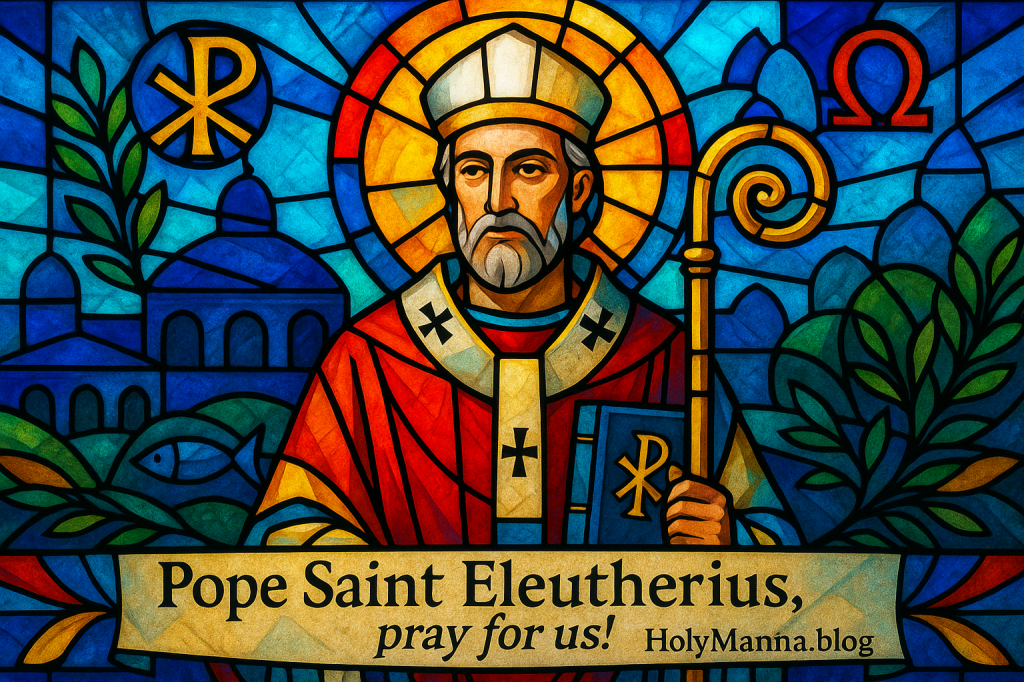
Keeper of Unity in a Fractured Age
Pope Saint Eleutherius shepherded the Church in the late second century, a time when the Christian community was growing across the Roman Empire while contending with internal confusion and external suspicion. He is remembered as a calm guardian of orthodoxy who resisted the errors of Gnosticism and Marcionism and helped the faithful hold together around the apostolic faith. His name is linked with a concise teaching on Christian freedom regarding foods and with a reputation for sensible, peace-seeking leadership. The Church commemorates him on May 26, inviting the faithful to thank God for pastors who preserve unity in truth.
From Deacon to Successor of Peter
Ancient tradition places Eleutherius’s origins in Epirus, in what is now northwestern Greece. As a young cleric in Rome, he served as a deacon under Pope Anicetus, which means he would have assisted at the heart of Church life in a bustling Christian community that welcomed travelers, merchants, and teachers from across the Mediterranean. This service formed him in the rhythms of charity, liturgy, and doctrine. After the death of Pope Soter, Eleutherius was chosen Bishop of Rome, likely around the years 174 to 177. He guided the Church into the reign of Emperor Commodus. While persecution flared in some regions, Rome itself experienced intervals of relative calm. Eleutherius’s background as a deacon is more than a detail. It shows how the papacy grows out of service at the altar and to the poor, preparing a man not merely to decide, but to discern and to love.
Guarding the Deposit: Teaching, Clarity, and Quiet Courage
Eleutherius’s pontificate is best understood through his defense of apostolic teaching. A tradition preserved in early papal notices credits him with affirming that Christians are not bound by ritual food prohibitions. This touches the core of the Gospel’s liberating claim that purity begins in the heart. Our Lord teaches in The Gospel of Mark: “Nothing that enters one from outside can defile that person.” (Mark 7:15) The apostolic Church echoes this in Acts of the Apostles and in Saint Paul’s exhortation that “everything created by God is good, and nothing is to be rejected if it is received with thanksgiving.” (1 Timothy 4:4–5) Eleutherius’s stance does not erase ascetic disciplines like fasting and abstinence, which the Church continues to commend for our sanctification. Instead, it protects the heart of Christian freedom so that discipline serves love and does not drift into dualistic suspicion of God’s good creation.
Eleutherius also lived during the spread of Montanism, a rigorist and ecstatic movement that raised difficult questions for bishops across the Mediterranean. Correspondence from the Churches of Lyons and Vienne shows how Rome’s counsel mattered for communities under pressure. Saints like Irenaeus worked to keep conversation with Rome strong and fraternal. Eleutherius’s contribution here was steady rather than spectacular. He fostered a response that sought truth while guarding communion, an approach that set the tone for later, clearer condemnations of error when necessary.
A beloved medieval story claims that a British king named Lucius wrote to Eleutherius asking for baptism. Scholars now judge this a pious legend, probably born from a textual confusion, but the tale expresses a true instinct about Eleutherius’s reputation. The Pope of Rome was seen as a father who could be asked for the light of the Gospel. That instinct remains at the heart of Catholic life.
The Grace of Governance: A Different Kind of Miracle
There are no widely attested accounts of Eleutherius working striking public miracles during his lifetime. The marvel to contemplate is the miracle of good governance. In an age crowded with competing teachings and charismatic claims, Eleutherius serves as a sign that the ordinary means of grace are extraordinary enough. He kept the Roman Church faithful to the apostles’ teaching, welcomed counsel from suffering communities like Lyons, and upheld a Eucharistic way of life that made sense of Christian freedom. His legacy calls us to see how truth, charity, and prudent judgment can bear fruits as wondrous as any sudden sign.
Trials Without Spectacle
Christians in various provinces suffered under Marcus Aurelius, and lingering hostility did not vanish overnight. Even when the Roman court was less aggressive, suspicion could surface quickly. Eleutherius’s trials were therefore daily and pastoral. They were the slow strain of resolving disputes, calming fears, and guarding the flock from divisive ideas. He endured these challenges by holding fast to the teaching of the apostles and by exercising a father’s patience toward the whole Church. He died in Rome, probably around the year 189. Early records place his burial near the tomb of Saint Peter on the Vatican Hill. His earthly life closes without drama, which is itself a testimony to a shepherd who spent his strength not on spectacle, but on fidelity.
After His Passing: Memory, Veneration, and a Clear Path
After his death, Eleutherius entered the grateful memory of the Church as one of the early popes who preserved the deposit of faith. He is honored in the Roman Martyrology, and his feast on May 26 continues to be kept in various calendars. Pilgrims who prayerfully visit the tombs of the early popes at Saint Peter’s Basilica and remember the line of succession from Peter often include Eleutherius among those for whom they give thanks. Specific posthumous miracle traditions are scarce, which only amplifies the point his life already made. The holiness that sustains the Church is not always accompanied by extraordinary signs. Sometimes it is nourished by patient leadership, right teaching, and the quiet endurance of a father in the faith.
Living the Lesson: Freedom Ordered to Love
Eleutherius helps us receive Catholic truth as a liberating gift. The New Covenant does not discard the Old but brings it to fulfillment. The Church’s moral and ascetical practices are not arbitrary rules. They are wise pathways that form us for love. As The Catechism of the Catholic Church teaches: “The Pope, Bishop of Rome and Peter’s successor… has full, supreme, and universal power over the whole Church.” (CCC 882) This service exists to protect our freedom in Christ from both legalism and license. The Magisterium is given to keep us close to the living Word: “This Magisterium is not superior to the word of God, but is its servant.” (CCC 86)
If you want to honor Eleutherius, receive the Church’s teaching with trust, especially in moments when culture is noisy and hearts are tempted by extremes. Fast and feast as the Church proposes. Let your freedom be shaped by the Eucharist, where you learn again that the good things of creation are ordered to divine love. Pray for your pastors. Ask for a share in Eleutherius’s patience when you face confusion at work, at home, or online. Choose the steady path of truth spoken in charity, and you will become a living sign of unity in your corner of the world.
Engage with Us!
Share your thoughts and prayer intentions in the comments. Tell us how this early pope’s quiet strength helps you today.
- Where do you sense God inviting you to live Christian freedom as humble fidelity rather than self-assertion?
- How does the Church’s Magisterium help you discern truth amid spiritual noise and competing voices?
- What concrete step can you take this week to guard unity in your parish, family, or small group?
- When have you experienced “quiet miracles” of good leadership that kept you on the path of faith?
May the witness of Pope Saint Eleutherius encourage you to live a life of faith, to trust the Church that Christ founded, and to do everything with the love and mercy Jesus taught us.
Pope Saint Eleutherius, pray for us!
Follow us on Instagram and Facebook for more insights and reflections on living a faith-filled life.

 Holy Manna!
Leave a comment