Saturday of the Twenty-second Week in Ordinary Time – Lectionary: 436
Grounded in Hope
If your heart is tired of striving, come and listen to the quiet promise of real rest in Christ. Today’s readings invite us to stand steady in the hope of the Gospel, to pray with confident trust, and to discover that true rest is not a rule but a relationship. In Colossians 1:21–23, Saint Paul looks us in the eye and says that once we were estranged, yet now Christ “has now reconciled [you] in his fleshly body through his death”, with a condition that protects the gift, “provided that you persevere in the faith, firmly grounded, stable, and not shifting from the hope of the gospel.” Perseverance is not mere grit. According to CCC 162, faith must be nourished by the Word, prayer, and the sacraments, and according to CCC 1817, hope leans on the promises of God rather than on our own strength. That is why Psalm 54 becomes the honest prayer on our lips: “O God, hear my prayer.” “God is present as my helper; the Lord sustains my life.” This posture of dependence clears the way for the Gospel scene in Luke 6:1–5, where Jesus is confronted over Sabbath observance. In first century Judaism, the Sabbath was cherished as a covenant sign, a weekly return to God’s rest from creation and a remembrance of Israel’s liberation. Over time, detailed applications of what counted as “work” grew around the command, so plucking and rubbing grain could be interpreted as reaping and threshing. Jesus recalls David eating the bread of the Presence and then reveals the heart of the matter: “The Son of Man is lord of the sabbath.” As CCC 2173 teaches, Christ does not abolish the Sabbath, He unveils its mercy and its orientation to life in Him. Put together, these texts teach one movement of the soul: reconciled by the Cross, we persevere in faith with a hope that prays boldly, and we find our Sabbath in the Person of Jesus who sustains and governs our rest. Where do you most need to stop striving and let the Lord of the Sabbath be your help today?
First Reading – Colossians 1:21–23
Hope That Holds You Steady
In Colossians, Saint Paul writes to a small Christian community in Colossae, a trade city in the Lycus Valley influenced by Hellenistic thought, local philosophies, and a blend of Jewish practices. The church faced pressures from teachings that diminished Christ’s sufficiency and encouraged severe observances that obscured the heart of the Gospel. Into this setting Paul proclaims that Christ’s death truly reconciles us and establishes us as holy before God. He insists that this reconciliation bears fruit only as we persevere, grounded and stable in hope. This message harmonizes with today’s theme. We are not saved by anxious striving but by communion with Christ, which becomes our true Sabbath rest. The First Reading shows how the Cross heals alienation and brings us into a life of steadfast faith that prays like the psalmist and rests in the Lord who is our help.
Colossians 1:21-23
New American Bible (Revised Edition)
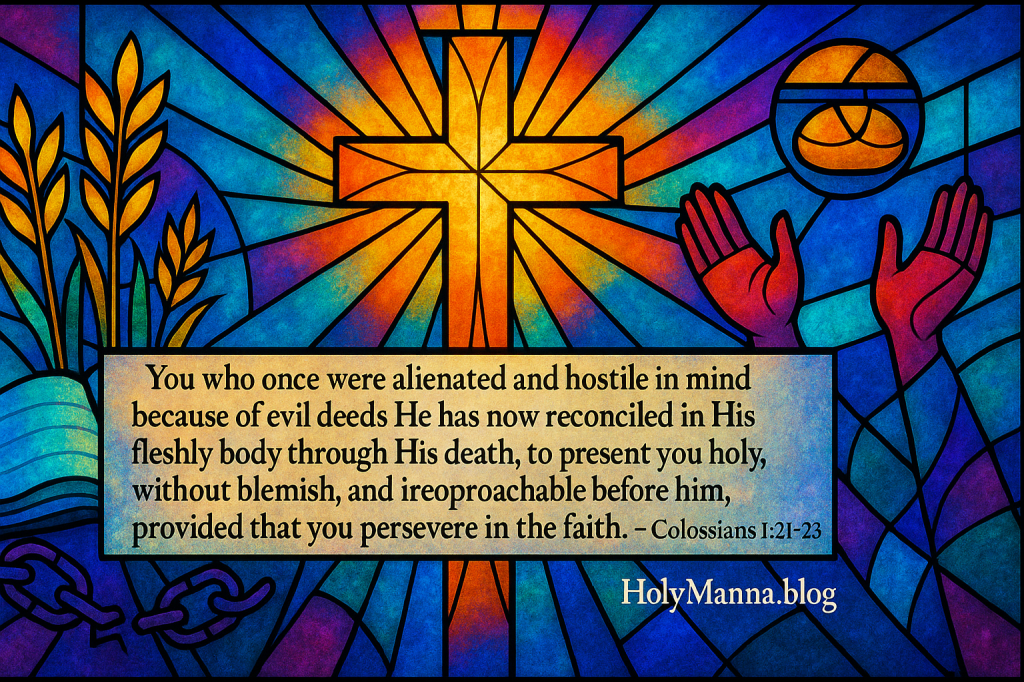
21 And you who once were alienated and hostile in mind because of evil deeds 22 he has now reconciled in his fleshly body through his death, to present you holy, without blemish, and irreproachable before him, 23 provided that you persevere in the faith, firmly grounded, stable, and not shifting from the hope of the gospel that you heard, which has been preached to every creature under heaven, of which I, Paul, am a minister.
Detailed Exegesis
Verse 21 – “And you who once were alienated and hostile in mind because of evil deeds”
Paul describes the human condition apart from Christ as alienation. The phrase “hostile in mind” signals that sin distorts more than behavior. It touches our thinking, our desires, and our worship. Alienation from God fractures relationships with others and within the self. The Church teaches that sin is more than a mistake. It sets us against God’s wisdom and love. Paul’s diagnosis prepares us to see reconciliation as a divine initiative, not a human self-help project.
Verse 22 – “he has now reconciled in his fleshly body through his death, to present you holy, without blemish, and irreproachable before him,”
Reconciliation occurs “in his fleshly body”, which underscores the Incarnation and the real, historical death of Jesus. The goal is not neutrality but sanctity. God intends to present us “holy, without blemish, and irreproachable”. This echoes Israel’s sacrificial language and reveals Christ as the true sacrificial mediator. The effect of the Cross is not only forgiveness but transformation. In the sacraments we are joined to this saving death and are made capable of a new life that mirrors the holiness of the One who saves.
Verse 23 – “provided that you persevere in the faith, firmly grounded, stable, and not shifting from the hope of the gospel that you heard, which has been preached to every creature under heaven, of which I, Paul, am a minister.”
The little phrase “provided that” does not cancel grace. It describes the path that grace creates. Perseverance is the daily fidelity that grace enables. To be “grounded” and “stable” suggests a well-founded building that does not drift with the cultural winds. The anchor is “the hope of the gospel.” Hope is not optimism. It is trust in Christ and his promises. Paul situates this hope within the Church’s universal proclamation. The Gospel is for “every creature under heaven”, and Paul’s ministry serves that catholic mission.
Teachings
The Catechism teaches: “Hope is the theological virtue by which we desire the kingdom of heaven and eternal life as our happiness, placing our trust in Christ’s promises and relying not on our own strength, but on the help of the grace of the Holy Spirit.” (CCC 1817). Our stability, therefore, rests on grace. The Catechism also teaches: “Our justification comes from the grace of God. Grace is favor, the free and undeserved help that God gives us to respond to his call to become children of God, adoptive sons, partakers of the divine nature and of eternal life.” (CCC 1996). Regarding the Sacrament of Penance, The Catechism states: “The whole power of the sacrament of Penance consists in restoring us to God’s grace and joining us with him in an intimate friendship.” (CCC 1468). The saints echo this synergy of grace and cooperation. Saint Augustine writes, “God who created you without you will not justify you without you.” Saint Thomas Aquinas adds, “Grace does not destroy nature but perfects it.”
Reflection
Reconciled hearts become steady hearts. If you have been drifting, let today be your return to the “hope of the gospel.” Make a concrete plan to persevere in faith. Begin with daily Scripture, even ten quiet minutes with Colossians 1:21–23. Entrust your sins to the mercy of Christ in a regular confession schedule. Receive the Eucharist with intentional preparation and thanksgiving. Build stability through simple rhythms. Pray a morning offering. Make an examen at night. Set a weekly hour of adoration. Pray the Rosary as a school of hope. Reconciliation is not a one time feeling. It is a relationship sustained by grace in the Church. Where do you sense alienation lingering in your mind or habits? What one step can you take today to become more grounded and stable in hope? How will you let the grace of reconciliation shape your next decision, conversation, or act of mercy?
Responsorial Psalm – Psalm 54:3–4, 6, 8
The Prayer That Perseveres
Psalm 54 is a Davidic lament traditionally linked to the betrayal by the Ziphites in 1 Samuel 23, where David turns to God rather than to retaliation. In Israel’s worship, psalms like this trained the heart to bring urgent need into the temple and to leave with a vow of thanksgiving. The psalm moves from petition to confidence to praise, which mirrors today’s theme of persevering in the hope of the Gospel and finding true rest in the Lord who sustains us. The invocation of the divine Name, the confession that God is our helper, and the promise of sacrificial thanksgiving all prepare us to live a stable and grounded faith that prays as it hopes and rests as it trusts.
Psalm 54:3-4, 6, 8
New American Bible (Revised Edition)
3 O God, by your name save me.
By your strength defend my cause.
4 O God, hear my prayer.
Listen to the words of my mouth.
6 God is present as my helper;
the Lord sustains my life.
Then I will offer you generous sacrifice
and give thanks to your name, Lord, for it is good.
Detailed Exegesis
Verse 3 – “O God, by your name save me. By your strength defend my cause.”
To pray “by your name” is to call upon God’s revealed identity and faithful presence. In biblical thought the name signifies the person. David asks that God’s covenant faithfulness become his rescue. The legal flavor of “defend my cause” places God as the just judge who vindicates the innocent. Christian prayer inherits this logic in the holy Name of Jesus, which literally means “God saves.” The verse teaches us to locate our deliverance not in our skill but in God’s character.
Verse 4 – “O God, hear my prayer. Listen to the words of my mouth.”
The parallel pleas intensify humble dependence. Prayer is not magic. It is relationship. The psalmist speaks plainly and trusts that God is attentive. The repetition models perseverance that refuses to quit asking, not because God is reluctant but because the heart is learning to lean on Him with filial confidence.
Verse 6 – “God is present as my helper; the Lord sustains my life.”
The lament pivots to faith. God is not a distant spectator but an active helper who upholds life. The verb “sustains” implies continual care, not a one time fix. Read with Colossians 1:22–23, the verse resonates with the promise that God not only reconciles us but stabilizes us. Our steadiness is grace in action. The Church will later echo this sustenance in the Eucharist, where Christ feeds and strengthens His people.
Verse 8 – “Then I will offer you generous sacrifice and give thanks to your name, Lord, for it is good.”
The psalm ends with a vow of thanksgiving. Gratitude seals trust. The “generous sacrifice” is not a bargain but a freely offered response to God’s faithful help. Praise of the divine Name is the fitting completion of petition. Suffering is real, yet praise is possible because God’s goodness is greater than our danger.
Teachings
The Catechism defines prayer with the Church’s ancient clarity: “Prayer is the raising of one’s mind and heart to God or the requesting of good things from God.” (CCC 2559). Petition rightly ordered becomes praise, which The Catechism calls the most immediate recognition of who God is: “Praise is the form of prayer which recognizes most immediately that God is God. It lauds God for his own sake, gives him glory, quite beyond what he does, but simply because HE IS.” (CCC 2639). Hope drives such persevering prayer: “Hope is the theological virtue by which we desire the kingdom of heaven and eternal life as our happiness, placing our trust in Christ’s promises and relying not on our own strength, but on the help of the grace of the Holy Spirit.” (CCC 1817). God’s sustaining help reaches its summit in the Eucharist, for “The Eucharist is ‘the source and summit of the Christian life.’” (CCC 1324). The saints testify to the same movement from plea to praise. Saint Augustine confesses, “You have made us for yourself, O Lord, and our heart is restless until it rests in you.” (Confessions I.1). Saint Teresa of Ávila strengthens perseverance with her counsel: “Let nothing disturb you, let nothing frighten you, all things are passing; God never changes. Patience obtains all things. Whoever has God lacks nothing; God alone suffices.”
Reflection
When fear rises, let your prayer take the shape of Psalm 54: invoke the Name, speak plainly, confess that God sustains you, and promise thanksgiving in advance. Begin your day with a brief act of hope, naming one concrete situation where you need God’s help, and conclude your day by thanking Him for one specific mercy received. If you can, visit the Blessed Sacrament this week and let Christ’s presence steady your heart. Bring a small thanksgiving offering of time or service to someone in need as your “generous sacrifice.” Where do you need to move from anxious pleading to trusting praise? What would it look like to let God’s help sustain your schedule rather than your schedule sustain you? How will you give thanks to the Lord’s Name today because He is good?
Holy Gospel – Luke 6:1–5
Mercy That Feeds the Hungry
In The Gospel of Luke, Jesus walks with His disciples through grainfields on the Sabbath. The scene unfolds within Second Temple Judaism, where Sabbath rest was a sacred covenant sign rooted in creation and the Exodus. Oral interpretations developed practical “fences” around the command to avoid work. Simple acts like plucking and rubbing grain could be construed as reaping and threshing. Jesus answers the objection by invoking David’s need in 1 Samuel 21 and by revealing His divine authority. He shows that the Sabbath is ordered to life, mercy, and communion with God. This directly serves today’s theme: we persevere in the hope of the Gospel and find true rest not in anxious legalism but in the Person of Christ who reconciles and sustains us.
Luke 6:1-5
New American Bible (Revised Edition)
Debates About the Sabbath. 1 While he was going through a field of grain on a sabbath, his disciples were picking the heads of grain, rubbing them in their hands, and eating them. 2 Some Pharisees said, “Why are you doing what is unlawful on the sabbath?” 3 Jesus said to them in reply, “Have you not read what David did when he and those [who were] with him were hungry? 4 [How] he went into the house of God, took the bread of offering, which only the priests could lawfully eat, ate of it, and shared it with his companions.” 5 Then he said to them, “The Son of Man is lord of the sabbath.”
Detailed Exegesis
Verse 1 – “While he was going through a field of grain on a sabbath, his disciples were picking the heads of grain, rubbing them in their hands, and eating them.”
The disciples’ hunger introduces the tension. Deuteronomy 23:25 allowed a traveler to pluck heads of grain by hand from a neighbor’s field. The question here is not theft but Sabbath activity. Jesus does not forbid His disciples. He permits a simple, human need to be met, preparing the revelation that the law’s purpose is life with God.
Verse 2 – “Some Pharisees said, ‘Why are you doing what is unlawful on the sabbath?’”
The Pharisees seek fidelity to God’s law. Their question reflects a sincere zeal shaped by customary applications of Sabbath prohibitions. Luke lets us feel the weight of this devotion, so that when Jesus responds He does not abolish the Sabbath but returns it to God’s intention. The issue is not whether the Sabbath is holy. It is how the holy day serves human life in God.
Verse 3 – “Jesus said to them in reply, ‘Have you not read what David did when he and those [who were] with him were hungry?’”
Jesus employs a recognized rabbinic strategy: Scripture interprets Scripture. By recalling David in need, He frames necessity and mercy as legitimate lenses for understanding the law. He quietly signals His messianic identity. If David’s royal need guided priestly bread to laymen in extremis, how much more may the Messiah shepherd His disciples in hunger.
Verse 4 – “[How] he went into the house of God, took the bread of offering, which only the priests could lawfully eat, ate of it, and shared it with his companions.”
The “bread of offering,” the bread of the Presence in Leviticus 24:5–9, was reserved for priests as a sign of God’s covenant hospitality. David’s reception of it in dire need becomes a precedent of mercy. Jesus applies this pattern to show that ritual law, while sacred, is ordered to the higher good of life and charity. The moment also hints toward the Eucharist, where Christ Himself becomes our bread for the journey.
Verse 5 – “Then he said to them, ‘The Son of Man is lord of the sabbath.’”
This climactic claim evokes Daniel 7’s “Son of Man” and asserts Christ’s authority to interpret God’s command. He is not one exegete among many. He is the Lord who fulfills the Sabbath by giving its true rest. In Him the weekly sign meets its substance. Rest is no longer a mere cessation from labor. It is participation in the life of the Lord.
Teachings
The Catechism explains the Lord’s interpretation of the Sabbath: “The Gospel reports many incidents when Jesus was accused of violating the sabbath law. But Jesus never fails to respect the holiness of this day. He gives this law its authentic and authoritative interpretation: ‘The sabbath was made for man, not man for the sabbath.’ With compassion, Christ declares the sabbath for doing good rather than harm, for saving life rather than killing.” (CCC 2173). The Church also teaches how the Lord’s Day fulfills the Sabbath: “Sunday is expressly distinguished from the sabbath which it follows chronologically every week; for Christians its ceremonial observance replaces that of the sabbath. In Christ’s Passover, Sunday fulfills the spiritual truth of the Jewish sabbath and announces man’s eternal rest in God.” (CCC 2175). This fulfillment requires a lived reverence: “On Sundays and other holy days of obligation the faithful are to refrain from engaging in work or activities that hinder the worship owed to God, the joy proper to the Lord’s Day, the performance of the works of mercy, and the appropriate relaxation of mind and body.” (CCC 2185). These teachings show that Christ’s lordship leads not to laxity but to a rightly ordered rest filled with worship and mercy. The saints echo this. Saint Augustine teaches that our rest is found in God alone: “You have made us for yourself, O Lord, and our heart is restless until it rests in you.” (Confessions I.1).
Reflection
The Lord of the Sabbath meets you in your real hunger. Let Him order your rest. Set apart Sunday for worship at Mass, for family communion, for works of mercy, and for genuine leisure that restores your soul. Examine your weekly rhythms to see where a rigid rule eclipses mercy or where busyness erodes worship. Choose one concrete practice that honors Christ’s lordship, such as a digital fast on Sunday afternoon or a family visit to someone who is lonely. Where is Jesus inviting you to let mercy interpret your rules rather than your rules smother mercy? How can you allow Sunday to become a living encounter with the Risen Lord rather than a catch up day? What hunger is He asking you to bring to Him today so that He can feed you with His rest?
Grounded in Hope, Fed by Mercy
Today’s Word traces one beautiful arc. In Colossians 1:21–23 we hear that Christ “has now reconciled [you] in his fleshly body through his death, to present you holy, without blemish, and irreproachable before him”, and we are urged to remain “firmly grounded, stable,” in the hope of the Gospel. Psalm 54 gives that hope a voice, teaching us to pray with trust until it becomes praise: “God is present as my helper; the Lord sustains my life.” In Luke 6:1–5 Jesus reveals the heart of that hope and the purpose of our rest: “The Son of Man is lord of the sabbath.” Held together, these readings proclaim that reconciliation is pure gift, perseverance is grace in action, and true rest is found in communion with the Lord who feeds hungry hearts with mercy.
Let this be your call to action. Anchor your week in Sunday Mass and let Jesus order your rest. Return to confession and let reconciliation become your steady rhythm. Pray Psalm 54 when fear rises and turn thanksgiving into your daily habit. Practice works of mercy that flow from worship, and choose one concrete way to let Christ sustain you today, such as a quiet visit before the tabernacle or fifteen minutes with the Scriptures. Where do you need to become more “grounded and stable” in hope this week? How will you let the Lord of the Sabbath lead you into a rest that heals and a mercy that serves?
Engage with Us!
We would love to hear from you in the comments below. Share how the Lord is speaking to you through today’s readings and how you plan to respond in faith.
- First Reading (Colossians 1:21–23): Where do you notice patterns of alienation in your thoughts or habits, and what concrete step will you take this week to persevere in faith and remain grounded in hope? How is the grace of reconciliation inviting you to a specific sacramental or prayer practice right now?
- Responsorial Psalm (Psalm 54:3–4, 6, 8): Where do you most need to move from anxious pleading to trusting praise, allowing God to sustain your life? What “generous sacrifice” of thanksgiving can you offer this week in response to God’s help, and whom might you serve as a living act of praise?
- Holy Gospel (Luke 6:1–5): How will you honor the Lord’s Day with worship, mercy, and true rest that restores communion with God and neighbor? Where is Jesus inviting you to let mercy interpret your rules and to feed real hunger in your home, parish, or neighborhood?
Take courage and walk in the hope of the Gospel. Rest in Christ who is Lord of the Sabbath. Live a life of faith, and do everything with the love and mercy Jesus taught us.
Sacred Heart of Jesus, we trust in You!
Immaculate Heart of Mary, pray for us!
Saint Michael the Archangel, defend us in battle!
Follow us on Instagram and Facebook for more insights and reflections on living a faith-filled life.

 Holy Manna!
Leave a comment