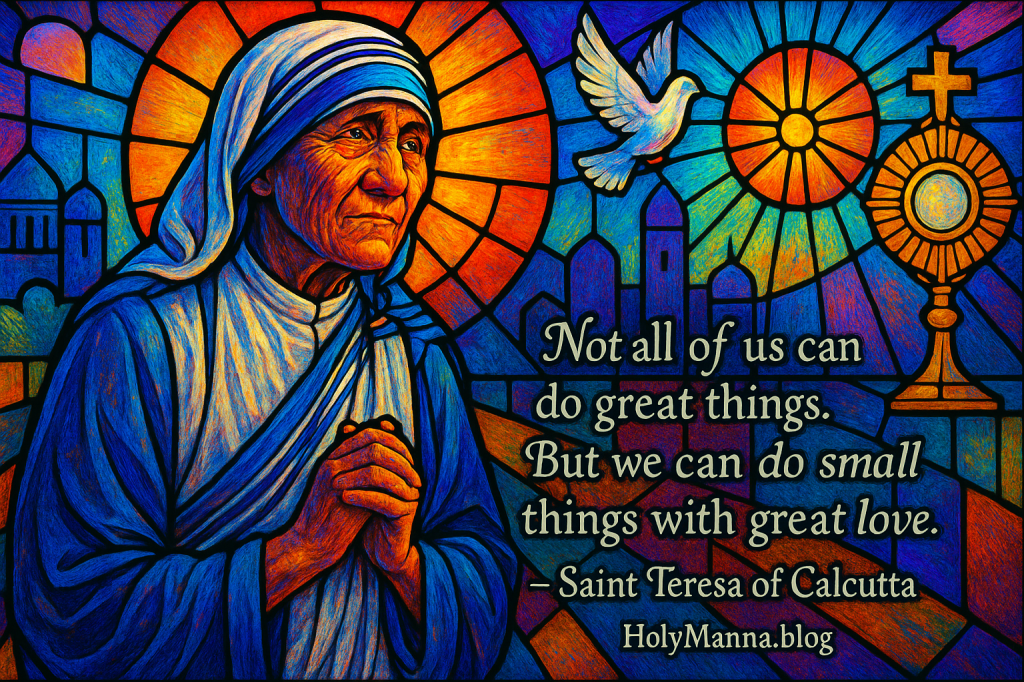
A Heart Ablaze for Jesus’ Thirst
Saint Teresa of Calcutta, known to the world as Mother Teresa, lived from 1910 to 1997 and became a universal icon of Christian charity. She founded the Missionaries of Charity to serve Christ in the poorest of the poor and to respond to Jesus’ words from the Cross, “I thirst.” Her witness of Eucharistic devotion, tender love for the forgotten, and uncompromising defense of human life continues to move consciences across cultures and nations. She received global recognition for peace and humanitarian service, yet she consistently insisted that the glory belongs to God and that every act of love must begin at home, in our families and parishes. She was beatified in 2003 and canonized in 2016, and the Church celebrates her memorial on September 5. Her life remains a living commentary on the Gospel and on the Church’s teaching in The Catechism of the Catholic Church that charity is the soul of holiness and the heart of Christian witness.
The Call Within the Call
Gonxha Agnes Bojaxhiu was born in Skopje to Albanian parents and was baptized soon after birth. Her father died when she was a child, and her mother, Drana, formed her in a home of prayer, hospitality, and mercy. As a teenager she joined a Marian sodality at her Jesuit parish and developed a missionary desire. At the age of eighteen she left home to join the Sisters of Loreto. She arrived in India in 1929, professed vows, and took the name Teresa after Saint Thérèse of Lisieux. She taught geography at St. Mary’s School in Calcutta and was known for cheerfulness, discipline, and a deep love for the Sacred Heart of Jesus. On September 10, 1946, during a train ride to Darjeeling, she experienced what she later called a “call within a call,” an interior invitation from Jesus to leave the convent and serve Him among those who suffered on the streets. With ecclesial permission she exchanged the Loreto habit for a simple white sari with blue borders and began to live among the poor. In 1950 the Missionaries of Charity were established in Calcutta with the mission to satiate the thirst of Jesus for love and souls through service to the most abandoned.
Love Made Visible
Mother Teresa’s daily pattern flowed from the altar to the alleys. She and her sisters began each morning with Holy Mass, Eucharistic adoration, and the Rosary. From there they moved into the city to bathe wounds, cradle infants, visit the dying, and bring the tenderness of Christ to those most likely to be forgotten. They opened Nirmal Hriday, the Home for the Dying, near the Kali Temple so that the destitute could die with dignity, a clean bed, and a hand that held their hand while whispering prayers of hope. They founded Shishu Bhavan to receive abandoned children, and Shanti Nagar to accompany those affected by leprosy with healthcare, work, and friendship. Later homes welcomed people living with HIV and AIDS. The family grew to include the Missionaries of Charity Brothers, contemplative branches, priest associates, and lay Co-Workers who carried the same spirit into their ordinary lives. She was frequently invited to speak across the world, but she always returned to the bedside and the street corner, repeating her simple formula of holiness. “Not all of us can do great things. But we can do small things with great love.”
Wonders of Providence
Mother Teresa did not present herself as a wonder-worker. She insisted that the real miracle is the conversion of a human heart to love. Yet the world often saw providential moments surrounding her mission. During the Lebanon conflict in 1982, a fragile pause in fighting allowed her and her team to cross a dangerous zone to evacuate vulnerable children to safety. Many considered this an answer to prayer and an intervention of God’s peace. Countless personal testimonies tell of physical, emotional, and spiritual healings after a visit to one of her homes or a conversation in which she urged a person to forgive, to reconcile, or to return to the sacraments. Her own words cut to the core of the Gospel. “If you cannot feed a hundred people, then feed just one.” Her witness made charity concrete and attainable for every Christian.
The Night and the Cross
Mother Teresa was not a martyr, yet she drank deeply from the chalice of Christ’s Passion. After her death, letters revealed that she endured a long interior darkness, a painful absence of felt consolation that lasted for years. This did not diminish her faith. It purified it. She held fast to Jesus in the Eucharist and identified with His cry, “I thirst.” Physically she suffered from heart problems, extreme fatigue, and the burdens of leadership as the congregation expanded into many countries. She also accepted criticism and misunderstanding with humility, choosing silence, prayer, and perseverance. “I have found the paradox, that if you love until it hurts, there can be no more hurt, only more love.” Her endurance teaches us that sanctity does not depend on constant spiritual sweetness, but on a steady act of love offered in trust.
Heaven’s Seal
The Church recognized two posthumous miracles through her intercession. The first involved the sudden healing of a woman in India who suffered from a serious abdominal tumor. After prayers seeking Mother Teresa’s intercession and the placing of a medal on the afflicted area, the tumor was found to be gone, leading to her beatification in 2003. The second miracle concerned a Brazilian man who suffered from severe brain abscesses. As his family and parish prayed through Mother Teresa’s intercession, he recovered unexpectedly and fully, allowing for his return to family life and the gift of children. These signs are the Church’s confirmation that her charity on earth flowers now in powerful intercession in heaven. The faithful continue to report graces, conversions, and healings when they ask her to pray for them.
Where Mercy Keeps Shining
Mother Teresa died on September 5, 1997, and was given a state funeral in India. Her tomb rests at the Mother House of the Missionaries of Charity in Kolkata, where pilgrims gather daily to pray, volunteer, and draw strength for their own vocations. Her simple room is preserved as a reminder that holiness grows in the soil of ordinary fidelity. Homes founded in her charism operate on every continent, and the sisters remain a recognizable sign of hope in their white saris with blue trim. The United Nations chose September 5 as the International Day of Charity in her honor, inviting the world to renew a culture of generosity and service. Many parishes, schools, and charity centers bear her name, and her words continue to inspire apostolates that place the Eucharist and the poorest at the center.
Why She Matters for Us
Saint Teresa’s life illuminates the heart of Catholic doctrine on charity and human dignity. The Catechism of the Catholic Church teaches that love for the poor is a requirement of justice and charity and that the works of mercy are a privileged path to holiness. Her entire spirituality can be summarized as seeing and serving Jesus in the distressing disguise of the poor while drawing strength from Jesus truly present in the Eucharist. She defended the sanctity of every human life from conception to natural death. “I feel the greatest destroyer of peace today is abortion.” She also urged Catholics to love their own families and neighbors with the same intensity that sends missionaries across oceans. Her witness invites us to examine our choices, our use of time and money, and our willingness to forgive and to begin again.
Living Her Lesson Today
Begin at the altar. If possible, attend Mass during the week or spend time before the Blessed Sacrament. Let adoration shape your gaze so that you can recognize Christ in the next person you meet. Choose one concrete work of mercy this week and do it with joy. Visit someone who is lonely. Bring a meal to a neighbor who is sick. Offer to pray with a co-worker who is anxious. Keep a simple rule in your home: smile, speak gently, and serve first. When discouragement comes, remember her counsel, “Do small things with great love.” Ask Saint Teresa of Calcutta to intercede for you so that your ordinary day becomes a field of extraordinary grace.
Engage with Us!
Share your thoughts and experiences in the comments below—your story may encourage someone else to love boldly in Christ.
- Where do you most clearly hear Jesus whisper “I thirst” in your daily life?
- Which work of mercy will you practice this week, and how?
- How does Saint Teresa’s fidelity amid spiritual darkness challenge your understanding of holiness?
- Who is the “poorest of the poor” in your world today, and what concrete step of love can you take?
- How can your parish or family become a more intentional school of mercy?
Go forth encouraged. Live a life of faith, and do everything with the love and mercy Jesus taught us.
Saint Teresa of Calcutta, pray for us!
Follow us on Instagram and Facebook for more insights and reflections on living a faith-filled life.

 Holy Manna!
Leave a comment