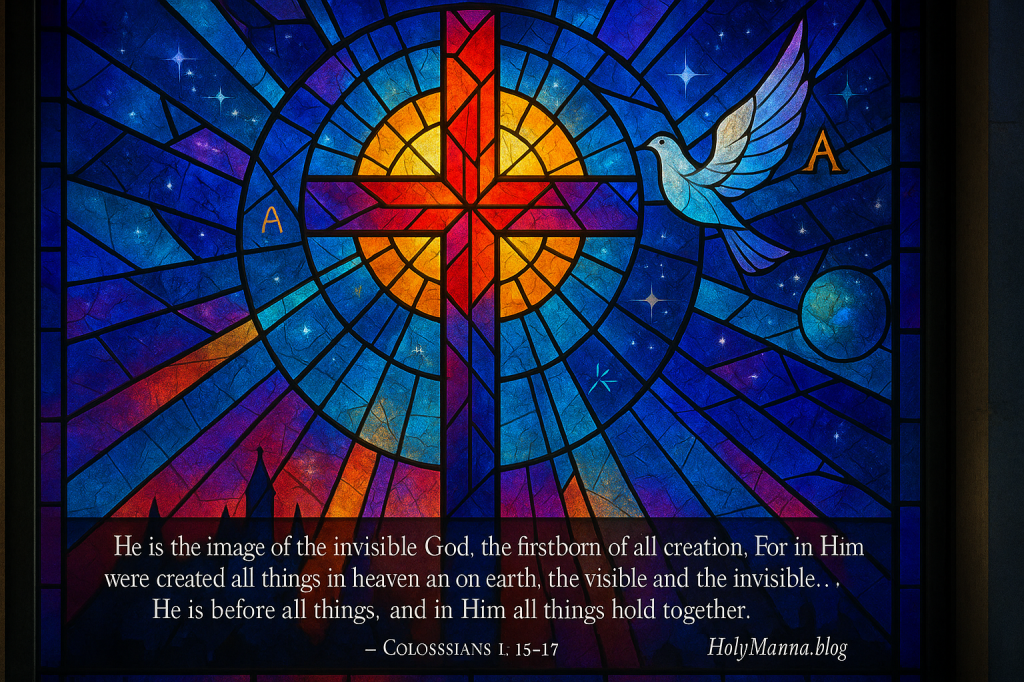
Friday of the Twenty-second Week in Ordinary Time – Lectionary: 435
New Wine for a New Creation
Come close and let your heart rest in the presence of Christ, the Bridegroom, whose victory over sin and death fills the Church with joy and asks for a renewed heart to receive His grace. Today’s readings trace a single arc: the cosmic preeminence of Jesus, the public celebration of God’s saving work, and the breakthrough of the New Covenant that cannot be squeezed into old habits. In Colossians 1:15-20, the Church preserves what many scholars recognize as an early Christological hymn, proclaiming Jesus as “the image of the invisible God” and the one “in [whom] all things hold together”, through whose Cross all creation is reconciled. This is not mere poetry. It is the foundation of our identity as His Body and Bride, a truth the Church confesses in CCC 792-796. The response is spontaneous doxology. Psalm 98:2-6 invites the world to see and sing, because “All the ends of the earth have seen the victory of our God” and the only fitting answer is trumpet sound, lyre, and loud praise before the King. Then the Gospel situates that praise within the rhythms of discipleship. In Luke 5:33-39, questions about fasting meet a startling claim: “Can you make the wedding guests fast while the bridegroom is with them?” The image is deeply Jewish and deeply nuptial. Weddings were days of feasting, not fasting, and wineskins of supple leather were needed to hold fermenting wine. So Jesus teaches that “new wine must be poured into fresh wineskins”, revealing that His presence inaugurates the New Covenant, the grace-filled law of the Spirit that transforms the heart, as taught in CCC 1969. There will be a time for fasting when the Bridegroom is taken away, and the Church embraces that discipline as part of her love for Christ, in line with CCC 1438. Held together, these readings announce a single theme: Christ the Bridegroom, Head of the Church, brings the newness of divine life to a reconciled creation, and He invites us to rejoice, to be renewed, and to adopt practices that match His living presence among us. How is Jesus inviting you today to become a “fresh wineskin” who welcomes His new wine with joyful praise and faithful discipline?
First Reading: Colossians 1:15-20
Christ the Image, Head, and Reconciler of All Things
In the Lycus Valley city of Colossae, a young Christian community faced pressures from religious syncretism and speculative teachings about angelic powers. Into this setting, Colossians preserves what many scholars regard as an early Christian hymn that proclaims the absolute primacy of Jesus Christ. He is not one spiritual power among many. He is the eternal Son through whom all things were made and by whom all things are reconciled. This hymn anchors the Church’s confession that Christ is Head of the Body and Bridegroom of the Church, and it prepares us to receive the Gospel’s call to become fresh wineskins for the new wine of grace. Within today’s theme, this reading announces that the Bridegroom’s presence is cosmic in scope and cruciform in character. His victory is not a private experience. It is the new creation unfolding in Him, inviting our worship and our conversion.
Colossians 1:15-20
New American Bible (Revised Edition)
His Person and Work
15 He is the image of the invisible God,
the firstborn of all creation.
16 For in him were created all things in heaven and on earth,
the visible and the invisible,
whether thrones or dominions or principalities or powers;
all things were created through him and for him.
17 He is before all things,
and in him all things hold together.
18 He is the head of the body, the church.
He is the beginning, the firstborn from the dead,
that in all things he himself might be preeminent.
19 For in him all the fullness was pleased to dwell,
20 and through him to reconcile all things for him,
making peace by the blood of his cross
[through him], whether those on earth or those in heaven.
Detailed Exegesis
Verse 15 – “He is the image of the invisible God, the firstborn of all creation.”
Paul declares that Jesus makes the unseen God visible. The term image evokes Genesis, where humanity is made in God’s image. Christ is the perfect Image who reveals the Father fully and restores the image in us. “Firstborn” does not mean created. It is a title of rank and inheritance. Christ is supreme over creation, not part of it.
Verse 16 – “For in him were created all things in heaven and on earth, the visible and the invisible, whether thrones or dominions or principalities or powers; all things were created through him and for him.”
Every order of reality, including spiritual hierarchies that fascinated the ancient world, originates in Christ, is sustained through Him, and finds its goal in Him. This dismantles any tendency to ascribe ultimate significance to cosmic powers. Christ is the Creator and telos of all that exists.
Verse 17 – “He is before all things, and in him all things hold together.”
Christ’s preexistence affirms His divinity. He is not an afterthought to creation but its ground and glue. The phrase “hold together” suggests continuous dependence. Your life, your work, and the Church’s mission coheres in Him. Apart from Him, things fragment.
Verse 18 – “He is the head of the body, the church. He is the beginning, the firstborn from the dead, that in all things he himself might be preeminent.”
Headship identifies Christ as source and ruler of the Church’s life. “Firstborn from the dead” names the Resurrection as the dawn of the new creation. His Paschal victory secures His primacy in all things and establishes the Church as His living Body animated by His Spirit.
Verse 19 – “For in him all the fullness was pleased to dwell,”
“All the fullness” points to the fullness of divinity. The Godhead dwells in Christ in a permanent and personal way. The covenant presence that once filled the Temple now resides bodily in the Son. He is Emmanuel, God with us.
Verse 20 – “and through him to reconcile all things for him, making peace by the blood of his cross, whether those on earth or those in heaven.”
Reconciliation is universal in scope and cruciform in means. Peace is not achieved by power politics or mere sentiment. It is forged by the blood of the Cross. Creation’s fractures are healed in the self-giving love of the Son who gathers all things into unity.
Teachings
Christ’s primacy over creation and His headship of the Church are central to Catholic faith. The Church Fathers and the Catechism bear witness to this mystery. CCC 795 quotes Saint Augustine to express our union with Christ in His Body: “Let us rejoice then and give thanks that we have become not only Christians, but Christ.” This line encapsulates the intimacy of Head and members, a communion that flows from Christ’s fullness dwelling in Him and shared with us. In the same vein, the Church teaches the nuptial bond between Christ and His Church, rooting our identity in His personal love and lordship, as summarized in CCC 792-796. The goal of the Incarnation is our participation in divine life, beautifully voiced by Saint Athanasius in a line echoed by CCC 460: “For the Son of God became man so that we might become God.” Christ is therefore both the pattern and the power of the new creation. His Resurrection makes Him “firstborn from the dead,” and His Cross is the instrument of universal reconciliation. The hymn in Colossians places worship, doctrine, and mission in right order. We adore Christ as Lord of all, we confess His divinity without compromise, and we serve His reconciling peace in the world.
Reflection
Christ is not an accessory to your life. He is the one in whom your life holds together. Begin with adoration. Set time each day to acknowledge His preeminence with real silence and real praise. Ask where fragmentation has entered your relationships, work, or interior life, and bring those places consciously under His lordship. Choose one concrete act of reconciliation this week, such as initiating a difficult but gentle conversation, seeking the Sacrament of Reconciliation, or repairing a neglected duty. Let your prayer be shaped by this hymn. Repeat it slowly and allow its phrases to reorder your desires. Where do you need Christ to hold things together today? What must yield in you so that His preeminence is more than a word? How can you participate in His reconciling peace by a specific act of love before the day ends?
Responsorial Psalm: Psalm 98:2-6
Sing the King’s Victory to the Ends of the Earth
Composed as an enthronement hymn, Psalm 98 celebrates the Lord as universal King whose saving deeds are visible before the nations. Israel’s liturgy bore public witness that God’s covenant faithfulness is not a private favor but a revelation meant for all peoples. Instruments, voices, and joyful shouts turn salvation into a festival. In today’s theme, this psalm is the Church’s response to the cosmic Christ of Colossians 1:15-20: the Bridegroom’s victory is proclaimed so that all creation may rejoice. The music of praise becomes our fresh wineskin, expanding our hearts to receive the new wine of grace revealed in Christ.
Psalm 98:2-6
New American Bible (Revised Edition)
2 The Lord has made his victory known;
has revealed his triumph in the sight of the nations,
3 He has remembered his mercy and faithfulness
toward the house of Israel.
All the ends of the earth have seen
the victory of our God.
4 Shout with joy to the Lord, all the earth;
break into song; sing praise.
5 Sing praise to the Lord with the lyre,
with the lyre and melodious song.
6 With trumpets and the sound of the horn
shout with joy to the King, the Lord.
Detailed Exegesis
Verse 2 – “The Lord has made his victory known; has revealed his triumph in the sight of the nations,”
The psalmist announces a public epiphany of God’s saving power. Salvation is not hidden. It is manifest “in the sight of the nations”, prefiguring the Gospel’s universal mission. In Christ, this victory is definitive, since in Him “all things hold together” and reconciliation is accomplished in the blood of the Cross. The Church sings because the victory is already revealed, even as we await its full consummation.
Verse 3 – “He has remembered his mercy and faithfulness toward the house of Israel. All the ends of the earth have seen the victory of our God.”
“Remembered” evokes covenant fidelity. God’s steadfast love for Israel becomes a sign for the world. The second line widens the lens from Israel to the nations. In the New Covenant, this promise reaches its apex as the Church, the Body and Bride of Christ, bears witness that the mercy shown to Israel is for all. The psalm’s geography stretches from Zion to the earth’s ends, matching the scope of Christ’s reconciliation.
Verse 4 – “Shout with joy to the Lord, all the earth; break into song; sing praise.”
Joyful noise is not emotional excess. It is the fitting response to God’s manifest deeds. The imperatives form a liturgical call to action that engages body and voice. Christian worship inherits this command, inviting the whole person to praise. Interior faith flowers into audible thanksgiving that strengthens communion and mission.
Verse 5 – “Sing praise to the Lord with the lyre, with the lyre and melodious song.”
Instruments serve the Word by adorning it with beauty. The lyre symbolizes crafted human skill offered back to God. Sacred music is not a performance for its own sake. It is a sacrifice of praise that orders artistry to adoration, evangelization, and the sanctification of the faithful.
Verse 6 – “With trumpets and the sound of the horn shout with joy to the King, the Lord.”
Trumpets and horn signal royal presence. The verse names God explicitly as King, uniting political imagery to divine sovereignty. For Christians, this kingship is revealed in the crucified and risen Bridegroom. Our praise acknowledges His lordship over history and our lives, and it trains our desires to rejoice in His reign.
Teachings
The Church understands the Psalms as the formative school of prayer. CCC 2587 teaches: “The Psalter is the book in which the Word of God becomes man’s prayer.” In the psalms, God gives us the words by which we answer Him, so our praise, lament, and thanksgiving are shaped by divine revelation. Sacred music serves this dialog of salvation. CCC 1156 affirms: “The musical tradition of the universal Church is a treasure of inestimable value, greater even than that of any other art.” Music is placed at the service of the Word, enabling the whole assembly to participate in the mystery celebrated. Praise, at its core, is an act of adoration. CCC 2096 states: “Adoration is the first act of the virtue of religion.” To adore is to acknowledge God as Creator and Lord, which Psalm 98 makes concrete by calling all the earth to rejoice before the King. By singing the Lord’s victory, the Church bears public witness that Christ’s reconciliation of all things is real and operative in history, harmonizing with the universal scope proclaimed in Colossians 1:15-20 and the nuptial joy revealed in Luke 5:33-39.
Reflection
Let this psalm train your heart to praise with both conviction and joy. Choose one concrete moment today to make God’s victory visible, such as singing a hymn slowly in prayer, offering a short act of thanksgiving before a task, or speaking a simple word that points someone to Christ’s goodness. Allow beauty to lead you into adoration rather than distraction, and let your voice become part of the Church’s worldwide chorus. Where can you publicly acknowledge God’s mercy today with a word of praise or a work of love? How might you let sacred music accompany your prayer so that your heart expands to receive Christ’s new wine? What area of your life needs to come under the joyful kingship of the Lord so that your praise is honest and whole?
Holy Gospel: Luke 5:33-39
The Bridegroom’s Joy and the New Wineskins of the Heart
In the world of first century Judaism, faithful Israelites fasted regularly as a sign of repentance and expectant hope. Pharisaic groups often fasted twice weekly, and even the disciples of John practiced penitential fasting as they prepared for the coming Messiah. Weddings, however, were different. They were weeklong feasts of covenant joy, and fasting would have contradicted the very purpose of the celebration. Into this cultural setting, Jesus identifies Himself as the Bridegroom of Israel, revealing that in His saving presence the long awaited wedding has begun. Today’s theme highlights Christ’s cosmic preeminence and nuptial joy, so this Gospel shows how His arrival demands a new interior capacity, new wineskins, for the new wine of the New Covenant. The joy of the Bridegroom does not abolish fasting. It reorders it, so that after His Paschal “being taken away”, the Church fasts in love and hope, and lives by the grace of the Spirit that cannot be contained by old patterns.
Luke 5:33-39
New American Bible (Revised Edition)
33 And they said to him, “The disciples of John fast often and offer prayers, and the disciples of the Pharisees do the same; but yours eat and drink.” 34 Jesus answered them, “Can you make the wedding guests fast while the bridegroom is with them? 35 But the days will come, and when the bridegroom is taken away from them, then they will fast in those days.” 36 And he also told them a parable. “No one tears a piece from a new cloak to patch an old one. Otherwise, he will tear the new and the piece from it will not match the old cloak. 37 Likewise, no one pours new wine into old wineskins. Otherwise, the new wine will burst the skins, and it will be spilled, and the skins will be ruined. 38 Rather, new wine must be poured into fresh wineskins. 39 [And] no one who has been drinking old wine desires new, for he says, ‘The old is good.’”
Detailed Exegesis
Verse 33 – “And they said to him, ‘The disciples of John fast often and offer prayers, and the disciples of the Pharisees do the same; but yours eat and drink.’”
The question compares religious practices to measure fidelity. Fasting and set prayers were hallmarks of serious devotion. The critique implies that Jesus is lax. The stage is set for Jesus to unveil the deeper reason behind authentic asceticism, which is communion with God in the time of fulfillment.
Verse 34 – “Jesus answered them, ‘Can you make the wedding guests fast while the bridegroom is with them?’”
Jesus frames His ministry as a wedding feast. To force fasting at a wedding would be a category error. By calling Himself the Bridegroom, He evokes Israel’s prophetic hope where God espouses His people. His presence signals that the covenant joy has arrived, which justifies the festive table fellowship of His disciples.
Verse 35 – “But the days will come, and when the bridegroom is taken away from them, then they will fast in those days.”
Here is a veiled prophecy of the Passion. The Church will enter seasons of fasting when the Bridegroom is “taken away”, especially in the Paschal fast and penitential times. Christian fasting therefore flows from love, not mere rule keeping. It imitates the self giving of Christ and sharpens desire for the Bridegroom’s return.
Verse 36 – “And he also told them a parable. ‘No one tears a piece from a new cloak to patch an old one. Otherwise, he will tear the new and the piece from it will not match the old cloak.’”
Patchwork piety fails. The grace of the New Covenant is not a scrap sewn onto an old garment of life. To try to graft Christ onto an unchanged heart damages both the gift and the receiver. A whole new garment is needed, which is a renewed life in the Spirit.
Verse 37 – “Likewise, no one pours new wine into old wineskins. Otherwise, the new wine will burst the skins, and it will be spilled, and the skins will be ruined.”
New wine ferments and expands. Old, rigid skins cannot stretch and so they burst. The image warns against attempting to contain the living dynamism of the Gospel within rigid patterns of self reliance or outdated forms that cannot bear the pressure of grace. The result is loss on both sides.
Verse 38 – “Rather, new wine must be poured into fresh wineskins.”
The imperative is clear. Interior renewal is not optional. Fresh wineskins symbolize converted hearts, supple and teachable, able to expand with the movements of the Spirit. Discipleship requires practices and structures that serve, rather than stifle, the life of grace.
Verse 39 – “[And] no one who has been drinking old wine desires new, for he says, ‘The old is good.’”
Jesus notes our attachment to the familiar. The old can taste “good,” not because it surpasses the new, but because habit dulls desire. He exposes resistance to change so that we freely choose the better wine of His Kingdom, even when conversion stretches us.
Teachings
The Bridegroom image expresses the personal union of Christ and the Church. The Church teaches in CCC 796 that the unity of Christ the Head with His members is often expressed as bridegroom and bride, and that the Lord Himself referred to Himself as Bridegroom. Fasting remains integral to Christian life, yet it is transformed by Christ’s Paschal mystery. According to CCC 1438, the Church’s penitential practice has privileged times such as Lent and each Friday in memory of the Lord’s Passion, so that fasting, prayer, and almsgiving conform us to Christ’s love. The New Covenant brings an interior law, the grace of the Holy Spirit, that forms hearts capable of the Sermon on the Mount and of authentic worship, as taught in CCC 1969. The saints echo this vision of interior transformation. Saint Thomas Aquinas states, “Grace does not destroy nature but perfects it.” This axiom illumines the parables of the cloak and wineskins. Christ does not discard our humanity. He heals, elevates, and stretches it, so that our natural capacities become fit vessels for supernatural charity. Saint Augustine captures the desire that fuels this renewal when he prays, “You have made us for yourself, O Lord, and our heart is restless until it rests in you.”
Reflection
Ask the Lord to make your heart a fresh wineskin. Choose one practice of joyful discipline this week that stretches your love, for example a simple fast from a preferred food on Friday, a deliberate act of hidden charity, or ten minutes of quiet adoration before the Blessed Sacrament. Let your fasting be ordered to feasting in Christ, so that deprivation opens into deeper communion. Examine where you cling to the familiar and call it “good”, and invite the Holy Spirit to expand your capacity for the new wine of grace. Where is Jesus inviting you to exchange patchwork religion for a renewed life in the Spirit today? How can your fasting, prayer, and almsgiving become expressions of bridal love rather than self improvement projects? What concrete change will make space for the Bridegroom’s joy to reshape your habits this week?
New Wine, New Hearts
Christ stands before us today as the cosmic Head who reconciles all things, the royal King who deserves our song, and the Bridegroom whose presence reshapes our lives. In Colossians 1:15-20 we behold the Lord in whom “all things hold together” and through whose Cross peace is made for heaven and earth. In Psalm 98 the Church answers with jubilant worship because “all the ends of the earth have seen the victory of our God.” In Luke 5:33-39 Jesus calls us from patchwork religion to interior renewal, insisting that “new wine must be poured into fresh wineskins.” Taken together, the Word proclaims a single invitation: adore the preeminent Christ, praise His saving victory, and receive the New Covenant with hearts made supple by the Spirit.
Let this be a week of concrete love. Set aside a few minutes each day for quiet adoration, even a simple gaze upon the crucifix, and let praise rise from your lips like the psalmist’s song. Choose an act of fasting in union with the Bridegroom’s self giving love, and let it overflow into mercy for someone who needs your patience or your presence. Seek reconciliation where there has been distance, and consider the Sacrament of Reconciliation as a doorway for the new wine to flow freely. What one habit will you renew so that your heart becomes a fresh wineskin for Christ’s grace? Where can you sing of His victory today with a word of praise or a work of love? May the Bridegroom’s joy lead you to the Eucharist with a ready heart, and may His peace hold your entire life together in His love.
Engage with Us!
We would love to hear your insights. Please share your reflections in the comments below and let the Word shape our conversation and our lives.
- First Reading – Colossians 1:15-20: Where do you most need Christ to hold your life together right now? How does recognizing Jesus as Head of the Church change the way you see your vocation and your parish? What concrete step can you take this week to participate in His work of reconciliation?
- Responsorial Psalm – Psalm 98:2-6: How can you make God’s saving work visible through your words and actions today? What role does sacred music or spoken praise play in your daily prayer? Where is the Lord inviting you to rejoice more openly in His kingship?
- Holy Gospel – Luke 5:33-39: What habit or pattern needs to be renewed so that your heart becomes a fresh wineskin for grace? How will you practice fasting or another form of loving discipline in a way that leads to deeper communion with Jesus? Where is the Bridegroom inviting you to exchange comfort for conversion this week?
Go in peace and live a life of faith. Do everything with the love and mercy that Jesus taught us, so that His new wine may transform your heart and bless everyone you meet.
Sacred Heart of Jesus, we trust in You!
Immaculate Heart of Mary, pray for us!
Saint Michael the Archangel, defend us in battle!
Follow us on Instagram and Facebook for more insights and reflections on living a faith-filled life.

 Holy Manna!
Leave a comment