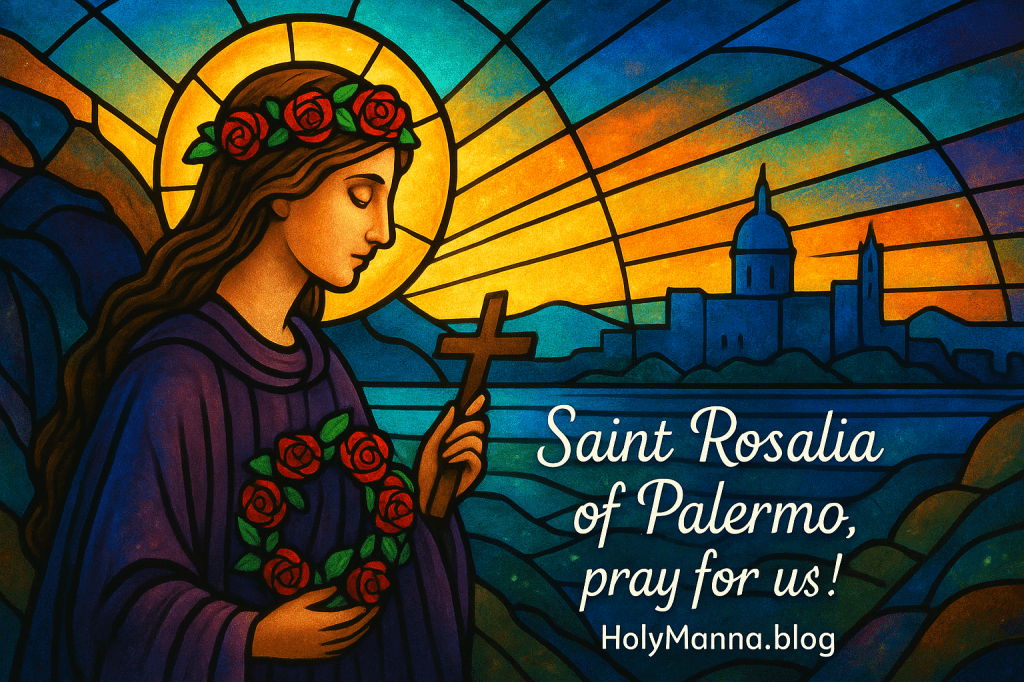
A Little Saint on a Great Mountain
Saint Rosalia, affectionately known as La Santuzza, is a 12th-century Sicilian hermit whose hidden love for Christ became the public hope of Palermo. She withdrew from noble prospects to live in prayer and penance on Monte Pellegrino and, according to enduring tradition, at Quisquina. Centuries after her death her intercession was credited with the end of a deadly plague, and she has been venerated ever since as patroness and protector of the city. Palermo honors her with a grand July celebration that remembers the deliverance from plague, and the Church commemorates her liturgically on September 4. Her life illuminates the heart of contemplative vocation in the Church and the power of the communion of saints to strengthen the living.
Roots of Fire
Rosalia is remembered as a young woman from a distinguished Norman family in Palermo who made a radical decision for God. Instead of the path of influence and comfort that her family could afford, she chose the solitude of caves and crags to fix her heart on Christ. Local memory preserves an ancient inscription at Quisquina in which Rosalia speaks of dwelling there for the love of Jesus, a tradition that has guided pilgrims for centuries. Her path fits the Church’s teaching on the eremitic life: hermits devote themselves to God in silence, solitude, and penance. The Catechism of the Catholic Church puts it plainly and beautifully, “Hermits devote their life to the praise of God and salvation of the world through a stricter separation from the world, the silence of solitude, and assiduous prayer and penance.” (CCC 920). Rosalia’s choice was not flight from the world but a mission of love for it, hidden in Christ. The Catechism also teaches that such a vocation “manifest[s] to everyone the interior aspect of the mystery of the Church.” (CCC 921).
Hidden Holiness, Lasting Light
Few details of Rosalia’s day to day are recorded, which is itself a lesson. Her sanctity did not depend on public achievements but on a steady offering of prayer, fasting, and love for the Lord. She is often depicted with a cross, a skull, a crown of roses, and a cave, signs that her life was steeped in contemplation of the Passion, remembrance of death, and joy in the Bridegroom. The greatest reason to remember Rosalia is that God magnified her hidden fidelity for the good of many. The Catechism reminds the faithful that the Church proposes the saints “as examples and intercessors.” (CCC 828). In Rosalia we see the quiet courage to choose Christ above appearance, pace, and praise.
Miracles in Silence
There are no reliable records of spectacular miracles during Rosalia’s lifetime. The miracle that emerges most clearly from the surviving memory is the miracle of perseverance. She embraced self-denial and solitude for love of God, and she remained faithful to that call. Her life demonstrates that God often stores the fruit of a saint’s prayer in mystery until the right hour. When that hour came for Palermo, the hidden seed blossomed for a whole city.
Trials of a Hermit
Rosalia was not a martyr. Her trials were the austere ones proper to desert places and mountain caves. She endured bodily hardship and spiritual testing, and she remained steadfast in charity and hope. The Church teaches that such penance is an act of love offered for others. The eremitic vocation reveals, as the Catechism says, “the interior aspect of the mystery of the Church.” (CCC 921). Rosalia’s solitude was a service to the Body of Christ. In a culture that prizes visibility, she teaches the hard virtue of constancy when no one is watching.
The City Saved
Rosalia’s name blazed into public view during the plague of 1624. In that crisis her relics were discovered on Monte Pellegrino and carried through Palermo in solemn procession. The plague rapidly subsided, and the city attributed its deliverance to her intercession. From that time devotion to La Santuzza grew quickly. A silver urn bearing her relics is treasured in Palermo’s cathedral, and each year the city honors God’s mercy through her with a magnificent July festival recalling the historical procession. Pilgrims climb Monte Pellegrino to pray in the grotto associated with her life, leaving petitions and thanksgiving for graces received. Artists fixed her memory in sacred art, with moving images that show Rosalia pleading for the plague-stricken. “Blessed Rosalia, pray for us.” These graces echo the Church’s teaching about heavenly intercession: “Being more closely united to Christ, those who dwell in heaven do not cease to intercede with the Father for us.” (CCC 956).
Lessons from a Cave
Rosalia’s life is a summons to choose the narrow path that leads to joy. Make space for silence each day, even if it is ten minutes of stillness with Jesus in front of the tabernacle or in a quiet corner of your home. Fast in small, steady ways and offer it for your city, for the sick, and for those who feel forgotten. Examine your habits and trade some noise for prayer. Consider a simple pilgrimage, perhaps a weekly visit to a church on a hill or a chapel across town, and offer the walk as intercession for others. Bring your petitions to the saints with confidence, since their help magnifies Christ’s mercy. The Catechism calls this living bond the communion of saints and teaches in luminous simplicity, “The communion of saints is the Church.” (CCC 946). Let your hidden fidelity, like Rosalia’s, become an open door for grace in your family, parish, and city.
Engage with Us!
We would love to hear how Saint Rosalia speaks to you. Share your thoughts and experiences in the comments below.
- Where is God inviting you to a “hidden” fidelity like Rosalia’s, quiet acts of prayer, penance, or service that no one sees but Him?
- How has the intercession of a saint strengthened you in a time of crisis, and how did that experience draw you closer to Jesus?
- What “plague” in your life or community most needs Rosalia’s intercession today, and what concrete step of trust can you take this week?
- How might you weave a short pilgrimage into your routine, perhaps a weekly visit to a chapel or a simple climb, offered for your city?
Take courage. Live your faith with love. Do everything with the mercy Jesus taught us, and ask Saint Rosalia to pray that your hidden life becomes a channel of hope for others.
Saint Rosalia, pray for us!
Follow us on Instagram and Facebook for more insights and reflections on living a faith-filled life.

 Holy Manna!
Leave a comment