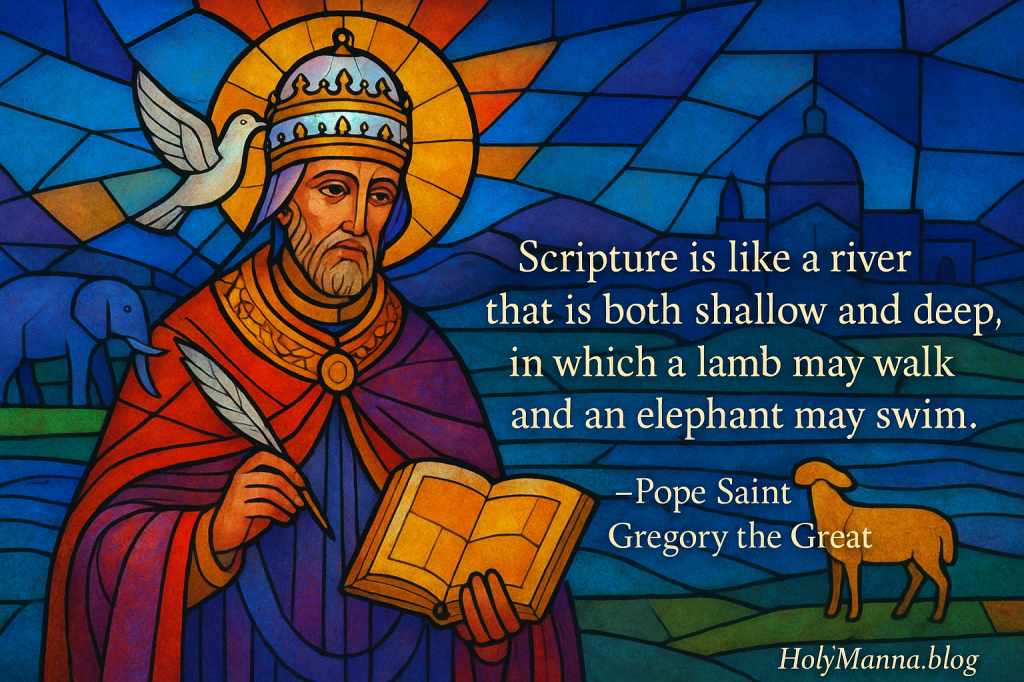
A Shepherd for Dark Times
Pope Saint Gregory the Great, born around 540 and died in 604, is honored as one of the four great Latin Doctors of the Church and as a model of pastoral charity. He became Bishop of Rome in 590 during famine, plague, and political instability, yet he stabilized the city, defended the poor, and renewed the Church’s inner life. He coined and embraced the title “servus servorum Dei” which means servant of the servants of God, and he lived that humility through concrete service and bold preaching. His writings shaped Christian thought for centuries, especially Pastoral Rule, Dialogues, Moralia in Job, and his Homilies on the Gospels and Homilies on Ezekiel. He advanced ordered divine worship and sacred music, promoted works of mercy, and sent missionaries to evangelize England, actions that reveal a faith rooted in contemplation and poured out in action. The Church confesses the role of Peter and his successors as visible sources of unity, and Gregory’s life is a luminous witness to that ministry of service for the sake of communion in truth and charity, see CCC 880 to 885 and 888 to 892. His liturgical memorial is September 3, and in earlier calendars it was March 12.
From Prefect to Monk on the Caelian Hill
Gregory was born into a noble Roman family. His father, Gordianus, served as a high official in the Church, and his mother, Saint Silvia, is also venerated for her holiness. He received an excellent education in grammar, rhetoric, and law, which prepared him for public service. Around 572 or 573 he was appointed Prefect of Rome, the highest civil office in the city. Success did not satisfy him. Grace drew him toward simplicity with Christ. After his father’s death he transformed the family home on the Caelian Hill into the Monastery of Saint Andrew, gave generously to the poor, and took the monk’s habit. His love for the cloister remained a constant thread in his life, even when obedience called him back to the wider Church. As deacon and papal envoy in Constantinople, he deepened his theological reflection and began the spiritual exegesis that would mature in Moralia in Job. Reflecting on the weight of pastoral care, he would later write the line so often attributed to him, “The care of souls is the art of arts.” In this period he learned to unite disciplined prayer with prudent governance, a union that would mark his papacy.
Pastor Reformer Missionary
Elected Pope in 590, Gregory immediately organized relief for a starving and terrified population. He restructured the Church’s charitable network through the Roman deaconries, managed the vast agricultural estates known as the Patrimony of Peter to fund aid, and insisted that bishops and stewards treat the poor as the treasures of Christ, see CCC 2447. He reformed ecclesial discipline and wrote Pastoral Rule, a handbook that still challenges bishops, priests, and lay leaders to shepherd with humility, integrity, and zeal. He encouraged ordered worship, supported the Roman schola cantorum, and fostered consistent liturgical prayer. While later tradition associates his name with chant and the sacramentary, what is certain is his tireless work to root the Church’s prayer in reverence, clarity, and Scripture.
His missionary heart shines in the mission to the Anglo Saxons. After seeing fair haired slaves in the Roman market and quipping that they were not Angles but angels in potential, he later sent Augustine and a band of monks from the Monastery of Saint Andrew to preach the Gospel in England in 596 and 597. Through letters full of fatherly wisdom, he counseled Augustine to preserve what was good in local customs, to purify rather than destroy, and to build on seeds of truth already present. He formed pastors through preaching, urging them to let Scripture move both mind and heart. A line often attributed to him captures his approach to lectio divina, “The sacred Scriptures grow with the one who reads them.”
Tradition remembers striking interventions of God during Gregory’s lifetime. In 590, while Rome reeled under the plague, Gregory led penitential processions with the ancient icon of Our Lady known as Salus Populi Romani, imploring mercy. Devout memory holds that he beheld Saint Michael the Archangel sheathing his sword above Hadrian’s Mausoleum, after which the plague subsided and the fortress became known as Castel Sant Angelo. Roman devotion also cherishes the image called the Mass of Saint Gregory, in which the Lord granted a vision that strengthened faith in the Real Presence in the Eucharist. These traditions, celebrated in liturgy and art, express what Gregory himself taught, that the Lord confirms His people and heals doubting hearts through the Church’s worship.
A Daily White Martyrdom
Gregory was not a martyr by blood, yet his life was cruciform. He suffered chronic illness that often left him exhausted and in pain, and he bore the administrative weight of feeding a city, negotiating with Lombard warlords, and relating to imperial officials who did not always share his priorities. He wrote frankly about the dangers of pride, ambition, and distraction in Church leadership, and he begged pastors to live as servants, not lords, in imitation of Christ, see CCC 876 and 896. His famous self description “servus servorum Dei” was not a slogan, it was a spiritual program that kept him lowly before God and close to the poor. He defended the primacy of the See of Peter with firm charity, resisted titles that threatened ecclesial communion, and constantly sought peace. In letters to queens, abbots, and governors, he combined clarity with gentleness, showing that genuine authority exists to build up the Body of Christ for mission, see CCC 871 to 879. His perseverance amid sickness and turmoil exemplifies the daily offering that the tradition calls white martyrdom.
Gregory’s Care Beyond the Grave
The most enduring posthumous tradition linked to Gregory is the practice of Gregorian Masses. In the Dialogues he recounts how thirty Masses offered on consecutive days for a deceased monk named Justus brought visible assurance of mercy. The Church does not treat such stories as doctrinal proofs, yet it warmly encourages prayers and suffrages for the dead, confident that our love can aid those being purified, see CCC 1030 to 1032. For many centuries the faithful have requested thirty consecutive Masses for a departed loved one, trusting the infinite value of the Eucharistic Sacrifice.
Veneration of Gregory’s relics in Saint Peter’s Basilica and devotion at the monastery of San Gregorio al Celio, which stands on the site of his Roman family home, have nourished pilgrims seeking pastoral courage and contemplative depth. Artists across the ages have depicted him writing under the inspiration of the Holy Spirit, feeding the poor from the granaries of the Church, and celebrating Mass as Christ manifests His Real Presence. These signs and memories reflect a spiritual father whose care did not end with death, since the saints, already united to Christ, intercede for us with a love made perfect, see CCC 956 to 957.
Walking the Gregory Way Today
Saint Gregory invites us to hold Scripture close every day, to let the Word pierce our patterns, and to allow contemplation to spill over into service. Read a Gospel passage slowly this week, then ask how God is sending you to the people in front of you. Organize mercy with intentionality, as Gregory organized the deaconries of Rome, perhaps by planning a concrete act of almsgiving, a visit to someone alone, or a commitment to a parish ministry, see CCC 2447. If you lead in any capacity, take up a page of Pastoral Rule and examine your heart for humility, consistency, and compassion. Pray for the living and the dead, especially at the Holy Sacrifice of the Mass, confident that our communion in Christ bridges every distance, see CCC 958. Above all, keep Gregory’s humility before you. The way to genuine greatness is to become small in love, to be a servant of the servants of God in your home, your parish, and your workplace. “The care of souls is the art of arts,” and God desires to apprentice each of us in that art.
Engage with Us!
- Where is Jesus inviting you to blend contemplation and action, as Gregory did?
- How does Gregory’s humility, “servant of the servants of God,” challenge your leadership at home, work, or ministry?
- What concrete work of mercy will you organize this week for someone in need?
- How might you deepen your love for Scripture so that, in Gregory’s words, it “grows” with you?
- Is there a departed loved one you feel called to remember at Mass this month?
May the Lord who formed Saint Gregory into a humble shepherd also form us into joyful servants. Go forward in faith, serve with mercy, teach with gentleness, and do everything with the love and compassion of Jesus Christ.
Pope Saint Gregory the Great, pray for us!
Follow us on Instagram and Facebook for more insights and reflections on living a faith-filled life.

 Holy Manna!
Leave a comment