A Hidden Torch of Nordic Light
Ingrid of Skänninge stands out as one of the earliest Dominican women in Scandinavia, a noble widow who turned the sorrow of loss into a life completely oriented toward Jesus Christ. Her reputation for holiness drew others to embrace prayer, penance, and works of mercy, and her example helped shape the spiritual landscape of medieval Sweden. She is honored as the foundress of Sweden’s first Dominican convent, remembered for her pilgrim heart, and cherished for the healings and favors reported through her intercession after death. Many local calendars keep her memory on September 2, which keeps alive the testimony of a woman who quietly brought the radiance of the Gospel to the North.
From Castle Hall to Cloistered Heart
Ingrid, often called Ingrid Elofsdotter, was born into a prominent family in Östergötland. She married a nobleman known as Sir Sigge, and their household would have been a place of influence as well as responsibility. Widowhood changed everything. Instead of retreating into comfort, Ingrid sought a deeper conformity to Christ. She undertook demanding pilgrimages to Rome, Jerusalem, and the shrine of Saint James at Compostela, journeys that required courage, resources, and an unshakable desire to be near the places where grace had touched the world. These travels refined her discernment and confirmed a call to a more radical life for God. Drawn to the Dominican way, with its love for Scripture, preaching, and study, she began to gather like-minded women who desired a pattern of prayer and mercy that would endure in Sweden. She is remembered most for founding a house where the Word of God could be contemplated and proclaimed through holy living.
A House for the Word in Skänninge
Around 1272 Ingrid established a Dominican community at Skänninge. In 1281 it received formal ecclesial recognition, and she served as prioress. The convent’s daily rhythm included the Divine Office, lectio divina, manual work, and concrete acts of charity for the poor and the sick. By anchoring a community of women in the Dominican charism, Ingrid gave Sweden a living school of the Gospel. The sisters prayed for preachers, supported the missionary witness of the friars, and became a steady flame of intercession for their towns and families. Although specific miracle accounts from Ingrid’s lifetime are sparse, her fidelity and generosity produced visible fruits. Young women were drawn to a life of virginity for Christ. The needy received relief and dignity. Local society learned that holiness is not only in the cathedral or at court but also within a cloister where God is loved above all things. The Catechism of the Catholic Church teaches that consecrated life is a prophetic sign for the Church and the world, and it belongs at the heart of the Church’s mission. As the Catechism puts it, “By the profession of the evangelical counsels, the characteristic features of Jesus… become visible in the midst of the world.” (CCC 915)
Crosses in a Northern Climate
Ingrid did not shed her blood for Christ, yet she carried real crosses. She endured the grief of bereavement and the responsibilities that fell upon a noble widow. She embraced long pilgrimages that taxed the body and demanded unwavering trust in Providence. Founding a convent required steady negotiation, wise stewardship, and a courage that perseveres when money is tight, buildings need repair, and human hearts need patient formation. Governance brought its own trials, since a prioress must correct faults with charity and hold a community together through seasons of change. Ingrid’s constancy illustrates the quiet heroism praised by the Church. The Catechism reminds us that those who give themselves to God in consecration “announce in the Church the glory of the world to come.” (CCC 933) Her holiness grew not from spectacle but from a thousand faithful decisions to love God and neighbor.
Afterglow at the Tomb
When Ingrid died at Skänninge in 1282, devotion to her blossomed. Pilgrims came to pray at her tomb, and stories of favors and healings spread among the faithful. Over the centuries Church authorities investigated her reputation for sanctity and the reports of miracles. Her cultus in Sweden gained recognition, and the translation of her relics was eventually authorized and solemnly carried out in the early sixteenth century, a sign that the Church discerned enduring veneration among the people of God. The upheavals of the Reformation later disrupted public devotion, and her remains were safeguarded by those who cherished her memory. Yet the light did not go out. The Church teaches that the saints do not cease to love us. The Catechism says of the blessed in heaven, “Being more closely united to Christ, those who dwell in heaven fix the whole Church more firmly in holiness.” (CCC 956) Veneration of relics and pilgrim visits to holy places are authentic forms of Christian piety that help the faithful draw near to the Lord who works through his friends. As the Catechism notes, “The religious sense of the Christian people has always found expression in various forms of piety surrounding the Church’s sacramental life.” (CCC 1674)
Why Ingrid Still Matters
Saint Ingrid speaks powerfully to anyone who longs to turn a painful chapter into a new beginning with God. She teaches that love can redirect influence into service, wealth into generosity, and grief into prayer. She shows that founding a community, raising a family in the faith, supporting a parish, or beginning a small work of mercy can change a culture from within. Her pilgrim heart invites us to make our own journeys of conversion. Her Dominican spirit calls us to love the Scriptures, to study the truth of the faith, and to let our lives preach Christ. If you are discerning a vocation, if you carry the burdens of leadership, or if you are trying to pray more faithfully in the middle of daily demands, ask her intercession. The communion of saints is not an idea but a living reality. The Catechism assures us that “It is not only through the sacraments and ministries that the Holy Spirit sanctifies and leads the People of God… he distributes special graces among the faithful of every rank.” (CCC 951) Ingrid’s life is one such grace offered to us today.
Choosing Fidelity Over Noise
Bring Ingrid’s wisdom into your week in simple, concrete ways. Set a time each day for silent prayer, and ask the Lord to show you one act of mercy to perform for someone who cannot repay you. Read a passage of the Gospels and ask for a Dominican heart that studies truth in order to love better. Consider making a small pilgrimage, perhaps to a local shrine or parish where you can attend Mass and pray for your family, your parish, and your nation. If you have known loss, entrust it to Christ and ask for a mission that turns pain into a gift. Remember that the saints are companions who draw us to Jesus. The Catechism reminds us that the communion of saints unites the Church on earth with the blessed in heaven, and that their intercession strengthens us for holiness. Let Ingrid’s quiet courage shape your choices, and let her love for Christ ignite your own.
Engage with Us!
We’d love to hear how Saint Ingrid’s story speaks to you. Share your thoughts and intentions in the comments below so we can pray with you.
- Where is the Lord inviting you to turn a personal loss into a deeper vocation, as Ingrid did after widowhood?
- How might you bring a “monastic” rhythm (prayer, work, study, mercy) into your daily routine this week?
- What pilgrimage, near or far, could you make to intercede for someone who needs healing or conversion?
- Which evangelical counsel (poverty, chastity, or obedience) do you feel called to practice more intentionally right now?
- How does the communion of saints encourage you to ask for Ingrid’s intercession with greater confidence?
May the Lord kindle in us the same faithful love that burned in Saint Ingrid’s heart. Let us live a bold and merciful faith, everything for Jesus, everything with Jesus, and everything in Jesus.
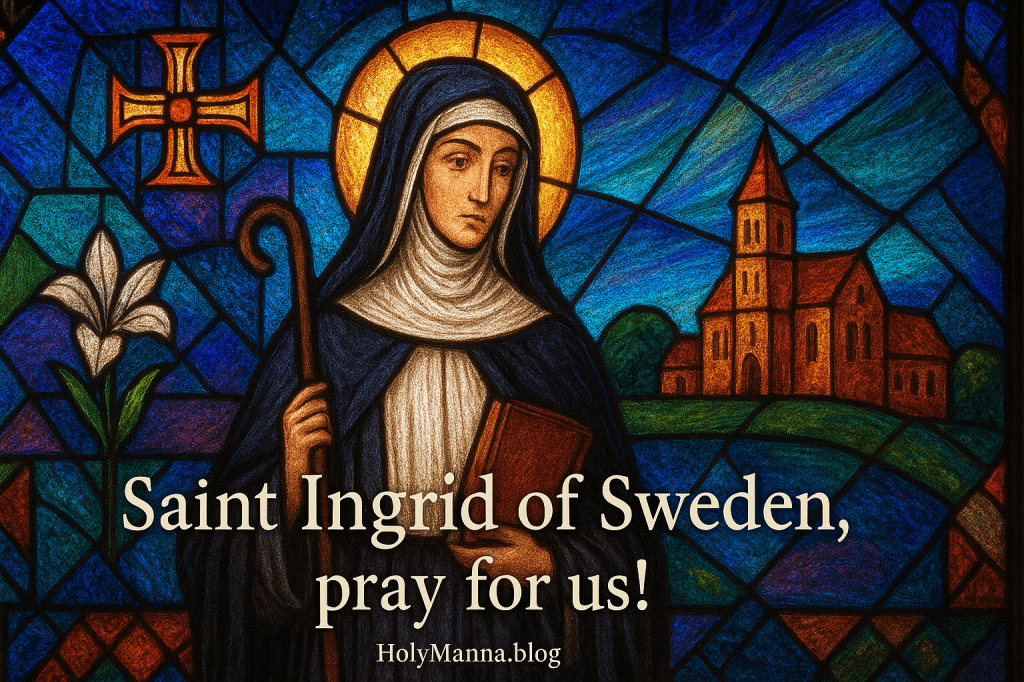
Saint Ingrid of Sweden, pray for us!
Follow us on Instagram and Facebook for more insights and reflections on living a faith-filled life.

 Holy Manna!
Leave a comment