Tuesday of the Twenty-second Week in Ordinary Time – Lectionary: 432
Awake in the Light
Step into the quiet of prayer and listen for the voice that steadies the heart. Today’s readings draw us into a single movement of grace, a call to live wakefully in God’s light, to trust without fear, and to submit to the liberating authority of Jesus Christ. In 1 Thessalonians 5:1-6, 9-11, Saint Paul situates the Church within the great biblical expectation of the “Day of the Lord,” reminding us that it will arrive “like a thief at night”, which means it cannot be managed by human timetables. In the first century, “peace and security” echoed the self-assured slogans of the Roman order, yet Paul warns that complacency breeds spiritual drowsiness. By contrast, the baptized are “children of the light,” a phrase that mirrors our baptismal identity as those re-created by grace to live in truth and charity, as taught in CCC 1695. The psalm gives this vigilance its interior tone. Psalm 27 teaches the courage of adoration, the longing to dwell with God and to behold his beauty, so that fear dissolves before the sanctuary’s radiance. Our lips can dare to say with David, “The Lord is my light and my salvation; whom should I fear?” Such trust is not naïve optimism. It is worship that trains the soul to wait well, to hope, and to act in love.
The Gospel shows why such confidence is reasonable. In Luke 4:31-37, Jesus teaches in the synagogue of Capernaum and silences a demon with a word. The crowd marvels, “For with authority and power he commands the unclean spirits, and they come out.” This is no spectacle. It is the revelation that the kingdom has drawn near, that Christ’s word is effective, and that darkness has no final claim on those who belong to him, as the Church affirms regarding the Lord’s signs and exorcisms in CCC 548 and the Church’s sharing in his liberating ministry in CCC 1673. Read together, these passages invite a baptismal way of life: alert minds, sober hearts, and a community that “encourages and builds up” because it knows it is destined for salvation in Christ. Where is the Lord inviting you to wake up, to trust his light, and to let his authoritative word drive out fear today?
First Reading – 1 Thessalonians 5:1-6, 9-11
Stay Awake for the Lord
Paul writes to a young Christian community in Thessalonica that lived at the crossroads of empire, trade, and ideas. The city enjoyed Roman favor and prided itself on civic stability, which made the cultural slogan of “peace and security” especially persuasive. Into this atmosphere, Paul proclaims the apocalyptic horizon of Christian hope. The “Day of the Lord” belongs to God’s sovereign timing and reveals the truth about every human claim to safety. Baptized believers are not to be anxious, nor are they to be lulled into moral sleep. They stand as “children of the light”, a baptismal identity that grounds sober vigilance, mutual encouragement, and confident hope. Read within today’s theme of living awake in Christ’s light, this passage teaches that true security is not an imperial promise or a personal plan. It is communion with Jesus who died and rose so that we might live with Him.
1 Thessalonians 5:1-6, 9-11
New American Bible (Revised Edition)
Vigilance. 1 Concerning times and seasons, brothers, you have no need for anything to be written to you. 2 For you yourselves know very well that the day of the Lord will come like a thief at night. 3 When people are saying, “Peace and security,” then sudden disaster comes upon them, like labor pains upon a pregnant woman, and they will not escape.
4 But you, brothers, are not in darkness, for that day to overtake you like a thief. 5 For all of you are children of the light and children of the day. We are not of the night or of darkness. 6 Therefore, let us not sleep as the rest do, but let us stay alert and sober.
9 For God did not destine us for wrath, but to gain salvation through our Lord Jesus Christ, 10 who died for us, so that whether we are awake or asleep we may live together with him. 11 Therefore, encourage one another and build one another up, as indeed you do.
Detailed Exegesis
Verse 1 – “Concerning times and seasons, brothers, you have no need for anything to be written to you.”
Paul acknowledges that the Thessalonians already possess basic catechesis about the Lord’s return. Christian hope does not rest on timetables. It rests on fidelity to Christ in the present. The Church teaches that revelation is complete in Christ. Speculation about dates distracts from conversion of life, prayer, and charity.
Verse 2 – “For you yourselves know very well that the day of the Lord will come like a thief at night.”
This image underscores suddenness and unpredictability. The biblical “Day of the Lord” is God’s decisive judgment and vindication. The call is not to fear but to readiness through a life of grace. Christian watchfulness means steady prayer and moral alertness, not anxiety.
Verse 3 – “When people are saying, ‘Peace and security,’ then sudden disaster comes upon them, like labor pains upon a pregnant woman, and they will not escape.”
Paul contrasts worldly slogans with divine reality. Roman propaganda celebrated public order, yet the apostle warns that self-reliant complacency collapses when ultimate realities break in. The labor image is striking. What arrives is painful yet purposeful, directed toward birth. God’s judgment exposes illusions in order to bring forth new life.
Verse 4 – “But you, brothers, are not in darkness, for that day to overtake you like a thief.”
Christians belong to the realm of light through baptism. The day does not “overtake” them because their lives already participate in the risen Lord. This does not exempt them from trial. It does mean they meet trial with grace-informed clarity.
Verse 5 – “For all of you are children of the light and children of the day. We are not of the night or of darkness.”
Identity precedes ethics. Because believers are “of the day”, their conduct should mirror daylight truth. The moral life flows from who we are in Christ. The Church continually links moral exhortation to sacramental identity.
Verse 6 – “Therefore, let us not sleep as the rest do, but let us stay alert and sober.”
“Sleep” here signifies moral indifference. “Alert and sober” names the virtues of vigilance and temperance. The Christian keeps a clear mind and a steadfast heart, ready for prayer and ready for love.
Verse 9 – “For God did not destine us for wrath, but to gain salvation through our Lord Jesus Christ,”
Destiny in Christ is not condemnation. It is salvation. Wrath names the just consequence of sin, which Christ overcomes. God’s purpose is merciful. The believer’s hope is anchored in Jesus, not in personal performance or political calm.
Verse 10 – “who died for us, so that whether we are awake or asleep we may live together with him.”
Christ’s death and resurrection establish a communion stronger than death. “Awake or asleep” likely means living or dead. In either state, the baptized belong to Him. Christian vigilance is therefore joyful. It is life with Christ now and forever.
Verse 11 – “Therefore, encourage one another and build one another up, as indeed you do.”
Eschatology produces ecclesiology. The hope of the Lord’s Day forms a community of mutual edification. “Encouragement” is not sentimental. It is a concrete ministry of speech and action that strengthens faith, hope, and love.
Teachings
This passage reveals the Church’s perennial stance toward the end of days. Christians await the Lord with sober hearts, not speculative calendars. The identity of “children of the light” frames the moral life. In The Catechism the Church summarizes our transformation in Christ as a call to live by the Spirit as children of light, and she situates Christian watchfulness within the life of prayer and virtue (CCC 1695; CCC 1813; CCC 2730; CCC 2849). The “Day of the Lord” remains God’s decision, which prevents presumption and fuels fidelity (CCC 1040; CCC 672). Historically, the Thessalonians faced pressure from imperial narratives of stability. Paul reframes security around communion with Christ crucified and risen. The saints echo this rhythm of hope and vigilance. They teach that steady prayer, sacramental life, and works of mercy are the real preparation for the Lord’s coming.
Reflection
The Word invites you to wakefulness that is hopeful, brave, and practical. Live as a child of the day by guarding your mind and heart, by rooting your habits in prayer, and by speaking words that build others up. Choose one concrete act of encouragement for someone who struggles. Practice temperance in media, food, or speech so that your inner life stays clear and free for God. Return to the sacraments, especially Reconciliation and the Eucharist, so that grace keeps you anchored in the light. Where are you tempted to chase “peace and security” apart from Christ? What habit could you adopt this week to remain “alert and sober” in love? How will you “encourage” and build up a specific person today, trusting that God has destined you for salvation in Jesus?
Responsorial Psalm – Psalm 27:1, 4, 13-14
Gazing on Beauty, Standing without Fear
Composed as a prayer of confident trust, Psalm 27 moves between threat and assurance while directing the worshiper toward the sanctuary where God’s presence drives out fear. In ancient Israel the temple signified communion with the living God, not mere ritual. To “dwell” there meant to live under God’s protection and to order life around praise and sacrifice. Within today’s theme of living awake in the light, this psalm supplies the interior posture for vigilance. Courage flows from adoration, and adoration flows from the conviction that the Lord’s presence is near. Those who “wait for the Lord” do not stall in passivity. They practice hopeful perseverance because God is faithful.
Psalm 27:1, 4, 13-14
New American Bible (Revised Edition)
Trust in God
1 Of David.
The Lord is my light and my salvation;
whom should I fear?
The Lord is my life’s refuge;
of whom should I be afraid?
4 One thing I ask of the Lord;
this I seek:
To dwell in the Lord’s house
all the days of my life,
To gaze on the Lord’s beauty,
to visit his temple.
13 I believe I shall see the Lord’s goodness
in the land of the living.
14 Wait for the Lord, take courage;
be stouthearted, wait for the Lord!
Detailed Exegesis
Verse 1 – “The Lord is my light and my salvation; whom should I fear? The Lord is my life’s refuge; of whom should I be afraid?”
The psalmist anchors identity in God’s nearness. Naming the Lord as “light” proclaims guidance, revelation, and victory over the shadows that breed anxiety. In the spiritual life, fear yields to filial confidence as we learn to stand within God’s radiance. This opening teaches that vigilance is not tense self-reliance. It is trusting dependence that steadies the heart.
Verse 4 – “One thing I ask of the Lord; this I seek: To dwell in the Lord’s house all the days of my life, To gaze on the Lord’s beauty, to visit his temple.”
The “one thing” simplifies desire. Adoration unifies a scattered heart. To “gaze on the Lord’s beauty” points to contemplative prayer, an attentive beholding that transforms the beholder. Christian tradition recognizes here the desire that culminates in the Eucharistic presence and in the beatific vision to come. The psalmist’s temple longing becomes the Church’s longing to remain before the Lord, whose beauty heals, orders, and sends.
Verse 13 – “I believe I shall see the Lord’s goodness in the land of the living.”
Hope is not postponed to the next life alone. The psalm confesses that God’s goodness becomes visible within history, even amid trial. Such faith trains the eyes to notice grace already at work. The vigilant heart expects God to act and therefore perseveres.
Verse 14 – “Wait for the Lord, take courage; be stouthearted, wait for the Lord!”
The final imperative frames waiting as a courageous virtue rather than passivity. “Be stouthearted” names the moral strength to endure pressure without surrendering trust. The repetition presses the lesson home. Endurance in hope is an act of worship.
Teachings
The psalm’s desire to adore aligns with the Church’s teaching on the virtue of religion. In The Catechism the Church teaches, “Adoration is the first act of the virtue of religion.” CCC 2096. Contemplation deepens that adoration into a loving gaze. The Catechism states, “Contemplation is a gaze of faith, fixed on Jesus.” CCC 2715. Prayer itself is defined with beautiful simplicity: “Prayer is the raising of one’s mind and heart to God or the requesting of good things from God.” CCC 2559. The psalm’s cry of hope corresponds to the theological virtue by which we lean on God’s fidelity. The Catechism teaches, “Hope is the theological virtue by which we desire the kingdom of heaven and eternal life as our happiness, placing our trust in Christ’s promises and relying not on our own strength, but on the help of the grace of the Holy Spirit.” CCC 1817. Its closing exhortation mirrors the moral virtue of courage. The Catechism teaches, “Fortitude is the moral virtue that ensures firmness in difficulties and constancy in the pursuit of the good.” CCC 1808. Saint Augustine echoes this interior movement toward adoration and rest in God, opening Confessions with the famous line, “You have made us for Yourself, and our hearts are restless until they rest in You.” Confessions I, 1.
Reflection
Let this psalm train your eyes to look for light, not for shadows. Begin or end the day with five quiet minutes before the Lord and repeat verse 1 until your breathing slows and your shoulders drop. Visit a church this week and sit before the tabernacle, letting the “one thing” simplify your desire. When fears surge, speak verse 14 aloud and ask for the virtue of fortitude. End your prayer by naming a concrete place where you have seen the goodness of the Lord “in the land of the living,” then thank Him for it. What threatens your peace today, and how will you bring it into the sanctuary of prayer? Where can you schedule time to “gaze on the Lord’s beauty” so that your heart is unified again? Whom can you encourage by witnessing to the goodness you have already seen?
Holy Gospel – Luke 4:31-37
The Word That Drives Out Darkness
Luke situates this scene at the start of Jesus’s Galilean ministry, immediately after His rejection in Nazareth. On the Sabbath, in the synagogue of Capernaum, Jesus teaches with an authority that is not borrowed from scribal traditions but springs from His divine identity. The confrontation with a demon inside the synagogue reveals that the kingdom of God has arrived as a liberating power. The evil spirit recognizes Jesus publicly as “the Holy One of God”, but Jesus refuses demonic testimony and silences it. This episode shows why vigilance without fear is rational. Christ’s word is effective, and His authority establishes true peace for those who walk in the light. Read within today’s theme, the Gospel discloses that staying awake in faith means trusting the power of Jesus’s word to unmask and overcome the darkness.
Luke 4:31-37
New American Bible (Revised Edition)
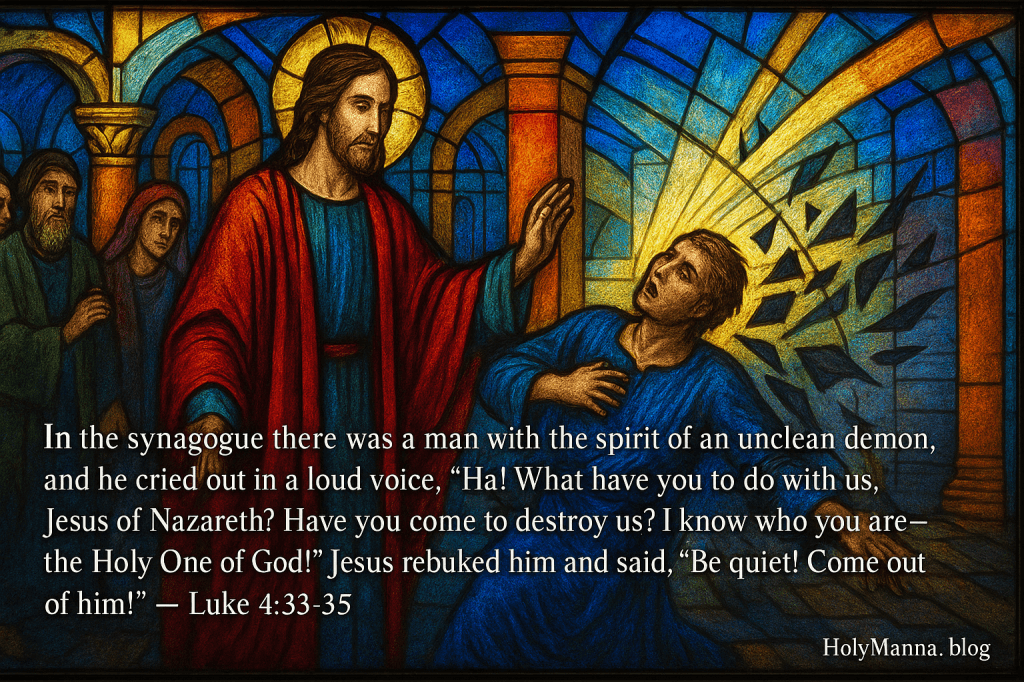
The Cure of a Demoniac. 31 Jesus then went down to Capernaum, a town of Galilee. He taught them on the sabbath, 32 and they were astonished at his teaching because he spoke with authority. 33 In the synagogue there was a man with the spirit of an unclean demon, and he cried out in a loud voice, 34 “Ha! What have you to do with us, Jesus of Nazareth? Have you come to destroy us? I know who you are—the Holy One of God!” 35 Jesus rebuked him and said, “Be quiet! Come out of him!” Then the demon threw the man down in front of them and came out of him without doing him any harm. 36 They were all amazed and said to one another, “What is there about his word? For with authority and power he commands the unclean spirits, and they come out.” 37 And news of him spread everywhere in the surrounding region.
Detailed Exegesis
Verse 31 – “Jesus then went down to Capernaum, a town of Galilee. He taught them on the sabbath,”
Capernaum becomes a base for Jesus’s public ministry. Teaching on the Sabbath places His mission within the heart of Israel’s worship. He fulfills the law and the prophets by revealing the Father’s will and by restoring creation’s rest through redemption.
Verse 32 – “and they were astonished at his teaching because he spoke with authority.”
Unlike the scribes, Jesus’s authority is intrinsic. His word accomplishes what it says. This line prepares the exorcism by establishing that His speech is effective, not merely informative. The astonishment of the crowd signals the inbreaking of God’s reign.
Verse 33 – “In the synagogue there was a man with the spirit of an unclean demon, and he cried out in a loud voice,”
The battle line between the kingdom of God and the powers of darkness is drawn inside the place of worship. Evil’s presence is unmasked by the presence of the Holy One. The loud cry exposes the demon’s agitation before divine authority.
Verse 34 – “Ha! What have you to do with us, Jesus of Nazareth? Have you come to destroy us? I know who you are, the Holy One of God!”
The demon speaks true words about Jesus yet does so without faith and in defiance. Demonic recognition is not saving confession. It is coerced disclosure under judgment. The question about destruction admits that Jesus has come to undo the works of the devil.
Verse 35 – “Jesus rebuked him and said, ‘Be quiet! Come out of him!’ Then the demon threw the man down in front of them and came out of him without doing him any harm.”
With a commanding word, Jesus frees the afflicted man. The rebuke restores order. The man is not harmed, which highlights the Lord’s merciful authority. Liberation is not spectacle. It is the fruit of God’s love for a person.
Verse 36 – “They were all amazed and said to one another, ‘What is there about his word? For with authority and power he commands the unclean spirits, and they come out.’”
The crowd interprets the sign correctly. The focus is Jesus’s word. Authority and power belong to Him, and unclean spirits obey. The sign invites faith and reinforces the call to trust Christ’s lordship in every form of spiritual struggle.
Verse 37 – “And news of him spread everywhere in the surrounding region.”
The report spreads because liberation spreads hope. Early witness is born from experienced mercy. The Gospel’s expansion is tied to Jesus’s authoritative word that heals and frees.
Teachings
The Catechism affirms the revelatory purpose of Christ’s signs and their call to faith: “The signs worked by Jesus attest that the Father has sent him. They invite belief in him. To those who turn to him in faith he grants what they ask; so miracles strengthen faith in the One who does his Father’s works; they bear witness that he is the Son of God.” CCC 548. The Church also teaches about exorcism in continuity with this Gospel: “When the Church asks publicly and authoritatively in the name of Jesus Christ that a person or object be protected against the power of the Evil One and withdrawn from his dominion, it is called exorcism.” CCC 1673. Regarding the limits of the devil’s power and God’s sovereignty, The Catechism states, “The power of Satan is, nonetheless, not infinite. He is only a creature, powerful from the fact that he is pure spirit, but still a creature. He cannot prevent the building up of God’s reign.” CCC 395. This passage therefore manifests Jesus’s identity and mission. His authoritative word reveals the nearness of the kingdom and prefigures the authority He entrusts to the Church for the liberation and healing of souls.
Reflection
Christ’s word still frees. Bring your anxieties, compulsions, resentments, and hidden fears into conversation with Jesus. Speak His name with faith and ask Him to command what oppresses you to depart. Pray with Scripture daily, since the Lord continues to teach with authority whenever the Gospel is proclaimed. Confess your sins regularly, receive the Eucharist with faith, and ask for deliverance from evil as you pray the Our Father with attention. If you feel harassed by persistent temptation, ask a priest for pastoral guidance and for the Church’s blessing. Where do you need to trust the authority of Jesus’s word today? What concrete step will you take to live in the light rather than in the shadows? How might you witness to His liberating power in a way that builds others up and strengthens their hope?
Walk in the Day
Today’s Word gathers us into a single path of grace. In 1 Thessalonians 5:1-6, 9-11 we are named “children of the light”, called to stay alert and sober, encouraging one another because God has destined us for salvation in Christ. Psalm 27 gives this vigilance its heartbeat, teaching us to pray with confidence, “The Lord is my light and my salvation, whom should I fear?” and to “wait for the Lord” with stout hearts that refuse despair. In Luke 4:31-37 Jesus reveals why such trust is reasonable, for “with authority and power he commands the unclean spirits, and they come out”, and the afflicted are left unharmed and restored. These three readings weave a single invitation. Live awake to God, adore Him with undivided desire, and trust the liberating power of Christ’s word over every darkness.
Here is the call to action. Begin and end your day by choosing the light. Offer a brief morning prayer that surrenders your plans to Jesus, then make a concrete act of encouragement that builds someone up. Visit the Lord in the Eucharist this week, even for a few minutes, and let your heart learn the psalm’s “one thing.” Pray with the Gospel until you can say with peace, “Whom should I fear?” Seal it with a simple examen at night, thanking God for every sign of His goodness in the land of the living. Where is Christ inviting you to wake up, to gaze on His beauty, and to trust His authority today? What step will you take, right now, to walk as a child of the day?
Engage with Us!
We would love to hear your insights in the comments below. Share how the Lord spoke to you through today’s readings and how you plan to respond this week.
- First Reading – 1 Thessalonians 5:1-6, 9-11: Where do you sense the Holy Spirit inviting you to live as “children of the light” in your work, your relationships, or your media habits today? What concrete practice will help you remain “alert and sober” this week, such as a set time for prayer or a commitment to encourage someone daily? How does the promise that God has destined us for salvation through Jesus reshape your fears about the future and your hope for the present?
- Responsorial Psalm – Psalm 27:1, 4, 13-14: When you pray, can you name the “one thing” you truly desire from the Lord, and how will you make time to “gaze on the Lord’s beauty” in prayer or before the Blessed Sacrament this week? What fear loses strength when you repeat “The Lord is my light and my salvation; whom should I fear?” aloud in faith? Where have you already seen the Lord’s goodness “in the land of the living,” and how can you witness to that goodness to build someone up today?
- Holy Gospel – Luke 4:31-37: Where do you need to trust the authority of Jesus’s word to bring freedom, and what step will you take to invite His healing into that place? How does the line “with authority and power he commands the unclean spirits, and they come out” strengthen your confidence to pray boldly against temptation and discouragement? Who in your life needs the hope of Christ’s liberating love, and how will you share it with gentleness and courage this week?
Go in peace and live a life of faith. Do all things with the love and mercy Jesus taught us.
Sacred Heart of Jesus, we trust in You!
Immaculate Heart of Mary, pray for us!
Saint Michael the Archangel, defend us in battle!
Follow us on Instagram and Facebook for more insights and reflections on living a faith-filled life.

 Holy Manna!
Leave a comment