Lily of the Immaculate
Saint Beatrice da Silva Meneses shines in Christian memory as the Portuguese noblewoman whose entire life became a hymn to the Immaculate Conception of the Blessed Virgin Mary. She is revered for founding the contemplative Order of the Immaculate Conception, known as the Conceptionists, whose white habit with a blue mantle was designed to proclaim the mystery of Mary’s sinless beginning. In the late fifteenth century, Beatrice and her first companions established a new Marian home of prayer at Toledo with the favor of Queen Isabella of Castile and the authorization of Pope Innocent VIII. Her vision of consecrated life anticipated the Church’s later solemn definition of the Immaculate Conception and offered the world a living catechesis in purity, humility, and contemplation. She was beatified in 1926 and canonized in 1976, and the Church keeps her memory on August 17, honoring a woman who taught generations to look to Jesus through the bright purity of His Mother.
A Young Heart Set Apart for God
Beatrice was born into a noble Portuguese family traditionally identified as Rui Gomes da Silva and Isabel de Meneses, and most modern accounts place her birth in Campo Maior on Portugal’s frontier. Raised in the faith, she learned early to unite refinement of manners with devotion to Jesus and a special love for the Virgin Mary. As a young woman she moved into the orbit of the Castilian court and became closely associated with the household that would form the future Queen Isabella. Court life brought visibility, honors, and the tensions that accompany high favor, yet the noise of ceremony stirred in Beatrice a longing for quiet communion with God. She withdrew from public life and sought seclusion with the Dominican nuns at Santo Domingo el Real in Toledo, where she spent years of hidden prayer and discernment. There, her devotion to Mary’s Immaculate Conception matured into a clear purpose. She desired a monastery that would exist for the single aim of praising the first grace of the Mother of God. What the world prized in her outward beauty, God transfigured into a radiant interior purity ordered entirely to Christ.
A Monastery for Mary’s First Grace
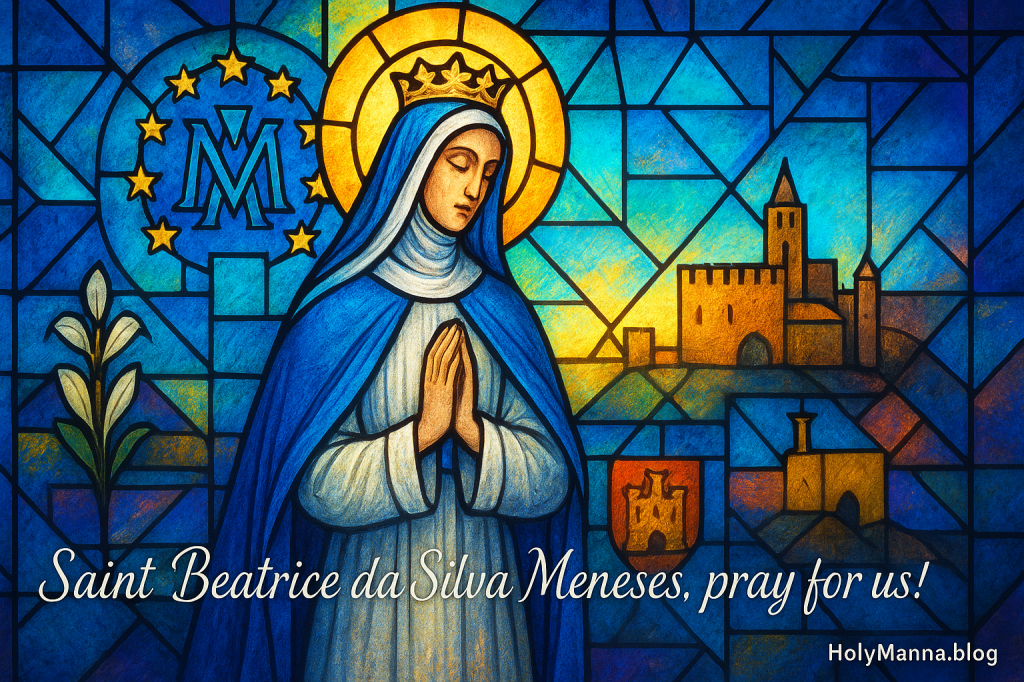
Beatrice’s years of discernment bore fruit when Queen Isabella offered practical help for a new foundation in Toledo. The early community took root at the royal chapel of Santa Fe and soon received papal authorization in 1489 to live a common rule of life. The first observance reflected Cistercian discipline, and in 1511 a proper rule gave the Conceptionists a distinct identity aligned with the Franciscan family. The habit chosen under Beatrice’s inspiration became a theology in cloth. The white tunic spoke of Mary’s stainless conception, the blue mantle evoked the sky and the divine favor that overshadowed her, and the medallion honored the Immaculate Conception by name. Contemporary tradition preserves gentle signs of God’s providence in Beatrice’s life. In times of confusion at court, the Blessed Virgin is said to have comforted her and indicated the color and form of the future habit. In the cloister, Beatrice encouraged her companions to invoke Mary as the all holy Mother who leads hearts to Jesus. Even when no spectacular wonders were recorded, the quiet miracles of conversion, reconciliation, and persevering fidelity surrounded her daily life. The saint’s greatest marvel during life was the creation of a community whose prayer and purity became a perpetual praise of Christ for the gift of His Mother.
Suffering Without Bitterness
The path to founding the order was not free of hardship. The favor she enjoyed at court drew envy, and the interior call she followed required long years of enclosure and silence before any visible foundation appeared. Beatrice endured misunderstanding, delay, and the pain of waiting for permission and support. Her response was never bitterness. She chose Eucharistic adoration, the rosary, and patient obedience to the Church as her way forward. She died at Toledo in 1492, shortly before her community could fully begin the rhythm of regular observance. Beatrice was not a martyr in the strict sense, yet her life was a white martyrdom of self renunciation. Her suffering purified her intention and taught her daughters to trust God’s timing. In this she mirrors Mary, who pondered and waited for the Lord’s hour. “Behold, I am the handmaid of the Lord. Let it be to me according to your word.” The words of The Gospel of Luke that formed Mary’s heart also formed the foundress who served Mary’s mystery.
A Blue Mantle Across Centuries
After her death, the memory of Beatrice’s holiness spread swiftly. The faithful visited her resting place in Toledo and testified to answered prayers and healings through her intercession. The Conceptionists flourished across Iberia and became a cherished contemplative presence in cities and towns where their quiet witness invited the baptized to a deeper Marian devotion. As the Catholic world expanded, the charism traveled with it, carrying Beatrice’s insight into new lands and languages. Her eventual beatification and canonization confirmed what popular devotion had long held. The Church recognized in her a prophetic figure who raised a banner for a doctrine that would be declared with full authority centuries later. Her tomb continues to be a place of gratitude, and her daughters remain a living shrine to the Immaculate Conception. Their choir offices, fasts, and hidden sacrifices are the miracles that remain, daily offerings that lift up the Church and draw countless souls to Jesus.
Why She Matters Now
Beatrice’s life teaches that doctrine is not an abstraction. It is a light that shapes daily choices. The Catechism confesses, “The most Blessed Virgin Mary was, from the first moment of her conception, preserved immune from all stain of original sin.” (CCC 491). To celebrate this truth is to choose purity of intention, mercy in speech, and fidelity in prayer. The Catechism also notes that consecrated life manifests the very heart of the Christian vocation, a life fully given to God in the Church (cf. CCC 916; CCC 931 to 933). That is precisely what Beatrice offered to the Lord. She shows modern Christians how to guard interior silence in a noisy world and how to center life on the Eucharist with Marian trust. Where is God inviting you to build a small cloister of the heart each day? Her story also reveals the power of patient hope. “To become the mother of the Savior, Mary was enriched by God with gifts appropriate to such a role.” (CCC 490). Beatrice’s order became a mirror of those Marian gifts, reminding the whole Church that holiness begins with grace received and ends with charity given.
Walking the Blue and White Way
To walk with Saint Beatrice is to practice a Marian style of discipleship that is contemplative at the center and apostolic at the edges. Begin by making room for silence before the Lord each day, even for a few minutes. Entrust your purity of heart to Mary, and ask her to help you love like Jesus loves. Unite your work and relationships to the mystery of the Immaculate Conception by choosing forgiveness over resentment and truth over self promotion. The communion of saints assures us that Beatrice intercedes for us as we do this, and the Lord multiplies small fidelities into great fruits for His Kingdom. “Being more closely united to Christ, those who dwell in heaven fix the whole Church more firmly in holiness.” (CCC 956). How might the Lord be asking you to let Mary lead you more swiftly to Him today? How might He be asking you to serve your neighbor with a cheerful, chaste, and merciful heart?
Engage with Us!
- Where do you sense God asking for patient perseverance, as He did with Beatrice during her long “hidden years”?
- How can you “wear” the colors of the Immaculate today—practically—through purity of intention, modest speech, and mercy?
- What concrete step can you take this week to build a more contemplative rhythm (adoration visit, rosary, media fast) in honor of Our Lady?
- How does the doctrine of the Immaculate Conception (CCC 490–493) strengthen your trust in God’s plan for your own holiness?
May Saint Beatrice da Silva Meneses help us live for Jesus with luminous purity and courageous love, so that in everything we do we act with the love and mercy that Jesus taught us.
Saint Beatrice da Silva Meneses, pray for us!
Follow us on Instagram and Facebook for more insights and reflections on living a faith-filled life.

 Holy Manna!
Leave a comment