Monday of the Twenty-second Week in Ordinary Time – Lectionary: 431
When the King Comes
Come with a hopeful heart as the Word announces a future that begins in the present and stretches into eternity. 1 Thessalonians 4:13-18 consoles a grieving Church with the promise of resurrection and communion in Christ, culminating in the assurance “We shall always be with the Lord.” In the first century, Christians in Thessalonica lived amid pagan funerary customs that often lacked true hope, yet Paul anchors their sorrow in the risen Lord and in the awaited Parousia, the coming of Jesus with the voice of an archangel and the trumpet of God. Psalm 96 lifts that same horizon to cosmic scale, an enthronement hymn that summons all creation to sing because the Lord comes to judge the earth with justice and to shepherd the nations in faithfulness. In Luke 4:16-30, Jesus enters the synagogue according to Jewish custom, reads Isaiah 61, and declares “Today this scripture passage is fulfilled in your hearing.” The background is the Jubilee vision, a year of release and restoration, which Jesus claims as His mission of good news to the poor, liberty to captives, and sight to the blind. Yet the hometown crowd resists, and the prophet finds no honor among his own, reminding us that the saving reign we await must also be received in faith today. The readings converge on a single theme. The Lord comes to save and to reign with justice, which turns Christian grief into confident hope and propels the Church to proclaim liberation even when that witness faces rejection. Where do you need His good news to be fulfilled today?
First Reading – 1 Thessalonians 4:13-18
Hope that consoles and sends
Paul writes to a young Church in Thessalonica, a bustling port city shaped by Roman customs and pagan funerary rites that often treated death as a final defeat. Into that cultural air, Paul breathes the Gospel’s clear promise of resurrection in Christ. He does not deny grief. He redirects it toward hope that rests on the Lord’s death and rising, and on His coming in glory. This passage fits today’s theme because it proclaims that the Lord comes to save and to reign with justice, which transforms Christian sorrow into confident consolation and propels believers to live as heralds of liberation, even when faith is tested by loss and misunderstanding.
1 Thessalonians 4:13-18
New American Bible (Revised Edition)
Hope for the Christian Dead. 13 We do not want you to be unaware, brothers, about those who have fallen asleep, so that you may not grieve like the rest, who have no hope. 14 For if we believe that Jesus died and rose, so too will God, through Jesus, bring with him those who have fallen asleep. 15 Indeed, we tell you this, on the word of the Lord, that we who are alive, who are left until the coming of the Lord, will surely not precede those who have fallen asleep. 16 For the Lord himself, with a word of command, with the voice of an archangel and with the trumpet of God, will come down from heaven, and the dead in Christ will rise first. 17 Then we who are alive, who are left, will be caught up together with them in the clouds to meet the Lord in the air. Thus we shall always be with the Lord. 18 Therefore, console one another with these words.
Detailed Exegesis
Verse 13: “We do not want you to be unaware, brothers, about those who have fallen asleep, so that you may not grieve like the rest, who have no hope.”
Paul names death as sleep, which signals both real loss and real expectation of awakening. He addresses a community tempted to absorb hopeless attitudes from its surroundings. Christian grief is honest, yet it is distinct because it is suffused with the sure promise of life in Christ. Knowledge of the faith changes the way we mourn.
Verse 14: “For if we believe that Jesus died and rose, so too will God, through Jesus, bring with him those who have fallen asleep.”
The pattern of our destiny is Christ Himself. The Paschal Mystery is not only a doctrine. It is the living template into which God fits all who belong to His Son. The same divine power that raised Jesus guarantees the gathering of the faithful dead into His presence.
Verse 15: “Indeed, we tell you this, on the word of the Lord, that we who are alive, who are left until the coming of the Lord, will surely not precede those who have fallen asleep.”
Paul invokes the authority of the Lord’s own teaching. No believer is advantaged over another at the Parousia. The communion of saints is not a queue of privilege. It is a single Body ordered by the Lord’s timing and grace. The dead in Christ are not forgotten. They are honored by God’s design.
Verse 16: “For the Lord himself, with a word of command, with the voice of an archangel and with the trumpet of God, will come down from heaven, and the dead in Christ will rise first.”
Apocalyptic imagery underscores royal manifestation. The command, the archangel’s voice, and the trumpet evoke Sinai and temple worship as well as royal processions. Christ the King descends in glory. Resurrection is the first act of His visible reign, and those who died in Him share that vindication before all.
Verse 17: “Then we who are alive, who are left, will be caught up together with them in the clouds to meet the Lord in the air. Thus we shall always be with the Lord.”
The emphasis is communion, not escape. The meeting in the clouds mirrors the ancient custom of going out to welcome a king who is arriving to take possession of his city. The goal is everlasting union. The Church does not flee the world. She welcomes her Lord who comes to complete His saving work.
Verse 18: “Therefore, console one another with these words.”
Doctrine blossoms into pastoral care. Christian eschatology is not speculation. It is a ministry of consolation. The community is commanded to speak these truths to one another so that faith forms the way we mourn, pray, and hope.
Teachings
The Church reads 1 Thessalonians 4:13-18 as a luminous summary of Christian hope in the resurrection and the definitive coming of Christ. The Catechism expresses this twofold horizon of future certainty and present participation. “Christ will raise us up ‘on the last day’; but it is also true that, in a certain way, we have already risen with Christ.” CCC 1002. This hope addresses our deepest fear with clarity. “It is in regard to death that man’s condition is most shrouded in doubt.” CCC 1006. The promise is concrete and embodied, not a vague survival. “We believe in the true resurrection of this flesh that we now possess.” CCC 1017. Together these teachings echo Paul’s assurance that those who have “fallen asleep” are not lost to God. They are held within the Paschal Mystery and will share visibly in Christ’s victory when He comes in glory, a vision that harmonizes with the biblical imagery of trumpet, archangel, and royal arrival found also in Isaiah 61, John 6:40, and the worshipful expectation of Psalm 96.
Reflection
Christ’s promise does not cancel sorrow. It converts it into a path of faithful love, courageous remembrance, and mutual consolation. Speak the truth of the resurrection at gravesides and hospital rooms. Pray for the dead by name and commend them to the mercy of Jesus. Receive the Eucharist with the intention of abiding in Him who will raise you up. Practice works of mercy that proclaim liberty to the oppressed and sight to the blind, because the Lord who will come in glory is already at work in you today. Where do you need His consolation to reshape the way you grieve and hope this week? Whom can you console with the words of this reading before the day ends?
Responsorial Psalm – Psalm 96:1, 3-5, 11-13
Creation Sings the King’s Arrival
Composed as an enthronement hymn within Israel’s worship, Psalm 96 calls the whole cosmos into liturgical joy because the Lord comes to govern the earth with justice and to shepherd the nations with faithfulness. In the ancient world, surrounding peoples venerated many gods and feared the fates that those powers seemed to control. Israel’s song answers with a universal summons that proclaims the Lord as Maker of the heavens and Judge of all. This psalm fits today’s theme because it turns expectation into worship. The Lord who comes in glory consoles the grieving, gathers the nations, and establishes a reign of justice that begins now in the praise of the Church and will be completed at His appearing.
Psalm 96:1, 3-5, 11-13
New American Bible (Revised Edition)
God of the Universe
1 Sing to the Lord a new song;
sing to the Lord, all the earth.
3 Tell his glory among the nations;
among all peoples, his marvelous deeds.
4 For great is the Lord and highly to be praised,
to be feared above all gods.
5 For the gods of the nations are idols,
but the Lord made the heavens.
11 Let the heavens be glad and the earth rejoice;
let the sea and what fills it resound;
12 let the plains be joyful and all that is in them.
Then let all the trees of the forest rejoice
13 before the Lord who comes,
who comes to govern the earth,
To govern the world with justice
and the peoples with faithfulness.
Detailed Exegesis
Verse 1: “Sing to the Lord a new song; sing to the Lord, all the earth.”
A new song signals a fresh act of God. The invitation extends beyond Israel to all the earth. Worship becomes missionary because praise proclaims what God has done and what He promises to do.
Verse 3: “Tell his glory among the nations; among all peoples, his marvelous deeds.”
Praise turns outward as testimony. Israel’s vocation is to narrate God’s deeds to every people. The Church inherits this mandate in the Gospel, where proclamation is itself a work of love that ushers others into the joy of God’s reign.
Verse 4: “For great is the Lord and highly to be praised, to be feared above all gods.”
Fear here means reverent awe. The psalm contrasts the Lord’s incomparable greatness with every rival claim to worship. True fear liberates from false masters because it orders the heart to God alone.
Verse 5: “For the gods of the nations are idols, but the Lord made the heavens.”
Idols are human constructs, powerless to save. The Creator’s identity grounds His universal authority. Because He made all things, His justice reaches all peoples and His mercy can recreate broken lives.
Verse 11: “Let the heavens be glad and the earth rejoice; let the sea and what fills it resound.”
Creation itself becomes a choir. The cosmic imagery shows that salvation is not only personal. It is also cosmic, drawing the material world into the joy of its Maker.
Verse 12: “Let the plains be joyful and all that is in them. Then let all the trees of the forest rejoice.”
The plains and trees are poetic witnesses. They rejoice because God’s governance heals fractures introduced by sin. The psalm anticipates the renewal that Christ brings and the final reconciliation of all things.
Verse 13: “Before the Lord who comes, who comes to govern the earth, to govern the world with justice and the peoples with faithfulness.”
The refrain emphasizes arrival and judgment. Judgment is good news because it is the vindication of truth and the defense of the poor. God’s governance is faithful, which means steadfast, covenantal love set in motion for the whole world.
Teachings
The psalm’s call to worship aligns with the Church’s teaching on adoration. “Adoration is the first act of the virtue of religion. To adore God is to acknowledge him as God, as the Creator and Savior, the Lord and Master of everything that exists, as infinite and merciful Love.” CCC 2096. The cosmic joy of Psalm 96 points toward the definitive coming of Christ. “The Last Judgment will come when Christ returns in glory.” CCC 1040. Our worship anticipates that day and participates in it sacramentally. “Christ is always present in his Church, especially in her liturgical celebrations.” Sacrosanctum Concilium 7. Therefore the Church’s praise is not mere memory. It is foretaste and font. “The liturgy is the summit toward which the activity of the Church is directed. At the same time it is the font from which all her power flows.” Sacrosanctum Concilium 10. In this light, Psalm 96 is a mission charter. It commands the Church to sing the new song of the Resurrection and to publish God’s glory among the nations until creation’s rejoicing is complete in the appearing of the King.
Reflection
Let this psalm school your heart to praise that becomes witness. Begin and end the day with a short act of adoration, naming God as Creator and Savior. Tell a concrete story of God’s work in your life to someone who needs hope. Join the Sunday Eucharist with conscious intention that your song joins the praise of all creation and strengthens the grieving with consolation. Where is God inviting you to tell His glory among the nations today? How might your worship become a work of mercy for someone who feels forgotten or afraid?
Holy Gospel – Luke 4:16-30
The Anointed Proclaims Jubilee
Jesus returns to Nazareth and enters the synagogue according to Jewish custom, where Scripture was read and expounded each Sabbath. He receives the scroll of Isaiah and reads the Jubilee oracle that promised release, restoration, and divine favor, an allusion to the year of Jubilee in Leviticus 25 when debts were remitted and captives set free. By declaring “Today this scripture passage is fulfilled in your hearing”, Jesus claims that the promised reign of God is present in His person and mission. The crowd welcomes His gracious words yet stumbles over His familiarity and the wideness of God’s mercy that reaches outsiders, like the widow of Zarephath and Naaman the Syrian. This Gospel completes today’s theme by unveiling the King who comes to save with justice and faithfulness, who consoles the grieving with real liberation, and who calls for faith that perseveres even in the face of rejection.
Luke 4:16-30
New American Bible (Revised Edition)
16 He came to Nazareth, where he had grown up, and went according to his custom into the synagogue on the sabbath day. He stood up to read 17 and was handed a scroll of the prophet Isaiah. He unrolled the scroll and found the passage where it was written:
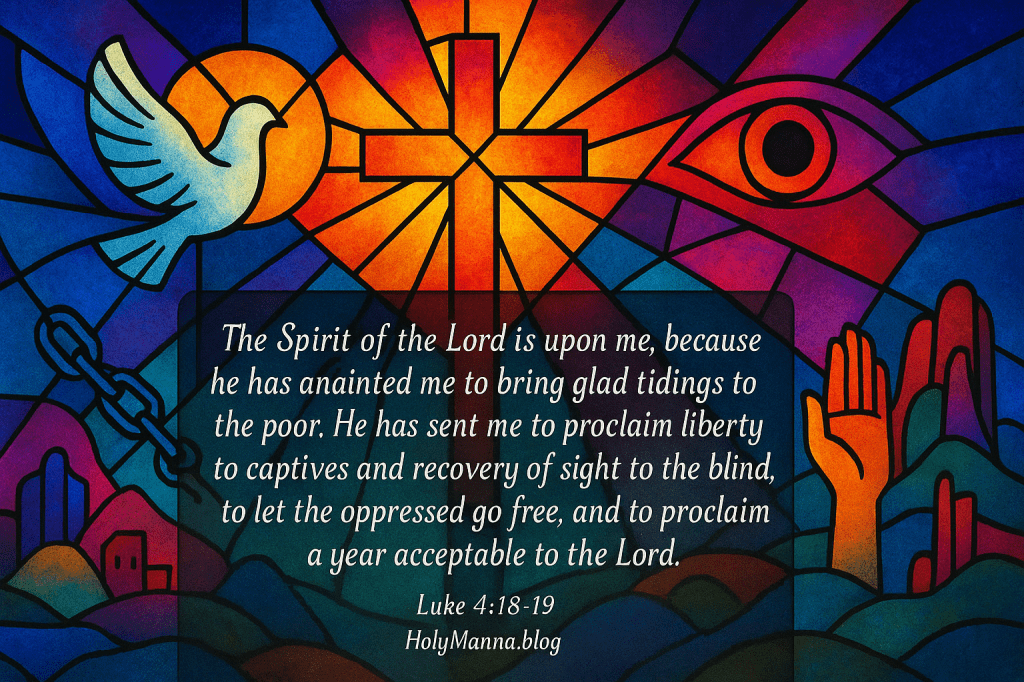
18 “The Spirit of the Lord is upon me,
because he has anointed me
to bring glad tidings to the poor.
He has sent me to proclaim liberty to captives
and recovery of sight to the blind,
to let the oppressed go free,
19 and to proclaim a year acceptable to the Lord.”
20 Rolling up the scroll, he handed it back to the attendant and sat down, and the eyes of all in the synagogue looked intently at him. 21 He said to them, “Today this scripture passage is fulfilled in your hearing.” 22 And all spoke highly of him and were amazed at the gracious words that came from his mouth. They also asked, “Isn’t this the son of Joseph?” 23 He said to them, “Surely you will quote me this proverb, ‘Physician, cure yourself,’ and say, ‘Do here in your native place the things that we heard were done in Capernaum.’” 24 And he said, “Amen, I say to you, no prophet is accepted in his own native place. 25 Indeed, I tell you, there were many widows in Israel in the days of Elijah when the sky was closed for three and a half years and a severe famine spread over the entire land. 26 It was to none of these that Elijah was sent, but only to a widow in Zarephath in the land of Sidon. 27 Again, there were many lepers in Israel during the time of Elisha the prophet; yet not one of them was cleansed, but only Naaman the Syrian.” 28 When the people in the synagogue heard this, they were all filled with fury. 29 They rose up, drove him out of the town, and led him to the brow of the hill on which their town had been built, to hurl him down headlong. 30 But he passed through the midst of them and went away.
Detailed Exegesis
Verse 16: “He came to Nazareth, where he had grown up, and went according to his custom into the synagogue on the sabbath day. He stood up to read.”
Jesus stands within Israel’s worship and reveals that the Gospel is the fulfillment of the Law and the Prophets. His practice of synagogue participation models faithful observance and prepares the moment of revelation.
Verse 17: “And was handed a scroll of the prophet Isaiah. He unrolled the scroll and found the passage where it was written:”
Jesus actively seeks the messianic text. The intentional choice signals that His ministry is not accidental. It is the Father’s plan revealed in Isaiah and now embodied in the Son.
Verse 18: “The Spirit of the Lord is upon me, because he has anointed me to bring glad tidings to the poor. He has sent me to proclaim liberty to captives and recovery of sight to the blind, to let the oppressed go free,”
The mission flows from the anointing. The poor are not only economically distressed. They are the humble who know their need. Liberty, sight, and freedom name concrete works of mercy that reveal the nearness of the Kingdom. The Church continues this Spirit driven mission in sacrament and service.
Verse 19: “And to proclaim a year acceptable to the Lord.”
This is Jubilee language. In Christ the definitive year of favor arrives. Time itself is touched by mercy. The acceptable year becomes a permanent horizon because the Anointed One abides with His people.
Verse 20: “Rolling up the scroll, he handed it back to the attendant and sat down, and the eyes of all in the synagogue looked intently at him.”
The dramatic pause places all attention on Jesus. He is not merely commenting on Scripture. He is the one about whom it speaks. The posture of sitting indicates the teacher’s authority in a synagogue setting.
Verse 21: “He said to them, ‘Today this scripture passage is fulfilled in your hearing.’”
The decisive word is today. Fulfillment is not deferred. It begins in the hearing Church, where the proclaimed Word effects what it signifies. The Messiah’s Jubilee is present in Jesus Himself.
Verse 22: “And all spoke highly of him and were amazed at the gracious words that came from his mouth. They also asked, ‘Isn’t this the son of Joseph?’”
Admiration mixes with scandal. Familiarity becomes an obstacle to faith. Grace is received with wonder and resisted by prejudice at the same time.
Verse 23: “He said to them, ‘Surely you will quote me this proverb, “Physician, cure yourself,” and say, “Do here in your native place the things that we heard were done in Capernaum.”’”
Jesus reveals their demand for signs on their terms. The proverb anticipates the Cross, where others will taunt Him to save Himself. True faith receives God’s works without dictating conditions.
Verse 24: “And he said, ‘Amen, I say to you, no prophet is accepted in his own native place.’”
Prophetic rejection is a biblical pattern. The Christ stands in the line of the prophets and surpasses them. Refusal does not negate His mission. It exposes the heart that resists grace.
Verse 25: “Indeed, I tell you, there were many widows in Israel in the days of Elijah when the sky was closed for three and a half years and a severe famine spread over the entire land.”
The reference to famine recalls 1 Kings 17. Scarcity tests faith and reveals God’s impartial generosity that cannot be confined to boundaries of tribe or familiarity.
Verse 26: “It was to none of these that Elijah was sent, but only to a widow in Zarephath in the land of Sidon.”
God’s mercy visits a Gentile widow. The point is not exclusion of Israel but the wideness of divine compassion. The Kingdom’s favor seeks the humble wherever they are found.
Verse 27: “Again, there were many lepers in Israel during the time of Elisha the prophet; yet not one of them was cleansed, but only Naaman the Syrian.”
Naaman’s cleansing in 2 Kings 5 shows that faith and obedience, not pedigree, open the door to healing. Jesus confronts hometown entitlement and invites universal repentance and trust.
Verse 28: “When the people in the synagogue heard this, they were all filled with fury.”
The shift from praise to rage unmasks the scandal of mercy. The Gospel disturbs closed hearts because it breaks down false securities and widens the circle of grace.
Verse 29: “They rose up, drove him out of the town, and led him to the brow of the hill on which their town had been built, to hurl him down headlong.”
Rejection aims at violence. Already the shadow of the Cross appears. The city that raised Him now seeks to cast Him out. The Messiah shares the fate of the prophets.
Verse 30: “But he passed through the midst of them and went away.”
Jesus is sovereign over the hour of His Passion. No rage can arrest the mission before its time. He continues toward those ready to receive the Jubilee.
Teachings
The identity and mission of Jesus shine through the anointing. “The word ‘Christ’ comes from the Greek translation of the Hebrew ‘Messiah’, which means ‘anointed’. It became the name proper to Jesus only because he accomplished perfectly the divine mission that ‘Christ’ signifies.” CCC 436. The works He proclaims are the pattern for His Church. “Christ’s compassion toward the sick and his many healings of every kind of infirmity are a resplendent sign that ‘God has visited his people’ and that the Kingdom of God is close at hand.” CCC 1503. The response to this Gospel must be concrete love. “The works of mercy are charitable actions by which we come to the aid of our neighbor in his spiritual and bodily necessities.” CCC 2447. The anointed community cannot hide this light. “The disciple of Christ must not only keep the faith and live on it, but also profess it, confidently bear witness to it, and spread it.” CCC 1816. In the liturgy, this fulfillment remains present. As we hear the Word and receive the Eucharist, the today of Jesus continues to set captives free, to give sight to the blind, and to make the poor rich in mercy.
Reflection
Jesus announces Jubilee where people expected routine, and He offers mercy where hearts preferred limits. Receive the Word today with readiness to be stretched by the wideness of God’s love. Practice a corporal or spiritual work of mercy that aligns with His manifesto. Confess the places where familiarity and pride have dulled your faith. Ask the Holy Spirit to make your home and parish places where the poor are welcomed and captives find liberty. Where is Jesus inviting you to move from admiration to obedience today? Who is the outsider you can honor and serve so that the Jubilee of Christ touches the margins near you?
Crowned by Hope, Sent in Mercy
The readings draw one luminous thread. The Lord comes to save, which turns sorrow into hope, worship into witness, and familiarity into the challenge of faith. In 1 Thessalonians 4:13-18 we hear the promise that “We shall always be with the Lord.” This word consoles the grieving and makes the Church a community that speaks life at the edge of death. In Psalm 96 creation learns a new song because the King comes to govern with justice and to shepherd the nations with faithfulness. In Luke 4:16-30 Jesus declares “Today this scripture passage is fulfilled in your hearing.” The Jubilee of God begins in Him, yet it meets resistance that invites us to deeper trust.
Let this day be a simple yes to the King who comes. Console one another with the hope of the Resurrection. Sing the Lord’s glory among the nations in prayer and conversation. Welcome the poor, the captive, and the outsider with works of mercy that make the Gospel visible. Receive the Eucharist as the place where today’s fulfillment touches your life and strengthens you to persevere when faith is tested. Where is the Spirit inviting you to move from admiration to obedience today? Whom will you console and serve so that the Lord’s Jubilee becomes good news in your corner of the world?
Engage with Us!
We would love to hear your reflections in the comments below. Share how the Lord is speaking to you through today’s readings and how you are responding in faith.
- 1 Thessalonians 4:13-18: How does the promise “We shall always be with the Lord.” shape the way you grieve and the way you console others today? What concrete step can you take this week to speak Christian hope to someone who is burdened by sorrow or fear of death?
- Psalm 96:1, 3-5, 11-13: Where is the Holy Spirit inviting you to sing a new song and to “tell his glory among the nations,” perhaps in your home, workplace, or parish? How does the assurance “The Lord comes to govern the world with justice.” move you to praise and to works of mercy that witness to His faithful love?
- Luke 4:16-30: What keeps you from welcoming the wideness of God’s mercy announced in Jesus’ word “Today this scripture passage is fulfilled in your hearing.”? Who is the outsider you can honor and serve this week so that Christ’s Jubilee becomes visible in your neighborhood?
Go forward encouraged. Live a life of faith that listens to the Word, sings the praise of the true King, and serves with the love and mercy that Jesus taught us.
Sacred Heart of Jesus, we trust in You!
Immaculate Heart of Mary, pray for us!
Saint Michael the Archangel, defend us in battle!
Follow us on Instagram and Facebook for more insights and reflections on living a faith-filled life.

 Holy Manna!
Leave a comment