Unlocked by Mercy, Claimed by Love
Saint Raymond Nonnatus was a thirteenth-century Mercedarian priest whose entire life was a proclamation of God’s liberating love. His surname means “not born,” a reference to his remarkable delivery by Caesarean section after his mother died in childbirth. He is cherished for ransoming enslaved Christians in North Africa, for preaching Christ so boldly that his captors padlocked his lips, and for the tender compassion that made him a patron for expectant mothers, newborns, and the falsely accused. The heart of his witness is simple and searing. In The Gospel of Matthew we hear Jesus say, “I was in prison and you visited me.” His vocation incarnated that line. The Church teaches in The Catechism of the Catholic Church that the works of mercy are essential to Christian life, “The works of mercy are charitable actions by which we come to the aid of our neighbor.” (CCC 2447). Raymond’s story is a luminous commentary on that teaching, showing how mercy becomes credible when it costs us something. His feast on August 31 invites us to look at those still held by chains seen and unseen and to love them into freedom.
Not Born but Given, A Son for Mary’s Work
Raymond first saw the light of day in Portell in Catalonia in 1204, his life spared in the very moment death touched his mother. From childhood he showed unusual devotion to the Blessed Virgin. Accounts describe a quiet youth who preferred prayer and the countryside to courtly ambitions. His father hoped for a practical life near the family lands, yet God drew Raymond to a more radical service of love. He eventually entered the Order of the Blessed Virgin Mary of Mercy, founded in 1218 by Saint Peter Nolasco. The Mercedarians existed for a singular purpose: to redeem Christians who had been captured and enslaved. Alongside the vows of poverty, chastity, and obedience, they professed a unique fourth vow to offer themselves as hostages if necessary to keep the faith of the captives intact. That vow shaped Raymond’s soul and set the course of his entire mission.
Within the order he was formed by a deep Eucharistic piety and a tender love for Mary. Ordained a priest, he asked for the most difficult assignments. He desired to go where the chains were heaviest, because the Gospel is most credible where people are most wounded. He would become known not only for the number of captives he helped to free, but also for the way he soothed fears, reconciled the despairing, and restored courage to those who felt forgotten by God.
Chains That Fell, Hearts That Opened
Raymond served as a “ransomer,” traveling by sea to the great slave markets of North Africa, especially in Algiers. He negotiated with traders, gathered funds, and personally escorted newly freed men and women back to Christian lands. When the money ran out and others still languished in chains, he lived the Mercedarian vow to its end by offering himself in exchange so that others could go free. Captivity did not halt his ministry. He prayed with prisoners, taught the faith, reconciled broken friendships, and urged everyone to place their suffering within the wounds of Christ. Tradition remembers conversions among guards who were struck by the serenity of his hope.
Hagiographical accounts speak of healings and providential deliverances attributed to his prayers. The most unforgettable sign in his life is the way God made his charity indestructible even when words were taken from him. Because he would not stop speaking of Jesus, his captors bored a hole through his lips and fixed them with a lock, a cruel attempt to silence the Gospel. Raymond answered with adoration, intercession, and the language of acts of love. Mercy continued to preach through his patience and courage. The Church recognizes in such holy endurance a form of miracle, a victory of grace that unlocks hearts.
The Seal on His Lips and the Crown of a Confessor
Raymond’s sufferings were fierce. He endured beatings and humiliations, and at one point he faced a sentence that would have ended in a public death. Divine providence turned the verdict into further imprisonment while his brothers sought the means for his ransom. After many months he was freed and returned to Spain, his face marked by the lock that once sealed his mouth and his heart marked by even greater compassion for the enslaved. His holiness did not remain hidden. Pope Gregory IX desired his counsel and elevated him as a cardinal deacon, honoring a life already spent for Christ. Summoned to Rome, Raymond set out in obedience but fell ill on the journey and died near Cardona in 1240. He is not commemorated as a martyr since he did not die by violence for the faith, yet the Church venerates him as a confessor who poured himself out until the very end. His trials purified his charity and left the Church a model of priestly mercy.
After the Chains, the Crowns of Intercession
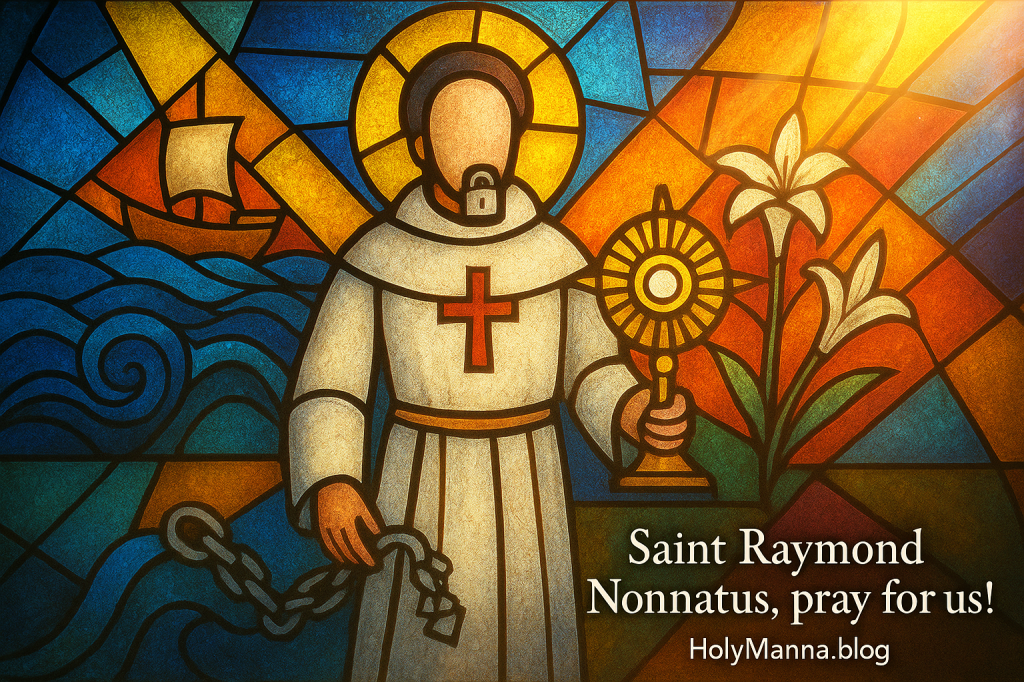
After his death, devotion to Raymond spread rapidly in Catalonia and beyond. Pilgrims flocked to the places that guarded his memory and relics, confident that the priest who traded his own freedom for the enslaved would not forget them in their distress. Parents prayed through him for safe deliveries, and many families recorded favors granted in childbirth, which helped shape his enduring patronage for expectant mothers, midwives, and newborns. Those unfairly maligned or entangled in legal injustices learned to ask for his aid, remembering the lock on his lips and the patient endurance with which he bore false accusations. In sacred art he is often depicted in the white Mercedarian habit with a padlock near his lips and sometimes with a monstrance, a reminder that his courage flowed from the Eucharistic Christ whom he adored. Shrines dedicated to him in Spain became places of thanksgiving for healings, reconciliations, and the quiet miracles of restored hope.
Pray, Redeem, Repeat
Raymond’s life is not a relic of a distant age. It is a roadmap for Christian discipleship in every generation. Captivity still disfigures lives. Addiction, exploitation, crushing debt, cycles of violence, loneliness, and the shame that silences people from asking for help are all chains that cry out for redemption. The Catechism of the Catholic Church calls us to theological charity, “the theological virtue by which we love God above all things for his own sake, and our neighbor as ourselves for the love of God.” (CCC 1822). If we love like that, then someone else’s captivity can never be someone else’s problem.
How can we imitate him concretely? We can support ministries that serve prisoners and victims of trafficking. We can practice the corporal and spiritual works of mercy in ordinary ways that are anything but small. We can speak truth with humility when others are slandered and keep confidences when charity requires silence. We can offer up misunderstandings without bitterness, uniting them to Christ for the good of those who suffer in secret. Daily intercession can become a habit of heart. A simple morning prayer can be “Lord, send me today to someone who feels chained.” We will begin to see our neighborhoods with the eyes of Christ. Raymond teaches us to keep returning to the Eucharist, because only a heart fed by Christ can spend itself without running dry.
Engage with Us!
I’d love to hear how Saint Raymond’s story moves you—share below so others can be strengthened by your witness.
- Where do you see “captivity” in your own community, and how might God be asking you to help ransom the afflicted, materially or spiritually?
- When has your faith been “padlocked” by fear, shame, or opposition, and what concrete step of courage can you take this week?
- How can you make one corporal or spiritual work of mercy part of your family’s rhythm this month ?
- Whom can you visit, write, or accompany so they know they’re not forgotten behind any kind of bars?
Go in courage. Let us live a faith that liberates, doing everything with the love and mercy Jesus taught us.
Saint Raymond Nonnatus, pray for us!
Follow us on Instagram and Facebook for more insights and reflections on living a faith-filled life.

 Holy Manna!
Leave a comment