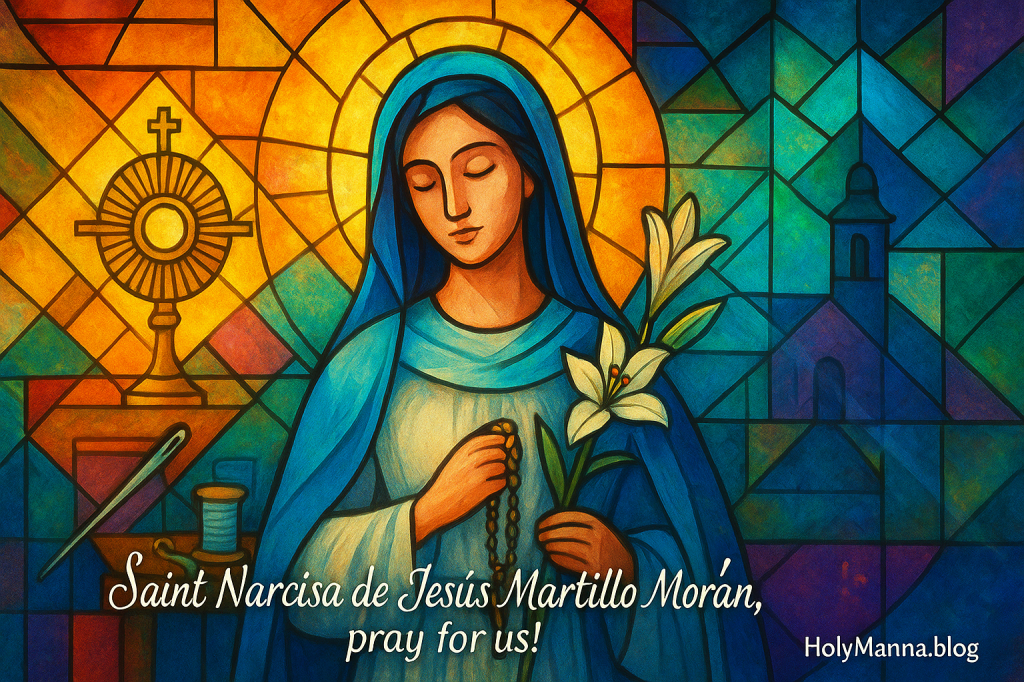
A Lily from Nobol
Saint Narcisa de Jesús Martillo Morán (1832–1869) shines as an Ecuadorian laywoman whose life was almost entirely hidden—simple work, silent prayer, and sacrificial love—yet whose holiness blossomed into a national witness. Known affectionately as “the Lily of Nobol,” she is revered for her purity, joyful charity, ardent devotion to the Eucharist, and a fierce love for the crucified Christ. She reminds the Church that sanctity is not reserved for cloisters and pulpits but can grow at a sewing table and in the quiet hours of the night. She was beatified in 1992 and canonized in 2008; her feast is kept on August 30. The path she walked embodies the call taught by The Catechism of the Catholic Church: “All Christians in any state or walk of life are called to the fullness of Christian life and to the perfection of charity.” (CCC 2013)
Roots in Guayas
Born on October 29, 1832, in San José de Nobol (Guayas, Ecuador), Narcisa was the sixth of nine children. Her parents, Pedro Martillo and Josefina Morán, were people of sturdy faith who handed on a love for prayer and the sacraments. From an early age she showed a contemplative temperament, a quick intellect, and artistic gifts—especially music and needlework. The family suffered early losses; after her mother’s death, Narcisa’s maturity flowered in responsibility and service to her siblings. When her father died in 1852, she moved to the bustling port of Guayaquil to earn her living as a seamstress. Sewing would become both her livelihood and a school of virtue, a place where she stitched together work, prayer, and charity for the poor.
She cultivated a disciplined spiritual life—daily Mass, long periods of adoration, the rosary, and frequent confession. She drew inspiration from Saint Mariana de Jesús (the “Lily of Quito”), whose example of reparation and love for the Crucified offered Narcisa a concrete model. Over time, her desire to belong wholly to God matured into private vows and a vocation as a lay tertiary of the Order of Preachers (Dominicans). In 1868 she moved to Lima, Peru, and lived as a consecrated laywoman attached to a Dominican convent, remaining in the world but not of it, offering her days for the salvation of souls.
The Seamstress of Mercy
Narcisa’s daily rhythm braided contemplation and action. She labored skillfully as a seamstress, served the poor with quiet generosity, and catechized children with gentleness. She kept prolonged vigils before the Blessed Sacrament, embraced regular fasting, and sought spiritual direction to guard humility and obedience. Her penances were austere, yet never gloomy; they were the language of love spoken to the Lord who gave Himself entirely. Those who knew her remembered a woman of serene cheerfulness whose kindness was unhurried, whose listening was deep, and whose counsel was steeped in Scripture and the Rosary.
Accounts from companions speak of moments of ecstasy during prayer and a striking conformity to the Passion of Christ. While the Church always insists that extraordinary phenomena must never eclipse the ordinary path of virtue, Narcisa’s life shows how God sometimes confirms hidden holiness with unusual graces. Above all, her holiness was measurable in charity—patience under strain, forgiveness of slights, and tireless service for the vulnerable—virtues every Christian can emulate.
Glimpses of Glory
Though she never sought attention, people quietly asked her prayers and testified to surprising favors: reconciled families, conversions of heart, relief from afflictions, and strength to endure trials. Companions observed that during intense prayer she would become wholly absorbed in God, and afterward she returned to ordinary tasks with even greater sweetness and zeal. These were not spectacles but “little sacraments” of God’s mercy—hints that Christ was near and active through a soul surrendered to Him. When the Church teaches about penance and almsgiving, it points to this interior change first: “Jesus’ call to conversion… does not aim first at outward works, ‘sackcloth and ashes,’ but at the conversion of the heart.” (CCC 1430) In Narcisa, the interior conversion bore outward fruit that others could taste and see.
Sickness, Misunderstanding, and a Holy Death
Narcisa did not die a martyr’s death; her path was the long martyrdom of fidelity. Poverty, bereavement, misunderstanding about her penitential practices, and periods of illness marked her years. She accepted each cross without bitterness and united it to Christ’s sacrifice at the altar. In late 1869 she suffered high fevers and, near midnight on December 8—the Solemnity of the Immaculate Conception—she entered eternal life in Lima. Those present noted a remarkable fragrance at the time of her passing, a traditional “odor of sanctity” that the Church sometimes associates with the pure and holy. The Catechism locates the strength for such fidelity in the sacraments, especially the Eucharist: “Daily conversion and penance find their source and nourishment in the Eucharist.” (CCC 1436)
A River After the Rain
After her death, devotion to Narcisa grew steadily. When her remains were later transferred to Ecuador, they were found incorrupt—an unexpected sign that further inflamed popular piety. Today her body rests in the National Shrine of Saint Narcisa de Jesús in Nobol, where pilgrims come from across Ecuador and beyond to seek her intercession and to give thanks for favors received. The faithful recount graces of healing, reconciliation, and renewed faith obtained through her prayers.
Two miracles—investigated with the Church’s customary rigor—paved the way to her beatification and canonization. The first involved the sudden, complete, and lasting cure of a man suffering from grave tumors; the second was the instantaneous restoration of a serious congenital condition in a child, judged medically inexplicable and enduring. These signs are not ends in themselves but windows into God’s fatherly care. They invite us to trust that Jesus Christ still heals, still reconciles, and still raises up the lowly through the prayers of His friends.
Learn from a Lily
Narcisa’s life distills the Gospel into a pattern anyone can follow: adore, offer, and act. Adore Jesus in the Eucharist and in Scripture, carving out daily silence to receive His gaze. Offer small penances with love—simpler meals, patient listening, forgiving first—as reparation and intercession for the world. Act with concrete mercy, especially toward the poor and those on the margins, letting your work become prayer and your prayer overflow into work. The Church calls these classic pathways “the three great works” of conversion: “Fasting, prayer, and almsgiving… express conversion in relation to oneself, to God, and to others.” (CCC 1434) If you feel far from perfection, be encouraged by the universal call to holiness: “All Christians… are called to the fullness of Christian life and to the perfection of charity.” (CCC 2013) Begin again today—quietly, steadily—like a seamstress who stitches one faithful thread at a time.
Engage with Us!
We’d love to hear how Saint Narcisa speaks to you—share your thoughts and prayer intentions in the comments.
- Where is Jesus inviting you to weave prayer into your daily work, as Narcisa did at her sewing table?
- What form of penance (prayer, fasting, or almsgiving) could you quietly offer this week for someone in need?
- How might you seek or resume regular confession and Communion to nourish “daily conversion”?
Go forth encouraged: live your faith boldly yet humbly; let every stitch of your day be sewn with the love and mercy Jesus taught us.
Saint Narcisa de Jesús Martillo Morán, pray for us!
Follow us on Instagram and Facebook for more insights and reflections on living a faith-filled life.

 Holy Manna!
Leave a comment