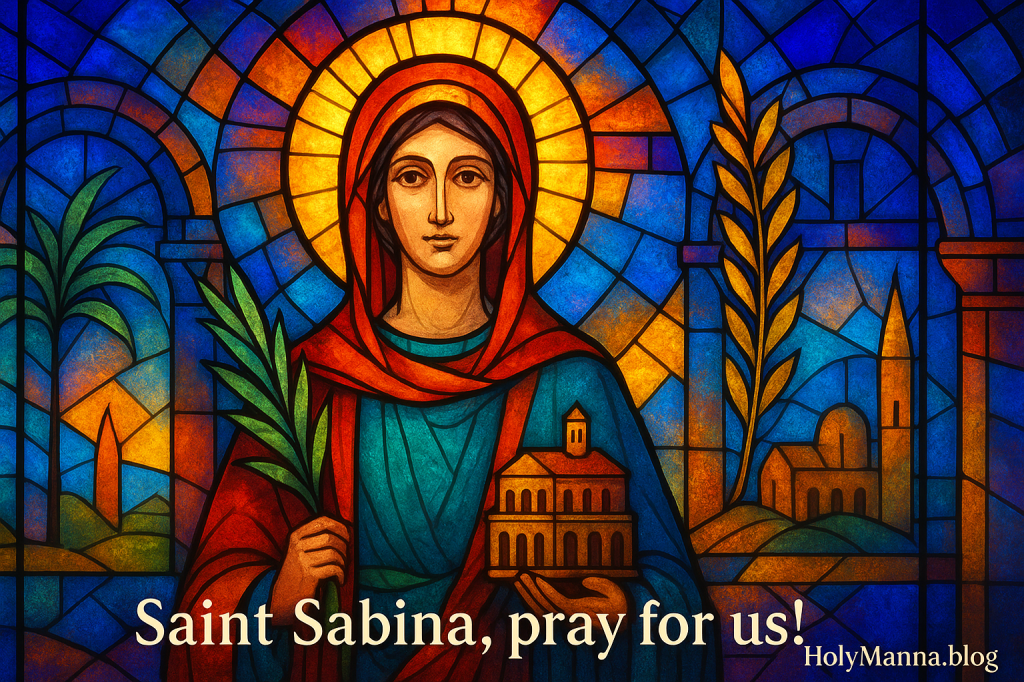
Faith on the Aventine
Saint Sabina is remembered as a second-century Roman matron who surrendered privilege and safety to confess Jesus Christ. The Church commemorates her on August 29. Each Ash Wednesday, the Roman stational liturgy begins at the basilica that bears her name on the Aventine Hill, keeping her witness before the faithful at the very doorway of our Lenten conversion. Though few biographical details are certain, her legacy is clear: a disciple who allowed friendship with Christ to reorder her life, her status, and ultimately her death. As the Catechism of the Catholic Church teaches, “Martyrdom is the supreme witness given to the truth of the faith: it means bearing witness even unto death.” (CCC 2473)
Conversion Through Holy Friendship
Tradition presents Sabina as a wealthy widow of senatorial rank who encountered the Gospel through the luminous fidelity of her servant, Saint Serapia (also known as Seraphia). Serapia’s humble courage during a time of suspicion toward Christians became a living catechesis; her prayer, charity, and fearless allegiance to Christ awakened Sabina’s own desire to belong to the Lord. Drawn by this witness, Sabina embraced baptism and began to identify publicly with the nascent Christian community in Rome. She is often associated with a late husband named Valentinus, remembered not to inflate her social standing but to underline the magnitude of her conversion: a woman of means who freely chose the path of the cross over the comfort of conformity. Her story shows how grace moves along the lines of friendship—faith begetting faith—until a household becomes a seedbed of holiness.
Quiet Bravery in the Heart of Empire
Early sources do not preserve a catalog of Sabina’s sayings or spectacular deeds. Instead, the Church remembers a pattern of life: fidelity to prayer, steadfast charity, hospitality to fellow believers, and the courage to be visibly Christian when discretion might have seemed the safer course. In the Roman world, where patronage carried real influence, a noblewoman’s public sympathies could protect the vulnerable—or provoke powerful opposition. Sabina used her position to strengthen the brethren and to honor the martyr Serapia, whose memory she cherished. No well-attested miracles are attributed to Sabina during her lifetime; her “marvel” is the simple heroism of daily faith, a witness that the Church proposes not for its novelty but for its purity. As the Catechism teaches, canonized saints are set before the faithful as models precisely because their lives let Christ’s victory be seen in concrete choices of love.
Tested by Steel
Sabina’s passion is situated by tradition in the second century, during one of the periodic crackdowns on Christians under imperial authority. Accounts agree on the essentials: she was arrested for confessing the name of Jesus, refused to renounce Him, and was condemned to death by beheading. The refined brutality of Roman justice meant her nobility could not shield her. In Sabina, the Church beholds a disciple who chose allegiance to Christ over status, comfort, and even life. Her martyrdom matters because it reveals the inner logic of baptism: union with the Lord’s death that blossoms into hope of His resurrection. The Catechism summarizes this logic with luminous brevity: “Martyrdom is the supreme witness given to the truth of the faith.” (CCC 2473) Sabina’s final “yes” joined her to the great cloud of witnesses whose blood became seed for new Christians.
Graces After Her Death
By the early fifth century, Sabina’s relics were honored on the Aventine Hill, where the presbyter Peter of Illyria constructed the Basilica of Santa Sabina (c. 422–432). The church’s ancient cypress doors, carved with biblical scenes, have instructed generations in salvation history; the luminous, spare interior has gathered popes, saints, and pilgrims into the same act of worship. In living practice, the Pope blesses ashes at nearby San Anselmo and then processes to Santa Sabina on Ash Wednesday, a ritual that places Sabina’s fidelity at the threshold of our Lenten conversion. Through the centuries, Christians have testified to favors received through her intercession and to the quiet healing that comes from praying where a martyr is venerated. The Catechism affirms why this matters: those in heaven remain active in love—“They do not cease to intercede with the Father for us.” (CCC 956) Popular devotion to relics and holy places, when ordered to the sacraments and the Gospel, expresses the Church’s living memory and God’s mercy at work across time.
How to Imitate Saint Sabina Today
Who has been a “Serapia” in your life—someone whose quiet fidelity drew you toward Jesus? Where is the Lord inviting you to let love cost you something—time, reputation, convenience? How might you consecrate your home, work, and relationships so that your daily choices become a chapel where Christ is honored? Sabina teaches us that the Gospel advances through friendship, hospitality, and the courage to be known as Christ’s own. Thank the person who helped your faith come alive, and become that person for someone else. Make one intentional act of witness today: trace the Sign of the Cross before a meal in public, speak a word of hope to someone anxious, or offer concrete help to a neighbor in need. Unite your little renunciations to the Eucharist you receive, and let confession clear space for grace to work. “The good of each is communicated to the others.” (CCC 947) Ask Saint Sabina to obtain for you a steadfast heart and the freedom to love Christ openly. In the communion of saints, our weaknesses are upheld and our courage multiplied; the good of one truly becomes the good of all.
Engage with Us!
We’d love to hear how Saint Sabina’s story resonates with you—share your reflections and intentions in the comments.
- What part of Sabina’s witness most challenges you right now?
- How can you accompany someone in faith this week, as Serapia accompanied Sabina?
- Will you make a brief, prayerful visit (even virtually) to Santa Sabina on Ash Wednesday or another day to unite yourself to the Church’s prayer?
Take heart and press on: live your faith openly, suffer patiently when it costs you, and do everything with the love and mercy Jesus has taught us.
Saint Sabina, pray for us!
Follow us on Instagram and Facebook for more insights and reflections on living a faith-filled life.

 Holy Manna!
Leave a comment