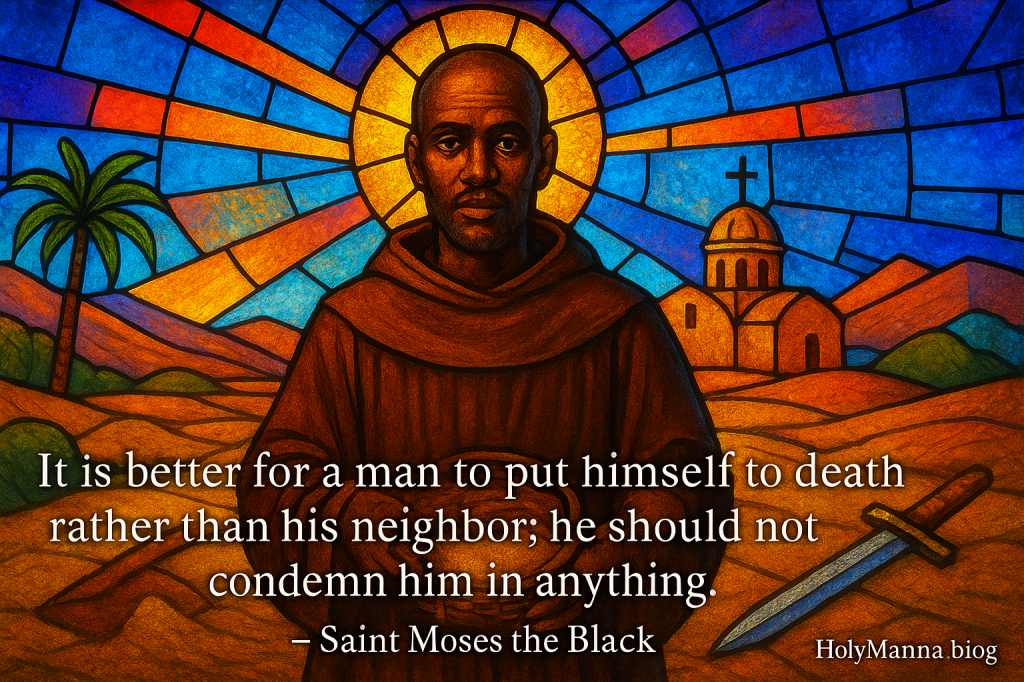
From Sword to Sand
Saint Moses the Black—also called Moses the Ethiopian—emerges from the fourth-century Egyptian desert as a luminous witness to the Gospel’s power to transfigure a human life. Once a feared brigand, he became a monk, priest, and spiritual father among the Desert Fathers of Scetis (Wadi El-Natrun). He is revered for courageous honesty about sin, tireless ascetic struggle, tender mercy toward the weak, and a radical embrace of evangelical nonviolence. Crucially, the Church venerates him as a martyr: around A.D. 405 he was slain during a raid on Scetis after refusing to take up arms, sealing his conversion with the blood-witness of charity. His feast in the Roman Martyrology is kept on August 28, and he is honored broadly in the Coptic and Eastern traditions as well. The Catechism of the Catholic Church summarizes the heart of his story in one line: “Christ’s call to conversion continues to resound in the lives of Christians.” (CCC 1428)
A Lion Becomes a Lamb
Moses was of Ethiopian heritage and, according to ancient monastic tradition, began life as a servant to a high official in Egypt. Dismissed for theft and violence, he gathered a band of robbers and terrorized the countryside. This was a man of imposing physique and greater appetites—anger, gluttony, lust—yet beneath the bravado burned a fierce intelligence and leadership that, in God’s time, would serve the Kingdom. Pursued by authorities, Moses fled into the desert and encountered the monks of Scetis. Their meekness, watchfulness in prayer, and unflinching love pierced him. He sought instruction under the seasoned elder Abba Isidore, received baptism, and began a life of penance marked by manual labor, night vigils, and long fasts. As temptation pressed hard, the elders taught him to remain in his cell, to pray the Psalms, and to expose his thoughts in obedience—classic desert remedies that slowly tamed his passions. Years later, the Patriarch of Alexandria, recognizing a tested virtue, ordained Moses a priest. What he is most known for is not a single exploit but a pattern: strength willingly surrendered to Christ, then returned as meekness for the sake of others. The Catechism names the road he walked: “The way of perfection passes by way of the Cross. There is no holiness without renunciation and spiritual battle.” (CCC 2015)
A Father of Souls in the Desert
As a monk and then a priest, Moses became a living catechesis on mercy. The famous account of four robbers invading his cell shows the change grace had wrought: he subdued them without harm, hoisted them onto his broad shoulders, carried them to the church, and begged the brethren to decide their fate. Confronted by undeserved kindness, the men repented and embraced monastic life. In another celebrated scene, the community summoned Moses to judge a brother who had sinned. He arrived carrying a leaky basket of sand and said, “My sins run out behind me, and I do not see them, and today I am coming to judge the errors of another.” The assembly was cut to the heart and forgave the offender. Moses also embodied the desert conviction that charity outranks personal austerity. When visitors arrived on a fast day, he prepared food for them without scruple, teaching the younger monks that fasting exists to serve love, not the other way around. In the realm of spiritual warfare, the elders testified that Moses received authority over demons after long ascetic combat, and that his prayer reconciled enemies, pacified violent hearts, and freed the afflicted. The miracles attributed to him in life are often the “quiet kind”: hardened sinners converted, communities healed, and the power of evil broken by humility, obedience, and intercessory prayer. In Moses we glimpse the evangelical counsels lived to their marrow (cf. CCC 915), the corporal and spiritual works of mercy woven into daily hospitality (cf. CCC 2447), and the protection of a good name through restraint from rash judgment (cf. CCC 2478: “To avoid rash judgment…”).
Strength Made Gentle
Moses’s sanctity was not an escape from struggle but a deep entry into it. He battled old habits relentlessly, sometimes spending entire nights in prayer to master a wandering mind and rebellious body. When assailed by lust, he sought counsel, intensified manual labor, and prayed until passion cooled—an image of grace cooperating with effort. As his reputation grew, some tested him through insults; he met them with self-accusation and silence, an asceticism of the tongue. In old age he shepherded many disciples. When word came that desert raiders were approaching Scetis, Moses forbade armed resistance. He recalled the Lord’s word, “All who take the sword shall perish by the sword.” (Mt 26:52) Choosing to remain in his church with a small band of brethren, he accepted death rather than return to violence. Thus he died a martyr around A.D. 405, the one who had once lived by the sword now crowned by the peace of Christ—fulfilling the beatitude of the peacemakers and the Catechism’s praise of evangelical nonviolence: “Those who renounce violence… bear witness to evangelical charity.” (CCC 2306). The Church therefore remembers him explicitly as a monk-priest and martyr.
A Shrine in the Sand
After his death, Moses’s memory spread across Egypt and beyond. Monastic communities preserved his sayings in the Apophthegmata Patrum (Sayings of the Desert Fathers), and his feast entered the calendars of East and West. Tradition holds that his relics are honored among the ancient monasteries of Wadi El-Natrun, where pilgrims still come seeking the desert’s quiet wisdom and the intercession of its saints. Reports through the centuries speak of renewed conversions, reconciled relationships, and freedom from spiritual oppression granted through his intercession—graces of the same kind he mediated in life. In this sense, his most characteristic “posthumous miracle” continues to be the transformation of the human heart: sinners returned to Confession, wrath cooled, and a new capacity for mercy awakened by his example and prayers.
Let Grace Rewire Your Strength
Saint Moses the Black teaches that God does not erase our strength; He converts it. The force that once fueled rage became in Moses a shelter for the weak, a courage for truth, and a steadfastness in prayer. His story is a masterclass in cooperation with grace: naming one’s sin without despair, submitting to a wise spiritual father, and training desire through prayer, fasting, manual work, and the sacraments. The Catechism calls every Christian to this lifelong turn toward God (CCC 1428), insisting that holiness is forged in daily renunciation (CCC 2015). Moses also models evangelical hospitality (CCC 2447): charity that gladly bends personal austerity to love the person in front of us. And he urges us to guard the reputation of others (CCC 2478), to refuse all revenge, and to prefer the Cross to the sword (CCC 2306). Practically, this week you can imitate him by choosing one small, steady practice—an evening examen with honest self-accusation, a weekly fast united to the Eucharist, or a set time for the Psalms. If anger or lust stalks you, ask for a wise confessor or spiritual director; make your cell—your room, your prayer corner—a workshop of grace. Moses shows that the desert can bloom within any heart that lets Christ be Lord.
Engage with Us!
We’d love to hear how Saint Moses the Black speaks to you—share your thoughts and testimonies in the comments so we can grow together in holiness.
- Where do you most need God’s mercy to rewrite your story?
- Whom is the Lord asking you to forgive—and what “basket of sand” can you carry to remember your own need for mercy?
- What small, consistent practice (fasting, a Psalm each day, a weekly hour of Adoration) will train your heart toward peace this week?
May Saint Moses the Black intercede for us, that we might live a life of faith, hope, and love—doing all with the mercy Jesus taught us.
Saint Moses the Black, pray for us!
Follow us on Instagram and Facebook for more insights and reflections on living a faith-filled life.

 Holy Manna!
Leave a comment