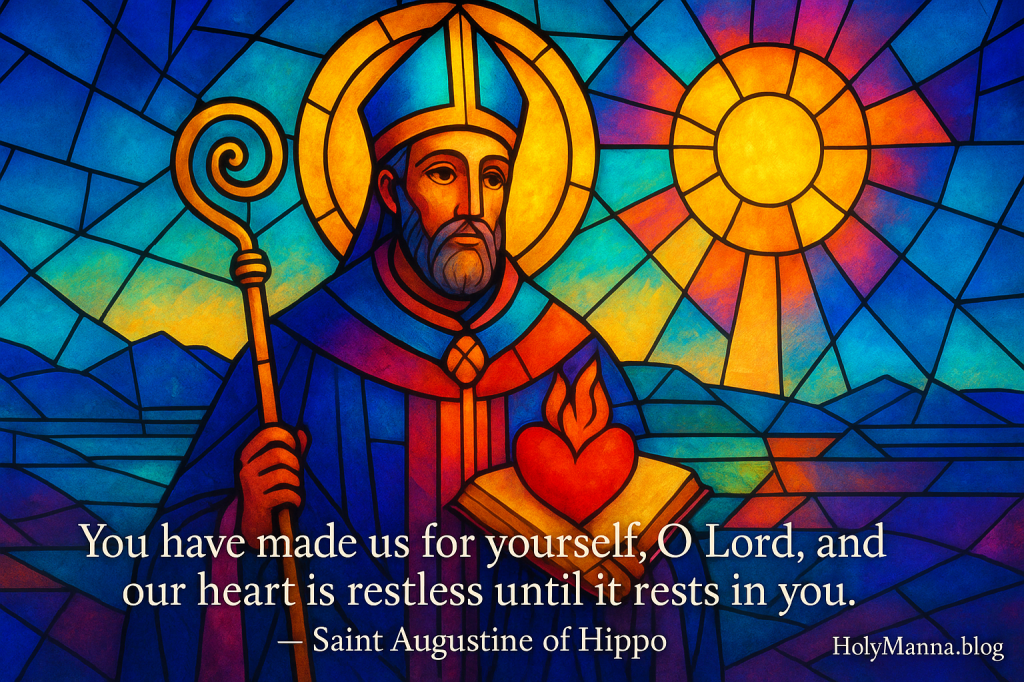
A Restless Heart Finds Its Home
Saint Augustine of Hippo (354–430) is among the greatest Fathers and Doctors of the Church, revered as the “Doctor of Grace” for his luminous teaching on divine mercy, conversion, and the interior life. His masterpieces—Confessions, The City of God, and On the Trinity—have nourished Christians for more than fifteen centuries and continue to shape Catholic theology, spirituality, and pastoral practice. Few lines have captured the human condition more honestly than Augustine’s famous prayer: “You have made us for yourself, O Lord, and our heart is restless until it rests in you.” His feast day is celebrated on August 28, and he remains a trusted guide for seekers who yearn for truth, healing, and a home in God.
The Long Conversion
Augustine was born in Tagaste (modern Souk Ahras, Algeria) to Monica, a fervent Christian, and Patricius, a Roman official who became Christian near the end of his life. Gifted with a brilliant mind, Augustine studied rhetoric in Madaura and Carthage, embraced an ambitious career, and fathered a son, Adeodatus. Intellectually restless, he explored Manichaeism for nearly a decade, then, after moving to Rome and Milan, encountered Neoplatonic thought and—decisively—Bishop Ambrose’s preaching. Ambrose opened Scripture to him, and Monica’s tears watered the soil of Augustine’s heart. In the garden of a Milan home in 386, anguished over his divided will, Augustine heard a childlike voice chant tolle lege—“take up and read.” He opened Saint Paul and found the summons to leave vice and “put on the Lord Jesus Christ.” Surrender followed; at the Easter Vigil of 387, Ambrose baptized Augustine, along with Alypius and Adeodatus. Soon after, at Ostia, Monica died, her lifelong prayer answered. Returning to North Africa, Augustine briefly embraced a monastic life at Tagaste before being pressed into service at Hippo Regius, where he was ordained priest (391) and later consecrated bishop (395/396). He is best known for his theology of grace and the Church, his penetrating analysis of the human heart, and his witness that genuine wisdom is inseparable from humble, ecclesial faith.
Shepherd and Scholar
As bishop of Hippo, Augustine preached constantly—his surviving sermons and letters reveal a pastor who loved Scripture, the sacraments, and his people. He defended Catholic unity against the Donatists, insisting that holiness and the efficacy of the sacraments come from Christ, not from the minister’s personal worthiness. He contended with Pelagius, clarifying the Church’s perennial faith that salvation is sheer gift: “Our justification comes from the grace of God. Grace is favor, the free and undeserved help that God gives us…” (CCC 1996). He also taught that “Grace is a participation in the life of God.” (CCC 1997), a truth he experienced in prayer and preached with urgency. While Augustine was not a “wonder-worker” in the popular sense, he carefully documented miracles God wrought among the faithful of his day—especially after the translation of Saint Stephen’s relics to North Africa. In The City of God (Book 22), he soberly lists healings, conversions, deliverance from evil, and even instances of the dead restored to life, having many of these accounts read publicly in church to edify his flock. These signs, Augustine taught, were not ends in themselves but confirmations of the Gospel and invitations to deeper conversion and charity.
Trials Without Blood
Augustine did not shed blood for Christ, yet his life bore the marks of what tradition calls white martyrdom. He carried the weight of controversies, journeys to councils, administrative burdens, the care of clergy and poor, and deep anxieties for unity and peace. In old age he watched the Vandals besiege Hippo. Stricken with illness in 430 as the siege raged, Augustine asked that the penitential psalms be copied and hung on his walls; he prayed them with tears, desiring to meet the Lord in humility and hope. He died on August 28, steadfast in faith, a bishop who had poured himself out for Christ and His Church. His endurance—rooted in grace, anchored in prayer—models for us how to bear trials with patience, intercession, and unwavering confidence in God’s mercy.
Beyond the Tomb
After Augustine’s death, devotion to him spread swiftly. His relics, preserved with care, were transferred from Africa to Sardinia and, in the early Middle Ages, solemnly brought to Pavia by King Liutprand. They now rest in the Basilica of San Pietro in Ciel d’Oro, where pilgrims continue to seek his intercession. Medieval accounts speak of healings and conversions at his shrine, and across the centuries countless readers of Confessions have testified to graces received—freedom from sin’s chains, strength to persevere, the courage to return to the sacraments. In this sense, Augustine’s posthumous miracles include not only physical healings attributed to his intercession but also the innumerable interior transformations wrought as his words lead restless hearts to Christ.
Let Grace Win Your Heart
Augustine’s story is our story writ large: desires misdirected, a heart ensnared, and then a decisive encounter with the living God who saves by grace. The Catechism reminds us, “Jesus calls to conversion… Baptism is the principal place for the first and fundamental conversion.” (CCC 1427). That grace does not merely help from the outside; “Grace is a participation in the life of God.” (CCC 1997). Practically, Augustine teaches us to pray honestly; to confess sin without self-deception; to read Scripture daily; to love the Eucharist and the unity of the Church; to serve the poor; and to entrust our minds to Christ so that thinking becomes an act of worship. Consider adopting Augustine’s rhythm: begin the day with a brief prayer from the Psalms, read a few pages of Confessions, and ask the Lord to reorder your loves. Seek Confession regularly, and when anxiety or temptation rises, turn that restlessness into a cry of love—“Late have I loved You; now I run.” Through Augustine, God shows that no past is too tangled for grace, no intellect too proud to kneel, and no heart too weary to be made new.
Engage with Us!
We’d love to hear your story—please share your thoughts and comments below!
- How has Augustine’s example stirred your heart?
- Where do you sense restlessness in your life right now, and how might God be inviting you to “take and read”?
- What one step—Confession, daily prayer with the Psalms, or spiritual reading—can you begin this week to “put on the Lord Jesus Christ” (Rom 13:14)?
As the Church teaches, the saints do not cease to help us: “Being more closely united to Christ, those who dwell in heaven… do not cease to intercede with the Father for us.” (CCC 956). Let’s ask Saint Augustine to pray that our hearts rest in God. Live the day with faith, and do everything with the love and mercy Jesus taught us.
Saint Augustine of Hippo, pray for us!
Follow us on Instagram and Facebook for more insights and reflections on living a faith-filled life.

 Holy Manna!
Leave a comment