Memorial of Saint Augustine, Bishop and Doctor of the Church – Lectionary: 428
Hearts on Watch
Where is your heart keeping watch today—and whom is it feeding while it waits? Today’s readings gather around a single call: watchful love that matures into holy stewardship. In 1 Thessalonians 3:7–13, Saint Paul’s pastoral heartbeat is audible as he prays that believers “increase and abound in love” so their hearts may be strengthened “to be blameless in holiness… at the coming of our Lord Jesus”—a vigilance measured not by anxiety but by charity. Psalm 90, a prayer traditionally ascribed to Moses, places this love inside God’s eternal horizon: “Teach us to count our days aright”, so that fleeting time is transfigured into wisdom, mercy at daybreak, and the humble plea, “Prosper the work of our hands!” In Matthew 24:42–51, Jesus intensifies the note of readiness—“Stay awake!”—by casting disciples as household stewards who feed the family “at the proper time”; in the world of first-century oikonomoi (stewards), fidelity is proven by daily, other-focused service, not dramatic gestures. This triad—abounding love, numbered days, faithful stewardship—finds a living icon in the Memorial of Saint Augustine, Bishop and Doctor of the Church. The restless seeker of Hippo reminds us that the soul’s vigilance is ordered by love: “You have made us for yourself, O Lord, and our heart is restless until it rests in you.” (Confessions I.1). Augustine’s ordo amoris teaches that holiness is rightly ordered affection poured out in concrete care for the Church; his pastoral realism echoes the Gospel’s “faithful and prudent servant,” and his luminous counsel—“Love, and do what you will.” (Homilies on 1 John)—captures Paul’s vision of a love that prepares us for the Lord’s Day. As the Church keeps her watch in sacred history (CCC 672; 1040–1041), she calls each of us to the universal path of sanctity (CCC 2013–2015) where charity is the form of all virtues (CCC 1827): to wake each morning under God’s mercy, to number our days with wisdom, and to spend them feeding Christ’s household until He comes.
First Reading – 1 Thessalonians 3:7–13
Abounding Love that Keeps Watch
In the bustling port city of Thessalonica—capital of Roman Macedonia and a vital hub on the Via Egnatia—Saint Paul established a young Christian community during his second missionary journey around A.D. 50. Persecution followed quickly, forcing his abrupt departure and leaving the Church to mature without his physical presence. Paul’s anxiety for their perseverance led him to send Timothy; the encouraging report that returned prompted this fervent thanksgiving and prayer. Framed by the early Church’s living expectation of Christ’s return, this passage shows that authentic vigilance is measured by charity: a community “standing firm in the Lord” expresses its watchfulness by increasing in love and growing in holiness. On the Memorial of Saint Augustine, Bishop and Doctor, the text resonates with Augustine’s ordo amoris: rightly ordered love that braces the heart, fashions a faithful steward, and readies the Bride for her coming Lord. In today’s theme of watchful love and holy stewardship, Paul’s prayer becomes our roadmap—love that abounds, time that is numbered wisely, and hearts strengthened for the Day.
1 Thessalonians 3:7-13
New American Bible (Revised Edition)
7 Because of this, we have been reassured about you, brothers, in our every distress and affliction, through your faith. 8 For we now live, if you stand firm in the Lord.
Concluding Thanksgiving and Prayer. 9 What thanksgiving, then, can we render to God for you, for all the joy we feel on your account before our God? 10 Night and day we pray beyond measure to see you in person and to remedy the deficiencies of your faith. 11 Now may God himself, our Father, and our Lord Jesus direct our way to you, 12 and may the Lord make you increase and abound in love for one another and for all, just as we have for you, 13 so as to strengthen your hearts, to be blameless in holiness before our God and Father at the coming of our Lord Jesus with all his holy ones. [Amen.]
Detailed Exegesis
Verse 7 – “Because of this, we have been reassured about you, brothers, in our every distress and affliction, through your faith.”
Paul reveals the reciprocal consolation of the Body of Christ: the Thessalonians’ steadfast faith relieves apostolic distress. Suffering is not removed but reinterpreted as fruitful when it strengthens others. This embodies the communion of saints, where the faith of one member fortifies another, and models the pastoral heart Augustine lived as bishop—finding rest not in ease, but in the faithful perseverance of his flock.
Verse 8 – “For we now live, if you stand firm in the Lord.”
Apostolic vitality is tethered to the community’s perseverance. Paul’s “we now live” underscores the life-giving effect of fidelity. Spiritual authority is parental and self-giving, not managerial; the shepherd’s joy is the stability of the sheep in the Lord. This anticipates the Gospel’s “faithful and prudent servant”, whose life is measured by the flourishing of those entrusted to him.
Verse 9 – “What thanksgiving, then, can we render to God for you, for all the joy we feel on your account before our God?”
Thanksgiving explodes into doxology. True pastoral joy is Godward: Paul “renders to God”, recognizing grace as the source of their growth. Gratitude here is both worship and warfare, guarding the heart from envy and control. Augustine would say grace precedes, accompanies, and follows every good—joy returns to its Giver.
Verse 10 – “Night and day we pray beyond measure to see you in person and to remedy the deficiencies of your faith.”
Prayer is relentless and practical: Paul longs to be present to complete what is lacking. “Deficiencies” do not shame; they invite formation. Apostolic ministry is catechetical and sacrificial, aiming at maturity. In Augustine’s pastoral praxis, teaching heals: doctrine orders desire, and presence fortifies the weak.
Verse 11 – “Now may God himself, our Father, and our Lord Jesus direct our way to you,”
Paul petitions for divinely guided reunion. The path of ministry is not self-engineered; it is directed by the Father through the Lord Jesus. This expresses the Church’s filial confidence in Providence and prepares the community to receive shepherds as gifts from God, not mere organizers.
Verse 12 – “and may the Lord make you increase and abound in love for one another and for all, just as we have for you,”
The heart of the petition: not mere survival, but superabundance of love, first intra-ecclesial (“for one another”) and then missional (“for all”). Love is both the mark and the mission of the Church. Augustine’s famous counsel captures the dynamism here: “Love, and do what you will.” (Homilies on the First Epistle of John). Charity becomes the form of every Christian action.
Verse 13 – “so as to strengthen your hearts, to be blameless in holiness before our God and Father at the coming of our Lord Jesus with all his holy ones.”
Charity is ordered to eschatology: love fortifies the heart for holiness, ready for the Parousia. Readiness is not panic but purity; not speculation but sanctification. The aim is “blameless in holiness”, the very thing Augustine sought after his restless conversion: a heart finally ordered toward God’s coming glory.
Teachings
Paul’s prayer discloses the Church’s path between Christ’s Ascension and Return: vigilant love that matures into holiness. The Catechism names this universal call with clarity. CCC 2013 teaches: “All Christians in any state or walk of life are called to the fullness of Christian life and to the perfection of charity.” This perfection is cruciform. CCC 2015 states: “The way of perfection passes by way of the Cross. There is no holiness without renunciation and spiritual battle.” Thus the prayer that love “increase and abound” (Verse 12) is not sentimental; it is sanctifying and costly. Augustine provides a luminous witness. In Confessions I.1 he prays: “You have made us for yourself, O Lord, and our heart is restless until it rests in you.” Preaching on fraternal charity, Augustine exhorts: “Love, and do what you will: if you keep silent, keep silent by love; if you speak, speak by love; if you correct, correct by love; if you spare, spare by love; let the root of love be within; of this root can nothing spring but what is good.” (Homilies on the First Epistle of John, Tractate 7). Paul’s eschatological horizon echoes the Catechism’s summons to readiness for judgment. CCC 1041 teaches: “The message of the Last Judgment calls men to conversion while God is still giving them the ‘acceptable time,’ the day of salvation.” In this light, Verse 13’s “blameless in holiness” becomes the Church’s daily ambition: to live the acceptable time as watchful love.
Reflection
Holiness grows where love is practiced on purpose. Begin your day, like Paul, by naming the people whose faith gives you life and by thanking God for them. Ask the Lord to direct your steps and to show you one concrete way to “abound in love” for a brother or sister in your parish, family, or workplace. Seek presence, not performance: send the message, make the visit, offer the correction gently, receive the correction humbly. Let your vigilance be measured by whom you feed and how you serve. Where is God inviting you to “remedy what is lacking” in your faith through prayer, study, or sacramental life this week? Whose fidelity makes you say, “Now I truly live”—and how can you strengthen their heart today? If the Lord came this evening, what act of love would you wish He found you doing—and what is stopping you from doing it now?
Responsorial Psalm – Psalm 90:3–5, 12–14, 17
Numbered Days, Dawn Mercy, Faithful Work
Composed as a prayer of Moses and placed at the head of Book IV of the Psalter, Psalm 90 sings from the wilderness school where Israel learned to see time against God’s eternity. In the ancient Near Eastern world, a “watch of the night” marked a short span of hours; by invoking that image, the psalm confronts human frailty, life’s brevity, and the need for wisdom that only God can give. It is a people’s plea to have their days “counted” by grace and their work “established” by divine favor. Read within today’s theme—watchful love and holy stewardship—the psalm teaches us to meet each dawn with mercy, spend the day in prudent service, and entrust the work of our hands to the Lord. On the Memorial of Saint Augustine, its cry harmonizes with his ordo amoris: time is redeemed when love is rightly ordered toward God and poured out in service of His household.
Psalm 90:3-5, 12-14, 17
New American Bible (Revised Edition)
3 You turn humanity back into dust,
saying, “Return, you children of Adam!”
4 A thousand years in your eyes
are merely a day gone by,
Before a watch passes in the night,
5 you wash them away;
They sleep,
and in the morning they sprout again like an herb.
12 Teach us to count our days aright,
that we may gain wisdom of heart.
13 Relent, O Lord! How long?
Have pity on your servants!
14 Fill us at daybreak with your mercy,
that all our days we may sing for joy.
17 May the favor of the Lord our God be ours.
Prosper the work of our hands!
Prosper the work of our hands!
Detailed Exegesis
Verse 3 – “You turn humanity back into dust, saying, ‘Return, you children of Adam!’”
The psalmist recalls humanity’s origin and end, echoing the language of Genesis and the mortality of the wilderness generation. This sober truth is not nihilistic; it is medicinal humility. By naming our dust, the prayer disposes us to receive mercy and to steward our brief time with reverence.
Verse 4 – “A thousand years in your eyes are merely a day gone by, Before a watch passes in the night,”
Divine eternity relativizes human chronology. What overwhelms us—centuries and empires—is to God as a passing watch. The verse invites holy detachment: faithful stewardship arises when we measure time by God’s gaze, not our anxieties.
Verse 5 – “You wash them away; They sleep, and in the morning they sprout again like an herb.”
Human generations are like flood-swept grass: fragile at evening, fresh at dawn. The imagery carries both judgment and hope—life fades swiftly, yet God gifts new beginnings. Morning renewal prepares us for the Gospel’s vigilant service: receiving mercy at daybreak to feed the household throughout the day.
Verse 12 – “Teach us to count our days aright, that we may gain wisdom of heart.”
This is the psalm’s hinge petition. To “count” days is to live intentionally before God, aligning choices with ultimate ends. Wisdom of heart is not mere calculation but grace-formed prudence that orders love and action.
Verse 13 – “Relent, O Lord! How long? Have pity on your servants!”
The ancient lament formula becomes a school of hope. Israel’s cry acknowledges covenant relationship: the Lord is not a distant power but the God who pities His servants. Honest lament keeps us awake to God’s coming and guards us from the wicked servant’s dullness.
Verse 14 – “Fill us at daybreak with your mercy, that all our days we may sing for joy.”
Mercy in the morning sets the tone for the whole day. Joy is not escapism but the fruit of being filled by God before we attempt any work. Augustine’s conversion language finds a resonance here: grace encountered becomes song sustained.
Verse 17 – “May the favor of the Lord our God be ours. Prosper the work of our hands! Prosper the work of our hands!”
The double petition underlines dependence. Prosperity here is not mere increase but divine establishing—God making our labor stable, meaningful, and oriented to His glory. This is the psalmic root of Christian stewardship.
Teachings
The psalm tutors us in mortality, wisdom, hope, and work offered to God. The Catechism defines prudence as the habit that disciplines such numbered days: CCC 1806 teaches, “Prudence is the virtue that disposes practical reason to discern our true good in every circumstance and to choose the right means of achieving it.” To live Psalm 90 is to let prudence steer love toward God’s ends. Our petition for morning mercy is animated by theological hope: CCC 1817 professes, “Hope is the theological virtue by which we desire the kingdom of heaven and eternal life as our happiness, placing our trust in Christ’s promises and relying not on our own strength, but on the help of the grace of the Holy Spirit.” The eschatological undercurrent—numbering days before judgment—accords with CCC 1041: “The message of the Last Judgment calls men to conversion while God is still giving them the ‘acceptable time,’ the day of salvation.” This conversion aims at holiness under the form of charity: CCC 2013 proclaims, “All Christians in any state or walk of life are called to the fullness of Christian life and to the perfection of charity.” Saint Augustine gives the psalm a personal voice. In Confessions I.1 he prays, “You have made us for yourself, O Lord, and our heart is restless until it rests in you.” And at the threshold of a new day, his exclamation in Confessions X.27 becomes a dawn prayer, “Late have I loved you, Beauty so ancient and so new, late have I loved you!” Both lines translate Psalm 90’s urgency into a baptized desire: let love be ordered to God, and let the work of our hands be established in Him.
Reflection
Begin each morning by receiving mercy before doing anything else: make an offering of your day, ask for wisdom of heart, and entrust your tasks to God’s favor. Practice a midday examen to “count” the hours already spent and to realign the rest with love. Close the day by commending unfinished work to the Lord who alone establishes it. Where do you sense the Lord inviting you to “count your days aright” today—habits, schedules, or relationships that need reordering? What concrete work of your hands needs to be placed under God’s favor so that it becomes stewardship, not self-assertion? If you met the Lord tonight, how would you want Him to find the “work of your hands”—and what one step will you take this hour to align it with His will?
Holy Gospel – Matthew 24:42–51
Stay Awake
Set within the Olivet Discourse, The Gospel of Matthew situates Jesus on the Mount of Olives addressing disciples about vigilance amid uncertain timing. First-century listeners knew the “watch of the night,” a short guard shift that could be easily slept through, and they knew the social role of the oikonomos—the household steward charged with feeding and managing servants in the master’s absence. Jesus weaves both images to teach that the Church’s readiness for the Son of Man is proved not by prediction but by prudent, other-focused service. In today’s theme of watchful love and holy stewardship, this passage shows that true preparation looks like the faithful servant who distributes food “at the proper time,” the daily charity Saint Augustine embodied as bishop. His ordo amoris orders our waiting: love God first, serve His household, and you will be ready whenever He comes.
Matthew 24:42-51
New American Bible (Revised Edition)
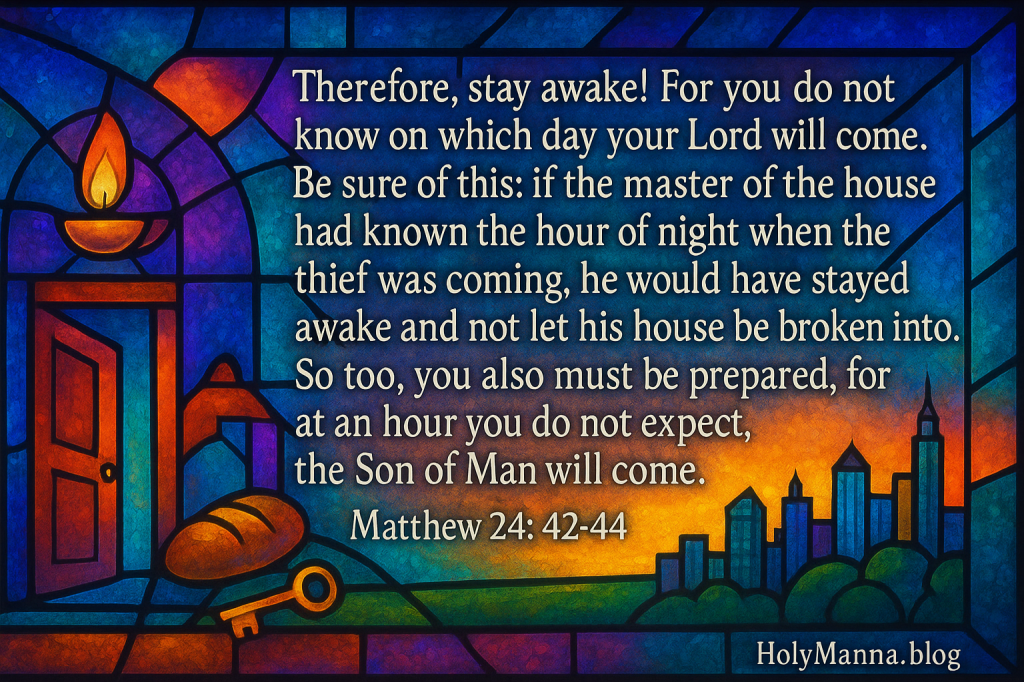
42 Therefore, stay awake! For you do not know on which day your Lord will come. 43 Be sure of this: if the master of the house had known the hour of night when the thief was coming, he would have stayed awake and not let his house be broken into. 44 So too, you also must be prepared, for at an hour you do not expect, the Son of Man will come.
The Faithful or the Unfaithful Servant. 45 “Who, then, is the faithful and prudent servant, whom the master has put in charge of his household to distribute to them their food at the proper time? 46 Blessed is that servant whom his master on his arrival finds doing so. 47 Amen, I say to you, he will put him in charge of all his property. 48 But if that wicked servant says to himself, ‘My master is long delayed,’ 49 and begins to beat his fellow servants, and eat and drink with drunkards, 50 the servant’s master will come on an unexpected day and at an unknown hour 51 and will punish him severely and assign him a place with the hypocrites, where there will be wailing and grinding of teeth.
Detailed Exegesis
Verse 42 – “Therefore, stay awake! For you do not know on which day your Lord will come.”
The command is immediate and personal. “Stay awake” is spiritual attentiveness rooted in faith, not nervous speculation. Ignorance of the exact day is a gift: it keeps disciples dependent, prayerful, and active in love.
Verse 43 – “Be sure of this: if the master of the house had known the hour of night when the thief was coming, he would have stayed awake and not let his house be broken into.”
The thief image highlights surprise, not hostility from Christ. Since the hour is unknown, constant watchfulness is the only wise posture. Complacency is the true vulnerability that lets evil “break in.”
Verse 44 – “So too, you also must be prepared, for at an hour you do not expect, the Son of Man will come.”
Preparation is an ongoing habit. The “Son of Man” title ties Jesus to Danielic judgment and authority. Readiness is a moral state—living in grace—more than a calendar calculation.
Verse 45 – “Who, then, is the faithful and prudent servant, whom the master has put in charge of his household to distribute to them their food at the proper time?”
Jesus defines vigilance through stewardship. Faithfulness and prudence join: fidelity to the master’s will and sound judgment in the household’s care. The concrete task—feeding—anticipates the Church’s pastoral ministry: doctrine, sacraments, and daily works of mercy.
Verse 46 – “Blessed is that servant whom his master on his arrival finds doing so.”
Beatitude rests on being found “doing”—not predicting or posturing. The servant’s routine obedience becomes the place of blessing. Ordinary duties, done in love, are eschatological.
Verse 47 – “Amen, I say to you, he will put him in charge of all his property.”
Greater responsibility follows proven fidelity. Participation in the master’s authority prefigures the reward of the faithful, where stewardship in little prepares for stewardship in much.
Verse 48 – “But if that wicked servant says to himself, ‘My master is long delayed,’”
The fall begins with an interior monologue. Distorted delay breeds practical atheism. The heart’s story line—“long delayed”—licenses neglect.
Verse 49 – “and begins to beat his fellow servants, and eat and drink with drunkards,”
Abuse replaces service, indulgence replaces self-gift. When love is disordered, authority turns violent and communion dissolves into dissipation.
Verse 50 – “the servant’s master will come on an unexpected day and at an unknown hour”
The surprise returns as justice. The master’s coming interrupts cycles of harm and vindicates the household. The unknown hour is a safeguard for the vulnerable.
Verse 51 – “and will punish him severely and assign him a place with the hypocrites, where there will be wailing and grinding of teeth.”
Judgment exposes hypocrisy—outward role, inward corruption. The imagery of “wailing and grinding of teeth” underscores the gravity of choosing against love. Eschatology is not abstract; it meets us in how we treat those entrusted to us.
Teachings
The Church reads this passage as a summons to persevering vigilance expressed in charity. Prudence focuses that vigilance in action; CCC 1806 teaches, “Prudence is the virtue that disposes practical reason to discern our true good in every circumstance and to choose the right means of achieving it.” Eschatological readiness calls for conversion today; CCC 1041 proclaims, “The message of the Last Judgment calls men to conversion while God is still giving them the ‘acceptable time,’ the day of salvation.” Charity gives form to every virtue and thus to stewardship itself; CCC 1827 affirms, “The practice of all the virtues is animated and inspired by charity, which ‘binds everything together in perfect harmony’; it is the form of the virtues, it articulates and orders them among themselves; it is the source and the goal of their Christian practice.” Saint Augustine translates the faithful servant’s heart into a rule of life. In Confessions I.1 he prays, “You have made us for yourself, O Lord, and our heart is restless until it rests in you.” And preaching on fraternal love, he counsels the steward’s ethos: “Love, and do what you will: if you keep silent, keep silent by love; if you speak, speak by love; if you correct, correct by love; if you spare, spare by love; let the root of love be within; of this root can nothing spring but what is good.” (Homilies on the First Epistle of John, Tractate 7). In this light, the Gospel’s “faithful and prudent servant” becomes the pattern for every Christian vocation—from bishops who “distribute food” sacramentally and doctrinally to parents who nourish their households day by day.
Reflection
Live readiness as love in action. Begin the day by asking for prudence to feed those entrusted to you and for charity to shape your choices. Practice hidden fidelity: complete small tasks thoroughly, keep your word, and make amends quickly when you fail. End the day with an examen that asks not “Did I predict well?” but “Whom did I feed?” Where is the Lord inviting you to stay awake—not in anxiety, but in attentive love for specific people today? What “proper time” moment is before you now—a conversation, a correction, an act of mercy—that would make you a faithful and prudent servant if you did it promptly? If the Master arrived this hour, what would He find in your household—and what single step can you take right now to reorder it in love?
Ready Hearts, Busy Hands: Love on Watch
The Word today gathers us into a single movement of grace: watchful love maturing into holy stewardship. In 1 Thessalonians 3:7–13, Paul’s prayer becomes our path as he asks that we “increase and abound in love” so our hearts are strengthened “to be blameless in holiness… at the coming of our Lord Jesus”. In Psalm 90, Israel teaches us to live time wisely before God: “Teach us to count our days aright”, “Fill us at daybreak with your mercy”, and “Prosper the work of our hands!” In Matthew 24:42–51, Jesus fixes our readiness in action: “Stay awake!” and be the servant who feeds the household “at the proper time.” On the Memorial of Saint Augustine, Bishop and Doctor, we remember that the soul keeps vigil by rightly ordered love—“You have made us for yourself, O Lord, and our heart is restless until it rests in you.” (Confessions I.1). The Catechism calls this the universal vocation to holiness in charity (CCC 2013; 2015) and the Church’s vigilant hope before judgment (CCC 1041): hearts set on God, hands serving His people.
Begin tomorrow at daybreak with mercy; number your hours with wisdom; spend them feeding Christ’s household. Make a simple rule: one concrete act of love before noon, one faithful duty done well by evening, one examen that asks, “Whom did I feed today?” Entrust the rest to the Master who sees in secret. How is the Lord inviting you right now to stay awake in love—for Him and for those He entrusts to you?
Engage with Us!
We’d love to hear how the Holy Spirit is stirring your heart through today’s Word—share your thoughts, prayers, and experiences in the comments so we can build each other up in Christ.
First Reading – 1 Thessalonians 3:7–13:
Where is the Lord inviting you to “abound in love” for someone specific this week, and what concrete action will you take?
How does living with the expectation of Christ’s return shape the way you pray for, encourage, or correct those entrusted to you?
What “deficiencies” in your faith might the Lord be asking you to remedy through study, sacrament, or mentorship?
Responsorial Psalm – Psalm 90:3–5, 12–14, 17:
What does it mean for you to “count your days aright” in your current season—how might your schedule change if God’s wisdom ordered your time?
How can you receive “mercy at daybreak” tomorrow—what morning habit will help you begin in grace and continue in joy?
Which work of your hands needs to be entrusted to God today so that it becomes stewardship rather than self-reliance?
Holy Gospel – Matthew 24:42–51:
What does “staying awake” look like in your relationships—whose needs are you called to notice and feed “at the proper time”?
Where have you grown spiritually drowsy—what small, faithful practice could reawaken prudence and charity in your daily routine?
If the Master arrived this evening, how would you want Him to find your household, your heart, and your habits—and what one step can you take right now to align them with His will?
Go in faith, and let every moment be an offering of love and mercy—live the day with watchful hearts and busy hands, doing everything in the way Jesus taught us.
Sacred Heart of Jesus, we trust in You!
Immaculate Heart of Mary, pray for us!
Saint Michael the Archangel, defend us in battle!
Follow us on Instagram and Facebook for more insights and reflections on living a faith-filled life.

 Holy Manna!
Leave a comment