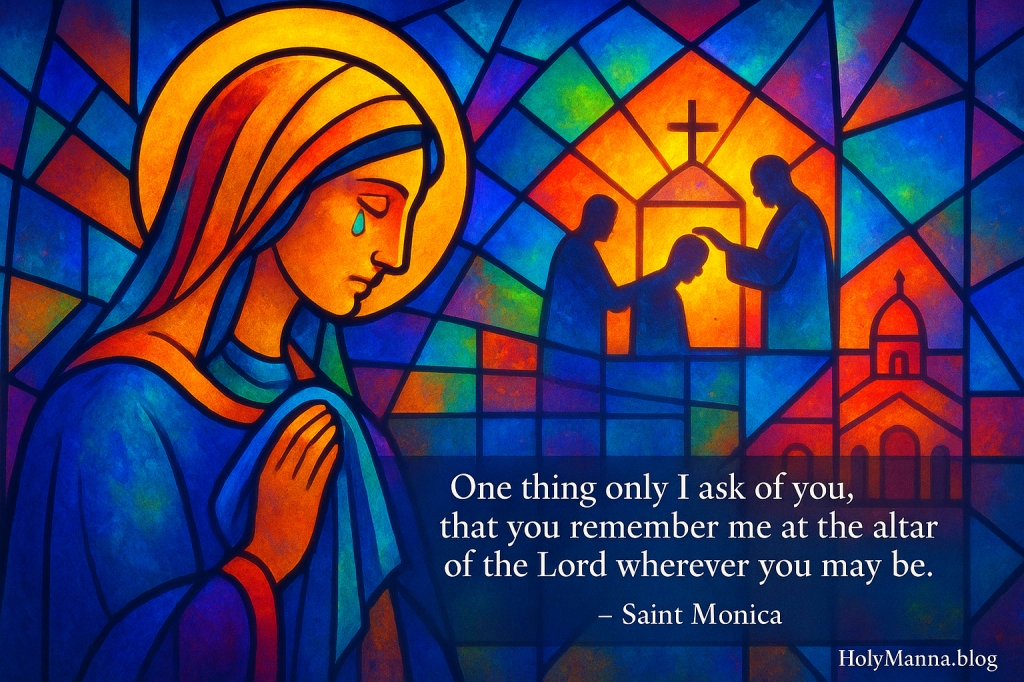
A Mother’s Intercession
Saint Monica (c. 332–387) stands in the heart of Christian memory as the mother whose steadfast prayers watered the desert of her son’s wanderings until it bloomed into the sanctity of Saint Augustine. She is honored as patron of mothers, wives, and those praying for the conversion of loved ones because her life shows how God braids family love and persevering intercession into salvation history. The Church places her memorial on August 27, the day before Augustine’s, to teach us that behind great saints often stand hidden intercessors. In Monica we see the Catechism’s summons made flesh: “Pray constantly” ( CCC 2742 ), trusting that God’s timing, not ours, ripens grace.
Roots at Tagaste
Born in Tagaste (modern Souk Ahras, Algeria) to a Christian family of North African Roman culture, Monica grew up in a household where faith, discipline, and service were woven together. As a young woman she married Patricius, a pagan municipal official known for a fiery temper. Monica answered domestic storms with the meek strength of the Gospel, winning the respect of servants and neighbors by her calm charity and peacemaking. Over time, her gentle witness and persistent prayer prepared the soil of her home for conversion: Patricius asked for baptism before his death, and Monica’s mother-in-law—once her adversary—softened under the sway of Monica’s patient love. She bore three children—Augustine, Navigius, and Perpetua—and took seriously the Catechism’s charge that parents are the first educators in faith: “Parents have the first responsibility for the education of their children.” ( CCC 2223 ) Monica’s “curriculum” was simple and searingly effective: daily prayer, almsgiving, fidelity to the Church’s worship, and practical mercy at home.
The Vigil of a Mother
Our surest portrait of Monica comes from Augustine’s Confessions, where he remembers two luminous consolations that steadied her hope during his years in error. First, a dream in which a radiant figure told her to “look and see” that “Where she was, there was he also.” Monica interpreted this not as her moving toward Augustine’s errors, but Augustine being drawn into her faith. Second, when Augustine seemed far gone in the sect of the Manichees, a bishop reassured her with the now-famous prophecy: “The son of these tears shall not perish.” Strengthened by these mercies, Monica fasted, prayed, and sought wise counsel. When Augustine deceived her and slipped away to Italy, she followed—Rome first, then Milan—seeking not to control him but to keep vigil beside God’s work in him. Under the pastoral care of Saint Ambrose, Monica learned docility to ecclesial discipline, even setting aside some devotional customs when prudence and unity counseled it; she lived the Church’s wisdom that tradition is received best with a filial heart (cf. CCC 2683).
Household Sanctity that Changed the World
Monica’s “daily liturgy” was the sanctification of ordinary time. She rose to pray for her family; she practiced fasting that love might sharpen her petitions (cf. CCC 1434 ); she gave alms to anchor prayer in mercy; she mended quarrels, advised younger women, and strengthened catechumens. In Milan she sought Ambrose’s guidance and attended his preaching with fervor, letting the Word prune her attachments and widen her hope. While no spectacular physical miracles are recorded during her life, the Church has long recognized the conversions that flowered around her as miracles of grace: a difficult husband baptized; a fractured household reconciled; and, most famously, Augustine’s dramatic turning to Christ, culminating in his baptism at the Easter Vigil of 387. Through Monica we see how intercession participates in God’s power: “Intercession is a prayer of petition which leads us to pray as Jesus did.” ( CCC 2634 )
A Mother’s Heart
Monica did not wear the crown of red martyrdom, but she bore the white martyrdom of patience for decades. She endured scorn for her faith, scolded her own tongue into gentleness, and absorbed daily offenses without bitterness. Above all, she suffered the slow agony of watching a brilliant son chase falsehood, fame, and pleasure. Augustine testifies that her tears were unceasing—tears that were not despair but prayer. The Catechism names this struggle the “battle of prayer,” calling it “humble, trusting, and persevering love.” (cf. CCC 2725 ) In that battle Monica shows us how to carry the Cross in family life: she stayed near the sacraments, sought counsel from holy pastors, and refused to weaponize religion in the home. Her endurance was not passivity; it was cruciform love that cooperated with grace until Easter dawned.
Remember Me at the Altar
After Augustine’s conversion and baptism, mother and son shared a moment of contemplative rapture at a window in Ostia as they prepared to return to Africa—the famous “vision at Ostia,” where their hearts seemed to touch the eternal beauty of God. Soon after, Monica fell ill. She confessed no desire for burial pomp in her homeland, saying it mattered not where her body lay because nothing is far from God. She asked only this: “One thing only I ask of you, that you remember me at the altar of the Lord wherever you may be.” In that plea she taught the faithful to wed love of family to the Sacrifice of the Eucharist, and she embodies the Catechism’s teaching that our prayer for the departed is powerful before God (cf. CCC 958 ). Monica died at Ostia around age fifty-six, leaving Augustine not an inheritance of wealth but a legacy of prayer.
Afterglow of Grace
Monica’s body was first laid to rest in Ostia. Centuries later, during the fifteenth century, her relics were translated to Rome under Pope Martin V and enshrined in what is now the Basilica of Sant’Agostino near Piazza Navona. Accounts from the translation speak of healings and favors along the route, and the stream of pilgrims has not ceased. Mothers and grandmothers press their prayers into the marble; spouses in difficult marriages ask for steadfastness; sons and daughters intercede for parents far from the sacraments. The Church’s living memory around her tomb testifies to the communion of saints (cf. CCC 956 ) and to the way God continues to console His people through His friends. Monica’s afterlife in the Church is not merely about answered petitions; it is about hearts being trained, by grace, to persevere in love.
A Rule of Life for Hope
Monica shows us that intercession is love in action. If you are praying for a loved one’s return to Christ, begin by anchoring your hope in the Eucharist. Have a Mass offered by name and remember them at Communion; the Catechism reminds us that the Eucharist is the “source and summit” of Christian life ( CCC 1324 ). Keep a simple fast each week, linking hunger to your petition ( CCC 1434 ). Confess regularly so your own heart stays supple to grace; the holier the intercessor, the freer God’s mercy can run through you. Shape your home into a “domestic church,” where “tenderness, forgiveness, respect, fidelity, and disinterested service are the rule.” ( CCC 2223 ; cf. CCC 1657 ) Seek wise pastoral counsel when zeal outruns prudence—Monica let the Church refine her devotions for the sake of unity. Above all, do not tire: “Pray constantly” ( CCC 2742 ). Your tears are not wasted; in Christ they are seeds. Offer them with love, and wait upon the God who turns long Fridays into Easter.
Engage with Us!
I’d love to hear how Saint Monica’s story is stirring your heart—share your intentions and reflections in the comments so we can pray with you.
- Where is God inviting you to persevere in prayer right now?
- How might you make your home a little more like a small Nazareth this week?
- Who is the “Augustine” you will bring to the altar by name at Mass?
- What concrete step of patience or fasting can you take for a loved one’s conversion?
- How does Monica’s quiet strength challenge your approach to family conflict?
Go in peace today with Monica’s confidence and the Church’s promise: “Pray at all times in the Spirit… keep alert with all perseverance.” Whatever your family story, let every word and work be done with the love and mercy Jesus has taught us.
Saint Monica, pray for us!
Follow us on Instagram and Facebook for more insights and reflections on living a faith-filled life.

 Holy Manna!
Leave a comment