Memorial of Saint Monica – Lectionary: 427
Saint Monica and the Call to Interior Conversion
Have you ever felt God chasing you past every mask and into the truth of your heart? Today’s readings trace a single arc: authentic holiness from the inside out. In Psalm 139:7–12, the psalmist marvels that God’s presence cannot be escaped—“Where can I go from your spirit?”—a lyrical confession of divine nearness that exposes both our darkness and our desire for light. Saint Paul, writing to a bustling Macedonian port city, recalls his tireless, fatherly ministry among the Thessalonians, not to impress but to help them receive “the word of God… not as a human word but… the word of God” (1 Thess 2:9–13). Meanwhile, Jesus confronts religious pretense in The Gospel of Matthew 23:27–32, condemning the scribes and Pharisees as “whitewashed tombs”—a searing image rooted in a first-century practice of whitening tombs before major feasts to mark impurity, now wielded as a parable against spiritual cosmetics that hide interior decay.
This is why the Memorial of Saint Monica (4th-century North Africa) fits so providentially today: her sanctity was not a façade but a furnace—years of persevering intercession, tears, and sacrificial love that God used to ignite the conversion of her son, Augustine. Tradition preserves Saint Ambrose’s assurance to her: “A child of so many tears will not perish.” Monica embodies what the Church teaches about intercessory prayer—love that pleads before God for another’s salvation (CCC 2634)—and about prayer’s unflagging perseverance (CCC 2742). She also exemplifies the vocation of Christian parents to hand on the faith in word and witness, shaping hearts for the Kingdom (CCC 2221–2226). Taken together, today’s liturgy presses a single question: not, How polished do we appear? but, How surrendered are we to the God who sees all, loves all, and wants to renew all within us? In this light, Psalm 139 proclaims God’s inescapable closeness, 1 Thessalonians reveals the power of the Gospel received as truly divine (CCC 103–104), and Matthew exposes hypocrisy so that grace can make us whole (CCC 575). The theme is clear: when we drop our whitewash and receive the living Word with Monica’s persevering faith, God’s presence becomes our purification, and integrity becomes our witness.
First Reading – 1 Thessalonians 2:9–13
The Fatherly Word That Works Within
Paul writes to a young Church in Thessalonica, a bustling Macedonian port where new believers faced social pressure, suspicion, and misunderstandings about the Gospel. To steady them, he reminds them that he, Silvanus, and Timothy labored with their own hands, embodying a ministry free of greed and full of paternal care. In the Greco-Roman world, traveling teachers were often suspected of exploiting patrons; Paul counters this by recalling nights of work and days of preaching, a coherence between life and message that speaks directly to today’s theme of interior authenticity over outward polish. In light of Matthew 23:27–32, where Jesus unmasks “whitewashed tombs”, Paul’s testimony shows what transparent holiness looks like. And on the Memorial of Saint Monica, we see that same parental, persevering love: her hidden intercession became the channel through which the word of God took root in Augustine’s heart, not as “human word” but as a living power at work. The reading prepares us to ask whether the Gospel is truly working within us or merely adorning us on the surface.
1 Thessalonians 2:9-13
New American Bible (Revised Edition)
9 You recall, brothers, our toil and drudgery. Working night and day in order not to burden any of you, we proclaimed to you the gospel of God. 10 You are witnesses, and so is God, how devoutly and justly and blamelessly we behaved toward you believers. 11 As you know, we treated each one of you as a father treats his children, 12 exhorting and encouraging you and insisting that you conduct yourselves as worthy of the God who calls you into his kingdom and glory.
Further Thanksgiving. 13 And for this reason we too give thanks to God unceasingly, that, in receiving the word of God from hearing us, you received not a human word but, as it truly is, the word of God, which is now at work in you who believe.
Detailed Exegesis
Verse 9 — “You recall, brothers, our toil and drudgery. Working night and day in order not to burden any of you, we proclaimed to you the gospel of God.”
Paul appeals to the community’s memory because memory guards against slander and confusion. His “night and day” labor evokes his tentmaking ministry (Acts 18:3), highlighting a shepherd who refuses financial manipulation. Interior integrity and exterior service match: the manner of preaching is itself part of the message. By refusing to burden them, Paul dramatizes the Gospel’s gratuity and models the dignity of human work, a point the Church summarizes: “Human work proceeds from persons created in the image of God… Work honors the Creator’s gifts and the talents received from him.” (CCC 2427).
Verse 10 — “You are witnesses, and so is God, how devoutly and justly and blamelessly we behaved toward you believers.”
Paul summons a double tribunal—human and divine. The community saw his conduct; God sees the heart. This is the anti-hypocrisy that Jesus demands in The Gospel of Matthew 23:27–32: righteousness must be real, not theatrical. The Church teaches that the Gospel advances by credible witness: “The duty of Christians to take part in the life of the Church impels them to act as witnesses of the Gospel and of the obligations that flow from it.” (CCC 2472). Holiness that is “devout, just, and blameless” becomes persuasive evidence that the Word has taken root.
Verse 11 — “As you know, we treated each one of you as a father treats his children,”
The pastoral heart is parental: particular, patient, personal. Paul’s image resonates powerfully on Saint Monica’s memorial; true spiritual authority carries the tenderness and tenacity of a parent. The Church situates the primary school of faith in the family: “Parents have the first responsibility for the education of their children.” (CCC 2223). Monica lived this responsibility in intercessory love, not by control but by constant prayer and tears.
Verse 12 — “exhorting and encouraging you and insisting that you conduct yourselves as worthy of the God who calls you into his kingdom and glory.”
Three verbs—exhort, encourage, insist—name the Church’s pedagogy: truth that summons, hope that consoles, firmness that anchors. The moral life is a response to a call—“the God who calls”—not self-improvement by willpower. The Catechism echoes the ancient exhortation of Saint Leo the Great: “Christian, recognize your dignity and, now that you share in God’s own nature, do not return to your former base condition by sinning.” (CCC 1691). Worthy conduct flows from a new identity and a new horizon: “kingdom and glory.”
Verse 13 — “And for this reason we too give thanks to God unceasingly, that, in receiving the word of God from hearing us, you received not a human word but, as it truly is, the word of God, which is now at work in you who believe.”
The climax: the preached message is God’s own Word, active and efficacious. Thanksgiving is the Church’s first response to this miracle. The Catechism explains the Church’s veneration for Scripture because of this divine authorship and power: “For this reason the Church has always venerated the divine Scriptures as she venerates the Lord’s Body. She never ceases to present to the faithful the bread of life, taken from the one table of God’s Word and Christ’s Body.” (CCC 103). And again, “In the sacred books the Father who is in heaven comes lovingly to meet his children and talks with them.” (CCC 104). The Word not only informs; it performs—“at work in you who believe.”
Teachings
Paul’s fatherly ministry, Monica’s maternal intercession, and the Church’s doctrine converge on a single insight: God’s Word, when received in faith, reshapes life from the inside out. The Church confesses the divine power of Scripture in worship and catechesis: “For this reason the Church has always venerated the divine Scriptures as she venerates the Lord’s Body…” (CCC 103) and “In the sacred books the Father who is in heaven comes lovingly to meet his children and talks with them.” (CCC 104). The dignity of labor that undergirds Paul’s witness is not incidental but theological: “Human work proceeds from persons created in the image of God… Work honors the Creator’s gifts and the talents received from him.” (CCC 2427). Christian witness must be credible in deed as well as word: “The duty of Christians to take part in the life of the Church impels them to act as witnesses of the Gospel and of the obligations that flow from it.” (CCC 2472). Within the domestic church, parents are the first evangelists: “Parents have the first responsibility for the education of their children.” (CCC 2223). Saint Monica embodies these teachings in history. Saint Augustine testifies of her love: “She wept for me more than mothers weep for the bodily death of their children.” (The Confessions). And Saint Ambrose’s consoling word to her endures as a maxim of hope: “The child of those tears shall not perish.” Her fidelity shows how intercession becomes the place where the Word keeps working until conversion dawns.
Reflection
Paul’s integrity, Monica’s perseverance, and God’s searching presence invite a brave examination of conscience. If others looked at our habits, would they glimpse the same Gospel we speak? Do our work rhythms, spending, words, and hidden choices align with the Father’s call to his “kingdom and glory”? Where is the Holy Spirit asking you to replace whitewash with wholehearted surrender today? What concrete step—an apology, a budget change, a renewed prayer schedule, an act of service—can you take so that the Word may be “at work in you who believe”? Ask Saint Monica to teach you how to pray with patient love for those far from God, and let Paul’s fatherly exhortation become your rule of life: give thanks unceasingly, receive the Word as truly divine, and live “worthy” of the One who calls.
Responsorial Psalm – Psalm 139:7–12
Held Fast by the God Who Finds Us
In the poetry of Psalm 139, Israel sings the mystery of God’s omnipresence and intimate knowledge. Ancient Israel spoke of Sheol as the shadowy realm of the dead; “wings of dawn” evokes the far east where light first breaks, and “beyond the sea” points westward—together sketching the whole compass of creation. This psalm is not surveillance but solace: the God who searches and knows is the same God whose hand guides and holds. Within today’s theme, it confronts the temptation to spiritual whitewash from The Gospel of Matthew 23:27–32—there is no hiding place from the One who loves the truth of our hearts—and it harmonizes with 1 Thessalonians 2:9–13, where the word of God “works within” believers. On the Memorial of Saint Monica, these verses become biographical: wherever Augustine fled, the God of Psalm 139 pursued him, while Monica’s persevering prayer trusted that the darkness of his wandering could not extinguish the light of grace.
Psalm 139:7-12
New American Bible (Revised Edition)
7 Where can I go from your spirit?
From your presence, where can I flee?
8 If I ascend to the heavens, you are there;
if I lie down in Sheol, there you are.
9 If I take the wings of dawn
and dwell beyond the sea,
10 Even there your hand guides me,
your right hand holds me fast.
11 If I say, “Surely darkness shall hide me,
and night shall be my light”—
12 Darkness is not dark for you,
and night shines as the day.
Darkness and light are but one.
Detailed Exegesis
Verse 7 — “Where can I go from your spirit? From your presence, where can I flee?”
The psalmist’s rhetorical question confesses a loving inescapability. God’s Spirit is not a force field but a faithful Presence. This verse aligns with the Church’s teaching that God initiates the dialogue of salvation in the depths of the human person: “Deep within his conscience man discovers a law which he has not laid upon himself but which he must obey… There he is alone with God whose voice echoes in his depths.” (CCC 1776).
Verse 8 — “If I ascend to the heavens, you are there; if I lie down in Sheol, there you are.”
The vertical extremes—heaven and Sheol—announce a theology of hope. No exaltation or abasement, triumph or defeat, escapes God’s reach. For Monica, whose tears descended to the “Sheol” of maternal anguish, this verse guarantees that grace descends further still. The paschal mystery will later unveil this promise: Christ has harrowed the depths to raise us with him (cf. 1 Pet 3:19–20).
Verse 9 — “If I take the wings of dawn and dwell beyond the sea,”
The east-west axis complements the heaven-Sheol axis: wherever the horizon leads, God’s Presence precedes. The imagery reassures exiles, travelers, and the restless of heart. Augustine would later confess God’s nearness even in his wanderings: “You were more inward than my innermost self and higher than my highest.” (The Confessions, X.27.38).
Verse 10 — “Even there your hand guides me, your right hand holds me fast.”
Two verbs—guide and hold—describe providence as direction and adhesion. God’s “right hand” is covenant shorthand for power exercised as mercy. The Catechism speaks of prayer that cooperates with this providence unceasingly: “‘Pray constantly’ (1 Th 5:17). It is always possible to pray… Prayer and Christian life are inseparable.” (CCC 2742).
Verse 11 — “If I say, ‘Surely darkness shall hide me, and night shall be my light’—”
Self-deception is named: the fantasy that darkness can veil our deeds or that we can relabel night as light. Here Matthew 23 resounds; hypocrisy is a kind of cosmetic nightfall. The psalm pierces that illusion not to condemn but to convert. True examination of conscience invites the God who already sees.
Verse 12 — “Darkness is not dark for you, and night shines as the day. Darkness and light are but one.”
In God, light is sovereign; darkness is transparent. This is the bedrock of Christian perseverance: sin, confusion, and suffering do not have the final word. Monica’s hope rested here. Adoration becomes the fitting response: “Adoration is the first attitude of man acknowledging that he is a creature before his Creator… It exalts the greatness of the Lord who made us.” (CCC 2628).
Teachings
Psalm 139 reveals that God’s presence is not merely spatial but personal and interior, resonating with the Church’s doctrine on conscience and prayer. The Church teaches: “Deep within his conscience man discovers a law which he has not laid upon himself but which he must obey… There he is alone with God whose voice echoes in his depths.” (CCC 1776). This interior echo is sustained through habitual prayer: “‘Pray constantly’ (1 Th 5:17). It is always possible to pray… Prayer and Christian life are inseparable.” (CCC 2742). The psalm’s confidence in providence flowers into adoration: “Adoration is the first attitude of man acknowledging that he is a creature before his Creator.” (CCC 2628). Saint Augustine gives voice to the psalm’s nearness of God: “You were more inward than my innermost self and higher than my highest.” (The Confessions, X.27.38). Saint Ambrose’s word to Monica embodies this theology of hope across the dark: “The child of those tears shall not perish.”
Reflection
God’s presence in Psalm 139 frees us from curating appearances and invites us to courageous transparency. Let your prayer today name the places you are tempted to hide, then ask for the guiding and holding of his “right hand.” Consider a concrete practice: a daily examen inviting God’s light over your thoughts, words, and choices; a brief act of adoration before the Blessed Sacrament; an intercession for a loved one far from the Church, in Saint Monica’s spirit of patient hope. Where are you calling darkness light to avoid the truth? What step could you take today to place that area under the hand that guides and holds? Who is God asking you to carry in persevering prayer until night shines as the day?
Holy Gospel – Matthew 23:27–32
Jesus Unmasks Performative Holiness
In The Gospel of Matthew 23:27–32, Jesus delivers a scorching prophetic critique of religious hypocrisy. In first-century Judea, tombs were whitewashed before major feasts to prevent ritual defilement; the practice kept passersby from accidentally touching a grave and becoming impure. Jesus seizes this familiar image to expose a deeper impurity: a life of piety polished for public view while the interior remains untouched by God. Within today’s theme of interior authenticity, this passage is the counterpoint to Psalm 139:7–12—we cannot hide from the God who sees the heart—and the living demonstration of 1 Thessalonians 2:9–13, where the word of God must be “at work in you who believe,” not merely decorating the surface. On the Memorial of Saint Monica, the contrast is striking: the scribes and Pharisees curate appearances; Monica perseveres in hidden intercession until real conversion—Augustine’s—blossoms from the inside out.
Matthew 23:27-32
New American Bible (Revised Edition)
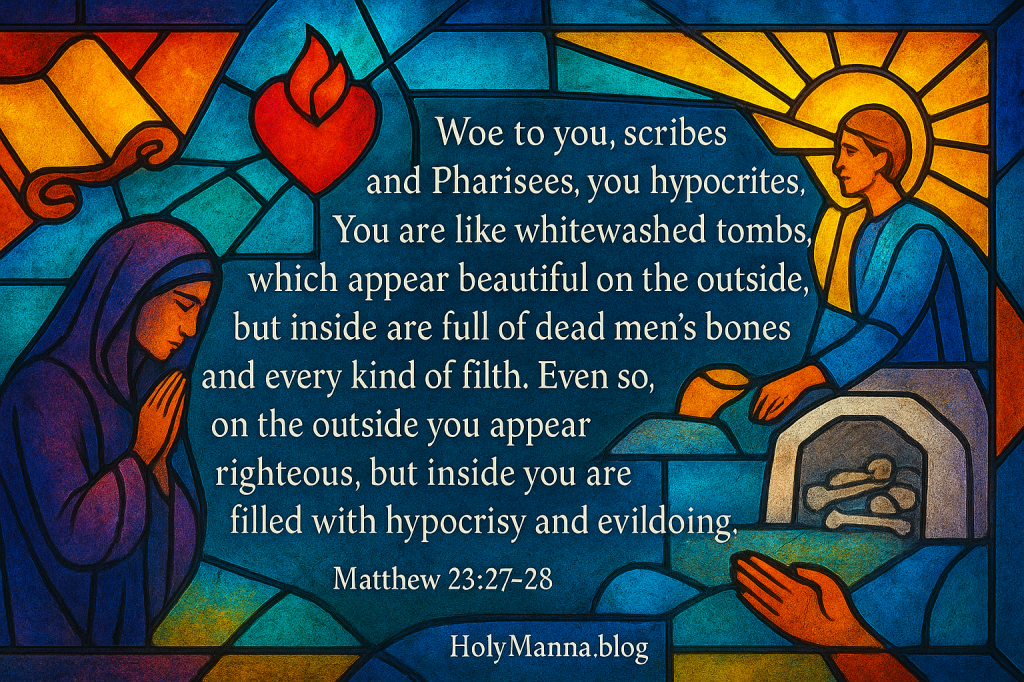
27 “Woe to you, scribes and Pharisees, you hypocrites. You are like whitewashed tombs, which appear beautiful on the outside, but inside are full of dead men’s bones and every kind of filth. 28 Even so, on the outside you appear righteous, but inside you are filled with hypocrisy and evildoing.
29 “Woe to you, scribes and Pharisees, you hypocrites. You build the tombs of the prophets and adorn the memorials of the righteous, 30 and you say, ‘If we had lived in the days of our ancestors, we would not have joined them in shedding the prophets’ blood.’ 31 Thus you bear witness against yourselves that you are the children of those who murdered the prophets; 32 now fill up what your ancestors measured out!
Detailed Exegesis
Verse 27 — “Woe to you, scribes and Pharisees, you hypocrites. You are like whitewashed tombs, which appear beautiful on the outside, but inside are full of dead men’s bones and every kind of filth.”
The “woe” is not a curse but a lamenting verdict from the divine Judge who longs to save. Whitewash symbolizes cosmetic righteousness; “bones and filth” signal death and impurity. Jesus targets the gap between public performance and interior reality. The Church warns that truth requires congruence of word and deed, guarding “against duplicity… and hypocrisy” (see Teachings).
Verse 28 — “Even so, on the outside you appear righteous, but inside you are filled with hypocrisy and evildoing.”
Jesus names the fault precisely: appearance without transformation. In biblical anthropology, the “inside” is the heart—the seat of desire and decision. The sixth beatitude’s promise is thereby inverted: without purity of heart, God is obscured. Genuine holiness flows from an interior made new by grace, not from image management.
Verse 29 — “Woe to you, scribes and Pharisees, you hypocrites. You build the tombs of the prophets and adorn the memorials of the righteous,”
Honoring prophets’ tombs should signal repentance for past violence; instead, it becomes another stage for self-congratulation. Jesus exposes commemorations that do not produce conversion. Saint Monica’s witness shows the alternative: memory that becomes intercession, reverence that becomes repentance.
Verse 30 — “and you say, ‘If we had lived in the days of our ancestors, we would not have joined them in shedding the prophets’ blood.’”
Moral hindsight breeds complacency. We assume we would have done better “back then,” while resisting the living Word now. The liturgy asks us to hear the prophets’ voice today—especially when it confronts our comfortable patterns.
Verse 31 — “Thus you bear witness against yourselves that you are the children of those who murdered the prophets;”
By denying complicity, they reveal continuity with their ancestors’ hardness of heart. Spiritual lineage is not about genes but about response to God. Refusal to repent enrolls us in the same school of resistance.
Verse 32 — “now fill up what your ancestors measured out!”
A terrifying irony: persistence in hypocrisy hastens judgment. Yet even this severe line is part of Jesus’ redemptive mission; his own Passion—soon to unfold—will turn murderous rejection into the very means of mercy for the repentant.
Teachings
The Gospel exposes the spiritual danger of duplicity and calls us to interior conversion. The Church teaches with clarity: “Truth as uprightness in human action and speech is called truthfulness, sincerity, or candor. Truth or truthfulness is the virtue which consists in showing oneself true in deeds and truthful in words, and in guarding against duplicity, dissimulation, and hypocrisy.” (CCC 2468). Conversion must therefore begin within: “Interior repentance is a radical reorientation of our whole life, a return, a conversion to God with all our heart, an end of sin, a turning away from evil, with repugnance toward the evil actions we have committed.” (CCC 1431). This purity is not mere moralism but the condition for seeing God: “‘Blessed are the pure in heart, for they shall see God.’ ‘Pure in heart’ refers to those who have attuned their intellects and wills to the demands of God’s holiness… there is a connection between purity of heart, of body and of faith.” (CCC 2518). Saint Augustine diagnoses the heart’s evasions and God’s nearness that heals them: “You were more inward than my innermost self and higher than my highest.” (The Confessions, X.27.38). Saint Ambrose’s word to Monica gives pastoral hope for our loved ones caught in patterns of sin: “The child of those tears shall not perish.” Authentic Christianity is not the art of whitewash but the miracle of a heart made new.
Reflection
Jesus’ woes are a mercy meant to crack our masks and free us for truth. Ask the Holy Spirit to show you one place where appearance outpaces conversion—then invite Jesus there. Consider a daily examen under the light of Psalm 139; confess concrete sins rather than curating your image; seek accountability with a trusted friend; and prioritize the Sacrament of Reconciliation as the ordinary path from performance to purity. Pray like Saint Monica for those you love who seem far: persevere, fast modestly, bless rather than nag, and entrust them daily to the God who is already pursuing them. Where are you tempted to polish the outside while neglecting the inside? What step of interior repentance can you take today to align your heart with the truth? Whom will you carry, by name, in persevering intercession until the night shines like the day?
Let God’s Word Work Within
Have you sensed the Lord pursuing you past every mask and into the truth that sets you free? Today’s liturgy sings a single melody in three movements. In Psalm 139:7–12, the psalmist confesses the inescapable tenderness of God—“Where can I go from your spirit?”—and discovers that even our darkness becomes transparent before His guiding hand. In 1 Thessalonians 2:9–13, Paul shows what authentic holiness looks like: laboring with integrity so that we might receive “the word of God… which is now at work in you who believe.” And in The Gospel of Matthew 23:27–32, Jesus unmasks the danger of performative religion—“whitewashed tombs”—calling us to interior conversion that matches the Father’s call to His kingdom and glory. The Memorial of Saint Monica crowns these readings with hope: her persevering intercession proves that grace reaches the places we cannot, and that steadfast love can midwife conversion in God’s time (CCC 2742).
Here is the invitation: let God’s presence become your place of truth, His Word your daily bread, and His mercy your way forward. Open the Scriptures with expectancy, adore Christ who speaks in both Word and Sacrament (CCC 103–104), and choose repentance of the heart, not just repair of appearances (CCC 1431). Pray like Monica for the ones you love; trust like the psalmist that God’s right hand holds you fast; live like Paul so your witness and your words tell the same story. Where is the Holy Spirit inviting you to move from whitewash to worship? Whom will you carry in persevering prayer until “night shines as the day”? Today, say yes: receive the living Word, step into the light, and let the God who sees you also renew you—from the inside out.
Engage with Us!
We’d love to hear how the Lord is speaking to you through today’s Word and the Memorial of Saint Monica. Share a grace, a challenge, or a prayer intention in the comments so our community can pray with you and encourage you to keep moving from appearance to authentic conversion in Christ.
First Reading – 1 Thessalonians 2:9–13: Where is the Holy Spirit inviting you to align your daily work with the Gospel so that your life and your words tell the same story? What would it look like this week to “receive the word of God… as it truly is” in a concrete decision or relationship? Who is God asking you to “father” or “mother” in the faith with patient exhortation, encouragement, and holy insistence?
Responsorial Psalm – Psalm 139:7–12: Where have you been tempted to hide, and how can you invite the Lord’s “right hand” to guide and hold you there today? What practical step—an evening examen, a brief visit to the Blessed Sacrament, or a simple act of adoration—will help you live beneath God’s loving gaze? Who needs your persevering intercession so that “night shines as the day” in their life?
Holy Gospel – The Gospel of Matthew 23:27–32: What “whitewash” is Jesus asking you to wash off—habits of image-management, half-truths, or hidden resentments—and how will you begin? How will you practice interior repentance today (CCC 1431)—naming a specific sin, seeking Confession, or making restitution? Where is the Lord inviting you to trade performance for purity of heart so you can see God more clearly in your daily duties?
May the God who searches and knows you lead you into deeper faith, hope, and love. Go in peace, live the truth with joy, and let every word and work be done in the love and mercy Jesus has taught us.
Sacred Heart of Jesus, we trust in You!
Immaculate Heart of Mary, pray for us!
Saint Michael the Archangel, defend us in battle!
Follow us on Instagram and Facebook for more insights and reflections on living a faith-filled life.

 Holy Manna!
Leave a comment