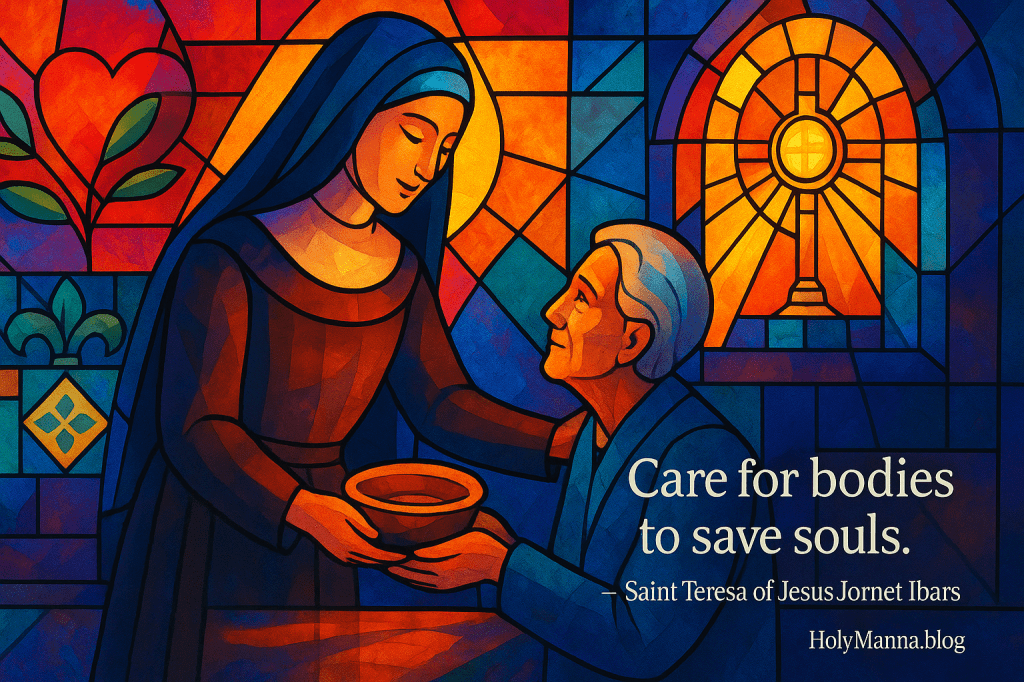
A Heart That Saw Christ in the Elderly
Saint Teresa of Jesus Jornet Ibars (1843–1897) shines as a modern witness to the Gospel of mercy lived with concrete tenderness. Best known as the foundress of the Little Sisters of the Abandoned Elderly, she organized love into a way of life, creating homes where the poor, sick, and lonely elderly were received as family. Her sanctity was recognized by the Church with beatification in 1958 and canonization in 1974. Far from seeking prominence, Teresa simply took Jesus at His word in The Gospel of Matthew: “As you did it to one of the least of these my brethren, you did it to me.” (Mt 25:40) She placed the Eucharist at the center of the Congregation’s day, drew strength from quiet prayer, and then poured that grace into the humble, hidden works of mercy. The Church teaches that the saints “are the source and origin of renewal in the most difficult moments in the Church’s history” (CCC 828); Teresa’s life catalyzed such renewal by restoring dignity to those society frequently ignores.
From Aitona to a Vocation
Teresa was born on January 9, 1843, in Aitona (Lleida), Spain, into a Christian household that valued faith, work, and education. Gifted with a keen mind and calm poise, she trained as a schoolteacher and served in rural classrooms, where she discovered both the joy of forming young souls and the ache of social abandonment at the margins. Early on she discerned a contemplative call and explored religious life with communities inspired by the Carmelites and Poor Clares. The Lord, however, drew her toward a different cloister—one formed by the infirmities and loneliness of the aged poor. This inner redirection matured when she met Fr. Saturnino López Novoa, a zealous priest whose pastoral experience with destitute seniors confirmed what grace was already whispering in her prayer: her vocation was to create a family for those who had none. When she professed vows, she chose the name “of Jesus,” echoing the Carmelite spirit of intimate friendship with Christ while remaining available to the world’s wounds.
Founding the Little Sisters of the Abandoned Elderly
In 1873, providence knit together prayer, pastoral need, and holy audacity. With Father López Novoa, Teresa gathered the first women, received the religious habit, and opened an initial house for elderly men and women who had no one to care for them. The fledgling community entrusted everything to Our Lady of the Forsaken, a Marian title dear to Valencia, and adopted a family style of life: simple rooms, shared tables, and a chapel where the Sisters learned to love their residents at the feet of the Eucharistic Lord. Teresa served as superior with a mother’s firmness and a daughter’s humility, drafting practical norms, encouraging a spirit of joy, and insisting that the homes feel like households rather than institutions. The Congregation spread rapidly across Spain and, in time, to other countries, carrying the same charism: to honor Christ in the aged through reverence, patience, and cheerful service.
Holiness Made Visible
Teresa did not chase extraordinary phenomena; her “wonders” were the daily triumphs of charity. She taught her Sisters to greet each resident by name, to listen without hurry, to anticipate needs before they were spoken, and to see suffering not as a burden but as a place of encounter with the Crucified and Risen Lord. She loved to repeat that caring for bodies opens the path to healing souls, a wisdom entirely consonant with The Catechism’s teaching on the corporal and spiritual works of mercy: “The works of mercy are charitable actions by which we come to the aid of our neighbor in his spiritual and bodily necessities.” (CCC 2447) Many who entered the homes embittered or fearful rediscovered peace; estranged relatives reconciled at bedsides; dying men and women received the sacraments after long absences from the Church. These quiet conversions were the living proof that Gospel mercy is not an idea but a power.
Thorns in the Crown
Nineteenth-century Spain was marked by political turmoil, cultural anticlericalism, and economic fragility—hard conditions for founding anything, much less a network of free homes for the poor. Teresa navigated shortages of funds, sudden relocations, and the heartbreak of turning away applicants when beds were full. Personally, she endured delicate health and seasons of interior dryness, yet she refused self-pity. Her response was practical faith: longer hours before the tabernacle, renewed gentleness with the most demanding residents, courageous appeals to benefactors, and a serene acceptance that God’s Providence often arrives at the last moment. She died in Llíria (Valencia) on August 26, 1897, “spent for souls,” leaving behind rules, a way of prayer, and—most importantly—a living family of Sisters determined to continue the work. The Church later held up her persevering love as a sign that holiness grows precisely in the soil of trial.
Intercession and Veneration
Following her death, devotion to Teresa intensified among the poor and those who served them. As her Congregation grew, requests for her intercession multiplied, and the Church recognized miracles through her prayer as part of the causes for beatification and canonization. Today, the faithful remember her especially on August 26 and visit places united to her life and death in Valencia and Llíria. More importantly, the homes of the Little Sisters themselves have become living shrines of mercy, where the Rosary is prayed at bedside, the Eucharist is adored, and the “pilgrims of the last stage of life” are accompanied with reverence until they meet the Father’s house. In this way her charism continues to bear fruit across continents, offering society a countercultural witness: the elderly are not a problem to manage but persons to love.
Why She Matters Now
Saint Teresa’s mission interprets the Fourth Commandment for our time. The Catechism teaches with luminous simplicity: “The fourth commandment reminds grown children of their responsibilities toward their parents. As much as they can, they must give them material and moral support in old age…” (CCC 2218) In a culture often tempted to measure worth by productivity, the Church proclaims the inviolable dignity of every person, especially the frail: “Those whose lives are diminished or weakened deserve special respect.” (CCC 2276) Teresa translates these teachings into a spirituality anyone can live: meet Christ daily in prayer, and then go find Him in the aged neighbor who needs your time, your patience, your smile. She invites us to “make room” in our schedules and in our hearts, to build homes that feel like sanctuaries, and to let our parishes become places where no one has to grow old alone.
Concrete Ways to Imitate Her Today
Begin at the altar and move toward the elderly with Eucharistic eyes. Offer a Mass or a Holy Hour for the seniors in your family and parish, and then visit someone who is isolated. Bring a simple meal, read a psalm, or pray a decade of the Rosary together. Learn a resident’s life story and thank God aloud for their fidelity. If you are a caregiver and feel exhausted, unite your weariness to the Cross during the offertory and ask Saint Teresa to obtain for you the quiet joy she gave her Sisters. Consider supporting or volunteering with ministries that accompany seniors, and ask your parish council to prioritize outreach to the homebound. How is Jesus inviting you to transform your home into a place where the elderly feel seen, safe, and loved? Which small habit—calling a grandparent, writing a note, scheduling a weekly visit—can you adopt this week to embody the works of mercy?
Engage with Us!
I’d love to hear your thoughts and prayers in the comments.
- Where is the Lord nudging you to serve an elderly person this week?
- What fears or obstacles keep you from this work of mercy?
- How might Saint Teresa’s witness strengthen your resolve to love to the end?
Go forth in faith. With Saint Teresa of Jesus Jornet as our companion, may we do everything with the love and mercy Jesus taught us.
Saint Teresa of Jesus Jornet, pray for us!
Follow us on Instagram and Facebook for more insights and reflections on living a faith-filled life.

 Holy Manna!
Leave a comment