Tuesday of the Twenty-first Week in Ordinary Time – Lectionary: 426
When God Searches the Heart
What if today God asked not for a polished performance, but for a truthful heart? In all three readings, the Holy Spirit spotlights interior authenticity as the measure of true worship. In 1 Thessalonians 2:1–8, Paul defends his mission against the era’s common suspicions about itinerant preachers—flattery, greed, and self-promotion were frequent charges in the Greco-Roman world. Having suffered at Philippi and then come to Thessalonica (see Acts 16–17), he insists his ministry aims “not…to please human beings, but rather God” and is marked by a tender, sacrificial love “as a nursing mother cares for her children”—even to the point of sharing “not only the gospel of God, but our very selves”. Psalm 139:1–6 gives the theological ground for such integrity: the Lord already knows our thoughts and words before they are spoken—“Lord, you have probed me, you know me”—so sincerity isn’t optional; it’s the only response that makes sense before the God who encircles us and lays His hand upon us. And in The Gospel of Matthew 23:23–26, Jesus unmasks religious posturing that majors on minutiae while neglecting the heart of the Law—“judgment and mercy and fidelity”—using vivid images from Jewish purity customs and tithing practices: “Blind guides, who strain out the gnat and swallow the camel!” The Lord’s remedy is decisive: “cleanse first the inside of the cup, so that the outside also may be clean.”
Historically and culturally, these texts converge on a first-century tension still alive today: meticulous external observance (tithing even small herbs; washing vessels) versus covenant faithfulness that springs from a purified heart. Paul’s maternal imagery and refusal of patronage-style flattery rebut the Greco-Roman honor economy; Jesus’ critique corrects a legalism that forgets mercy; David’s psalm anchors both in God’s searching gaze. The Church calls this “interior conversion”—a real change of heart that gives life to exterior works (see CCC 1430–1431), along with purity of intention that orders every act to God (see CCC 1752; CCC 2518) and the primacy of charity that fulfills the Law through justice and mercy (see CCC 1827–1829; CCC 1807; CCC 2447). As you dive into each passage today—Paul’s transparent ministry in 1 Thessalonians 2, the all-knowing love of God in Psalm 139, and Jesus’ incisive call in Matthew 23—watch for how the Lord invites you from appearance to reality, from performance to communion, from the outside of the cup to the inside.
First Reading – 1 Thessalonians 2:1–8
A Ministry Measured by the Heart
In the wake of persecution at Philippi and fresh mission work in Thessalonica (see Acts 16–17), Paul defends his Gospel ministry in a culture familiar with slick itinerant speakers who chased honor, fees, and fame. Against that backdrop, he presents a radically different standard: God’s searching gaze. The apostolic task is not to impress but to be entrusted, not to extract but to pour out one’s very self. This reading fits today’s theme of interior authenticity before God: the God who “probes and knows” (see Psalm 139) requires ministers and disciples whose motives are purified, whose actions flow from a heart aligned with “judgment and mercy and fidelity” (The Gospel of Matthew 23:23). Paul’s maternal imagery and refusal of flattery or greed reveal that the true measure of ministry is love shaped by God’s own heart.
1 Thessalonians 2:1-8
New American Bible (Revised Edition)
Paul’s Ministry Among Them. 1 For you yourselves know, brothers, that our reception among you was not without effect. 2 Rather, after we had suffered and been insolently treated, as you know, in Philippi, we drew courage through our God to speak to you the gospel of God with much struggle. 3 Our exhortation was not from delusion or impure motives, nor did it work through deception. 4 But as we were judged worthy by God to be entrusted with the gospel, that is how we speak, not as trying to please human beings, but rather God, who judges our hearts. 5 Nor, indeed, did we ever appear with flattering speech, as you know, or with a pretext for greed—God is witness— 6 nor did we seek praise from human beings, either from you or from others, 7 although we were able to impose our weight as apostles of Christ. Rather, we were gentle among you, as a nursing mother cares for her children. 8 With such affection for you, we were determined to share with you not only the gospel of God, but our very selves as well, so dearly beloved had you become to us.
Detailed Exegesis
Verse 1 — “For you yourselves know, brothers, that our reception among you was not without effect.”
Paul begins with shared memory: the Thessalonians themselves are the evidence. Apostolic authenticity isn’t theoretical; it bears tangible fruit—conversion, consolation, and perseverance. In a city marked by patronage and public performance, the “effect” is the transformed community, a sign that God’s power—not personality—carried the mission.
Verse 2 — “Rather, after we had suffered and been insolently treated, as you know, in Philippi, we drew courage through our God to speak to you the gospel of God with much struggle.”
The beating and imprisonment at Philippi (Acts 16:22–24) becomes Paul’s credential: suffering purified motives and revealed reliance on God. Courage “through our God” shows that bold proclamation springs from grace, not bravado. Interior authenticity grows where the ego dies; affliction becomes the furnace of pure intention.
Verse 3 — “Our exhortation was not from delusion or impure motives, nor did it work through deception.”
Paul negates the triad commonly associated with charlatans: error, impurity, trickery. The Gospel is truth addressing the whole person; it neither flatters passions (“impure motives”) nor manipulates (“deception”). Authentic preaching respects freedom and illumines conscience.
Verse 4 — “But as we were judged worthy by God to be entrusted with the gospel, that is how we speak, not as trying to please human beings, but rather God, who judges our hearts.”
Here is the theological center: the Gospel is a trust from God, and God alone is the audience who “tests hearts.” This reorients ministry from people-pleasing to God-pleasing. As The Catechism teaches about intention, what we aim at determines the moral weight of our acts (see CCC 1752). Paul’s criterion is God’s judgment, not human applause.
Verse 5 — “Nor, indeed, did we ever appear with flattering speech, as you know, or with a pretext for greed—God is witness—”
Flattery and greed were the stock-in-trade of some itinerants. Paul invokes both the Thessalonians’ memory and God’s witness. Authentic love speaks truth without manipulation and refuses to turn the Gospel into gain. The apostle’s transparency protects the flock and honors the Lord.
Verse 6 — “nor did we seek praise from human beings, either from you or from others,”
Praise-hunting distorts the Gospel into self-promotion. Paul renounces the ancient honor economy that measured worth by status and acclaim. The disciple’s dignity rests in baptismal identity, not in public esteem.
Verse 7 — “although we were able to impose our weight as apostles of Christ. Rather, we were gentle among you, as a nursing mother cares for her children.”
Apostolic authority is real, but its style is maternal. The image of a “nursing mother” signals intimacy, sacrifice, and steady care. Authority in the Church is charitable service patterned on Christ’s meekness, not coercion. Gentleness is not weakness; it is strength governed by love.
Verse 8 — “With such affection for you, we were determined to share with you not only the gospel of God, but our very selves as well, so dearly beloved had you become to us.”
The climax: the gift is not merely a message but a life. True evangelization communicates Christ by self-gift. The interior motive—charity—overflows into concrete availability, presence, and sacrifice. Ministry measured by God’s heart always becomes a pouring-out of one’s own life.
Teachings
Paul’s witness embodies the Church’s doctrine of interior conversion and purity of intention. The Catechism of the Catholic Church describes repentance not as mere externals but as a deep reorientation toward God: “Interior repentance is a radical reorientation of our whole life, a return, a conversion to God with all our heart, an end of sin, a turning away from evil, with repugnance toward the evil actions we have committed. At the same time it entails the desire and resolution to change one’s life, with hope in God’s mercy and trust in the help of his grace.” (CCC 1431) Regarding intention, The Catechism teaches that the aim shapes the act: “In contrast to the object, the intention resides in the acting subject. Because it lies at the voluntary source of an action and determines it by its end, intention is an element essential to the moral evaluation of an action. The end is the first goal of the intention and indicates the purpose pursued in the action.” (CCC 1752) Paul’s “end” is to please God “who judges our hearts” (1 Thessalonians 2:4). Evangelization, then, becomes credible through witness: “Modern man listens more willingly to witnesses than to teachers; and if he does listen to teachers, it is because they are witnesses.” (Evangelii Nuntiandi 41). Paul’s maternal charity fulfills the law’s “weightier matters”—justice, mercy, fidelity—highlighted by Jesus in The Gospel of Matthew 23:23.
Reflection
God invites us to a ministry and discipleship that are clean from the inside: purified motives, truthful speech, and gentle, sacrificial love. Consider beginning your day by naming your true intention before God and asking for the grace to seek His pleasure alone. Choose one relationship in which you can embody Paul’s “nursing mother” tenderness—through patient listening, practical help, or steadfast encouragement. Renounce subtle “flattery” or image-management and practice transparent truth in charity. Where are you tempted to please people rather than God? What would it look like today to “share not only the gospel, but your very self” with someone in need? How might suffering you face become the furnace that purifies your intention so that Christ’s love can shine through you?
Responsorial Psalm – Psalm 139:1–6
Known Completely, Loved Completely
In Israel’s worship, Psalm 139 voiced a radical confession: God alone truly knows the human heart. Composed within the Davidic tradition and prayed in the Temple and synagogue, this psalm celebrates the Lord’s omniscience and intimate providence—not as surveillance but as covenantal care. In a culture where outward ritual could be perfected yet motives remain mixed, the psalm insists that nothing interior is hidden from the God who forms and guides His people. This prepares us perfectly for today’s theme of interior authenticity before God. If, as Paul testifies in 1 Thessalonians 2, authentic ministry seeks to please God who tests hearts, then Psalm 139 gives the theological ground: because God already knows our thoughts and words, sincerity becomes the only fitting response. The One who encircles us and lays His hand upon us invites a life where the inside is cleansed so the outside may truly shine.
Psalm 139:1-6
New American Bible (Revised Edition)
The All-knowing and Ever-present God
1 For the leader. A psalm of David.
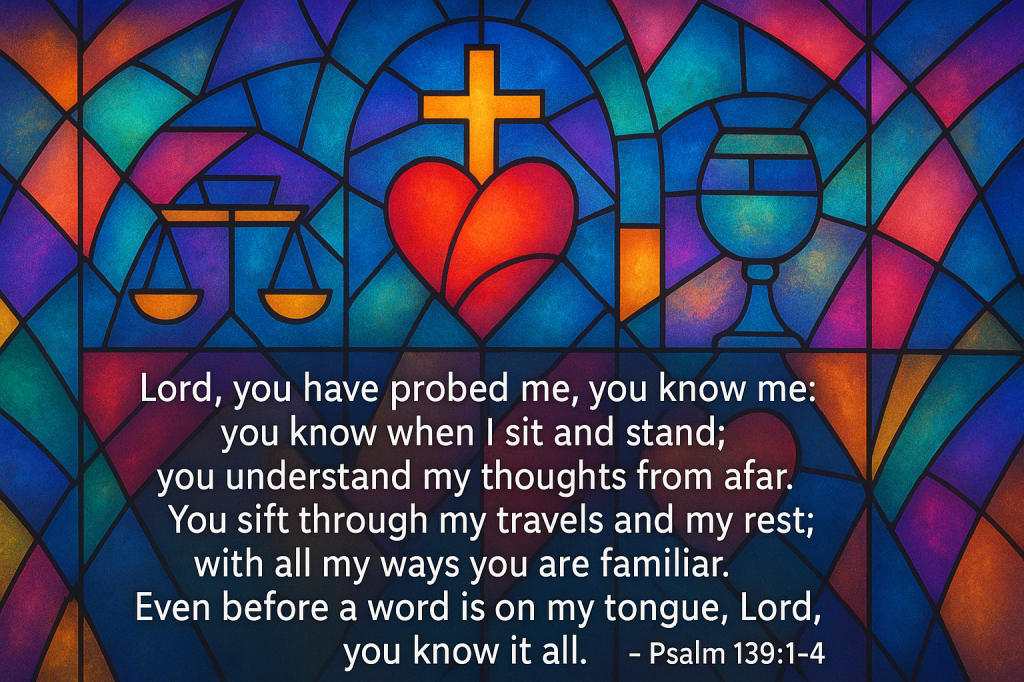
Lord, you have probed me, you know me:
2 you know when I sit and stand;
you understand my thoughts from afar.
3 You sift through my travels and my rest;
with all my ways you are familiar.
4 Even before a word is on my tongue,
Lord, you know it all.
5 Behind and before you encircle me
and rest your hand upon me.
6 Such knowledge is too wonderful for me,
far too lofty for me to reach.
Detailed Exegesis
Verse 1 — “For the leader. A psalm of David. Lord, you have probed me, you know me:”
The superscription places this prayer in Israel’s liturgical life and Davidic school of prayer. “Probed” suggests searching to the depths; God’s knowledge is personal, not abstract. This line establishes the psalm’s keynote: before all appearances, God knows the truth of the person—our thoughts, desires, and intentions.
Verse 2 — “you know when I sit and stand; you understand my thoughts from afar.”
Daily postures—sitting, standing—become icons of total transparency before God. “From afar” does not imply distance from God but His transcendent gaze that comprehends us more than we grasp ourselves. The disciple is invited to integrate every ordinary act with God’s presence, living coram Deo—before the face of God.
Verse 3 — “You sift through my travels and my rest; with all my ways you are familiar.”
“Sift” evokes careful, discerning attention. God’s knowledge is discerning yet gentle, like a loving Father who knows the child’s paths. Nothing in our routines or detours escapes His providence. This grounds a spirituality of honesty: we bring our whole story—work, commute, fatigue—into prayer.
Verse 4 — “Even before a word is on my tongue, Lord, you know it all.”
Speech reveals the heart, yet God knows the word before it forms. This encourages integrity of speech and silence: we can surrender unspoken fears and unformed intentions to Him. It also cautions against hypocrisy—since God knows the motive, our worship must match our interior state.
Verse 5 — “Behind and before you encircle me and rest your hand upon me.”
The verbs move from knowledge to protection and blessing. To be “encircled” is not to be trapped but to be held. The hand upon us evokes priestly blessing and paternal care. God’s encompassing presence makes conversion safe: we can risk interior honesty because Love surrounds us.
Verse 6 — “Such knowledge is too wonderful for me, far too lofty for me to reach.”
A humble doxology. The psalmist acknowledges the abyss between Creator and creature, yet marvels at being known and loved. Awe—not anxiety—is the right response to God’s searching gaze. This awe becomes the wellspring of purity of intention and truthful living.
Teachings
The Church reads this psalm as a school of interior prayer where the heart meets the God who knows it. The Catechism describes the heart’s depths and God’s unique access to it: “The heart is the dwelling-place where I am, where I live; according to the Semitic or Biblical expression, the heart is the place ‘to which I withdraw.’ The heart is our hidden center, beyond the grasp of our reason and of others; only the Spirit of God can fathom the human heart and know it fully. The heart is the place of decision, deeper than our psychic drives. It is the place of truth, where we choose life or death. It is the place of encounter, because as image of God we live in relation: it is the place of covenant.” (CCC 2563) Prayer itself is God’s initiative that meets us in this hidden center: “God calls man first. Man may forget his Creator or hide far from his face; he may run after idols or accuse the deity of having abandoned him; yet the living and true God tirelessly calls each person to that mysterious encounter known as prayer.” (CCC 2567) Purity of heart, the very aim of today’s theme, is not cosmetic but contemplative and moral: “The sixth beatitude proclaims, ‘Blessed are the pure in heart, for they shall see God.’ ‘Pure in heart’ refers to those who have attuned their intellects and wills to the demands of God’s holiness, chiefly in three areas: charity; chastity or sexual rectitude; love of truth and orthodoxy of faith. There is a connection between purity of heart, of body and of faith: the faithful must believe the articles of the Creed ‘so that by believing they may obey God, by obeying they may live well, by living well they may purify their hearts, and with pure hearts they may understand what they believe.’” (CCC 2518) The saints echo this interior path: St. Augustine confesses, “You have made us for Yourself, and our heart is restless until it rests in You.” (Confessions I,1) St. Teresa of Avila describes prayer as God’s loving knowledge of us and our honest response: “Mental prayer in my opinion is nothing else than an intimate sharing between friends; it means taking time frequently to be alone with Him who we know loves us.” (Life 8.5)
Reflection
Because God knows us completely, we can live honestly, speak truthfully, and confess humbly. Begin prayer today by acknowledging that God already knows what you carry; then tell Him anyway, letting love purify your intentions. Practice one act of hidden fidelity—a faithful duty performed without seeking notice—as a concrete way to live before His face. End your day with a brief examen: review your words before the God who knew them “before they were on your tongue”, asking for cleansing where motives were mixed and giving thanks where grace shone through. Where do you hide from God’s loving gaze? What would change if you believed you are safely “encircled” by His hand today? Which ordinary moment—sitting, standing, traveling, resting—will you consciously do coram Deo, letting Him cleanse the inside so the outside may be clean?
Holy Gospel – Matthew 23:23–26
Clean the Inside First
Set in the climactic controversies of Holy Week in Jerusalem, The Gospel of Matthew 23:23–26 records Jesus’ fiercest critique of religious hypocrisy. The Lord addresses respected experts—the scribes and Pharisees—within a culture that prized meticulous observance of tithes and purity customs. Herb-tithing and vessel-washing, though legitimate practices within Israel’s law, had become substitutes for the deeper demands of covenant fidelity. Jesus does not discard lawful observances; He restores their hierarchy, insisting that interior conversion and charity animate every external act. In harmony with today’s theme, He calls us to reality before God: cleanse the heart so that works of religion become transparent to “judgment and mercy and fidelity.”
Matthew 23:23-26
New American Bible (Revised Edition)
23 “Woe to you, scribes and Pharisees, you hypocrites. You pay tithes of mint and dill and cummin, and have neglected the weightier things of the law: judgment and mercy and fidelity. [But] these you should have done, without neglecting the others. 24 Blind guides, who strain out the gnat and swallow the camel!
25 “Woe to you, scribes and Pharisees, you hypocrites. You cleanse the outside of cup and dish, but inside they are full of plunder and self-indulgence. 26 Blind Pharisee, cleanse first the inside of the cup, so that the outside also may be clean.
Detailed Exegesis
Verse 23 — “Woe to you, scribes and Pharisees, you hypocrites. You pay tithes of mint and dill and cummin, and have neglected the weightier things of the law: judgment and mercy and fidelity. These you should have done, without neglecting the others.”
“Woe” is a prophetic lament, not mere condemnation. Jesus acknowledges the legitimacy of tithing but indicts a disordered priority: meticulous minor observances have eclipsed the law’s heart—justice (right judgment), mercy (active compassion), and fidelity (steadfast covenant loyalty). The final sentence safeguards right order: do the essentials first while still honoring lesser precepts.
Verse 24 — “Blind guides, who strain out the gnat and swallow the camel!”
A vivid hyperbole. In purity practice, a tiny unclean insect would be strained from wine, yet Jesus says they miss something far larger—like swallowing a camel (also unclean). The image exposes moral myopia: fastidiousness about trifles while tolerating grave injustice. The issue is not zeal but sight.
Verse 25 — “Woe to you, scribes and Pharisees, you hypocrites. You cleanse the outside of cup and dish, but inside they are full of plunder and self-indulgence.”
Ritual washings of vessels (see Leviticus and later customs) symbolized holiness; Jesus unmasks the contradiction: outward polish concealing interior greed. “Plunder” signals exploitation masked by piety. True worship cannot coexist with unjust gain.
Verse 26 — “Blind Pharisee, cleanse first the inside of the cup, so that the outside also may be clean.”
The remedy is ordered: begin with the heart. Interior purification (repentance, reordered loves) naturally transfigures exterior conduct. Jesus offers hope, not cynicism—when the inside is cleansed, the outside will follow.
Teachings
The Church safeguards this Gospel’s hierarchy of values: interior conversion first, then visible works that flow from charity. The Catechism teaches: “Jesus’ call to conversion and penance… does not aim first at outward works… but at the conversion of the heart, interior conversion. Without this conversion, such penances remain sterile and false; however, interior conversion urges expression in visible signs, gestures, and works of penance.” (CCC 1430) Interior repentance is further described as: “a radical reorientation of our whole life, a return, a conversion to God with all our heart… [entailing] the desire and resolution to change one’s life, with hope in God’s mercy and trust in the help of his grace.” (CCC 1431)
Purity of heart unites seeing God with living the truth: “The sixth beatitude proclaims, ‘Blessed are the pure in heart, for they shall see God.’ ‘Pure in heart’ refers to those who have attuned their intellects and wills to the demands of God’s holiness… There is a connection between purity of heart, of body and of faith… ‘so that by believing they may obey God, by obeying they may live well, by living well they may purify their hearts, and with pure hearts they may understand what they believe.’” (CCC 2518)
Charity orders all observances and expresses itself in works of mercy, the very “weightier matters” Jesus names: “The works of mercy are charitable actions by which we come to the aid of our neighbor in his spiritual and bodily necessities.” (CCC 2447)
Finally, intention determines moral quality—why we do religious acts matters: “Because it lies at the voluntary source of an action and determines it by its end, intention is an element essential to the moral evaluation of an action.” (CCC 1752)
Reflection
Jesus does not ask you to abandon religious practices; He asks you to start where He starts—at the heart—so your practices shine with love. Invite the Lord to cleanse motives before you pray, fast, give, or serve; then let that interior truth shape an outward act of mercy today: reconcile with someone you’ve avoided, give quietly to someone in need, or correct an injustice within your reach. End the day with an examen that names where image-management replaced integrity and where grace made the “outside” match the “inside.” Where have you strained out “gnats” while swallowing “camels” in your priorities? What concrete act of mercy can flow today from a cleansed heart? If Jesus placed your “cup” before you now, what inside would He lovingly wash first?
From the Inside Out: Live What God Sees
Paul shows us a ministry that seeks “not…to please human beings, but rather God” (1 Thessalonians 2:4), Psalm 139 assures us that the One we serve already knows us—“Lord, you have probed me, you know me” (Psalm 139:1), and Jesus orders our priorities toward the heart of the Law—“judgment and mercy and fidelity”—by commanding us to “cleanse first the inside of the cup” (Matthew 23:23–26). Together, these readings call us to interior authenticity: let God’s loving gaze purify intention, and let that purified intention overflow into concrete love. Interior conversion, as taught by The Catechism (CCC 1430–1431), is the spring from which works of justice and mercy flow; when the heart is made true before God, the outside will follow.
Today, renew your yes to God at the level of motive: begin prayer by telling the Lord your true intention, surrender what is mixed or self-seeking, and ask for the grace to act from love. Choose one act that embodies the “weightier matters”—seek reconciliation, offer hidden service, or practice mercy where it costs you something. Make an examen tonight with Psalm 139 on your lips, and, if needed, plan a sincere return to the Sacrament of Reconciliation so grace can wash the inside of the cup. If God already knows your heart, what new freedom might you live in today? Which ordinary moment will you do coram Deo so that your outside reflects a heart cleansed by love? Whom will you love with justice, mercy, and fidelity before the Lord who knows you completely?
Engage with Us!
We’d love to hear how the Holy Spirit is speaking to you through today’s readings. Share your thoughts, prayers, and experiences in the comments—your witness can strengthen someone else’s journey toward Christ.
First Reading – 1 Thessalonians 2:1–8:
How is God inviting you to move from people-pleasing to seeking the One “who judges our hearts” (1 Thessalonians 2:4)?
Where is He asking you to share “not only the gospel” but also your very self with someone today (1 Thessalonians 2:8)?
What concrete step will help purify your intentions so your service is gentle and genuine?
Responsorial Psalm – Psalm 139:1–6:
How does knowing that the Lord has “probed” and knows you (Psalm 139:1) change the way you pray today?
Which ordinary moments—sitting, standing, traveling, resting—will you consciously live before God’s face?
What might you bring to the Lord this evening that He already knows but wants you to entrust to Him in love?
Holy Gospel – Matthew 23:23–26:
Where have you strained “gnats” while swallowing “camels” in your priorities, and how can you reorder them toward “judgment and mercy and fidelity” (Matthew 23:23)?
What does it look like for you to “cleanse first the inside of the cup” in one specific area of life today (Matthew 23:26)?
Which act of hidden mercy will flow from a heart made clean?
May the Lord grant us hearts renewed by grace, so that every prayer, word, and work is done in faith, and everything we do is suffused with the love and mercy Jesus taught us.
Sacred Heart of Jesus, we trust in You!
Immaculate Heart of Mary, pray for us!
Saint Michael the Archangel, defend us in battle!
Follow us on Instagram and Facebook for more insights and reflections on living a faith-filled life.

 Holy Manna!
Leave a comment