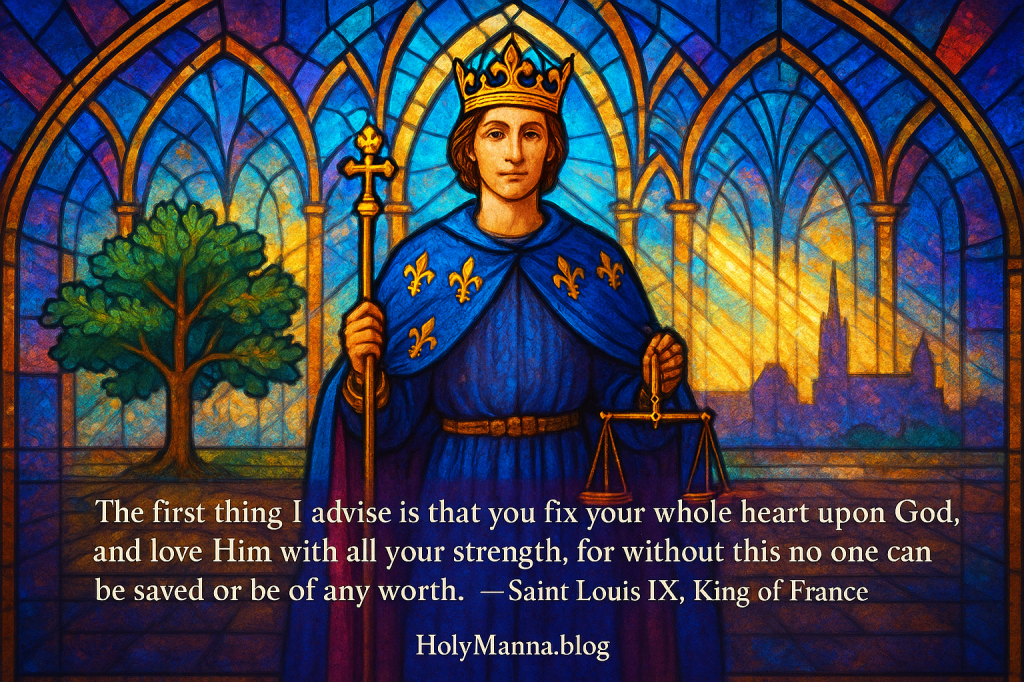
A Crown Laid at the Feet of Christ
Few rulers ever fused holiness and statesmanship like Saint Louis IX (1214–1270). The only canonized king of France, he is remembered for an intense love of Christ and His Passion, a relentless pursuit of justice, and a concrete charity that dignified the poor. He built Sainte-Chapelle in Paris to enshrine relics of the Passion, including the Crown of Thorns, not as a royal trophy but as a visible confession that the true Sovereign of France is Christ. His contemporaries praised his humility—he dressed simply, prayed the Divine Office, and revered the sacraments—while he labored to make the kingdom’s laws reflect the Gospel. Canonized in 1297, he remains a model for lay leadership, public service, and the sanctification of everyday duty. The Church celebrates his feast on August 25th, the day he surrendered his soul to God near Tunis while on crusade.
Roots of a Saint
Born at Poissy, Louis often styled himself “Louis of Poissy,” recalling the font where he was baptized—a clue to how he understood identity: first a son of God, then a son of France. The son of King Louis VIII and Blanche of Castile, he was crowned at twelve after his father’s death, and his mother governed as regent with remarkable prudence and sanctity. Blanche formed him in prayer, reverence for the clergy, and a hatred for sin; the young king learned that royal authority was a stewardship to be exercised for the weak and the common good. In 1234 he married Margaret of Provence; their marriage was affectionate and fruitful, and they raised a large family, including his heir Philip. Louis’ spiritual maturity shone in his Enseignements (spiritual testament) to his son, where he placed salvation before power: “Fair son, the first thing I would teach thee is to set thine heart to love God.” Elsewhere he urged a moral clarity that still startles modern readers: “I would rather see you dead at my feet than that you should commit a mortal sin.” Far from severity for its own sake, this was a father’s insistence that eternal life outweighs earthly success. He is best known for integrating this supernatural vision into the ordinary tasks of kingship—hearing cases himself, disciplining his court, and making his palace a school for the virtues.
Justice Beneath an Oak
Louis’ sanctity flowered in his governance. He introduced measures to restrain private warfare and feuding, strengthened royal courts (the Parlement of Paris), and sought to ensure equal access to justice, becoming famous for receiving petitioners “under the oak” at Vincennes. He reformed coinage and administration, condemned corruption, and insisted that officials serve rather than lord it over the people. His return from the Holy Land in 1254 sparked a program of moral renewal that addressed blasphemy, gambling, and exploitative practices. He pursued peace with neighboring realms, notably concluding treaties with England and Aragon that privileged stability over expansion. These political achievements were rooted in prayer: Louis loved the Mass, confessed frequently, and fasted with Franciscan simplicity. He washed the feet of the poor on Holy Thursday, dined with them regularly, and gave alms discreetly, mindful of Christ’s command in Matthew 6. He founded and supported hospitals and houses of mercy, among them the Quinze-Vingts in Paris to care for hundreds of blind neighbors. He adorned Paris with Sainte-Chapelle, a luminous sermon in stone and glass that lifted minds to the mysteries of the Passion.
Accounts from his household and later canonization records preserve reports of healings connected to his prayers and his compassionate touch, especially among the sick and outcast he personally served. While legends about royal healing (“the king’s touch”) would later be elaborated, the essential point remains: Louis believed that a Christian ruler must be close to the suffering, for Christ the King is found there.
Cross and Crown
Holiness did not spare Louis from hardship. During the Seventh Crusade (1248–1254), he achieved an early victory at Damietta in Egypt but suffered severe losses and was captured after the battle of Mansurah (1250). His conduct in captivity revealed the man within the monarch—calm, penitent, magnanimous. He comforted the wounded, negotiated without hatred, and, once ransomed, remained in the Holy Land for years, repairing fortifications, redeeming captives, and strengthening Christian communities rather than chasing military glory. Returning to France, he embraced penance and reform with renewed zeal. In 1270 he launched the Eighth Crusade, hoping to reopen paths to the Holy Land, but disease ravaged the camp near Tunis. As death approached on August 25, Louis asked to be laid on ashes in the form of a cross. He commended his people to God, prayed for Jerusalem, and surrendered himself as a servant-king to the true King. He was not a martyr, yet his life bears witness to a martyr’s spirit—perseverance through failure, fidelity under humiliation, and charity amid enmity.
Miracles Proved His Sanctity
After his death, the faithful flocked to his remains for intercession. Reports of healings multiplied: fevers abated, injuries mended, and long-standing ailments eased after prayers through his intercession and visits to his tomb. The Church studied these testimonies carefully during his cause, drawing on eyewitness chronicles and the records assembled by those who had known him best—his confessor, his chaplains, and his friend and biographer, the nobleman Joinville, whose The Life of Saint Louis remains a classic. Canonization followed in 1297, and devotion to the “saint-king” spread quickly across Europe. Pilgrims honored his relics at the royal abbey of Saint-Denis; churches and chapels rose in his name; and his image—often with a crown and a thorn of the Passion—became a catechesis in stained glass and stone. In Paris, Sainte-Chapelle continued to draw hearts to Christ’s kingship, while throughout Christendom the memory of Louis’ justice and mercy encouraged rulers and citizens alike to seek holiness in public life.
Walking with Saint Louis Today
Saint Louis embodies the Catholic conviction that grace perfects nature. He proves that holiness is not the enemy of competence; it is its soul. The Catechism teaches, “Those who exercise authority should do so as a service.” (CCC 2235). It also insists that “Authority is exercised legitimately only when it seeks the common good and when it employs morally licit means to attain it.” (CCC 1903). Louis shows what this looks like on the ground: patient listening, impartial judgment, protection of the vulnerable, and a heart anchored in worship. He also makes mercy practical. The Catechism defines the works of mercy as the ordinary pathways of love: “The works of mercy are charitable actions by which we come to the aid of our neighbor in his spiritual and bodily necessities.” (CCC 2447). To imitate Saint Louis, begin at home and work: hear others out before you decide; make restitution when you’ve harmed; give alms quietly; keep holy the Lord’s Day; build small “chapels” of prayer in your routine—a morning psalm, a noonday examen, an evening act of charity. Ask the Holy Spirit for fortitude to bear setbacks without bitterness (CCC 1808) and for justice that refuses to cut corners (CCC 1807). Above all, enthrone Christ in the center of your responsibilities—budget meetings, parish ministries, parenting, civic duties—so that your crown, however small, is laid daily at His feet.
Engage with Us!
We’d love to hear how Saint Louis IX challenges and inspires you.
- Where is Christ asking you to exercise “authority as service” this week?
- What would a concrete work of mercy look like in your schedule today?
- How might you “beautify” your prayer life so that worship overflows into justice and peace at home and in society?
May Saint Louis IX teach us to live our baptismal royalty with courage and tenderness—doing everything in the love and mercy Jesus taught us.
Saint Louis IX, pray for us!
Follow us on Instagram and Facebook for more insights and reflections on living a faith-filled life.

 Holy Manna!
Leave a comment