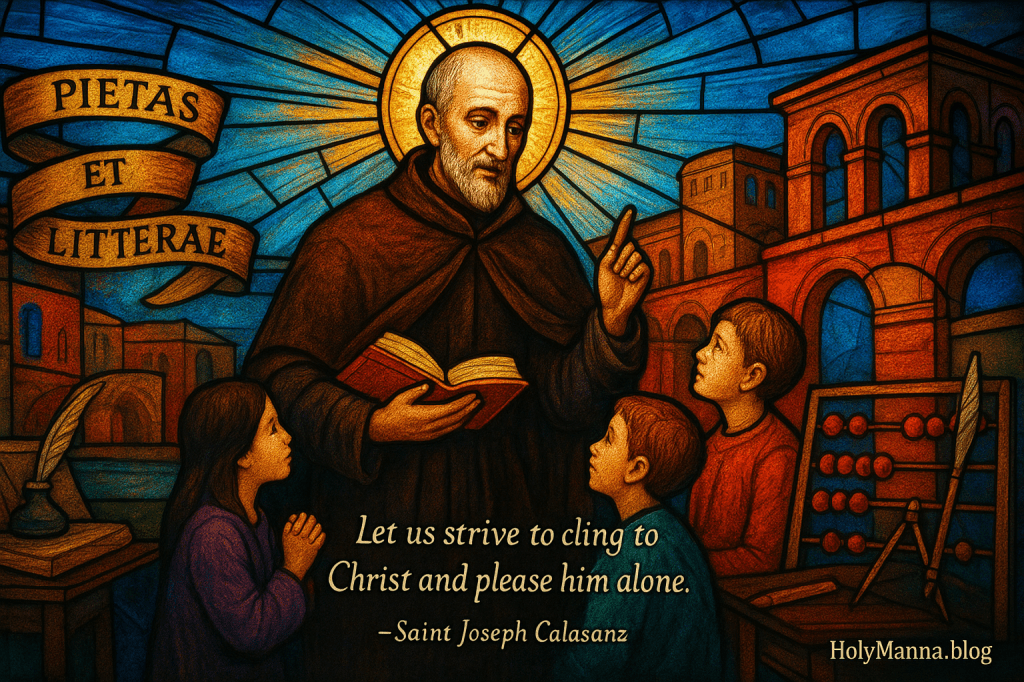
Piety and Letters for the Little Ones
Joseph Calasanz, also known as Joseph Calasanctius (1557–1648), is celebrated as the trailblazer of free, popular education for the poor. A priest aflame with pastoral charity, he founded the Piarists—the Order of Poor Clerics Regular of the Mother of God of the Pious Schools—whose mission unites catechesis with rigorous learning under the motto Pietas et Litterae (“piety and letters”). In an age when schooling was a privilege of the wealthy, Calasanz opened the first enduring, tuition-free school in Rome (1597) and organized a network of classrooms that welcomed the city’s most vulnerable children. His life gives flesh to the Lord’s command, “Let the children come to me; do not hinder them.” He is honored as the patron of Christian popular schools, and his feast invites us to see education itself as a work of mercy (CCC 2447; CCC 2221–CCC 2226; CCC 2229).
A Hidden Spring in Aragon
Born on September 11, 1557, in Peralta de la Sal in the Kingdom of Aragon (today Spain), Joseph grew up amid the rugged beauty of the foothills of the Pyrenees. Gifted with a bright mind and a steady spirit, he studied philosophy, theology, and canon law, discerning a call to the priesthood and receiving ordination in 1583. He served in various ecclesial roles in Spain—experience that sharpened his pastoral judgment—yet the Lord was preparing him for a greater mission. In 1592 he journeyed to Rome, initially seeking opportunities within the Church’s service. What he encountered there changed everything: neighborhoods crowded with children who had no access to instruction, families battered by poverty, and a Church eager to catechize but lacking workers for the harvest. Joseph began volunteering with catechetical groups and soon recognized that the Gospel’s call to evangelize the little ones required a concrete, sustainable answer. How does the Lord use the needs around you to clarify your vocation?
Drawn by compassion, he resolved to devote his life to the spiritual and intellectual formation of youth, convinced that the renewal of society begins by forming children in faith, virtue, and sound learning. This conviction—deeply rooted in the Catholic understanding that parents are the first educators and the Church assists them (CCC 2221–CCC 2223)—became the axis of his priesthood.
A Revolution of Mercy in the Classroom
In November 1597, Joseph opened a free school in two borrowed rooms at the Roman parish of Santa Dorotea. Word spread quickly; within months, enrollment swelled with boys who came barefoot and hungry, eager to learn prayers, reading, writing, arithmetic, and the basics of Latin grammar. Calasanz insisted on a gentle, orderly pedagogy: beginning each day with prayer, teaching the Gospel, drilling multiplication tables, and weaving catechesis through every subject so that faith would become culture. He trained and encouraged teachers, set up classes by level so students could progress, and sought benefactors to cover supplies and bread so poverty would never be a barrier.
As the work matured, companions gathered around him. In 1617 the community received papal approval as a congregation; in 1621 it was elevated to a religious order with solemn vows. The Piarists spread through Italy and beyond, establishing schools that combined worship, discipline, and practical instruction. Calasanz championed mathematics and the sciences alongside catechism because he believed that truth is one and that Christian wisdom embraces every branch of learning. The most distinctive “miracles” of his lifetime were the transformations that unfolded in those classrooms: children formed in prayer who could also keep accounts honestly, measure fairly, write clearly, and serve their neighbors with competence and compassion. Where might God be inviting you to join prayer with practical skill for the sake of the poor?
When Love Meets the Cross
The very fruitfulness of the Piarist schools brought challenges. As the order expanded, internal tensions, human weaknesses, and outside pressures converged. Joseph endured investigations, administrative upheavals, and public misunderstandings. In the 1640s, the order’s privileges were severely curtailed; houses were placed under local authority, and the aged founder—who had spent himself for the little ones—suffered demotion and humiliation. He responded with the meek strength of a saint: he obeyed the Church, forgave offenses, and continued to encourage his spiritual sons to love God and the children entrusted to them. Though not a martyr by blood, he bore a kind of white martyrdom of reputation, health, and labor, offering it for the perseverance of the work. He died in Rome on August 25, 1648, trusting that the Lord would vindicate what had been begun for His glory. In the years that followed, the Church cleared his name and restored the Piarists, confirming that fidelity in trial is never wasted in God’s economy (CCC 1820; CCC 2015). What crosses is the Lord asking you to carry quietly for the sake of a mission bigger than yourself?
The Echo After the Bell
After his death, devotion to Joseph Calasanz grew steadily. Miracles—especially healings obtained by invoking his intercession—were investigated and accepted in the processes that led to his beatification (1748) and canonization (1767). His tomb at San Pantaleo in Rome became a place of prayer for educators, parents, and children. The Piarists preserved his relics, including his heart and tongue, as tangible reminders of a founder whose love and preaching were poured out for the young. Pilgrims continue to visit Piarist churches and schools throughout the world, thanking God for graces received and asking St. Joseph Calasanz to shape their homes and classrooms into sanctuaries where Christ is known, loved, and served. His legacy, renewed in every generation, is a living catechesis on the dignity of the child and the sanctifying power of teaching as ministry (CCC 1700; CCC 2447). Where has the Lord used a teacher’s presence to heal something in you?
Forming Minds and Hearts, Not One Without the Other
The Catechism teaches that parents bear the first responsibility for the education of their children and that civil and ecclesial authorities must ensure schools are accessible to all, especially the poor (CCC 2221–CCC 2229). St. Joseph Calasanz turned these principles into a concrete, joyful program: daily prayer, solid doctrine, and serious study offered freely to those who could never afford it. His life reminds us that evangelization is not opposed to excellence; rather, charity demands competence. He also models a humble obedience that trusts God to purify and protect a mission even through painful setbacks. “Let the children come to me.” In every parish and family, that mandate becomes a pastoral plan: teach the faith clearly, cultivate virtue patiently, and give children the tools to live the truth courageously. How is the Lord asking you to close the gap between what you believe about education and what you actually do for a child?
Practicing the Lesson
Begin by praying each day for teachers and students by name. Offer to tutor at your parish or sponsor supplies for a family in need. Read a passage of the Gospel with a child and then help with homework—five minutes of Scripture, fifteen minutes of spelling or math. Encourage your parish council to prioritize scholarships for Catholic schools and robust catechesis for all families, including those who cannot pay. If you meet resistance or encounter bureaucratic tangles, persevere with the patience of Calasanz; sanctity often looks like steady, hidden faithfulness. Remember, authentic Christian education forms the whole person—mind, heart, and will—so that truth can be loved and lived (CCC 1803–CCC 1832). What one concrete act will you take this week to unite mercy and mastery in service of a child?
Engage with Us!
We’d love to hear your reflections and experiences—share in the comments how this saint speaks to you today.
- Where have you seen “piety and letters” at work in your life?
- What concrete step can you take to welcome the little ones—by teaching, mentoring, or supporting a school?
- How does Calasanz challenge your view of success and setback?
Let’s encourage one another to live a life of faith, doing everything with the love and mercy Jesus taught us, for the glory of God and the good of His children.
Saint Joseph Calasanz, pray for us!
Follow us on Instagram and Facebook for more insights and reflections on living a faith-filled life.

 Holy Manna!
Leave a comment