From Chancellor to Shepherd of Souls
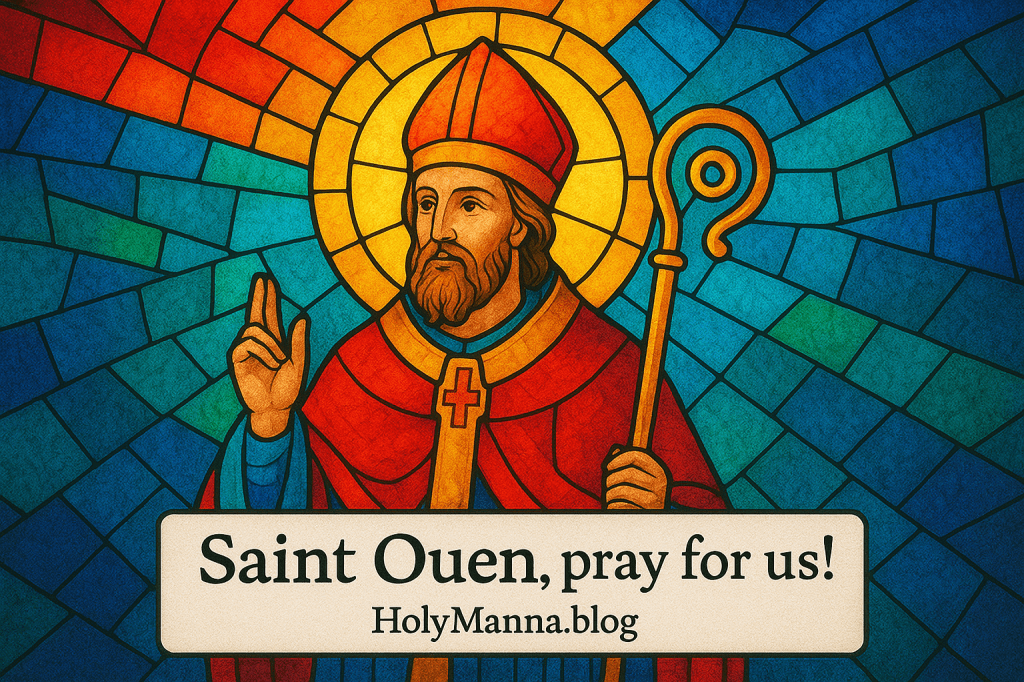
Saint Ouen—known in Latin as Audoenus—was one of the most influential Church leaders of the 7th century in what is now northern France. Renowned for his wisdom, diplomacy, and holiness, he played a pivotal role in both royal courts and in the spiritual renewal of his diocese. His life bridged two worlds: the sophisticated and often dangerous sphere of Merovingian politics, and the humble, service-oriented mission of a bishop shepherding his flock. Ouen was not only a close friend and collaborator of Saint Eligius, but also the author of Eligius’s biography, which remains one of the richest historical sources for the period. His episcopacy was marked by reform, evangelization, and a clear commitment to rooting out lingering pagan practices, replacing them with the light of Christ. Today, he is honored as the patron saint against deafness and a powerful intercessor for those seeking healing and spiritual clarity.
Noble Roots and a Higher Calling
Ouen was born around 609 near Soissons, in a place called Sancy, to a respected Gallo-Roman family. His parents ensured that he received an excellent education, and he was placed at the Abbey of Saint-Médard in Soissons, where he was instructed in letters, the Scriptures, and the traditions of the Church. His intellectual gifts and integrity drew the attention of the Merovingian kings, and he entered the royal court, eventually becoming referendary—essentially the king’s chancellor—under King Dagobert I. Though his role placed him in the midst of wealth, political intrigue, and influence, Ouen experienced a deepening call to serve Christ more directly. In 634, he was ordained a priest, and just a few years later, in 640, he was consecrated bishop of Rouen. His conversion was not one from unbelief to belief, but from worldly ambition to spiritual mission, choosing the care of souls over the pursuit of power. As bishop, he immediately set about reforming the clergy, founding monasteries, and promoting sound Christian teaching. He also helped to establish and support monasteries such as Rebais and Fontenelle (Saint-Wandrille), recognizing them as centers of both prayer and learning.
Evangelizing with Zeal and Wisdom
Ouen’s years as bishop were marked by tireless efforts to strengthen the faith of his flock and bring the Gospel to places still touched by paganism. He visited rural areas personally, taught the truths of the Catholic faith, and encouraged the destruction of idols and shrines dedicated to false gods, replacing them with churches and crosses. His zeal was balanced by prudence, winning over hearts not only through firm preaching but also by pastoral gentleness. While Ouen’s sanctity was most evident in his governance, historical accounts do include miracles associated with him during his life, often in connection with his missionary journeys and the relics he brought back from Rome and Cologne. His work in founding and reforming monastic communities reflected his belief that holiness and learning must walk hand in hand. By fostering a strong monastic presence in Normandy, he ensured that the faith would be preserved and handed down in purity for generations. His dedication to evangelization embodies the Church’s teaching that bishops are above all heralds of the Gospel, entrusted with bringing Christ to every corner of their dioceses.
A Cross of Leadership in Troubled Times
Though Ouen did not suffer martyrdom in the traditional sense, his episcopate unfolded during an era of political unrest and factional violence. The Merovingian kingdoms were frequently torn by rivalries, and Ouen was often called upon to mediate disputes between nobles and even between entire realms. His position required great courage and patience, as aligning too closely with any political faction could have brought ruin to his diocese. He worked tirelessly to restore peace between Neustria and Austrasia, even in the face of opposition from powerful figures like the palace mayor Ebroin. This ministry of reconciliation was perhaps one of the greatest crosses he bore. It demanded not only diplomatic skill but also deep faith that Christ, the Prince of Peace, could heal divisions. In August of either 683 or 684, while on a diplomatic mission to Clichy, Ouen died, having worn himself out in the service of both Church and kingdom. His body was reverently returned to Rouen and laid to rest in the abbey church of Saint Peter, which was renamed in his honor.
Signs and Wonders from Heaven
After his death, the people of Rouen and the surrounding regions quickly came to venerate Ouen as a saint. Miracles were reported at his tomb, especially healings related to hearing loss, which led to his patronage against deafness. Pilgrims came seeking his intercession, and his shrine became one of the most important pilgrimage sites in Normandy. Over the centuries, his relics were translated several times—once to protect them from Viking invasions, and later during periods of political upheaval. The final solemn translation took place in 1860, reaffirming his enduring place in the life of the Church. Devotion to Saint Ouen spread beyond France; churches dedicated to him were established in England and Ireland, a testimony to the wide reach of his reputation for holiness. The magnificent Gothic abbey church of Saint-Ouen in Rouen, with its soaring arches and famous organ, continues to inspire awe and devotion, standing as a visible reminder of the saint who once walked among his people, guiding them to Christ.
The Silent Power of Faithful Service
Saint Ouen’s life teaches us that the path to holiness often runs through the ordinary and the hidden. He reminds us that leadership in the Church is not about status but about service, not about ambition but about the salvation of souls. In him we see a bishop who guarded the faith, strengthened the Church, and brought peace where there was discord. His steady, faithful work echoes the Catechism’s reminder that saints are given to us as models and intercessors, showing that holiness is possible in every age and circumstance. For those of us living in a world still fractured by division and plagued by false idols—whether literal or metaphorical—Saint Ouen challenges us to be instruments of unity, truth, and compassion. His legacy urges us to seek the Lord’s will with courage, to evangelize with both zeal and patience, and to trust that the seeds of faith we plant will bear fruit in God’s time.
Engage with Us!
I’d love to hear your thoughts and prayer experiences—share them in the comments so we can learn from one another and grow together.
- Where is the Lord inviting you to exchange visible “position” for hidden service right now?
- How can you bring peace into one concrete relationship or setting this week, in Saint Ouen’s spirit?
- What small step could help you love the Church more—study, prayer before the Blessed Sacrament, reconciliation with someone, or volunteering in your parish?
Let’s keep supporting one another in the journey of faith, and strive to do everything with love, as our Lord Jesus did.
Saint Ouen, pray for us! ✨
Follow us on Instagram and Facebook for more insights and reflections on living a faith-filled life.

 Holy Manna!
Leave a comment