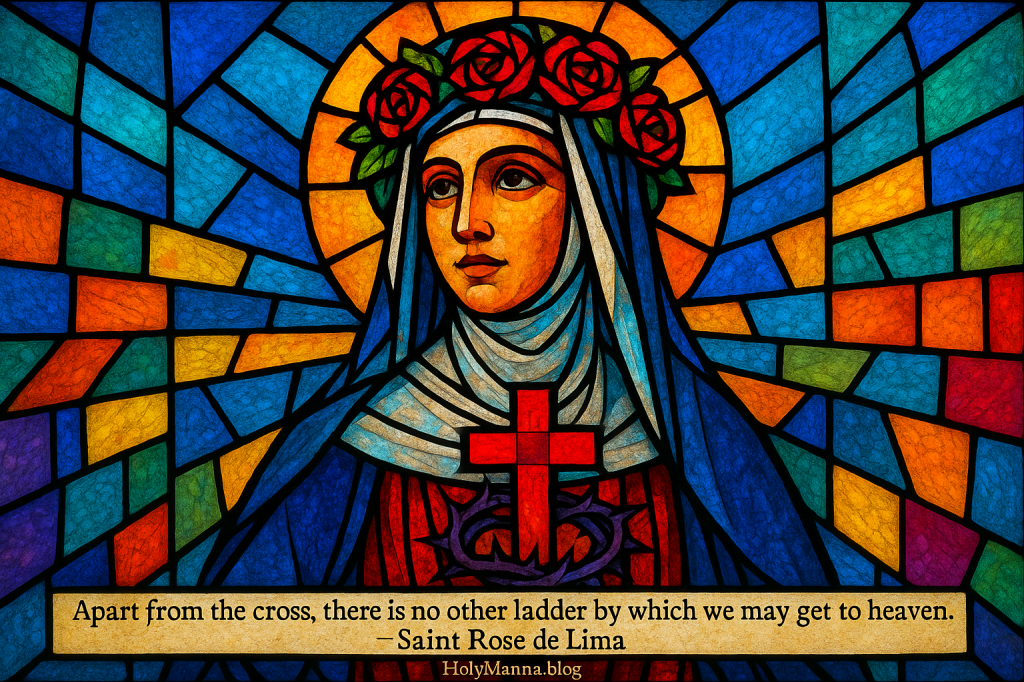
The Hidden Garden of Holiness
Saint Rose of Lima (1586–1617) is remembered as the first canonized saint of the Americas and a radiant witness to Christ’s transforming love. A member of the Third Order of Saint Dominic, she is celebrated for her deep mystical union with God, her acts of charity, and her heroic penance. Her sanctity was not expressed in public preaching or grand missionary journeys, but in a quiet life of prayer, sacrifice, and tireless service to the poor. She is the patroness of Peru, Latin America, the Philippines, and all who seek purity of heart. The Church holds her up as a reminder that holiness can blossom even in the humblest and most hidden corners of the world.
A Rose Among Thorns: Early Life and the Blossoming of Faith
Born Isabel Flores de Oliva in Lima, Peru, to Gaspar Flores and María de Oliva, Rose entered a colonial society marked by wealth and growing European influence. From infancy, she was called “Rose” after a family friend saw her face glow with supernatural beauty, likening her to a rose. As she grew, her beauty became a source of unwanted attention from suitors, and she took radical steps to preserve her consecration to God. She cut her long hair, rubbed pepper and lime on her skin, and wore simple clothing, refusing to draw admiration for her appearance. Confirmed by Saint Toribio de Mogrovejo, she cultivated a life of prayer and fasting from an early age. At 20, she joined the Third Order of Saint Dominic, inspired by Saint Catherine of Siena, and set up a small hermitage in her family’s garden where she lived a semi-cloistered life devoted to Christ. She sustained herself by embroidery and gardening, offering her earnings to help the poor.
Miracles in the Hidden Cell: A Life of Prayer and Divine Favor
Rose’s daily life was a fusion of intense prayer, acts of penance, and works of mercy. She wore a silver crown lined with inward-facing spikes under a wreath of roses, uniting herself to Christ’s crown of thorns. Her bed was made of broken glass, pottery shards, and wood, reminding her of the suffering of Jesus. Despite these sacrifices, her heart overflowed with kindness—she opened her home to care for the sick and hungry, treating them with gentleness and joy. In 1615, when Dutch pirates threatened Lima, Rose rushed to the tabernacle of the church, placing herself before the Blessed Sacrament and praying with such fervor that many credited the city’s safety to her intercession. She was also known for moments of ecstasy in prayer, visions of Christ and the Blessed Virgin, and the gift of prophecy. Her life teaches that the greatest miracles often come not in public spectacles, but in the quiet power of holiness hidden in God.
Trials in the Garden: Enduring Hardship with Love
Though she never suffered physical martyrdom, Rose endured a lifelong martyrdom of the heart. Her family at times misunderstood her vocation, and some neighbors criticized her extreme penances. She was afflicted with long bouts of illness and spiritual dryness, yet she never wavered in her love for Christ. She faced temptations against her purity and was often mocked for rejecting marriage and worldly success. Rose transformed these sufferings into offerings for the salvation of souls, famously saying, “Apart from the cross, there is no other ladder by which we may get to heaven.” In her final years, she suffered debilitating illness that confined her to the home of a family friend, where she died peacefully at the age of 31 on August 24, 1617, whispering the name of Jesus.
The Fragrance of Sanctity: Miracles After Death
The death of Rose of Lima brought an outpouring of veneration from the people of Peru. Her funeral was attended by the city’s highest officials, and miracles were soon reported at her tomb. Many sick were healed after invoking her intercession, and her name spread throughout the Spanish colonies. Pope Clement IX beatified her in 1668, and Pope Clement X canonized her in 1671, declaring her patroness of Peru, the Indies, and the Philippines. Today, pilgrims flock to her shrine at the Basilica of Santo Domingo in Lima, where her relics are enshrined alongside those of Saint Martin de Porres and Saint John Macías. One of the most beloved devotional practices is to drop written petitions into the well in her family’s garden, trusting in her heavenly intercession.
Lessons from the Rose: A Reflection for the Soul
The Catechism teaches that the saints are models and intercessors, showing us how to live the Gospel fully (CCC 828). Saint Rose of Lima’s life challenges us to embrace prayer, penance, and charity with courage and love. Her example reminds us that holiness is not reserved for those in cloisters or pulpits—it can grow in the ordinary soil of daily life if we are willing to give ourselves entirely to God. Her radical humility and purity of heart show us how to resist the lure of vanity and pride. Like her, we can choose hidden acts of sacrifice, offer our trials to Christ for the salvation of souls, and serve the poor as if serving Jesus Himself. Her words ring true for every Christian: “Let all men know that grace comes after tribulation.” May we, too, live as “roses” in the garden of God, bringing beauty and fragrance to a world in need of His love.
Engage with Us!
I’d love to hear how Saint Rose’s courage and tenderness speak to you—share your thoughts below and let’s pray for one another.
- Where is Jesus inviting you to a hidden act of love for someone in need this week?
- How might you practice temperance today so that your love is freer and more joyful?
- When suffering comes, how can you unite it to Christ and ask Saint Rose to intercede for you?
Let’s keep encouraging each other in the journey of holiness—and strive to do everything with love, as our Lord Jesus did.
Saint Rose of Lima, pray for us! 🌹
Follow us on Instagram and Facebook for more insights and reflections on living a faith-filled life.

 Holy Manna!
Leave a comment