Saturday of the Twentieth Week in Ordinary Time – Lectionary: 424
Walking the Humble Path that Heaven Rewards
Sometimes the greatest works of God begin quietly—in the hidden corners of human kindness, in the humble choices to serve without seeking recognition. Today’s readings invite us to reflect on how true greatness in the Kingdom of God is not about status, titles, or public honor, but about self-giving love that bears fruit for generations. In Ruth 2 and 4, we encounter the faithfulness of a foreign widow whose loyalty to her mother-in-law led her into the providential care of Boaz, a man of generosity and honor. This act of humility and service became part of the very lineage of King David, and ultimately, of Christ Himself. Psalm 128 echoes the blessings promised to those who fear the Lord and walk in His ways—blessings that flow into their homes, families, and communities. Yet in Matthew 23:1-12, Jesus offers a sobering reminder that religious appearance without humble service is hollow, warning against the pride of the scribes and Pharisees who “preach but do not practice.” He reveals the true measure of discipleship: “The greatest among you must be your servant. Whoever exalts himself will be humbled; but whoever humbles himself will be exalted.” Together, these passages draw us into a single truth—God’s lasting blessings are reserved for those who quietly and faithfully walk in humility, placing the good of others above themselves. How might God be inviting you today to serve in a way that no one but Him sees?
First Reading – Ruth 2:1-3, 8-11; 4:13-17
The Humble Servant Who Changed Salvation History
The Book of Ruth unfolds during the period of the Judges, a time in Israel’s history marked by social instability and a wavering commitment to God’s covenant. Against this backdrop, the story of Ruth—a Moabite widow—shines as a testament to faithfulness, humility, and God’s providential care. Moabites were often viewed with suspicion by Israel due to historical hostilities (cf. Deuteronomy 23:3), yet Ruth’s loyalty to her mother-in-law Naomi and her embrace of the God of Israel reveal a radical openness to God’s plan. The practice of gleaning, central to this passage, was part of Israel’s Law, where landowners were commanded to leave the edges of their fields for the poor, widows, and foreigners (cf. Leviticus 19:9-10). In this way, Ruth’s encounter with Boaz was not mere chance but an intersection of divine law, human kindness, and God’s providence. Today’s theme—humble service that bears lasting fruit—is powerfully embodied here: Ruth’s quiet acts of loyalty and humility lead to blessings that extend beyond her lifetime, ultimately weaving her into the lineage of King David and the Messiah.
Ruth 2:1-3, 8-11; 4:13-17
New American Bible (Revised Edition)
The Meeting. 2:1 Naomi had a powerful relative named Boaz, through the clan of her husband Elimelech. 2 Ruth the Moabite said to Naomi, “I would like to go and glean grain in the field of anyone who will allow me.” Naomi said to her, “Go ahead, my daughter.” 3 So she went. The field she entered to glean after the harvesters happened to be the section belonging to Boaz, of the clan of Elimelech.
8 Boaz then spoke to Ruth, “Listen, my daughter. Do not go to glean in anyone else’s field; you are not to leave here. Stay here with my young women. 9 Watch to see which field is to be harvested, and follow them. Have I not commanded the young men to do you no harm? When you are thirsty, go and drink from the vessels the young people have filled.” 10 Casting herself prostrate upon the ground, she said to him, “Why should I, a foreigner, be favored with your attention?” 11 Boaz answered her: “I have had a complete account of what you have done for your mother-in-law after your husband’s death; you have left your father and your mother and the land of your birth, and have come to a people whom previously you did not know.
4:13 Boaz took Ruth. When they came together as husband and wife, the Lord enabled her to conceive and she bore a son. 14 Then the women said to Naomi, “Blessed is the Lord who has not failed to provide you today with a redeemer. May he become famous in Israel! 15 He will restore your life and be the support of your old age, for his mother is the daughter-in-law who loves you. She is worth more to you than seven sons!” 16 Naomi took the boy, cradled him against her breast, and cared for him. 17 The neighbor women joined the celebration: “A son has been born to Naomi!” They named him Obed. He was the father of Jesse, the father of David.
Detailed Exegesis
Verse 2:1 – “Naomi had a powerful relative named Boaz, through the clan of her husband Elimelech.”
This verse introduces Boaz, a “man of standing” in both wealth and moral character. His connection to Naomi is key, as the role of kinsman-redeemer—one who protects family lineage and property—will be central to the story.
Verse 2 – “Ruth the Moabite said to Naomi, ‘I would like to go and glean grain in the field of anyone who will allow me.’ Naomi said to her, ‘Go ahead, my daughter.’”
Here, Ruth takes initiative in seeking provision for both herself and Naomi. Her request underscores her humility and willingness to labor. As a foreigner and widow, she approaches this with no presumption of privilege, trusting in God’s mercy expressed through His people.
Verse 3 – “So she went. The field she entered to glean after the harvesters happened to be the section belonging to Boaz, of the clan of Elimelech.”
The “happening” is a literary nod to divine providence. Though it seems accidental, the narrative invites us to see God’s guiding hand directing Ruth exactly where she needed to be.
Verse 8 – “Boaz then spoke to Ruth, ‘Listen, my daughter. Do not go to glean in anyone else’s field; you are not to leave here. Stay here with my young women.’”
Boaz immediately offers Ruth protection and belonging within his household’s work. Addressing her as “my daughter” reveals respect and care, breaking the social barriers that might have kept a Moabite woman at a distance.
Verse 9 – “Watch to see which field is to be harvested, and follow them. Have I not commanded the young men to do you no harm? When you are thirsty, go and drink from the vessels the young people have filled.”
Boaz ensures Ruth’s safety and dignity. His command to the young men not to harm her reflects both his moral leadership and his acknowledgment of her vulnerable status. In offering her water, he treats her as a full member of the community.
Verse 10 – “Casting herself prostrate upon the ground, she said to him, ‘Why should I, a foreigner, be favored with your attention?’”
Ruth’s posture and words show deep humility and gratitude. She recognizes the extraordinary nature of Boaz’s kindness given her outsider status, revealing her awareness of both cultural prejudices and God’s grace at work.
Verse 11 – “Boaz answered her: ‘I have had a complete account of what you have done for your mother-in-law after your husband’s death; you have left your father and your mother and the land of your birth, and have come to a people whom previously you did not know.’”
Boaz affirms Ruth’s sacrificial love and courage. This echoes Genesis 12:1, where Abraham leaves his homeland in faith—a parallel suggesting Ruth’s own step into covenant faithfulness.
Verse 13 – “Boaz took Ruth. When they came together as husband and wife, the Lord enabled her to conceive and she bore a son.”
This union fulfills the role of kinsman-redeemer and is marked by God’s direct blessing in granting conception, a sign of divine favor and continuation of covenant promise.
Verse 14 – “Then the women said to Naomi, ‘Blessed is the Lord who has not failed to provide you today with a redeemer. May he become famous in Israel!’”
The community rejoices, seeing in this child not just personal joy for Naomi but the working of God’s redemption for His people.
Verse 15 – “He will restore your life and be the support of your old age, for his mother is the daughter-in-law who loves you. She is worth more to you than seven sons!”
The women’s praise elevates Ruth’s love and loyalty above even the cultural ideal of sons, showing the transformative nature of covenant love.
Verse 16 – “Naomi took the boy, cradled him against her breast, and cared for him.”
This verse emphasizes restoration and healing. Naomi, once bitter and empty, now holds tangible proof of God’s faithfulness.
Verse 17 – “The neighbor women joined the celebration: ‘A son has been born to Naomi!’ They named him Obed. He was the father of Jesse, the father of David.”
Here, the narrative ties Ruth’s humble obedience to the grand arc of salvation history. From Ruth comes David, and from David will come the Messiah.
Teachings
The Catechism teaches that “God’s providence consists in the dispositions by which He guides all His creatures with wisdom and love to their ultimate end” (CCC 321). Ruth’s journey shows that God’s plan often unfolds through ordinary acts of fidelity and service. Saint Augustine reminds us that humility is the foundation of all virtue: “If you plan to build a tall house of virtues, you must first lay deep foundations of humility” (Sermon 69). Historically, Ruth’s inclusion in Israel prefigures the universal call of the Gospel—God’s plan to gather all nations into His covenant family through Christ.
Reflection
Ruth’s example teaches us that humble service, done without seeking recognition, can bear fruit beyond our imagination. Her willingness to step into the unknown, to work hard for the sake of another, and to embrace the God of Israel brought blessings to countless generations. Where is God calling you to serve quietly today, trusting Him to use even the smallest acts for His greater plan? Perhaps it’s in your family, in unnoticed acts of kindness at work, or in caring for someone in need. True greatness in God’s eyes is found here—in love expressed through service. May we walk in Ruth’s footsteps, choosing humility over honor, and trusting God to weave our lives into His story of salvation.
Responsorial Psalm – Psalm 128:1-5
The Blessing of a God-Fearing Home
Psalm 128 is a wisdom psalm, traditionally sung during pilgrimages to Jerusalem as one of the “Songs of Ascents.” It celebrates the blessings that flow from a life lived in reverence toward God—blessings that are deeply personal yet also extend into family, community, and the nation of Israel. In the ancient Israelite mindset, to “fear the Lord” was not to live in terror but to stand in awe-filled reverence before His majesty, aligning one’s life with His covenant commands. In a society where family heritage, agricultural prosperity, and communal stability were seen as signs of divine favor, this psalm affirms that such blessings are the fruit of walking faithfully with God. Today’s theme—humble service that bears lasting fruit—fits seamlessly here: the psalm’s vision of a flourishing home is rooted not in self-promotion or outward show, but in a quiet, steadfast obedience to God’s will.
Psalm 128:1-5
New American Bible (Revised Edition)
The Blessed Home of the Just
1 A song of ascents.
Blessed are all who fear the Lord,
and who walk in his ways.
2 What your hands provide you will enjoy;
you will be blessed and prosper:
3 Your wife will be like a fruitful vine
within your home,
Your children like young olive plants
around your table.
4 Just so will the man be blessed
who fears the Lord.
5 May the Lord bless you from Zion;
may you see Jerusalem’s prosperity
all the days of your life,
Detailed Exegesis
Verse 1 – “Blessed are all who fear the Lord, and who walk in his ways.”
The psalm begins with a beatitude, much like the Sermon on the Mount in Matthew 5. Here, blessing is tied to both interior disposition (“fear the Lord”) and outward action (“walk in his ways”). This pairing reminds us that true faith is lived, not merely professed.
Verse 2 – “What your hands provide you will enjoy; you will be blessed and prosper.”
The verse reflects the agrarian culture of ancient Israel, where the fruit of one’s labor was seen as a direct gift from God. It speaks to contentment—receiving and rejoicing in God’s provision rather than striving endlessly for more.
Verse 3 – “Your wife will be like a fruitful vine within your home, your children like young olive plants around your table.”
The imagery here is deeply symbolic: the vine represents joy, fertility, and abundance; olive plants symbolize longevity, peace, and covenant blessing. This verse envisions a household that is vibrant, flourishing, and rooted in God’s grace.
Verse 4 – “Just so will the man be blessed who fears the Lord.”
This reiteration ties the blessings of verses 2 and 3 directly back to the central condition: reverent obedience to God. It affirms that such a life is not only good but the true measure of divine favor.
Verse 5 – “May the Lord bless you from Zion; may you see Jerusalem’s prosperity all the days of your life.”
Here, the blessing expands beyond the home to the nation. Zion, as the dwelling place of God, symbolizes the source of all blessing. The prosperity of Jerusalem reflects the collective wellbeing of God’s people, showing that personal faithfulness contributes to the flourishing of the wider community.
Teachings
The Catechism teaches that “The fear of the Lord is a filial respect for God… It is the beginning of wisdom, the foundation of hope, and the starting point of love” (CCC 1831). This psalm beautifully illustrates that principle, showing how reverence for God naturally overflows into family life and community well-being. Saint John Chrysostom noted, “When the head of the household fears the Lord, all in the house are blessed. This fear is not servile, but one of love and trust.” Historically, Psalm 128 was prayed by Jewish pilgrims traveling to Jerusalem, reinforcing the communal and national dimension of personal holiness.
Reflection
Psalm 128 challenges us to see the connection between our reverence for God and the fruitfulness of our relationships, homes, and communities. A God-fearing life is not lived for show, but is quietly built in daily choices—choosing honesty over deceit, service over self-interest, prayer over distraction. What small steps could you take today to “walk in His ways” within your home and workplace? Could it be setting aside time to pray as a family, offering encouragement instead of criticism, or honoring God through the integrity of your work? The blessings God promises may not always be material, but they will always be rich, life-giving, and enduring.
Holy Gospel – Matthew 23:1-12
The Servant’s Crown in the Kingdom of God
This passage from The Gospel of Matthew comes during the final week of Jesus’ earthly ministry, as He addresses the crowds and His disciples in the Temple courts. The scribes and Pharisees were the recognized religious authorities in first-century Judaism, entrusted with teaching and interpreting the Law of Moses. Yet, Jesus here warns against following their example, exposing the danger of religious hypocrisy—a focus on outward appearances rather than inner conversion. The cultural background is crucial: in Jewish society, honor and public recognition held high value, and religious leaders often occupied privileged social positions. However, Jesus redefines greatness in the Kingdom as humble service, aligning perfectly with today’s theme—humble service that bears lasting fruit. He invites His followers to reject pride, self-exaltation, and the pursuit of titles, embracing instead a life where authority is exercised through service and love.
Matthew 23:1-12
New American Bible (Revised Edition)
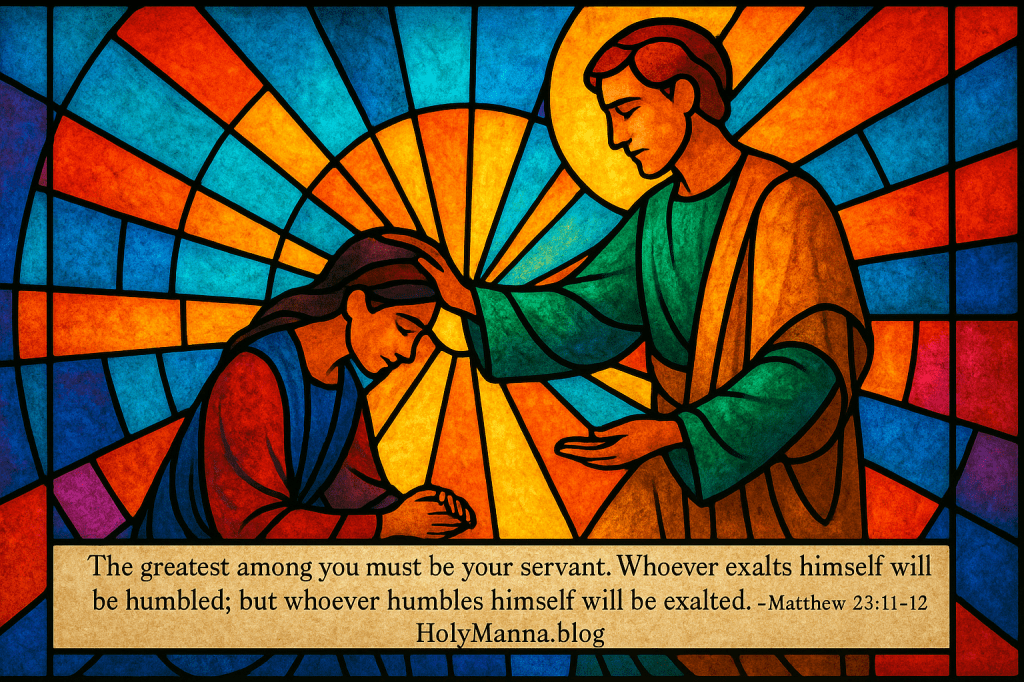
Denunciation of the Scribes and Pharisees. 1 Then Jesus spoke to the crowds and to his disciples, 2 saying, “The scribes and the Pharisees have taken their seat on the chair of Moses. 3 Therefore, do and observe all things whatsoever they tell you, but do not follow their example. For they preach but they do not practice. 4 They tie up heavy burdens [hard to carry] and lay them on people’s shoulders, but they will not lift a finger to move them. 5 All their works are performed to be seen. They widen their phylacteries and lengthen their tassels. 6 They love places of honor at banquets, seats of honor in synagogues, 7 greetings in marketplaces, and the salutation ‘Rabbi.’ 8 As for you, do not be called ‘Rabbi.’ You have but one teacher, and you are all brothers. 9 Call no one on earth your father; you have but one Father in heaven. 10 Do not be called ‘Master’; you have but one master, the Messiah. 11 The greatest among you must be your servant. 12 Whoever exalts himself will be humbled; but whoever humbles himself will be exalted.
Detailed Exegesis
Verse 1 – “Then Jesus spoke to the crowds and to his disciples”
Jesus speaks to both the general public and His closest followers, indicating that His message is for everyone—leaders and laypeople alike.
Verse 2 – “The scribes and the Pharisees have taken their seat on the chair of Moses.”
The “chair of Moses” symbolizes teaching authority over the Law. Jesus acknowledges their legitimate role in preserving God’s Word, even though their personal conduct is flawed.
Verse 3 – “Therefore, do and observe all things whatsoever they tell you, but do not follow their example. For they preach but they do not practice.”
Jesus calls for respect toward the Law they teach, but He clearly separates the message from the messenger when the latter fails to live by it. Hypocrisy is condemned, as integrity requires that teaching and living be one.
Verse 4 – “They tie up heavy burdens hard to carry and lay them on people’s shoulders, but they will not lift a finger to move them.”
The Pharisees often added strict interpretations and extra regulations beyond the Law, making religious observance burdensome. Yet, they offered no compassion or assistance to those struggling to bear the load.
Verse 5 – “All their works are performed to be seen. They widen their phylacteries and lengthen their tassels.”
Phylacteries (small boxes containing Scripture) and tassels on garments (Numbers 15:38-39) were meant to remind Israel of God’s Law, but the Pharisees exaggerated theirs for the sake of public admiration.
Verse 6 – “They love places of honor at banquets, seats of honor in synagogues”
This reflects their craving for social prestige rather than service. In the Kingdom of God, honor is not self-sought but bestowed by the Father.
Verse 7 – “Greetings in marketplaces, and the salutation ‘Rabbi.’”
Titles like “Rabbi” conferred social respect and authority. Jesus warns that such honors can corrupt when pursued for self-glorification rather than God’s glory.
Verse 8 – “As for you, do not be called ‘Rabbi.’ You have but one teacher, and you are all brothers.”
Jesus levels the spiritual playing field—every disciple is equal before God, and all share one ultimate Teacher: Christ Himself.
Verse 9 – “Call no one on earth your father; you have but one Father in heaven.”
This is not a prohibition against earthly titles like “father” in a familial or pastoral sense, as seen in 1 Corinthians 4:15, but a call to recognize God as the ultimate source of life and authority.
Verse 10 – “Do not be called ‘Master’; you have but one master, the Messiah.”
Jesus guards against pride by reminding His disciples that leadership must be modeled after His own service, not domination.
Verse 11 – “The greatest among you must be your servant.”
This central teaching overturns worldly values: greatness is measured by one’s willingness to serve, not by status or power.
Verse 12 – “Whoever exalts himself will be humbled; but whoever humbles himself will be exalted.”
This echoes Proverbs 29:23 and points to a divine reversal—those who grasp for honor will lose it, while those who humble themselves will be lifted up by God.
Teachings
The Catechism affirms that “Jesus enjoins His disciples to prefer humble service to positions of honor” (CCC 876). It also teaches that “the way of Christ is the way of humility and self-abasement” (CCC 459). Saint Gregory the Great once said, “The more one is lifted up in power, the more he should abase himself in humility” (Pastoral Rule, II.6). Historically, this Gospel passage has been read as a warning to Church leaders and all Christians against clericalism and spiritual pride, calling the faithful back to the example of Christ the Servant.
Reflection
Jesus’ words cut to the heart of every disciple: our service must not be about us but about Him. Titles, recognition, and influence can tempt us into self-exaltation, but the Lord calls us to live as servants—lifting burdens, not adding to them. Do you serve to be seen, or do you serve so that God alone is glorified? True humility is not thinking less of ourselves, but thinking of ourselves less. In the home, at work, or in ministry, we can imitate Christ by noticing the needs of others and responding with quiet, faithful love. If we follow this path, we can trust His promise: those who humble themselves will indeed be exalted—not in fleeting human praise, but in eternal glory.
Living the Blessing of Humble Service
Today’s readings weave a single, beautiful thread: God’s favor rests on those who walk humbly before Him and serve others with a pure heart. In Ruth 2 and 4, we see a foreign widow’s quiet loyalty become part of God’s eternal plan, reminding us that no act of faithfulness is too small for Him to use in salvation history. Psalm 128 assures us that blessings—whether in our homes, work, or community—flow from reverent obedience to the Lord. And in Matthew 23, Jesus teaches that greatness in God’s Kingdom is found not in status or outward show, but in service and humility: “Whoever humbles himself will be exalted.” These passages together invite us to trust that the unseen sacrifices, the unnoticed kindnesses, and the hidden prayers of our daily lives are the very soil in which God plants seeds of lasting fruit. Will you choose today to serve without seeking recognition, trusting that God sees and will bless your faithfulness? Step into that humble path with confidence, for in serving others, we walk in the footsteps of Christ Himself—and He will lift us up in due time.
Engage with Us!
We’d love to hear how today’s Word of God is speaking to your heart. Share your thoughts, prayers, and personal experiences in the comments so we can grow together as a community of faith. Your reflections may inspire someone else to take a step closer to Christ.
Reflection Questions:
First Reading – Ruth 2:1-3, 8-11; 4:13-17
How does Ruth’s humility and willingness to serve inspire you in your own relationships? In what ways can you trust God’s providence even when you can’t see the full picture?
Responsorial Psalm – Psalm 128:1-5
What does “fearing the Lord” mean to you in daily life? How can you cultivate a home environment that reflects the blessings described in this psalm?
Holy Gospel – Matthew 23:1-12
Are there areas in your life where you are tempted to seek recognition or praise? How can you shift your focus toward serving quietly and faithfully for God’s glory alone?
May we live each day anchored in faith, walking humbly before the Lord, and doing everything with the love and mercy Jesus taught us—trusting that in His time, He will exalt the humble and bless the work of our hands.
Follow us on Instagram and Facebook for more insights and reflections on living a faith-filled life.

 Holy Manna!
Leave a comment