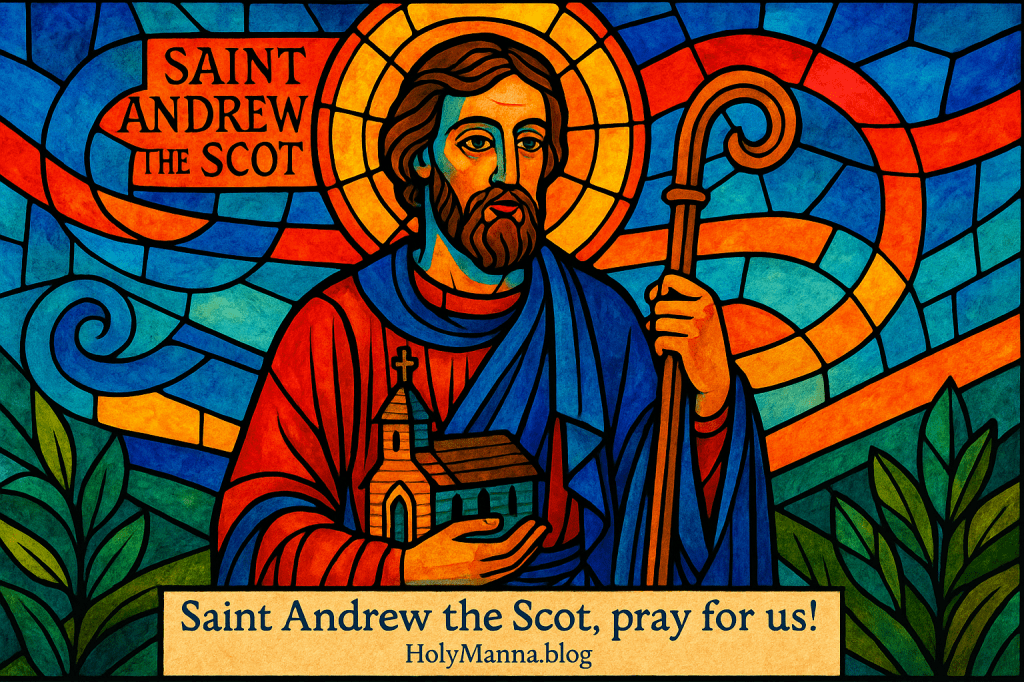
Archdeacon, Builder, and Abbot
Famed in Tuscany yet born in Ireland, Saint Andrew “the Scot” was a faithful servant of God whose life bridged the monastic fervor of Ireland with the pastoral needs of Italy. Though known locally in Florence and Fiesole, his witness speaks to the universal Church: a man who left his homeland to follow God’s call, who supported his bishop in every work, who restored a ruined church and made it a place of prayer, and who gave himself entirely to the poor. His feast on August 22 is an invitation to remember that the work of sanctity often happens in quiet fidelity, year after year.
From Ireland to Fiesole
Andrew was born in Ireland in the early ninth century to a noble family whose Christian faith had already taken deep root. In his youth, he came under the guidance of the learned monk Donatus, a fellow Irishman known for his holiness and scholarship. Their relationship was not merely teacher and pupil, but a spiritual companionship rooted in the pursuit of God. Around the year 816, Andrew joined Donatus on a pilgrimage to the Eternal City, a journey that was as much about spiritual transformation as physical travel. Passing through Tuscany, they arrived in Fiesole just as the people were seeking a new bishop. According to tradition, a divine sign indicated Donatus as God’s choice, and the people acclaimed him as their shepherd. Donatus, recognizing Andrew’s virtues, appointed him archdeacon of the cathedral—entrusting him with pastoral care, the administration of Church affairs, and the spiritual formation of the faithful. From that day forward, Andrew’s life would be intertwined with the Church of Fiesole.
Stones Raised in Faith
Andrew’s love for the Church was made visible in stone and mortar. With Donatus’s blessing, he undertook the restoration of the crumbling country church of San Martino a Mensola, a site that had suffered neglect and, according to local tradition, damage from Hungarian raids. Andrew poured his energy into the project, not merely rebuilding walls but reviving the faith of the local people. Beside the church, he founded a small monastery, gathering a community of monks committed to prayer, manual labor, and service. His life as abbot was marked by humility and generosity; he used the monastery’s resources to aid the poor, feed the hungry, and shelter travelers. Those who came to him in need found not only material help but spiritual comfort. Stories from his lifetime tell of miraculous healings, deliverance from demonic oppression, and restored sight to the blind—all signs of God’s mercy working through his hands. Yet Andrew himself sought no glory, directing all praise to Christ.
Perseverance in a Chaotic Age
While Andrew’s path did not lead to martyrdom, it required the courage of perseverance. The ninth century was a time of instability in Italy, marked by political unrest, invasions, and the decline of rural life. Many churches fell into ruin, clergy were scarce, and the faith of the people was often fragile. Andrew’s long service—forty-seven years as archdeacon under Bishop Donatus—was a quiet resistance to this decay. He stood firm in his duties, ensuring the sacraments were celebrated, the poor were tended, and the monasteries remained places of prayer. His trials were not the sudden tests of persecution but the steady challenge of remaining faithful in small things, day after day, without applause or worldly recognition. In this, he bore witness to the truth that holiness often grows in the soil of patient endurance.
Grace Beyond the Grave
As Andrew approached the end of his earthly life, he was granted a tender consolation. His sister, Saint Brigid the Younger, who had remained in Ireland, was miraculously brought to his side in Fiesole to comfort him in his final hours. This sibling reunion at the threshold of eternity speaks to the mysterious communion of saints even before death. Andrew died around 877 or 880 and was buried at San Martino a Mensola, the church he had lovingly restored. His memory never faded among the local faithful. In 1285, his tomb was rediscovered, sparking renewed devotion. A century later, in 1389, a magnificent gilded reliquary-urn was commissioned to hold his remains, adorned with images from his life so that future generations could contemplate his example. To this day, pilgrims visit San Martino to honor him, seek his intercession, and draw inspiration from his steadfast love for God and neighbor.
Walking with Saint Andrew Today
The life of Saint Andrew the Scot is a living parable of the Church’s teaching on the communion of saints and the call to use our gifts for the good of all. The Catechism reminds us that the saints, having gone before us, continue to share in our journey: “The witnesses who have preceded us into the kingdom… share in the living tradition of prayer by the example of their lives… and their prayer today.” (CCC 2683). Andrew’s “charisms”—his gifts of healing, building, teaching, and organizing—were, as The Catechism says, “intended for the common good” (CCC 2003). His work was not for personal honor but for the strengthening of the Body of Christ. As we reflect on his life, we see that rebuilding a ruined church or feeding the hungry are not tasks of the past; they remain vital works today. Each of us is called to be a restorer—in our parishes, families, and communities—through acts of compassion, steadfast service, and unwavering faith.
Engage with Us!
Friend, share your thoughts below—how does Saint Andrew’s steady love for the Church and the poor speak to you today?
Where is God asking you to “rebuild” something—your parish life, a family relationship, or your personal prayer?
How might you practice Andrew’s quiet charity this week—one concrete act for someone in need?
What ruins—spiritual or practical—need your patient, prayerful attention right now?
Let’s pray for one another and strive to do everything with love, as Our Lord Jesus did.
Saint Andrew the Scot, pray for us! ✨
Follow us on Instagram and Facebook for more insights and reflections on living a faith-filled life.

 Holy Manna!
Leave a comment