Memorial of the Queenship of the Blessed Virgin Mary – Lectionary: 423
Crowned Through Love
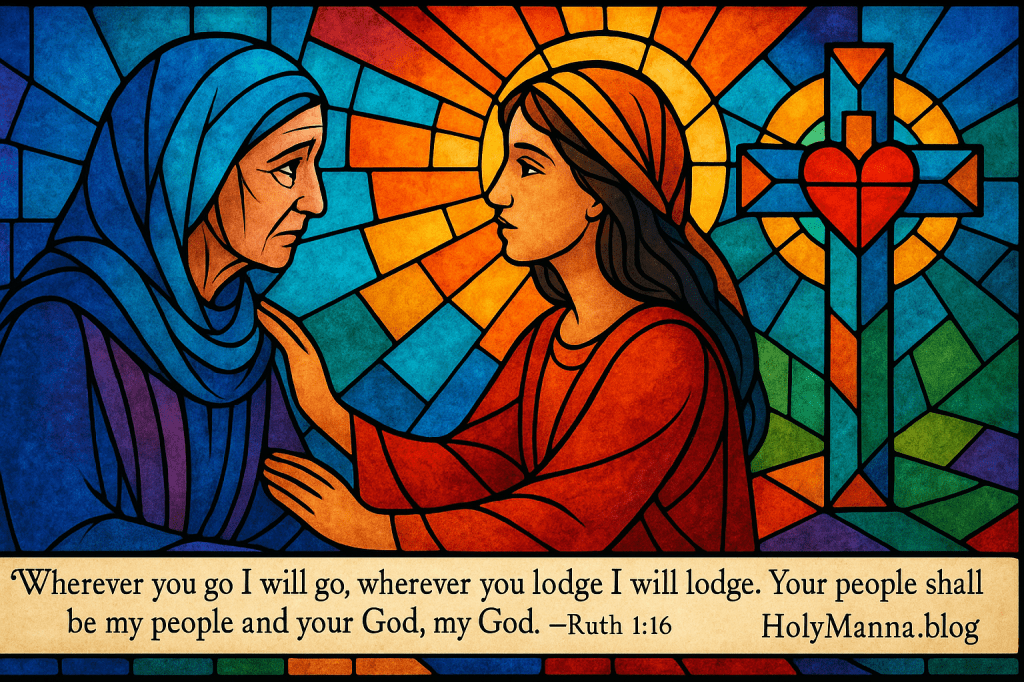
There is a kind of love that changes the course of history; a love that clings, commits, and crowns. Today’s readings draw us into that very love, one that binds us first to God and then to one another, revealing the path to true greatness in His Kingdom. In Ruth 1, we witness the radical loyalty of a Moabite widow who, in the face of loss and uncertainty, refuses to abandon her mother-in-law. Ruth’s words, “Wherever you go I will go… Your people shall be my people, and your God, my God,” are more than a pledge of companionship; they are a covenantal embrace of Israel’s God and His people. Her fidelity echoes the faithfulness of God Himself, celebrated in Psalm 146, where the Lord is praised as the One who “keeps faith forever” and “raises up the lowly”. This is not mere sentiment but the active, saving love that defines the God of Israel. In The Gospel of Matthew (22:34-40), Jesus crystallizes the whole law into two inseparable commands: “You shall love the Lord, your God, with all your heart… and you shall love your neighbor as yourself”. These are not just the greatest commandments; they are the very heartbeat of covenant life. Today, as we honor the Queenship of the Blessed Virgin Mary, we see in her the perfect fulfillment of this love. Her “yes” to God was total, her service to others complete. Crowned in heaven, Mary reigns not through domination but through humble, maternal intercession—a queenship born from perfect obedience and unwavering charity. Will we allow this same faithful love to rule our hearts so that we, too, may share in the joy of our heavenly King?
First Reading – Ruth 1:1, 3-6, 14-16, 22
Faithful Love That Crosses Borders
The opening chapter of Ruth unfolds during the period of the Judges, a time when Israel lacked centralized leadership and frequently fell into cycles of sin, oppression, repentance, and deliverance. Famines were common, and in this case, a Jewish family from Bethlehem—ironically meaning “House of Bread”—is forced to leave for Moab, a foreign land often viewed with suspicion by Israel due to its idolatry and troubled history with God’s people (cf. Deuteronomy 23:3). Yet from this unlikely setting emerges a story of extraordinary covenantal love. Ruth, a Moabite widow, chooses to remain with her Israelite mother-in-law Naomi, embracing not only Naomi’s people but also her God. In doing so, Ruth becomes a living parable of today’s theme: love that binds us to God and one another, paving the way for God’s greater plan. Her loyalty prefigures the universality of God’s Kingdom, where faith and love transcend bloodlines and borders—a truth perfectly embodied in the Blessed Virgin Mary, whose queenship is rooted in total fidelity to God’s will.
Ruth 1:1, 3-6, 14-16, 22
New American Bible (Revised Edition)
Naomi in Moab. 1 Once back in the time of the judges there was a famine in the land; so a man from Bethlehem of Judah left home with his wife and two sons to reside on the plateau of Moab.
3 Elimelech, the husband of Naomi, died, and she was left with her two sons. 4 They married Moabite women, one named Orpah, the other Ruth. When they had lived there about ten years, 5 both Mahlon and Chilion died also, and the woman was left with neither her two boys nor her husband.
6 She and her daughters-in-law then prepared to go back from the plateau of Moab because word had reached her there that the Lord had seen to his people’s needs and given them food.
14 Again they wept aloud; then Orpah kissed her mother-in-law good-bye, but Ruth clung to her.
15 “See now,” she said, “your sister-in-law has gone back to her people and her god. Go back after your sister-in-law!” 16 But Ruth said, “Do not press me to go back and abandon you!
Wherever you go I will go,
wherever you lodge I will lodge.
Your people shall be my people
and your God, my God.
22 Thus it was that Naomi came back with her Moabite daughter-in-law Ruth, who accompanied her back from the plateau of Moab. They arrived in Bethlehem at the beginning of the barley harvest.
Detailed Exegesis
Verse 1 – “Once back in the time of the judges there was a famine in the land; so a man from Bethlehem of Judah left home with his wife and two sons to reside on the plateau of Moab.”
This verse sets the stage with historical context. The “time of the judges” was spiritually turbulent for Israel, yet here we see God already working through ordinary circumstances like famine and migration. The move to Moab foreshadows how God can work through the unexpected and the foreign to accomplish His plan.
Verse 3 – “Elimelech, the husband of Naomi, died, and she was left with her two sons.”
Naomi’s loss begins here, foreshadowing deeper trials. In biblical times, widows were among the most vulnerable, and this marks the start of Naomi’s descent into poverty and uncertainty.
Verse 4 – “They married Moabite women, one named Orpah, the other Ruth. When they had lived there about ten years…”
Marrying Moabite women was culturally unconventional for Israelites due to religious differences, yet this union is crucial for salvation history—Ruth will become an ancestor of King David, and ultimately of Christ Himself (cf. Matthew 1:5).
Verse 5 – “Both Mahlon and Chilion died also, and the woman was left with neither her two boys nor her husband.”
Naomi’s life is stripped of all earthly security. The triple loss is a narrative descent into complete dependence on God, mirroring the kind of spiritual poverty that opens hearts to His providence.
Verse 6 – “She and her daughters-in-law then prepared to go back from the plateau of Moab because word had reached her there that the Lord had seen to his people’s needs and given them food.”
News of God’s provision in Bethlehem signals a turning point—both physical and spiritual. God’s mercy calls Naomi home, and Ruth’s story of faith will take root in this return journey.
Verse 14 – “Again they wept aloud; then Orpah kissed her mother-in-law good-bye, but Ruth clung to her.”
The word “clung” suggests covenantal commitment, the same verb used to describe a man clinging to his wife in Genesis 2:24. Ruth’s loyalty is more than emotional—it is a binding decision of faith and solidarity.
Verse 15 – “See now,” she said, “your sister-in-law has gone back to her people and her god. Go back after your sister-in-law!”
Naomi gives Ruth an out, recognizing the difficulty of her choice. This moment underlines that true love for God must be freely chosen, not coerced.
Verse 16 – “But Ruth said, ‘Do not press me to go back and abandon you! Wherever you go I will go, wherever you lodge I will lodge. Your people shall be my people and your God, my God.’”
This declaration is one of the most profound statements of love and conversion in Scripture. Ruth binds herself to Naomi’s fate and, more importantly, to the God of Israel. This marks her full embrace of the covenant faith.
Verse 22 – “Thus it was that Naomi came back with her Moabite daughter-in-law Ruth, who accompanied her back from the plateau of Moab. They arrived in Bethlehem at the beginning of the barley harvest.”
The mention of the barley harvest hints at hope and renewal. God’s timing is perfect—this season will become the setting for Ruth’s meeting with Boaz, a union that will continue the messianic line.
Teachings
The Catechism teaches that God’s plan of salvation is universal, extending beyond Israel to include all nations: “The plan of salvation also includes those who acknowledge the Creator” (CCC 839). Ruth’s conversion shows this reality in miniature—her faith and loyalty bring her into God’s covenant people. Saint Ambrose saw in Ruth a figure of the Church, gathered from all nations: “Ruth the Moabite, a stranger, is joined to the people of Israel and becomes a mother in Israel. So too the Church, gathered from the nations, is made fruitful by the union with Christ.” Her decision mirrors Mary’s own “yes”, where love for God outweighed every fear, leading to her exaltation as Queen of Heaven.
Reflection
Ruth’s journey challenges us to ask: Am I willing to leave behind comfort, familiarity, and even cultural identity to follow where God leads? Her faith was not theoretical—it was lived in costly, daily fidelity. We are called to this same love that goes beyond convenience and preference, the love that Jesus commands in Matthew 22. Like Ruth, we may be invited into situations where loyalty to God and others requires sacrifice. Yet it is precisely in that self-giving love that we find the crown prepared for us in heaven, just as Mary’s crown was won through her perfect “yes”. Will you choose today to cling to God with Ruth’s steadfastness and Mary’s trust, allowing His love to lead you into His Kingdom?
Responsorial Psalm – Psalm 146:5-10
The King Who Reigns Through Mercy
Psalm 146 is a hymn of praise that exalts God as the unfailing protector of the poor, the oppressed, and the vulnerable. Composed in the post-exilic period when Israel had returned from Babylonian captivity, it contrasts the limitations of earthly rulers with the limitless justice and mercy of the Lord. For the Jewish people, who had experienced the fragility of political power, this psalm was both a comfort and a reminder: true hope rests in God alone. Today, this psalm fits perfectly with the theme of faithful love that binds us to God and one another. It is the same steadfast love Ruth demonstrated in clinging to Naomi, the same love Jesus commands in Matthew 22, and the same love that crowns the Blessed Virgin Mary as Queen—her reign marked not by power for its own sake, but by tender care for her children.
Psalm 146:5-10
New American Bible (Revised Edition)
5 Blessed the one whose help is the God of Jacob,
whose hope is in the Lord, his God,
6 The maker of heaven and earth,
the seas and all that is in them,
Who keeps faith forever,
7 secures justice for the oppressed,
who gives bread to the hungry.
The Lord sets prisoners free;
8 the Lord gives sight to the blind.
The Lord raises up those who are bowed down;
the Lord loves the righteous.
9 The Lord protects the resident alien,
comes to the aid of the orphan and the widow,
but thwarts the way of the wicked.
10 The Lord shall reign forever,
your God, Zion, through all generations!
Hallelujah!
Detailed Exegesis
Verse 5 – “Blessed the one whose help is the God of Jacob, whose hope is in the Lord, his God”
The psalmist begins with a beatitude, declaring true happiness comes not from wealth, status, or human alliances, but from trusting in the God of Jacob. This echoes Ruth’s decision to place her hope in Israel’s God rather than return to Moab’s gods.
Verse 6 – “The maker of heaven and earth, the seas and all that is in them, who keeps faith forever”
God’s power as Creator affirms His sovereignty, but the greater emphasis is on His fidelity—He “keeps faith forever”. The same God who called Israel keeps His promises to the smallest and most vulnerable, a truth Mary proclaimed in the Magnificat (Luke 1:54-55).
Verse 7 – “Secures justice for the oppressed, who gives bread to the hungry. The Lord sets prisoners free”
This verse reveals God’s active justice: He not only sees but intervenes to restore dignity. The imagery of bread recalls both God’s provision of manna and Jesus’ feeding of the multitudes, pointing to the Eucharist where the Bread of Life feeds His people.
Verse 8 – “The Lord gives sight to the blind. The Lord raises up those who are bowed down; the Lord loves the righteous”
Physical healing and spiritual renewal are both in view here. The lifting of the bowed down mirrors Ruth’s journey from widowhood in a foreign land to honored ancestor of the Messiah, and Mary’s own exaltation from humble handmaid to Queen of Heaven.
Verse 9 – “The Lord protects the resident alien, comes to the aid of the orphan and the widow, but thwarts the way of the wicked”
This verse is a direct connection to Ruth’s story: she was both a foreigner and a widow, yet God protected and blessed her. God’s justice is not abstract; it is deeply personal, especially for the marginalized.
Verse 10 – “The Lord shall reign forever, your God, Zion, through all generations! Hallelujah!”
The psalm ends with an eternal perspective: God’s reign is unshakable and everlasting. For Christians, this reign is made visible in Christ the King and honored in Mary’s Queenship, as her maternal rule reflects His eternal kingship.
Teachings
The Catechism reminds us that God’s kingdom is marked by justice and mercy: “The Kingdom of God… is righteousness and peace and joy in the Holy Spirit” (CCC 2819, quoting Romans 14:17). Saint Augustine saw in this psalm the portrait of Christ’s reign, writing: “He who made heaven and earth is the same who made Himself the servant of man, that man might not be a slave forever.” Mary, as Queen, shares in this work of justice and mercy through her intercession, just as the Church continues Christ’s mission of lifting up the lowly and protecting the vulnerable.
Reflection
This psalm challenges us to anchor our trust in God’s reign rather than in fleeting human powers. Do I truly believe that my security and dignity come from the Lord, or do I still rely on worldly measures of stability? Like Ruth, we are called to entrust our future to God’s providence, even when the path is uncertain. We are also invited to imitate Mary by caring for those the psalm highlights—the poor, the stranger, the oppressed. In doing so, we participate in the justice and mercy of God’s eternal kingdom. Will you choose today to live as a citizen of this kingdom, letting your love for God overflow in concrete acts of compassion toward your neighbor?
Holy Gospel – Matthew 22:34-40
The Heart of the Law
In this passage from The Gospel of Matthew, Jesus is approached by a scholar of the Law—a Pharisee—seeking to test Him with a question about the greatest commandment. This was not merely a theological curiosity; Jewish rabbis often debated which commandments in the Torah were weightier than others. The Law contained 613 precepts, and disputes arose over whether there was a unifying principle behind them. By the time of Jesus, the Pharisees and Sadducees were engaged in ongoing disputes over the interpretation of the Law. In His response, Jesus cuts through legal complexity, pointing to love as the foundation upon which all the Law and the Prophets rest. This ties seamlessly to today’s theme: love that binds us to God and to one another, just as Ruth clung to Naomi and Mary gave her complete “yes” to God.
Matthew 22:34-40
New American Bible (Revised Edition)
34 When the Pharisees heard that he had silenced the Sadducees, they gathered together, 35 and one of them [a scholar of the law] tested him by asking, 36 “Teacher, which commandment in the law is the greatest?” 37 He said to him, “You shall love the Lord, your God, with all your heart, with all your soul, and with all your mind. 38 This is the greatest and the first commandment. 39 The second is like it: You shall love your neighbor as yourself. 40 The whole law and the prophets depend on these two commandments.”
Detailed Exegesis
Verse 34 – “When the Pharisees heard that he had silenced the Sadducees, they gathered together”
This verse sets the context: Jesus has just refuted the Sadducees in a debate about the resurrection. The Pharisees, sensing an opportunity, regroup to challenge Him next.
Verse 35 – “And one of them, a scholar of the law, tested him by asking”
The “scholar of the law” was an expert in the Torah and rabbinical tradition. His question was framed as a test, implying a trap. The intention may have been to force Jesus into a theological stance that could alienate some followers.
Verse 36 – “Teacher, which commandment in the law is the greatest?”
This question seeks to distill the entire Law into a single priority. It was a common rabbinic exercise but here is charged with a confrontational undertone.
Verse 37 – “He said to him, ‘You shall love the Lord, your God, with all your heart, with all your soul, and with all your mind.’”
Jesus quotes Deuteronomy 6:5, part of the Shema—a daily Jewish prayer affirming exclusive devotion to God. The threefold “heart, soul, mind” underscores the totality of love: emotional, spiritual, and intellectual.
Verse 38 – “This is the greatest and the first commandment.”
By calling it “first”, Jesus affirms that love for God is the root of all righteousness. Without it, religious observance becomes hollow.
Verse 39 – “The second is like it: You shall love your neighbor as yourself.”
Quoting Leviticus 19:18, Jesus links love of neighbor inseparably with love of God. The phrase “like it” shows that both commands are of equal weight; one cannot truly exist without the other.
Verse 40 – “The whole law and the prophets depend on these two commandments.”
Jesus declares that all Scripture—“Law and Prophets” being shorthand for the entire Old Testament—hangs upon these two commandments. This is a radical unification of divine law under the primacy of love.
Teachings
The Catechism affirms this unity: “The entire Law of the Gospel is contained in the ‘new commandment’ of Jesus, to love one another as he has loved us” (CCC 1970, cf. John 13:34). Saint Augustine famously wrote: “Love, and do what you will… Let the root of love be within, of this root can nothing spring but what is good.” The teaching is clear—true holiness flows from love, not mere legal observance. Mary’s Queenship reflects this perfectly: her greatness lies not in earthly authority but in her complete love for God and her maternal love for all humanity.
Reflection
This Gospel challenges us to examine our own priorities: Do I treat love as the foundation of my faith, or do I sometimes reduce religion to rules and routines? Loving God with all our heart, soul, and mind means giving Him the first place in our decisions, desires, and daily life. Loving our neighbor as ourselves calls us to see every person as worthy of compassion and respect, even those who are difficult to love. Ruth’s choice to stay with Naomi, and Mary’s fiat, both show that this love is not theoretical—it requires sacrifice, risk, and trust. Will you live today in such a way that your love for God overflows naturally into love for those around you, allowing the two great commandments to become the crown of your life?
Clinging to Love, Crowned in Glory
Today’s readings weave together a single golden thread: the call to a love that binds us completely to God and overflows to others. In Ruth 1, we see steadfast loyalty in action—Ruth’s refusal to leave Naomi reveals a heart that has chosen God’s people and God Himself, even at great personal cost. In Psalm 146, we are reminded that the Lord’s reign is defined by mercy, justice, and care for the most vulnerable—a reign in which the lowly are lifted high. In Matthew 22, Jesus distills all the Law and the Prophets into two commandments: “You shall love the Lord, your God, with all your heart… and you shall love your neighbor as yourself.” These are not two separate duties but one inseparable reality: our love for God is shown in our love for others. The Memorial of the Queenship of the Blessed Virgin Mary draws this message into perfection, for Mary’s crown was not won by earthly conquest but by her humble and total “yes” to God, lived out in constant charity toward others. Her queenship reminds us that the highest honor in God’s Kingdom is given to those who love most completely. Will you allow this faithful love to take root so deeply in your heart that, like Ruth, like Mary, you will follow God wherever He leads, knowing He has prepared for you a share in His eternal glory?
Engage with Us!
We’d love to hear how God’s Word is speaking to your heart today. Share your thoughts, prayers, and insights in the comments below—your reflection may inspire someone else on their journey of faith.
Reflection Questions:
First Reading – Ruth 1:1, 3-6, 14-16, 22: When have you, like Ruth, chosen to follow God into the unknown? What did it teach you about trust and loyalty?
Responsorial Psalm – Psalm 146:5-10: Which of the Lord’s promises in this psalm brings you the most comfort today, and how can you share that comfort with others?
Holy Gospel – Matthew 22:34-40: What is one concrete way you can love God more fully this week? How will that love naturally extend to your neighbor?
Let us go forth today committed to live a life of faith, doing everything with the love and mercy Jesus taught us, so that in every action, word, and thought, we may reflect His Kingdom here on earth.
Follow us on Instagram and Facebook for more insights and reflections on living a faith-filled life.

 Holy Manna!
Leave a comment