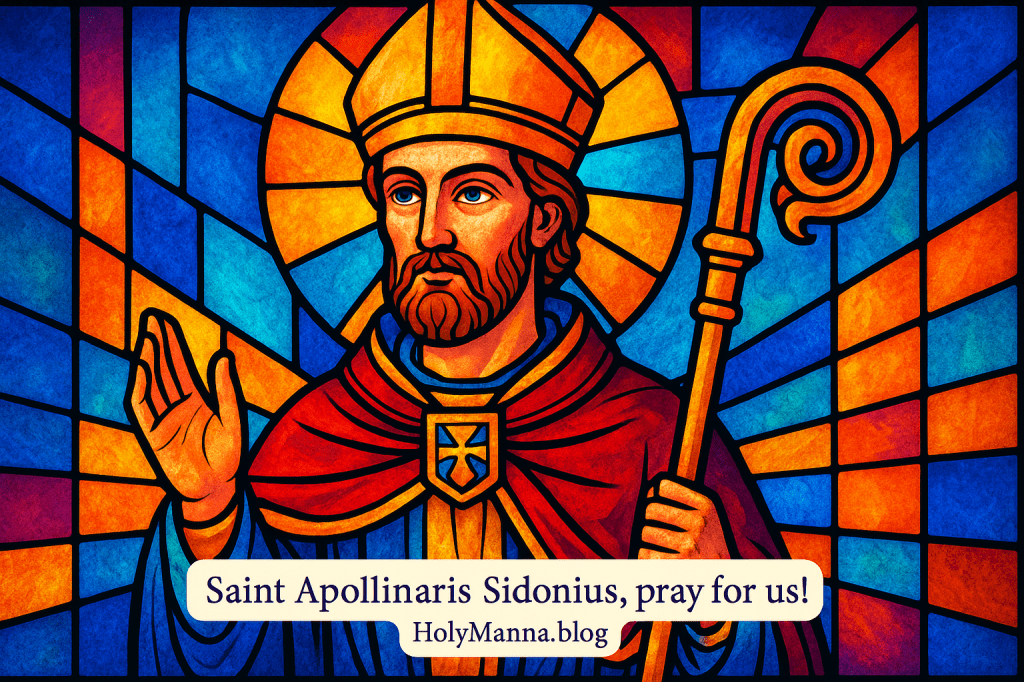
A Poet-Bishop in the Twilight of Rome
Saint Apollinaris Sidonius (c. 430–late 480s) lived during one of the most turbulent eras in Western history, when the Western Roman Empire was disintegrating and the Christian faith faced both external threats and internal challenges. Born into a high-ranking Gallo-Roman family, Sidonius was a man of letters, politics, and eventually deep pastoral care. His legacy shines not only through his ecclesial leadership but also through his writings—panegyrics, letters, and poems that give us invaluable insight into the life of the Church in the fifth century. His ability to navigate both imperial courts and the pastoral needs of a besieged city made him a bridge between the fading Roman order and the emerging Christian West. The Church honors him as a confessor—one who suffered for the faith without martyrdom—whose courage, humility, and steadfastness remain timeless examples of fidelity.
From Noble Roots to the Shepherd’s Staff
Sidonius was born in Lugdunum (modern Lyon), a city known for its deep Christian roots since the days of Saints Irenaeus and Blandina. His family was not only wealthy but deeply entrenched in public service and the Catholic faith. His marriage to Papianilla, daughter of the Emperor Avitus, placed him at the very center of political life in Rome. Sidonius first gained prominence as a master orator, composing elaborate panegyrics for emperors Avitus, Majorian, and Anthemius. These works secured him not only fame but also the high honor of serving as Urban Prefect of Rome in 468—a role that required him to balance civic administration, diplomacy, and public order.
Although Sidonius was already a Christian, it was his unexpected appointment as Bishop of Clermont around 469–471 that transformed his life’s mission. Moving from the glitter of imperial halls to the humble service of a war-threatened flock, Sidonius embraced the episcopate as a divine calling. He would spend the rest of his life defending the Catholic faith, guiding the faithful through political upheaval, and living the Gospel with remarkable constancy.
Guardian of Souls and Penman of Gaul
As bishop, Sidonius proved to be both a spiritual leader and a cultural guardian. His letters and poems—the Epistulae and Carmina—offer not only elegant Latin prose but also a record of a shepherd’s heart in action. These works reveal a man committed to fostering unity in the Church, encouraging monastic life, and strengthening his clergy during times of uncertainty. His love for the poor was tangible. During a severe famine, Sidonius personally fed thousands of refugees, using his resources to keep them alive. His contemporaries praised his humility, noting that he never considered himself above even the most lowly of his flock.
While no spectacular miracles are attributed to him during life in the manner of dramatic healings or visions, his ministry was a living miracle of perseverance. Sidonius embodied the truth that holiness is often found in tireless daily service, in choosing to love and lead even when the cost is high. His literary works, particularly his letters, became a form of pastoral care for far-off communities, uniting the faithful through words of encouragement and exhortation.
Siege, Exile, and Unshakable Faith
Sidonius’ episcopate coincided with one of the gravest threats to his city: the expansion of the Visigothic Kingdom under the Arian King Euric. In 473, Sidonius and his brother-in-law, the noble Ecdicius, organized the defense of Clermont. For months, they resisted siege through both military strategy and spiritual encouragement. Yet in 475, Clermont fell. Sidonius was taken prisoner and exiled to Liviana, near Carcassonne. His imprisonment did not break his spirit—rather, it deepened his faith and commitment to his people.
Eventually allowed to return to Clermont, he resumed his pastoral duties without seeking revenge, ministering even to those who had opposed him. His endurance under political pressure, his refusal to abandon his people, and his capacity for forgiveness reveal a shepherd who understood Christ’s call to love one’s enemies. He died in the late 480s, leaving behind not only a strengthened local Church but also a treasury of writings that preserved the Catholic faith in a volatile age.
A Legacy That Still Nourishes
Shortly after his death, the people of Clermont began to venerate Sidonius as a saint, honoring his feast day with solemnity. His relics were eventually moved from the church of St. Saturninus to that of St. Genesius, and his memory remained intertwined with the history of Auvergne. Pilgrims came to honor him not for dramatic posthumous miracles but for the enduring miracle of his witness—a man who bridged two worlds, preserving both the treasures of Roman Christian culture and the integrity of the Catholic faith amid barbarian invasions. His literary and pastoral legacy has continued to inspire generations, offering a model of leadership rooted in service, charity, and faith under pressure.
Lessons from a Saint at the Edge of an Era
Saint Apollinaris Sidonius reminds us that holiness is not only forged in martyrdom but also in the quiet, steady endurance of trials. His life mirrors the teaching of the Catechism of the Catholic Church that the saints “do not cease to intercede with the Father for us” and “propose… models and intercessors” (CCC 828, 956). He lived what the Church calls the communion of saints—a living exchange of prayer, example, and perseverance in love. His example teaches us that faithfulness in small, daily duties is as heroic in God’s eyes as great public acts of sacrifice.
Sidonius also models how to engage culture without losing one’s faith. His intellectual and literary gifts served the Gospel rather than mere ambition. His courage in the face of siege, famine, and exile shows us that Christian leadership requires both prudence and the willingness to suffer for the flock. For anyone today facing uncertainty—whether in family, work, or faith—Sidonius offers the reassuring truth that grace can sustain us through every storm.
Engage with Us!
I’d love to hear how Saint Apollinaris Sidonius speaks to your journey—share below so we can pray with you and for you.
- Where is your faith being “besieged,” and how might God be asking you to persevere with charity as Sidonius did?
- How can you let the poor and displaced take priority in your week—through concrete almsgiving, time, or advocacy?
- What one practice (praying with a saint’s letter, fasting, daily intercessions) will you adopt to deepen your life of prayer this month?
Let’s keep encouraging each other and strive to do everything with love—as our Lord Jesus did.
Saint Apollinaris Sidonius, pray for us! ✨
Follow us on Instagram and Facebook for more insights and reflections on living a faith-filled life.

 Holy Manna!
Leave a comment