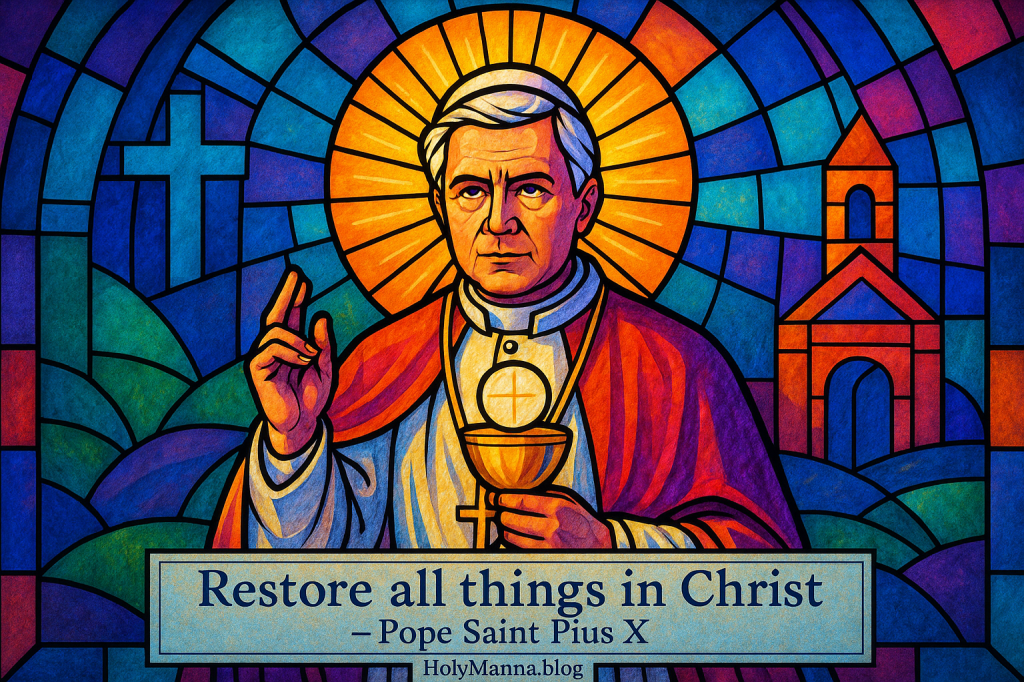
The Shepherd with a Gentle Hand
Giuseppe Melchiorre Sarto, later Pope Saint Pius X, is celebrated in the Church as a holy shepherd whose pastoral zeal brought a deeply personal touch to his mission. As Pope from 1903 to 1914, he devoted himself to renewing the life of the faithful through frequent Communion, liturgical purity, and doctrinal clarity. He had a profound reverence for the Eucharist that shaped his papacy and left a lasting legacy: his motto, “to restore all things in Christ,” expressed a deep conviction that Christ must touch every dimension of Christian life with healing. Church historians tell us he was beloved for both his humility and firmness, displaying a unique combination of gentle pastoral care and unwavering doctrinal resolve.
Roots of Faith in a Simple Village
Born June 2, 1835, in the little village of Riese in Italy’s Veneto region, Giuseppe was the second of ten children in a modest family. His father was the local postman, and his mother worked as a seamstress. Although not born into wealth, his parents instilled solid Christian values—earning one story of how, as a boy, he gave away part of his lunch to a poor child, already showing sacrificial love. While still a teen he felt a calling to the priesthood and entered the seminary in Padua. His early years, first as a teacher and then as a parish priest, deeply shaped him. He cared for the sick non-stop during a cholera outbreak in 1866, administering Blessed Sacrament even when parishioners panicked. This selfless devotion to Christ in the suffering foreshadowed his entire life and ministry.
A Pope Who Poured Out the Eucharist
As Pope, Pius X revolutionized the spiritual rhythm of Catholic life. Recognizing how the faithful thirsted for God’s nearness, he encouraged daily Communion and lowered the first Communion age to around seven years, when children begin to reason. He trusted in the Eucharist’s power to form holy hearts. He promoted beautiful liturgical worship through Tra le Sollecitudini, teaching that sacred music should lift hearts and minds to God, not entertain. He advanced catechesis in Acerbo Nimis, urging priests to teach with care and clarity so people could embrace and live the faith. His establishment of the Pontifical Biblical Institute in 1909 helped anchor sacred studies in rigorous scholarship. He also laid the groundwork for modern canon law through the codification efforts that culminated in the 1917 Code of Canon Law.
Miracles Wrought in Souls and Structures
Though Pope Pius X is not primarily associated with dramatic miracles during his life, the signs of God’s work through him were seen in the spiritual renewal and structures he left behind. The renewal of parish life through frequent Communion and catechetical clarity brought countless conversions, healing, and growth. His liturgical reforms—especially emphasizing Gregorian chant and liturgical norms—contributed to a return to reverence and holiness in worship across parishes. The institutions he founded and laws he shaped became vessels through which grace flowed for generations.
Trials That Tempered the Faithful
Pius X endured not with violence, but with courage under pressure. He abolished the ancient jus exclusivae, defending the independence of papal elections, and resisted outside interference in Church governance. He faced the French law separating Church and State in 1905, navigating grave tensions with prudence. He tackled the growing tide of Modernism with firm moral clarity, issuing Lamentabili Sine Cura and Pascendi Dominici Gregis, and requiring clergy to take an oath rejecting Modernist errors. Illness also afflicted him in his last years; yet he continued his work, traveling, guiding, and encouraging until his passing on August 20, 1914. Though not a martyr by blood, he embraced suffering with serenity, offering himself for the flock during the tumult of war’s outbreak.
Miraculous Echoes from Eternity
After his death, Pius X was invoked in healing prayers and novenas by countless pilgrims. A celebrated cure occurred when attorney Francesco Belsami recovered instantly from a grave pulmonary abscess after his intercession. Another case involved Sister Maria Ludovica Scorcia, who experienced a miraculous healing following a novena and prayers to him. These and other reports supported his beatification in 1951 and canonization by Pope Pius XII on May 29, 1954. His mortal remains lie in a glass coffin in St. Peter’s Basilica, where pilgrims continue to linger in prayer, seeking his intercession.
Eucharist, Reform, and the Gentle Strength of Holiness
Saint Pius X invites us to root our lives in the sacramental mystery. The Catechism reminds us that the Eucharist is “the source and summit of the Christian life,” and that “Holy Communion augments our union with Christ.” Pius X discovered and blessed the simple truth that when Christ is central, Christian life flourishes. Let our lives reflect that Eucharistic vision, investing in Mass, Confession, catechesis, and holy habits, allowing grace to reform us. As he did, let our hearts brim with compassion, our words with clarity, and our worship with reverence. As we rest in Christ, we too can become instruments of restoration.
Engage with Us!
I’d love to hear how Saint Pius X speaks to you—share your thoughts and testimonies in the comments so we can pray with you and for you.
- Which one practice could help you “restore all things in Christ” this week—daily Mass, a weekday visit to the Blessed Sacrament, or renewed catechesis at home?
- How does “Holy Communion augments our union with Christ” challenge the way you prepare for and give thanks after receiving?
- Where do you need courage to defend the faith with charity, as Pius X did amid cultural pressure?
Let’s support one another on the way of holiness and strive to do everything with love, as our Lord Jesus did.
Pope Saint Pius X, pray for us! ✨
Follow us on Instagram and Facebook for more insights and reflections on living a faith-filled life.

 Holy Manna!
Leave a comment