Memorial of Saint Pius X, Pope – Lectionary: 422
A Heart Prepared for God
There is a deep difference between doing something for God and being ready for God. Today’s readings challenge us to see that the Lord does not delight in mere outward actions, vows, or rituals, but in a heart and life aligned with His will. In Judges 11, Jephthah is moved by zeal but bound by a rash promise, revealing the danger of acting without discernment. The tragedy that follows is a sobering reminder that our offerings to God must be guided by wisdom and love, not impulse. Psalm 40 echoes this truth, proclaiming, “Sacrifice and offering you do not want; you opened my ears… I delight to do your will, my God; your law is in my inner being!” In The Gospel of Matthew, Jesus paints the Kingdom of Heaven as a wedding feast—lavish, ready, and open to all—but entry demands not just accepting the invitation, but being “clothed” in righteousness, truly prepared to honor the King.
On this Memorial of Pope Saint Pius X, the Church remembers a shepherd whose life’s motto, Instaurare omnia in Christo (“To restore all things in Christ”), sought to draw the faithful beyond external observance into genuine communion with God. His reforms—especially encouraging frequent Communion and lowering the age for First Holy Communion—were meant to prepare hearts to encounter Christ in the Eucharist worthily and joyfully. Today’s readings and this saint’s legacy together remind us that God’s call is both generous and demanding: Are we ready to meet Him with hearts clothed in humility, purity, and love?
First Reading – Judges 11:29-39
Zeal Without Discernment
The story of Jephthah unfolds during the turbulent period of the Judges, a time when Israel was caught in a constant cycle of disobedience, oppression, repentance, and deliverance. Jephthah himself was an unlikely leader—a warrior and the son of a prostitute, rejected by his people but later called upon to lead them against the Ammonites. This narrative captures both the triumph of God’s deliverance and the tragedy of human rashness. In the Ancient Near Eastern context, vows were a common way to bind oneself to divine favor, but Israel’s covenant law had already taught that God desired faithfulness over human bargaining. This reading ties into today’s theme by reminding us that zeal for God must be rooted in wisdom and obedience, not in impulsive or misdirected devotion. Jephthah’s story stands as a cautionary tale: victory in God’s name means little if we lose sight of His will.
Judges 11:29-39
New American Bible (Revised Edition)
Jephthah’s Vow. 29 The spirit of the Lord came upon Jephthah. He passed through Gilead and Manasseh, and through Mizpah of Gilead as well, and from Mizpah of Gilead he crossed over against the Ammonites. 30 Jephthah made a vow to the Lord. “If you deliver the Ammonites into my power,” he said, 31 “whoever comes out of the doors of my house to meet me when I return from the Ammonites in peace shall belong to the Lord. I shall offer him up as a burnt offering.”
32 Jephthah then crossed over against the Ammonites to fight against them, and the Lord delivered them into his power. 33 He inflicted a very severe defeat on them from Aroer to the approach of Minnith—twenty cities in all—and as far as Abel-keramin. So the Ammonites were brought into subjection by the Israelites. 34 When Jephthah returned to his house in Mizpah, it was his daughter who came out to meet him, with tambourine-playing and dancing. She was his only child: he had neither son nor daughter besides her. 35 When he saw her, he tore his garments and said, “Ah, my daughter! You have struck me down and brought calamity upon me. For I have made a vow to the Lord and I cannot take it back.” 36 “Father,” she replied, “you have made a vow to the Lord. Do with me as you have vowed, because the Lord has taken vengeance for you against your enemies the Ammonites.” 37 Then she said to her father, “Let me have this favor. Do nothing for two months, that I and my companions may go wander in the mountains to weep for my virginity.” 38 “Go,” he replied, and sent her away for two months. So she departed with her companions and wept for her virginity in the mountains. 39 At the end of the two months she returned to her father, and he did to her as he had vowed. She had not had relations with any man.
It became a custom in Israel
Detailed Exegesis
Verse 29 – “The spirit of the Lord came upon Jephthah. He passed through Gilead and Manasseh, and through Mizpah of Gilead as well, and from Mizpah of Gilead he crossed over against the Ammonites.”
Here we see God’s empowerment of Jephthah for battle. In the Old Testament, the Spirit of the Lord often came upon leaders for a specific mission. Jephthah’s mission is divinely appointed, which makes his later vow all the more unnecessary—God’s presence was already with him.
Verse 30 – “Jephthah made a vow to the Lord. ‘If you deliver the Ammonites into my power,’ he said…”
Despite the Spirit’s presence, Jephthah adds a conditional bargain with God, revealing a lack of full trust. In Israelite tradition, vows were solemn but not to be made lightly, as taught in Deuteronomy 23:21-23.
Verse 31 – “…whoever comes out of the doors of my house to meet me when I return from the Ammonites in peace shall belong to the Lord. I shall offer him up as a burnt offering.”
The vow is tragically ambiguous. Jephthah does not specify an animal, making it possible—and as it turns out, certain—that a human would be involved. The Torah expressly forbade human sacrifice (Leviticus 18:21), making this a distortion of God’s law, perhaps influenced by surrounding pagan practices.
Verse 32 – “Jephthah then crossed over against the Ammonites to fight against them, and the Lord delivered them into his power.”
God’s victory comes despite Jephthah’s vow, not because of it. This underscores that divine aid does not depend on bargaining, but on God’s sovereign will.
Verse 33 – “He inflicted a very severe defeat on them from Aroer to the approach of Minnith—twenty cities in all—and as far as Abel-keramin. So the Ammonites were brought into subjection by the Israelites.”
The scale of the victory emphasizes God’s power and faithfulness to His people.
Verse 34 – “When Jephthah returned to his house in Mizpah, it was his daughter who came out to meet him, with tambourine-playing and dancing. She was his only child: he had neither son nor daughter besides her.”
The joyful greeting echoes scenes of victory celebrations in Exodus 15 and 1 Samuel 18, but here it turns to sorrow. The note that she is his only child heightens the gravity of the vow’s cost.
Verse 35 – “When he saw her, he tore his garments and said, ‘Ah, my daughter! You have struck me down and brought calamity upon me. For I have made a vow to the Lord and I cannot take it back.’”
Tearing garments symbolizes deep mourning. Jephthah’s claim that he cannot take back the vow reflects a misunderstanding—Levitical law offered ways to redeem rash vows without sin (Leviticus 5:4-6).
Verse 36 – “Father,” she replied, “you have made a vow to the Lord. Do with me as you have vowed, because the Lord has taken vengeance for you against your enemies the Ammonites.”
Her submission is striking, reflecting a faithfulness and acceptance that contrasts with her father’s lack of discernment.
Verse 37 – “Then she said to her father, ‘Let me have this favor. Do nothing for two months, that I and my companions may go wander in the mountains to weep for my virginity.’”
In ancient Israel, childbearing was linked to one’s legacy and participation in God’s covenant blessings. Her virginity means the end of Jephthah’s lineage.
Verse 38 – “‘Go,’ he replied, and sent her away for two months. So she departed with her companions and wept for her virginity in the mountains.”
The communal mourning shows this loss was felt beyond the family—it was a loss to Israel’s future.
Verse 39 – “At the end of the two months she returned to her father, and he did to her as he had vowed. She had not had relations with any man.”
The text concludes starkly, leaving no doubt about the tragic fulfillment of the vow. It became a custom in Israel to remember her, indicating the lasting impact of this event.
Teachings
The Catechism of the Catholic Church warns about rash and ill-considered vows: “A vow is an act of devotion in which the Christian dedicates himself to God… It should be made only after serious deliberation” (CCC 2102). Jephthah’s story mirrors the truth that God does not demand harmful sacrifices: “For I desire steadfast love and not sacrifice, the knowledge of God rather than burnt offerings” (Hosea 6:6). Saint Thomas Aquinas, in his Summa Theologica, teaches that a vow contrary to God’s law is invalid and sinful to fulfill. Historically, the Church Fathers read this passage as a warning against importing pagan customs into the worship of the one true God.
Reflection
This reading invites us to examine how we serve God: Are our acts of devotion rooted in His truth or in our own misguided zeal? We may not make literal vows like Jephthah, but we often commit to things without fully discerning if they align with God’s will. In our daily lives, we can guard against this by praying before committing, seeking wise counsel, and measuring our promises against Scripture and the Church’s teaching. Do we trust that God’s presence is already with us, or do we try to “secure” His favor through our own bargains and conditions? Today, let us resolve to seek wisdom before action, to ensure that our zeal is clothed in discernment, and to live in obedience that flows from love rather than fear.
Responsorial Psalm – Psalm 40:5, 7-10
The Heart God Desires
Psalm 40 is a psalm of thanksgiving and trust, traditionally attributed to King David, celebrating God’s deliverance and calling His people to faithful obedience. In the historical context of ancient Israel, sacrificial worship was central to religious life, yet the prophets and psalmists often reminded the people that external offerings were empty without a heart attuned to God’s will. This psalm captures that truth with poetic clarity: God’s primary desire is not ritual for its own sake, but a life conformed to His law. In light of today’s theme, this passage stands in direct contrast to Jephthah’s rash vow, showing that God is pleased not with impulsive offerings but with deliberate obedience rooted in love. It also resonates with The Gospel of Matthew, where those invited to the feast must come prepared in spirit, not merely present in body. Pope Saint Pius X, with his emphasis on interior devotion and worthy reception of the Eucharist, embodied the psalmist’s call to let God’s law be “in my inner being.”
Psalm 40:5, 7-10
New American Bible (Revised Edition)
5 Blessed the man who sets
his security in the Lord,
who turns not to the arrogant
or to those who stray after falsehood.
7 Sacrifice and offering you do not want;
you opened my ears.
Holocaust and sin-offering you do not request;
8 so I said, “See; I come
with an inscribed scroll written upon me.
9 I delight to do your will, my God;
your law is in my inner being!”
10 When I sing of your righteousness
in a great assembly,
See, I do not restrain my lips;
as you, Lord, know.
Detailed Exegesis
Verse 5 – “Blessed the man who sets his security in the Lord, who turns not to the arrogant or to those who stray after falsehood.”
This verse sets the foundation: true security is found not in human schemes or alliances, but in trusting God. It reflects Israel’s repeated temptation to rely on foreign powers or idols, a temptation still relevant for us today when we look to worldly solutions before God’s guidance.
Verse 7 – “Sacrifice and offering you do not want; you opened my ears. Holocaust and sin-offering you do not request.”
The psalmist affirms a theme echoed by prophets like Samuel (1 Samuel 15:22) and Hosea (Hosea 6:6): God desires obedience and attentiveness (“opened my ears”) over ritual offerings. This is not a rejection of the sacrificial system, but a call to prioritize the spirit behind it.
Verse 8 – “So I said, ‘See; I come with an inscribed scroll written upon me.’”
The “inscribed scroll” refers to the law of God, understood here as written on the psalmist’s heart and life. This anticipates the new covenant promised in Jeremiah 31:33, where God’s law would be written within His people.
Verse 9 – “I delight to do your will, my God; your law is in my inner being!”
This verse is the heartbeat of the psalm. Obedience is not mere duty but joy, and God’s law is not an external imposition but an internalized truth. The delight in God’s will points to the transformation that grace accomplishes.
Verse 10 – “When I sing of your righteousness in a great assembly, see, I do not restrain my lips; as you, Lord, know.”
The psalmist moves from personal devotion to public witness. Faith is not a private treasure but something proclaimed boldly before others, giving glory to God.
Teachings
The Catechism of the Catholic Church affirms this interior dimension of worship: “The only perfect sacrifice is the one that Christ offered on the cross… By uniting ourselves with his sacrifice we can make our lives a sacrifice to God” (CCC 2100). This psalm anticipates the perfect obedience of Christ, who, as Hebrews 10:5-7 quotes from this very passage, came to do the Father’s will rather than offer empty ritual. Saint Augustine, in his Expositions on the Psalms, teaches that “opened ears” signify the willingness to listen and obey God, which is the essence of true sacrifice. Historically, this psalm was seen as Messianic, pointing toward Jesus’ complete fulfillment of God’s will, making it especially relevant to the Eucharistic devotion Pope Saint Pius X championed.
Reflection
This psalm invites us to look beyond our external acts of faith to the condition of our hearts. It challenges us to ask: Do I obey God because I feel obligated, or because I truly delight in His will? In daily life, we can live this psalm by beginning our day with a sincere prayer of surrender—placing our trust in God before making plans, asking Him to align our desires with His law, and being ready to give witness to His goodness. When we receive the Eucharist, we should come not as a ritual habit but as a conscious act of love and obedience, clothed in the readiness of heart that the wedding feast in the Gospel demands.
Holy Gospel – Matthew 22:1-14
Dressed for the King’s Banquet
In the cultural and religious world of first-century Judaism, a wedding feast was a powerful symbol of joy, covenant, and divine blessing. To be invited to such a feast, especially by a king, was an extraordinary honor. In The Gospel of Matthew, Jesus uses this imagery to describe the Kingdom of Heaven, revealing both the generosity of God’s invitation and the seriousness of our response. Historically, Israel understood itself as God’s chosen people, the first to receive His covenantal invitation. Yet Jesus warns that rejecting this call—or accepting it without proper preparation—leads to exclusion from the joy of the Kingdom. This parable fits our theme perfectly: being called is not enough; one must be ready, clothed in the righteousness that comes from true obedience and love. The tragedy of Jephthah’s vow shows the danger of misplaced zeal, Psalm 40 highlights God’s desire for willing hearts over ritual, and here, Christ makes clear that our readiness to enter the feast depends on living according to His will.
Matthew 22:1-14
New American Bible (Revised Edition)
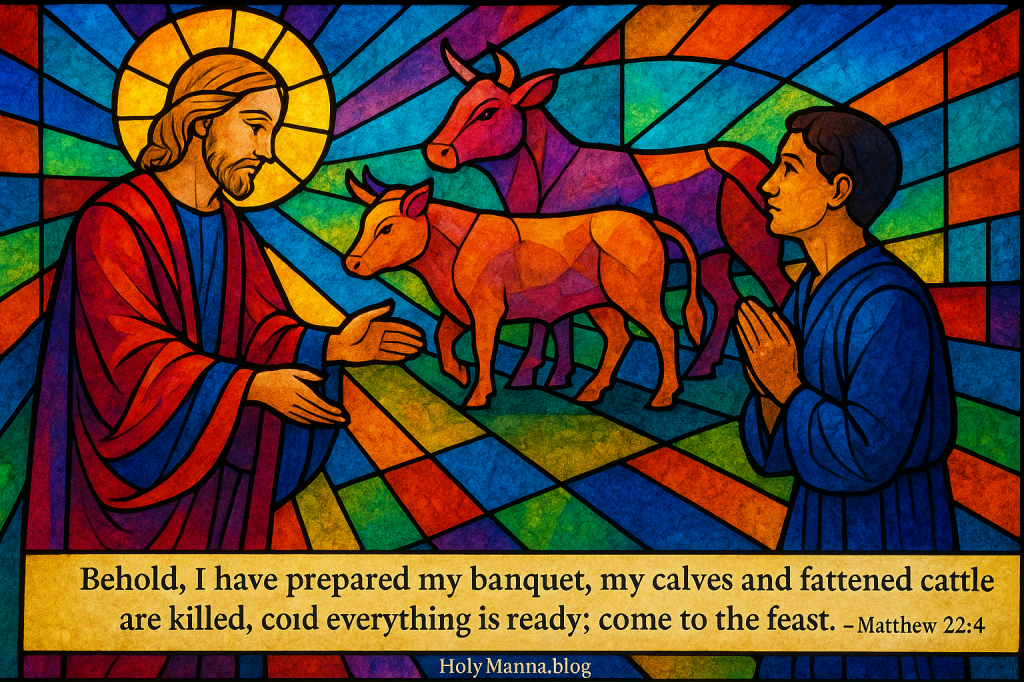
The Parable of the Wedding Feast. 1 Jesus again in reply spoke to them in parables, saying, 2 “The kingdom of heaven may be likened to a king who gave a wedding feast for his son. 3 He dispatched his servants to summon the invited guests to the feast, but they refused to come. 4 A second time he sent other servants, saying, ‘Tell those invited: “Behold, I have prepared my banquet, my calves and fattened cattle are killed, and everything is ready; come to the feast.”’ 5 Some ignored the invitation and went away, one to his farm, another to his business. 6 The rest laid hold of his servants, mistreated them, and killed them. 7 The king was enraged and sent his troops, destroyed those murderers, and burned their city. 8 Then he said to his servants, ‘The feast is ready, but those who were invited were not worthy to come. 9 Go out, therefore, into the main roads and invite to the feast whomever you find.’ 10 The servants went out into the streets and gathered all they found, bad and good alike,[e] and the hall was filled with guests. 11 But when the king came in to meet the guests he saw a man there not dressed in a wedding garment. 12 He said to him, ‘My friend, how is it that you came in here without a wedding garment?’ But he was reduced to silence. 13 Then the king said to his attendants, ‘Bind his hands and feet, and cast him into the darkness outside, where there will be wailing and grinding of teeth.’ 14 Many are invited, but few are chosen.”
Detailed Exegesis
Verse 1 – “Jesus again in reply spoke to them in parables, saying,”
Parables are teaching tools that use everyday images to reveal spiritual truths, often challenging listeners to deeper reflection.
Verse 2 – “The kingdom of heaven may be likened to a king who gave a wedding feast for his son.”
The king represents God the Father, the son is Jesus Christ, and the wedding feast symbolizes the eternal union between Christ and His Church (Revelation 19:7-9).
Verse 3 – “He dispatched his servants to summon the invited guests to the feast, but they refused to come.”
The “invited guests” represent Israel’s leaders and people, who, despite centuries of preparation through the Law and Prophets, reject the Messiah.
Verse 4 – “A second time he sent other servants, saying, ‘Tell those invited: “Behold, I have prepared my banquet, my calves and fattened cattle are killed, and everything is ready; come to the feast.”’”
God’s invitation is generous and persistent, emphasizing the abundance and readiness of His Kingdom. The prepared banquet evokes the Eucharist, the foretaste of the heavenly feast.
Verse 5 – “Some ignored the invitation and went away, one to his farm, another to his business.”
This reflects the human tendency to prioritize worldly concerns over eternal matters. Even good things—work, family, possessions—become obstacles when they displace God’s call.
Verse 6 – “The rest laid hold of his servants, mistreated them, and killed them.”
This points to the persecution of prophets and, later, of the apostles, showing the hostility faced by God’s messengers.
Verse 7 – “The king was enraged and sent his troops, destroyed those murderers, and burned their city.”
This verse likely alludes to the destruction of Jerusalem in 70 AD, seen as a judgment for the rejection of Christ.
Verse 8 – “Then he said to his servants, ‘The feast is ready, but those who were invited were not worthy to come.’”
Worthiness is not about status or heritage but about one’s response to God’s call.
Verse 9 – “Go out, therefore, into the main roads and invite to the feast whomever you find.”
The invitation now extends to the Gentiles, fulfilling God’s plan that all nations be gathered into His Kingdom (Isaiah 25:6-9).
Verse 10 – “The servants went out into the streets and gathered all they found, bad and good alike, and the hall was filled with guests.”
God’s invitation is radically inclusive—both sinners and saints are called. However, entry is not the final goal; transformation is necessary.
Verse 11 – “But when the king came in to meet the guests he saw a man there not dressed in a wedding garment.”
The wedding garment symbolizes the sanctifying grace and holiness required to enter Heaven. Baptism gives us this garment, but it must be kept pure through faithful living.
Verse 12 – “He said to him, ‘My friend, how is it that you came in here without a wedding garment?’ But he was reduced to silence.”
The man’s silence shows he has no excuse; God offers the means to be prepared, but it must be accepted.
Verse 13 – “Then the king said to his attendants, ‘Bind his hands and feet, and cast him into the darkness outside, where there will be wailing and grinding of teeth.’”
This is an image of eternal separation from God—a consequence not of being invited, but of failing to live accordingly.
Verse 14 – “Many are invited, but few are chosen.”
God’s call is universal, but salvation requires our free cooperation with His grace.
Teachings
The Catechism of the Catholic Church teaches: “The parables invite us to the wedding feast, but they also require us to put on the wedding garment. This garment is the sanctifying grace of God, received through Baptism and nourished by the Eucharist” (CCC 546). Saint Gregory the Great explained that the wedding garment is love: without charity, all other virtues are empty. The Fathers of the Church often connected this parable to the Eucharistic liturgy, where we are invited to the banquet of the Lamb but must approach worthily (1 Corinthians 11:27-29). Pope Saint Pius X’s call for frequent, worthy Communion was precisely to ensure the faithful were not only invited but truly ready for the feast.
Reflection
This Gospel forces us to ask: Am I merely invited, or am I prepared? The King’s invitation reaches everyone, but we must clothe ourselves in the virtues of faith, hope, and love, kept alive by the sacraments. In daily life, this means examining our conscience regularly, seeking the Sacrament of Reconciliation, and approaching the Eucharist with reverence and joy. It means letting God’s will guide our choices over the distractions of work, possessions, and comfort. The eternal wedding feast is ready—will we be dressed for the King when He calls us to the table?
Ready for the Feast
Today’s readings lead us on a journey from misguided zeal, to the joy of doing God’s will, to the ultimate invitation into His eternal banquet. In Judges 11, we witness how Jephthah’s lack of discernment turns a victory from God into a personal tragedy, reminding us that actions for God must be rooted in wisdom and obedience. Psalm 40 shifts our gaze to the heart God truly desires—one that delights in His law and finds joy in His will. Finally, in The Gospel of Matthew, Jesus reveals that all are invited to the wedding feast, but only those clothed in righteousness will enter into the joy of the King.
The Memorial of Pope Saint Pius X ties these lessons together with the life of a shepherd who sought not empty ritual but deep, living communion with Christ. His reforms called the faithful to approach the Eucharist frequently and worthily, clothed in grace and charity, ready for the feast that begins here and finds its fullness in Heaven.
God’s invitation is generous and unceasing. Yet it is also a call to transformation, to leave behind the arrogance of self-reliance, the distractions of the world, and the complacency of mere outward religion. Will we trust Him enough to prepare our hearts, clothe ourselves in His grace, and live each day as if the banquet were about to begin? Let us respond to His call today with joyful readiness, letting His law be written on our hearts and His love shape our lives—so that when the King calls, we will be found clothed in Christ, ready to take our place at His table.
Engage with Us!
We would love to hear how today’s Scriptures and the witness of Pope Saint Pius X speak to your heart. Share your reflections, insights, or personal stories in the comments so we can grow together as a community of faith. Your words may inspire and encourage someone else on their journey toward Christ.
Reflection Questions:
First Reading – Judges 11:29-39: Have there been moments when you acted for God without fully discerning His will? How can you ensure your zeal is guided by wisdom and obedience in the future?
Responsorial Psalm – Psalm 40:5, 7-10: Do you find delight in doing God’s will, or do you sometimes see it as a burden? How can you grow in joy when following His commands?
Holy Gospel – Matthew 22:1-14: If the wedding garment represents a life clothed in grace and love, what steps can you take today to ensure you are ready for the King’s banquet?
Let us walk in faith, clothe ourselves daily in the love and mercy of Jesus, and live each moment with the readiness and joy of those who know the feast is near.
Follow us on Instagram and Facebook for more insights and reflections on living a faith-filled life.

 Holy Manna!
Leave a comment