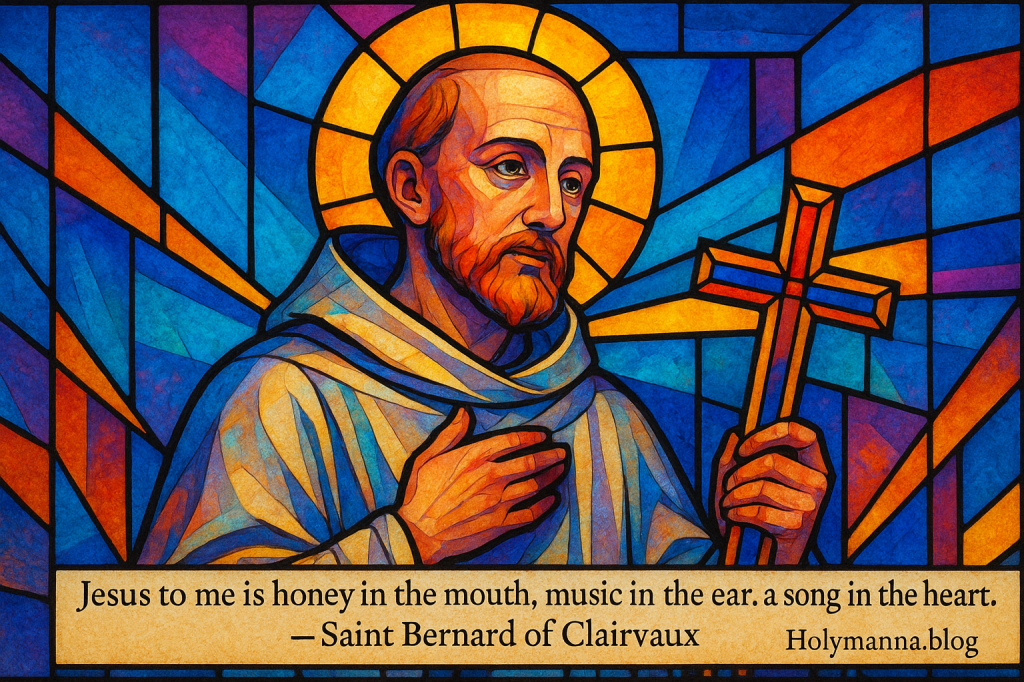
A Voice Like Honey, A Heart on Fire
Saint Bernard of Clairvaux stands as one of the towering spiritual figures of the 12th century, revered for his deep mystical writings, passionate preaching, and unwavering service to the Church. Known as the Doctor Mellifluus or “Honey-Sweet Doctor,” he earned this title because his words, both spoken and written, dripped with the sweetness of divine love and wisdom. He was a monk who became an abbot, a reformer who helped shape the Cistercian order, a trusted counselor to popes, and a peacemaker during one of the Church’s great schisms. His theological insight, particularly in his Sermons on the Song of Songs, remains a treasure for those who seek a more intimate relationship with Christ. Through his example, the Church remembers that love for God is the foundation and goal of every Christian life.
A Noble Heart Surrenders Everything
Bernard was born in 1090 in Fontaine-lès-Dijon, Burgundy, to Tescelin Sorrel, a knight of noble standing, and Aleth de Montbard, a devout woman who nurtured in her son a love for prayer and purity of heart. His mother’s piety deeply influenced him, and her death while Bernard was still young became a moment of spiritual awakening. Known for his intelligence and noble demeanor, Bernard received an education in literature and rhetoric, preparing him for a life of influence. Yet, rather than pursuing worldly honors, he heard the call of God with urgency. In 1113, at just twenty-three years old, he entered the young Cistercian community at Cîteaux, bringing with him thirty companions—including several of his own brothers and close friends. Only two years later, in 1115, he was sent to found a new monastery in a remote valley that would be called Clairvaux, “Valley of Light.” This humble foundation would grow to be one of the most influential monastic centers in Europe, and Bernard would become its first abbot, guiding it with a blend of firmness, gentleness, and burning zeal for souls.
Builder of Monasteries, Shaper of Christendom
As abbot, Bernard’s leadership and holiness drew countless men to embrace the Cistercian ideal of simplicity, prayer, and manual labor. From Clairvaux alone, sixty-eight monasteries were founded during his lifetime, and by the time of his death, hundreds more across Europe traced their origin to his spiritual influence. His vision extended far beyond the cloister walls. He played a decisive role in the Council of Troyes in 1129, where the Knights Templar were officially recognized and given a spiritual mission. Bernard himself wrote In Praise of the New Knighthood, a treatise blending chivalric ideals with the Gospel, encouraging knights to be defenders of the faith as much as warriors on the battlefield. His authority was such that kings, bishops, and even popes sought his counsel. Bernard was instrumental in healing the papal schism between Pope Innocent II and the antipope Anacletus II, traveling and preaching tirelessly to rally the Church to unity. In all his endeavors, his guiding principle was that reform and mission must be rooted in a deep interior life with Christ.
Abbot, Preacher, and Wonder-Worker
Bernard was not only a skilled administrator and diplomat but also a contemplative who drew his strength from hours in prayer. His writings, such as On Loving God and his meditations on the Blessed Virgin Mary, remain classics of Catholic spirituality. He urged that “The reason for loving God is God Himself; and the measure of love due to Him is immeasurable love.” His preaching was powerful enough to move entire crowds to repentance and conversion. Accounts from his contemporaries tell of miraculous healings through his intercession: a young boy suffering from a severe ulcer on his foot was cured when Bernard made the Sign of the Cross over him; others found relief from fevers, paralysis, and spiritual affliction. One dramatic moment in his public life occurred when he confronted Duke William of Aquitaine during the Church’s schism. Bringing the Blessed Sacrament to the church door, Bernard pleaded with the duke not to despise Christ Himself—an act so compelling that the duke repented on the spot, restoring peace and unity to his lands.
Illness, Controversy, and a Failed Crusade
Despite his extraordinary achievements, Bernard’s life was marked by hardship. His personal health was frail, partly due to the extreme austerities he practiced, including long fasts and physical mortifications. He was thrust into theological disputes, most famously his conflict with Peter Abelard, whose speculative theology Bernard opposed for its perceived departure from orthodox teaching. At the Council of Sens in 1141, Bernard’s arguments led to Abelard’s condemnation, though Bernard sought to temper the victory with mercy. In 1146, Pope Eugene III—once Bernard’s own disciple—called on him to preach the Second Crusade. Bernard’s eloquence stirred Europe to respond, and his sermon at Vézelay was so compelling that entire crowds took the cross. However, the Crusade’s eventual failure brought Bernard harsh criticism, which he bore humbly, attributing the defeat to the sins of the crusaders and urging repentance rather than blame. Through illness, misunderstanding, and controversy, Bernard remained steadfast in his love for Christ and His Church.
Afterglow of Sanctity
Saint Bernard died peacefully on August 20, 1153, at Clairvaux, surrounded by his monastic community. His sanctity was so widely recognized that Pope Alexander III canonized him in 1174, and in 1830 Pope Pius VIII declared him a Doctor of the Church, honoring the depth of his theological and mystical writings. His relics became treasured by the faithful, with major portions preserved in the Cathedral of Troyes. Pilgrims from across Europe traveled to honor his memory and seek his intercession, trusting that he, now in heaven, continued to work for the unity of the Church and the salvation of souls. The Church teaches in CCC 956 that “Being more closely united to Christ, those who dwell in heaven fix the whole Church more firmly in holiness… they do not cease to intercede with the Father for us.” Countless believers have found in Bernard a faithful friend and heavenly advocate. His feast day on August 20 invites the faithful to meditate on his example of unwavering love for God and to ask his help in persevering in faith.
Love Without Measure
What makes Bernard so compelling even today is the seamless way he united deep contemplation with decisive action. He reminds us that our prayer life is not meant to remain enclosed within our own hearts but should overflow into service, evangelization, and the renewal of the Church. His devotion to the Blessed Virgin Mary was not sentimental but Christ-centered, always directing souls to her Son. In his own words, “In dangers, in perplexities, in doubtful cases, think of Mary, call upon Mary… you will never go astray.” His life calls us to cultivate a love for God that knows no limits, a readiness to defend the truth with charity, and a courage to act for the good of the Church even in times of trial. As we honor Saint Bernard, we are reminded that holiness is not a matter of retreating from the world entirely, but of allowing God’s love to so possess us that, whether in the cloister or the public square, we can be instruments of His peace.
Engage with Us!
I’d love to hear how Saint Bernard speaks to you—share your thoughts and graces in the comments so we can learn from one another.
- Which line from Saint Bernard’s writings most moves your heart to love Jesus today?
- Where is the Lord inviting you to “love without measure”—in prayer, family, or work?
- How might deeper Marian devotion (Rosary, Saturday devotion, simple “Memorare”) help you cling to Christ this week?
Let’s support one another on the narrow way and strive to do everything with love, as our Lord Jesus did.
Saint Bernard of Clairvaux, pray for us! 🍯
Follow us on Instagram and Facebook for more insights and reflections on living a faith-filled life.

 Holy Manna!
Leave a comment